

Introduction
In April 2013, the UN Security Council authorized the establishment of the Multidimensional Integrated Stabilization Mission in Mali (MINUSMA). The mission was mandated to stabilize population centers in the north, support the implementation of the political transitional roadmap, protect civilians under threat of violence, and promote human rights, among other tasks.1UN Security Council, Resolution 2100 (April 25, 2013), UN Doc. S/RES/2100.On June 16, 2023, after ten years of the mission’s presence in the country, the government of Mali requested its immediate withdrawal. Following the government’s request, the UN Security Council terminated the mandate on June 30th and decided that the mission’s withdrawal would be completed by December 2023.2UN Security Council, Resolution 2690 (June 30, 2023), UN Doc. S/RES/2690.
One year since the Security Council’s decision to withdraw the mission from Mali, IPI, the Stimson Center, and Security Council Report co-hosted a roundtable on June 13, 2024, to take stock of major lessons learned from MINUSMA’s ten-year presence. The roundtable offered a platform for member states, UN officials, civil society stakeholders, and independent experts to share their assessments of MINUSMA in a frank and collaborative manner. The discussion was intended to contribute to efforts to examine the successes and challenges of MINUSMA during its tenure and drawdown. The discussion also aimed to consider how lessons from Mali could inform future peace operations.
Participants generally agreed that MINUSMA played an essential role in supporting the implementation of the 2015 Agreement for Peace and Reconciliation in Mali, protecting civilians, and stabilizing urban centers. However, the mission faced significant difficulties, particularly given the lack of peace to keep. Although the mission made efforts to adapt to the changing political and security context in Mali, the lack of buy-in from governing authorities following two unconstitutional changes of government and increased volatility in the operating environment ultimately led to the withdrawal of host-state consent in June 2023.
MINUSMA’s Evolving Role in Mali
Following the rebellion by Tuareg separatist groups in northern Mali in early 2012, terrorist groups quickly took advantage of the insecurity to consolidate their presence and operations in the region. Popular discontent was fueled by the government’s inability to respond to the terrorist violence, leading to the March 2012 military coup that toppled the civilian regime. The African-led International Support Mission in Mali (AFISMA) was eventually deployed in January 2013 to respond to the crisis and was incorporated into MINUSMA upon its deployment in July of that year. The UN peacekeeping mission, initially authorized to maintain a force of 11,200, was mandated to stabilize population centers in the northern region and to support the political transition process. The signing of the Ouagadougou agreement between the government and armed groups in June 2013 paved the way for organizing and holding legislative and presidential elections. MINUSMA played a central role by providing logistics, election materials, and security for voters.
In the aftermath of the 2013 election, the security situation remained fragile. Although the UN secretary-general’s visit that year was critical in signaling the international community’s commitment to peace and security in Mali, there was growing dissatisfaction with MINUSMA among Malians. One participant noted that this was further exacerbated by widespread perceptions among Malians that the mission was not effectively supporting the extension of state authority in Kidal, where armed groups had established a semi-autonomous governance structure separate from Bamako. Another participant noted that MINUSMA’s participation in the Coordination of Azawad Movements’ (CMA) celebration of the independence of Azawad as contradictory to the principle of territorial integrity that the mission was authorized to uphold.
In June 2015, the government and armed groups signed the Agreement for Peace and Reconciliation in Mali resulting from the Algiers peace process, with Algeria as the principal mediator and the international community as the guarantor. However, it was noted that, unlike the prior Ouagadougou agreement, the Algiers process did not include civil society actors. With the signing of the agreement, MINUSMA’s mandate evolved to support cease-fire monitoring and implementation of the agreement in addition to the original elements of the mandate.3UN Security Council, Resolution 2227 (June 29, 2015), UN Doc. S/RES/2227, para. 14.
MINUSMA’s presence in the north helped facilitate overall compliance with the agreed security arrangements. Progress was made on disarmament, demobilization, and reintegration (DDR), supported by the creation of reconstituted battalions in the north and the establishment of interim authorities. The mission also facilitated dialogue among the parties in collaboration with the International Mediation, a framework launched by Algeria to revitalize the peace process that comprised Algeria, France, the United States, MINUSMA, the African Union (AU), the Economic Community of West African States (ECOWAS), and the European Union (EU).
In 2016, the spread of insecurity in central Mali and increased attacks by terrorist groups against MINUSMA had major implications for the mission’s stabilization and protection of civilians mandate.4Jaïr van der Lijn, “Assessing the Effectiveness of the United Nations Mission in Mali/MINUSMA,” Norwegian Institute for International Affairs, May 2019.This led to the decision in 2019 to expand the mission’s mandate to support the stabilization of central Mali “within existing resources.”5UN Security Council, Resolution 2423 (June 28, 2018), UN Doc. S/RES/2423, para. 38.The resulting reallocation of personnel, logistics, and political capital overstretched MINUSMA in a context of intensifying asymmetric threats. From 2017 onward, MINUSMA’s mandate also incorporated operational and logistical support to the G5 Sahel Joint Force, enabling the latter to combat terrorist activity in Mali and the region.6UN Security Council, Resolution 2391 (December 8, 2017), UN Doc. S/RES/2391.
Following consecutive unconstitutional changes of government in August 2020 and May 2021, MINUSMA’s mandate was expanded to include support for Mali’s political transition. MINUSMA maintained regular dialogue and consultations with transitional authorities and civil society actors. It provided technical and logistical support in preparation for elections through close collaboration with the Independent Authority for Election Management. It also facilitated dialogue between the government of Mali and ECOWAS to reach an agreement on the transition timeline.7UN Security Council, Situation in Mali—Report of the Secretary-General, UN Doc. S/2023/402, June 1, 2023, para. 5.
However, MINUSMA was further exposed to threats and attacks by terrorist groups with the departure of Operation Barkhane and the European Union’s Takuba Task Force in 2022, which made protecting civilians even more challenging. The mission’s protection of civilians efforts were also limited by other factors, including undeclared caveats that limited the engagement of some troops and, in 2022, the bilateral withdrawal of several troop-contributing countries whose troops constituted 17 percent of the mission’s force.
Malian transitional authorities became increasingly critical of MINUSMA’s ability to carry out its mandate. In response to these difficulties and the strained relations between MINUSMA and transitional authorities, the UN conducted a strategic review of the mission. The review, submitted to the Security Council in January 2023, offered three options for MINUSMA’s reconfiguration: (1) to increase the number of uniformed personnel to enhance the mission’s mobility and facilitate the additional support requested by the government; (2) to maintain the current strength of the mission and optimize its presence and resources in certain regions; or (3) to withdraw the mission’s uniformed personnel and convert MINUSMA into a special political mission. In June 2023, Malian authorities requested the mission’s immediate withdrawal, citing the inability of MINUSMA to respond adequately to the security situation in Mali and mistrust toward the mission among authorities and the Malian public.
Challenges and Lessons Learned
MINUSMA’s experience in Mali offers several lessons for future peacekeeping missions, especially in terms of the mission’s relationship with the host state and public, its support to the political transition and peace process, its partnerships with regional organizations and other security actors, and the impact of Security Council dynamics.
Relationship with the Host State and Population
Participants generally agreed that there was a mismatch from the start between the government’s expectations and MINUSMA’s capabilities. A few participants reflected that the government appeared to prioritize sovereignty and restoration of state authority above all else, including above sustaining the political transition or the peace process in the north. While participants mostly agreed that MINUSMA’s mandate was robust, some believed the mission did not sufficiently deliver on these government priorities. This mismatch became an even greater source of discord after the coups d’état of 2020 and 2021 that placed military leaders in leading government roles.
While MINUSMA was operating in a context of asymmetric violence fueled in large part by terrorist and other criminal activities, it did not have a counterterrorism mandate. Conducting counterterrorism operations would have been beyond its capacity and gone against core peacekeeping tenets. However, it was difficult for the general population to understand these limitations, which contributed to Malians’ frustration with the role of the mission and increased their susceptibility to disinformation about MINUSMA.
Another challenge was the disconnect between the mission’s mandate and its resources. While MINUSMA’s mandate expanded significantly over the years with the changing political and security landscape, the Security Council did not provide the requisite resources to support MINUSMA’s expanded footprint. This was evident when MINUSMA’s mandate was extended to the central region without the provision of additional resources. Even when the secretary-general and France did propose raising the troop ceiling in 2021, Malian authorities disagreed with the increase without also giving the mission a stronger counterinsurgency mandate.8International Crisis Group, “MINUSMA at a Crossroads,” December 2022.The mismatch between an expanded mandate and limited resources restricted the mission’s ability to effectively adapt to changes in the security and political environment.
It was highlighted that effective peacekeeping depends on consistent communication and cooperation among all involved parties. This includes communication between the peacekeeping mission and the host state, host population, Security Council, UN Secretariat, and troop- and police-contributing countries. A few participants also emphasized that peacekeeping missions should strive to better take into consideration and adapt to the culture, history, and political dynamics of the host country.
However, other participants noted that Malian authorities’ insufficient cooperation with the mission undermined the mission’s ability to implement its mandate throughout its deployment. The host authorities’ noncompliance with some of the provisions of the 2013 status of forces agreement impeded operational coordination between the mission and the Malian armed forces, limiting their ability to carry out joint patrols. MINUSMA also faced restrictions on its freedom of movement, both by air and by ground, which impacted its ability to deliver on its protection of civilians mandate. Restrictions on the use of unmanned aircraft, in particular, hindered the implementation of the mission’s mandate and threatened the safety and security of UN personnel, particularly along supply routes. The mission’s disproportionate use of resources to protect its convoys also diverted resources from implementing its mandate, including on the protection of civilians.9Peter Albrecht, Signe Marie Cold-Ravnkilde, and Rikke Haugegaard, “African Peacekeepers in Mali,” Danish Institute for International Studies, 2017.Furthermore, the spread of mis- and disinformation about the mission and the orchestration of anti-MINUSMA protests endangered the safety of peacekeepers and limited their mobility among communities.10UN Security Council, Situation in Mali—Report of the Secretary-General, UN Doc. S/2023/21, January 6, 2023.
Participants reflected that frustration with MINUSMA among some host communities was exacerbated by the mission’s inability to provide the expected level of protection. While most UN troops were stationed in cities, armed groups proliferated in rural Mali, creating protection gaps and compelling civilians to seek other forms of protection. This contributed to the proliferation of self-defense militias, including some established along ethnic lines, which further fueled intercommunal clashes.11International Crisis Group, “Reversing Central Mali’s Descent into Communal Violence,” November 2020.
Participants expressed that the intensification of asymmetric warfare in contexts like Mali has contributed to growing demand for peace enforcement action among host states and populations. This comes alongside a decline in political consensus on multidimensional peacekeeping among member states in New York, with some desiring to shift toward more nimble and adaptable peace operations. However, one participant cautioned that any such changes should be driven by needs on the ground rather than a lack of political consensus.
Support to the Political Transition and Peace Process
The peace process in northern Mali experienced several challenges over the course of MINUSMA’s deployment. It was noted that, despite the signing of the peace agreement in 2015, insecurity persisted and worsened. This was due in part to the absence of political will to cooperate among the signatory groups during the agreement’s implementation. Another factor was that the agreement did not include the terrorist groups that were more actively engaging in violence than the signatory groups. Moreover, the agreement suffered from an absence of national ownership. The government terminated the agreement soon after MINUSMA’s departure, referring to its “absolute unenforceability” and characterizing it as an imposition by external actors.12Malian Ministry of Territorial Administration and Decentralization, “Statement No. 065 by the Transitional Government,” January 25, 2024.
It was also noted that the unconstitutional changes of government in 2020 and 2021 and ongoing military rule had a significant impact on the mission’s effectiveness, though the factors driving these developments were largely outside the scope of the mission’s mandate to address. The protracted political transition took the attention of the international community and Malian authorities away from the implementation of the peace agreement, leaving MINUSMA with little leverage to ensure the signatories continued to abide by it. With ECOWAS’s imposition of additional sanctions against Mali in January 2022, the peace process slipped further down the list of international and regional priorities.
A key lesson that emerged from MINUSMA’s experience in supporting both the peace process and the political transition in Mali is the significance of national ownership by the government and signatory groups. Since the signing of the peace agreement in 2015, Mali has experienced two unconstitutional changes of government. Following these changes, there was a need to provide the new transitional authorities a sense of ownership over the peace agreement. This would have required stronger and more sustained political engagement by regional actors and the broader international community.
Partnerships with Regional Organizations and Other Security Actors
One participant highlighted the importance of viewing UN peacekeeping missions in Africa as a shared international responsibility and a common good for the continent that requires the political backing of regional stakeholders. Close consultation between UN missions and African actors could make efforts to advance political processes and respond to evolving security dynamics more coherent and effective.
In a context where MINUSMA was experiencing challenges with the host government, the role of organizations such as the AU in providing political support to UN peacekeeping missions is critical. The AU could have helped build support for the mission and address the restrictions it faced, including by mediating between the government and ECOWAS. ECOWAS’s imposition of sanctions due to the delay in the political transition led the Malian authorities to impose restrictions on troop rotations of West African TCCs in and out of the country, which was a serious violation of the status of forces agreement.13“Mali Orders Suspension of U.N. Peacekeeping Mission Rotations,” Reuters, July 15, 2022; “U.N. Troop Rotations in Mali to Resume on Monday,” Reuters, August 14, 2022.Because such a large proportion of MINUSMA’s uniformed personnel were provided by countries in the ECOWAS region, these restrictions hurt the effectiveness and morale of the mission. A more proactive role for the AU might have alleviated this impact.
Greater synergy of efforts between MINUSMA and regional actors may also have helped manage the backlash against human rights reporting. The government of Mali was critical of what it considered the “politicization and instrumentalization” of human rights by the peacekeeping mission.14UN Security Council, Internal Review of the United Nations Multidimensional Integrated Stabilization Mission in Mali—Report of the Secretary-General, UN Doc. S/2023/36, January 16, 2023.This led the host authorities to restrict the mission’s freedom of movement. After the 2022 renewal of MINUSMA’s mandate, the government directly communicated to the Security Council that the government would not allow full freedom of movement for the mission in carrying out human rights investigations. The backlash escalated in May 2023 following the publication of a UN report that concluded that the killing of more than 500 people in Moura was carried out by Malian troops and foreign military personnel. The report exacerbated tensions with the government. MINUSMA’s human rights director was declared persona non grata following the selection of a Malian civil society representative that briefed the Security Council.
It was suggested that the AU could have helped manage these challenges. For example, the AU could have mobilized African human rights instruments in support of the mission’s human rights mandate, as the government may have been more receptive to human rights reporting anchored in African instruments. More systematic input from African stakeholders on these delicate issues may have helped the mission in its engagement with the host country on human rights issues and broadened support for its human rights activities.
Beyond regional actors, there are also lessons from MINUSMA’s partnerships with other international security actors. In a high-threat environment such as Mali, a peacekeeping mission requires the support of peace enforcement and counter terrorism operations. MINUSMA was therefore one part of a broader security architecture that included peace enforcement action undertaken by Operation Barkhane and the G5 Sahel Joint Force. The withdrawal of these forces in the final years of MINUSMA’s presence increased challenges around the protection of civilians, which could have contributed to increasing dissatisfaction with the mission among host authorities and the Malian public.
Security Council Dynamics
It was highlighted that some of the difficulties encountered by MINUSMA and subregional actors could have been mitigated if the Security Council had been able to forge a united stance on the situation in Mali, including the role of peacekeeping in the country. Participants reflected that Mali’s reorientation of its security partnerships amid broader geopolitical polarization, particularly after early 2022, reduced political support for MINUSMA and made council discussions on Mali more contentious. This lack of international consensus may have further reduced the host state’s support for the mission. In June 2022, for the first time since the establishment of MINUSMA, the resolution renewing its mandate was not unanimously adopted, with China and Russia abstaining, arguably emboldening the host state to directly question the mandate. The deteriorating relationship between Mali and France, which served as the penholder for MINUSMA, also negatively impacted the mission, particularly after the military authorities ended security cooperation with France. In March 2023, the Malian government demanded the removal of France as penholder.
Conclusion
Despite challenging relations with the host state and a difficult security environment, MINUSMA played a vital role in Mali. The mission contributed to stabilization efforts and the extension of state authority in the north and center of the country, provided technical support to host authorities, and served as a guarantor for the implementation of the Agreement for Peace and Reconciliation in the north. It prioritized the protection of civilians as well as human rights monitoring, investigation, and reporting. It also helped enable the safe delivery of civilian-led humanitarian assistance and provided operational and logistical support to forces combatting terrorist groups in the country and region. Furthermore, the mission mobilized the international community to remain politically engaged in supporting the advancement of peace in Mali.
However, the mission also faced a highly volatile security environment and diverging expectations about its role in the country, all of which was further exacerbated by divisive regional and geopolitical dynamics. This made it difficult for MINUSMA to operate effectively, leading host authorities to withdraw consent for the mission. Overall, MINUSMA’s ten-year presence underscores the importance of political consensus and multistakeholder partnerships for effective peacekeeping. It also highlights the mismatch between the tenets of UN peacekeeping operations and asymmetric threat environments, which limited MINUSMA’s effectiveness.
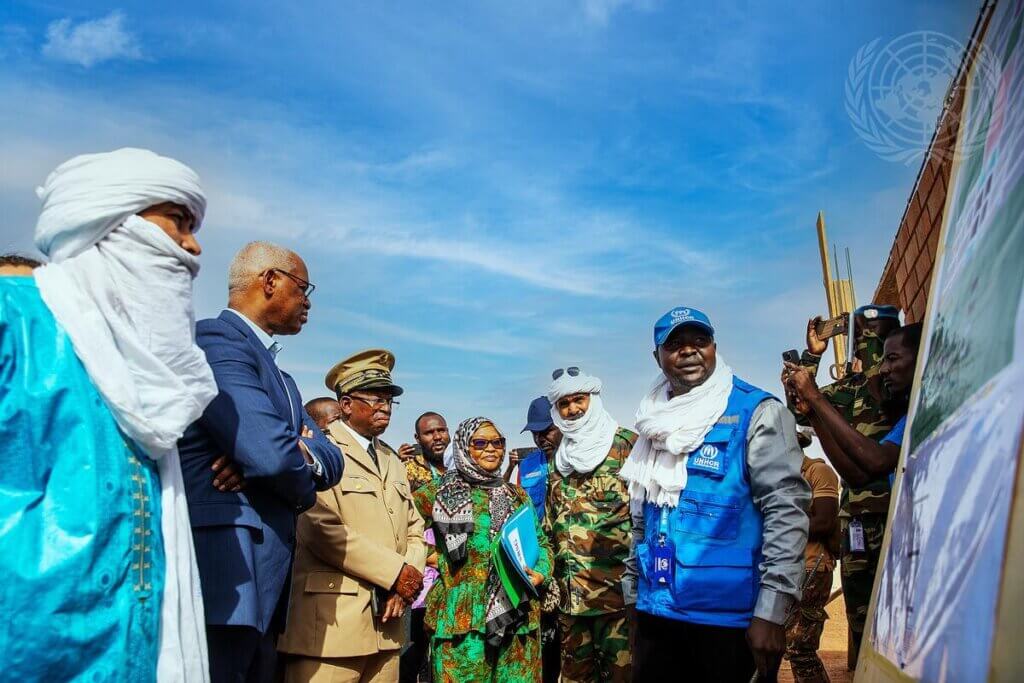
Photo Caption: El-Ghassim Wane (second from left), former Special Representative of the Secretary-General and Head of MINUSMA, visits the Ménaka region in Mali in March 2023, together with officials from the UN Refugee Agency (UNHCR) and the UN Office for the Coordination of Humanitarian Affairs (OCHA). The group attends a presentation about the village Espoir, built with the help of several UN agencies to accommodate the many internally displaced persons who flock to the town of Ménaka as they flee jihadist exactions. Credit: UN Photo/Harandane Dicko.


Community Adaptation for a Water Festival Without Clean Water