
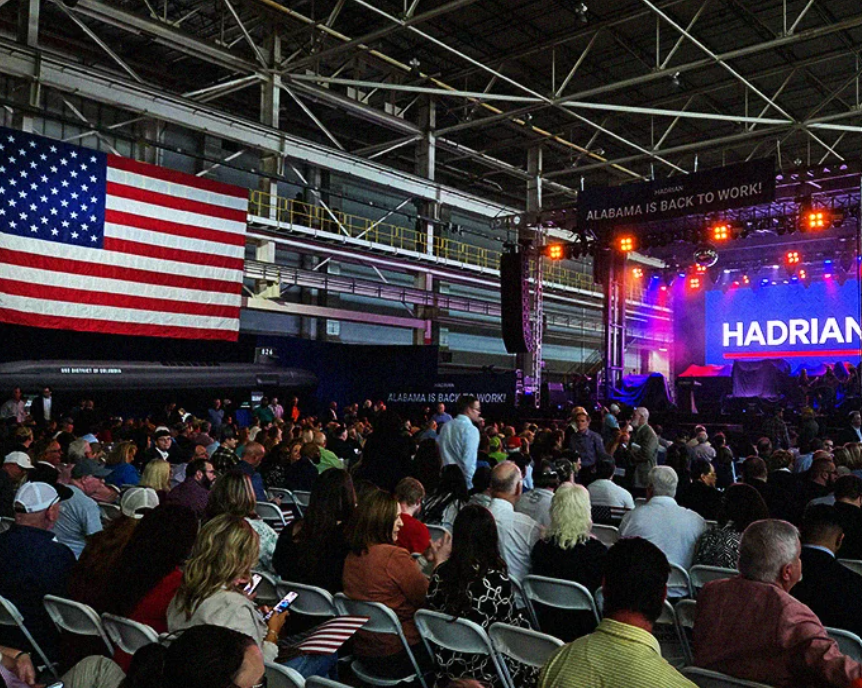
When I arrived this March in Cherokee, Alabama, at the ribbon-cutting ceremony for Hadrian’s defense tech factory, some of the first workers I saw were Lynyrd Skynyrd’s roadies. They were setting up for a show to celebrate the opening of Hadrian’s fourth “AI-powered” automated facility, expected to start churning out precision components for military contractors and the Pentagon by the end of the year. Hadrian’s founder, Chris Power, alongside backers like Peter Thiel and Marc Andreessen, hope to build components for the next generation of American nuclear submarines with as little human participation as possible.
Power immigrated to the United States from Australia in 2019, determined to save the country from over fifty years of deindustrialization. As he put it in a 2024 interview, “I literally moved over here because I had this thesis that the U.S. industrial base was in massive decline.” A year after emigrating, he founded a manufacturing technology startup. Hadrian, so named for the Roman emperor best remembered for his public works investment, is now one of several companies relying on artificial intelligence to automate manufacturing in the United States. Automation, Power says, is the key to securing another century of U.S. empire.
According to Hadrian, its proprietary software, Opus, enables the company to automate the production of parts for major missile, fighter jet, space, and shipbuilding programs. What this means is actually quite straightforward: Software deskills factory work by prompting workers to manage production workflow, training new technicians to operate multiple machines simultaneously in thirty days or fewer. When those workers go home, Hadrian’s factories operate semiautonomously, keeping humans in the loop while offering customers 24/7 service. Hadrian says that this allows them to deliver parts at half the cost and ten times the speed of traditional suppliers, framing Opus as the manufacturing equivalent to Tesla’s Autopilot.
Although there are no fully autonomous factories in the United States—in China, they have been in development for about a decade—companies like Hadrian are embracing AI-enabled automation to expedite weapons production. I traveled to Alabama to learn more about how. Hadrian invited me to a ribbon-cutting ceremony for its newest factory, which the invitation promised will put “thousands of Alabama’s world-class workers back at the helm of global industry.” The event drew a crowd of at least two thousand people, including shipbuilding bigwigs, venture capitalists, local businesses owners, and elected officials at the local, state, and federal levels.
From the outside, the building itself was little more than an endless, flat glass facade, unrelentingly bright in the March sun. Inside, the factory floor, which Hadrian hopes will reach full-rate production within two years, lacked functional machinery of any kind, instead boasting a giant stage flanked with signs declaring alabama is back to work. Locals came in droves, likely lured in part by Skynyrd. A model of the USS District of Columbia, the lead ship in the U.S. Navy’s Columbia-class ballistic missile submarine program, sat adjacent to the stage in front of a giant American flag. The program, which Hadrian plans to contribute components to, is a next-generation armada of ballistic missile submarines slated to traverse the globe armed with nuclear weapons.
Attendees lined up for photos as they awaited remarks from Chris Power, then-Secretary of the Navy John Phelan, and several members of Alabama’s congressional delegation. With their help, the arms industry is strengthening its foothold in Alabama, particularly in the northwest. Just forty-five minutes east of Factory 4 sits a new Lockheed Martin plant, opened to support the president’s theoretical missile defense shield—“Golden Dome for America”—for which the One Big Beautiful Bill Act provided over $24 billion.
After waiting for what felt like an hour, I entered a VIP room decorated like West Elm’s best attempt at Tucker Carlson’s podcast studio, complete with cowhide rugs and wood-paneled staging walls bearing messages like gas & oil, route 66, and quite simply, garage. Waiters circled the room with a bean salad dubbed, ambitiously, “cowboy caviar.” Drinks in hand, VIPs lined up for complimentary company merchandise: navy blue Carhartt jackets, customizable with Hadrian patches.
Dr. Ethan Stokes, a city councilman in nearby Sheffield, Alabama, approached me with interest in my “Special Guest” badge. Apparently, the promise of passed hors d’oeuvres and Skynyrd did not draw legions from the media. As Ethan later shared over email, “Sheffield was once a thriving town with high employment and middle-upper class living.” Now he says the city’s primary challenge is “the prevalence of derelict and abandoned properties in our city.” When Ford left, other industries followed suit, leaving the majority of the city’s residents “in a state of financial despair.” Similar stories played out across the United States as companies sought cheaper foreign labor and bigger profit margins. Meanwhile, the Cold War shaped an industrial policy that favored military contractors at the expense of civilian industries, even after the Berlin Wall fell.
A mile long and lined with railroad tracks, Factory 4 has been empty since 2021—when FreightCar America, a railroad car company, moved its business to Mexico. A half-hour drive down the Tennessee River, Sheffield was once home to the largest aluminum casting plant in the world, closed by Ford Motor Company in the 1980s. A decade later, the passage of the U.S.-led North American Free Trade Agreement ended nearby Florence’s reign as the T-shirt capital of the planet. Like many American communities, places like Florence and Sheffield are still struggling to bounce back from their factories shuttering, making the towns fertile ground for companies like Hadrian.
Elected officials lauded Factory 4 as a bastion of U.S. industrial power. “We need more people building things that keep us safe from the axis of evil,” said Representative Mike Rogers, chair of the House Armed Services Committee, during his remarks. “China,” the apparent leader of the so-called axis, “is our number one enemy,” followed Alabama Senator Tommy Tuberville. The increasing fear of China, stoked in large part by the former head of then Indo-Pacific Command, provides cover for lawmakers to continue prioritizing Pentagon budget increases over the material needs of their constituents. A growing portion of that budget now goes to military technology firms like Hadrian, many of which have yet to prove their long-term business viability, of critical importance to local taxpayers more than anyone else.
State and local authorities offer a variety of corporate incentives designed to attract companies like Hadrian. The Shoals Economic Development Authority, a public-private organization partially funded by Alabama taxpayers, provided Hadrian an investment incentive only available in Lauderdale and Colbert counties, the latter of which is now home to Factory 4. According to the Authority, Hadrian received $4.4 million in tax rebates—$5,000 for each job created, to be distributed after the company creates and maintains 888 jobs “for a set period of time” unspecified by the Authority. (When reached for comment, the Authority said that the Project Development Agreement was not yet finalized.) The Alabama Department of Revenue rejected my public records request for any details regarding other state and local tax incentives Hadrian may have received.
Many state incentives are encapsulated in the Alabama Jobs Act—what some tax reform advocates call the state’s “primary corporate subsidy program.” Hadrian more than qualifies, though the company did not respond to a request for confirmation that it received incentives through the Jobs Act. What’s clear is that Alabama’s expansive corporate incentives contribute to paltry tax revenues, helping to rank Alabama forty-ninth in the nation in total tax collection in 2025. As the nonprofit Alabama Arise points out, Alabama’s corporate incentives have failed to reduce poverty in the state, close the racial income gap, or bring Alabama workers’ wages on par with the national average.
Meanwhile, Factory 4’s opening was made possible by funding provided through last year’s One Big Beautiful Bill, which catalyzed a historic rebalancing of national resources. The legislation added more than $100 billion to the Pentagon budget, bringing the total to over a trillion dollars while instituting the largest ever cuts to health care and food assistance programs—particularly meaningful for Alabamians, 15 percent of whom rely on food stamps. OBBA granted $900 million to Factory 4 alone.
At the opening, however, doyens of Washington’s national security establishment framed the bill as a boon for Americans nationwide. “American manufacturing is back,” declared Alabama Senator Katie Britt, adding that Hadrian will be “transformative” for the Muscle Shoals region. Fellow Alabama Senator Tuberville concurred, noting that people will be building ships in Factory 4 long after we’re all dead and gone. Then-Navy Secretary John Phelan went so far as to say that Hadrian’s factory is more than an investment in infrastructure, it’s an investment in workers themselves—who have experienced firsthand the effects of offshoring and deindustrialization.
Alabamians’ tax dollars subsidized Hadrian setting up shop in Alabama, which in turn will deprive the state of millions in tax revenue. Meanwhile, study after study shows that tax incentives fail to stimulate the jobs and economic growth that recipient firms promise. Moreover, tax incentives don’t even significantly impact where companies decide to do business. Alabama is one of twenty-six “right-to-work” states, in which workers are paid about 7 percent less on average than their peers in union-friendly states. According to journalist Taylor Barnes, the top five U.S. military contractors favored anti-union states for expansions and relocations by a factor of about 1.5 between 2010 and 2022. When it comes to the arms industry, military contractors may be more incentivized by repressive labor laws than tax breaks.
After the national anthem, the Pledge of Allegiance, and a prayer, Chris Power finally graced the stage. “I was going to wear a suit, but I think we earned the right to wear a Carhartt,” Power said, kicking off the ceremony for Factory 4. The facility is Hadrian’s fourth factory but its first major foray into shipbuilding. Six hours from deep water, Factory 4 constitutes one of the largest ever investments in the maritime industrial base: $2.4 billion total, paid for by a combination of VC money and federal appropriations. “This has nothing to do with growing the company,” Power told the crowd, nearly a month into the U.S. war on Iran. “This is about keeping sailors safe in dark places, so we can drink beers and watch Lynyrd Skynyrd.”
Ostensibly, Power aims to spark a renaissance in automated manufacturing, spawning dozens of companies like Hadrian across industries. In a phone interview I conducted after the event, I asked him to name some companies that are following in Hadrian’s footsteps. He told me that he has not yet seen anyone step up to the plate to reshore other critical capabilities, like antibiotics or other pharmaceuticals. Why, then, did Hadrian start with defense work, I asked. “Simply because, one, it’s critical for the Davidson window,” he said. “And secondly, the level of efficiency we need to be in the commercial market, like iPhones, is ten times the efficiency we need—or level of automation—because we’re competing against CCP subsidies in energy and labor. Versus defense manufacturing, [which] is onshore, and we can solve that problem today,” Power explained.
The Davidson window is named after Admiral Philip Davidson, former head of what is now called the U.S. Pacific Command. In 2021, he implored lawmakers to provide more resources for military forces in the region, expressing concern that China was accelerating its ambitions to supplant the United States as a global superpower. Davidson specifically referenced a potential Chinese invasion of Taiwan, telling lawmakers that “the threat is manifest during this decade, in fact, in the next six years.” The sentiment has since permeated the national security establishment, helping Pentagon defenders justify the Navy’s largest shipbuilding request since 1962, even as the Navy fails to maintain the ships it already has: USS Ford and Lincoln aircraft carriers have been plagued by faulty toilets, laundry facilities on fire, and shortages of food amid record-breaking deployments in the United States’ war on Iran.
Much like the war on terror, great power competition—and thus, reindustrialization—is designed to last forever. There is no end-state in which the United States clearly prevails but many metrics by which it is already losing. China claims the world’s fastest trains and its cheapest electric vehicles, capturing over 70 percent of global supply. The country likewise dominates in electronics, machinery, pharmaceuticals, and more, making up nearly a third of global manufacturing output. Through aggressive industrial policy and investment, as well as repressive labor practices, China has largely achieved the production goals that President Xi Jinping set out in “Made in China 2025.”
By comparison, advocates of reindustrializing the United States offer a muddy path toward their ideal future, one in which manufacturing secures everlasting American empire to the material benefit of working Americans—contradictory goals, if history is any indication. By Power’s account, growth is simply a precondition to fulfill Hadrian’s principal purpose: building autonomous factories to reindustrialize America. Power argues that the United States has a matter of years to determine whether the U.S.-led Western order will persist. If we don’t act fast, warns Hadrian investor Marc Andreessen, we’ll end up “living in a world of Chinese robots everywhere.” Failure to reindustrialize, it seems, is failure to “win” a poorly defined competition with China.
Chinese manufacturers like Estun Automation have manufactured industrial robots since 2010, supplying Chinese companies with the technology they need to run fully autonomous factories. They require little to no human input, eliminating the need for lighting, air conditioning, and heating. Instead, China’s “dark” factories rely on artificial intelligence to direct robots through the welding, painting, assembly, and quality inspection of parts. As a result, Chinese companies like Xiaomi produce a smartphone every three seconds. BYD, the world’s premier electric vehicle manufacturer, produces a car every sixty seconds. Automation has driven Chinese exports to record levels while displacing workers in blue collar manufacturing jobs.
In the United States, Power has leveraged automation to rise to the forefront of a burgeoning movement to bring back U.S. industrial power, a goal succinctly captured by both Presidents Biden and Trump, who promised to “Build Back Better” and deliver a new “golden age” in U.S. manufacturing, respectively. In 2024, Power cofounded the New American Industrial Alliance (NAIA), a coalition of founders, investors, and policymakers committed to restoring U.S. manufacturing capacity, bolstering national security, rebuilding institutional trust, and ushering in “a new era of prosperity for Americans of all economic classes.”
Every year, the coalition gathers in Detroit for the Reindustrialize Summit, a convening focused on networking and fundraising. NAIA members include giants like Google, Meta, Boeing, Palantir, and Anduril, but leadership is comprised of the so-called little guys: newer startup founders, a former hedge fund manager, and a conservative writer. NAIA grew out of a broader industrial coalition whose summit attendees represent over a trillion dollars in investable capital, according to its website. Last year alone, venture capital invested about $50 billion in military technology firms like Hadrian. In August 2026, Hadrian raised $1.4 billion in equity financing, bringing its valuation to nearly $8 billion.
Backed by billionaires like Andreessen and Thiel, Hadrian’s fundraising success rides not only on the promise of reindustrialization, but on the intensification of great power competition. The term is inescapable in Washington, even if its ambiguity renders its strategic ends completely unclear. As Hadrian simply stated in my invitation to Factory 4, the facility is “an important step in rebuilding America’s ability to make, produce, and win.”
Still, NAIA members hark back to a mythological time when manufacturers guaranteed quality of life even without labor protections, tapping into the populism that Trump wielded to court his base in 2016 and 2024, when he promised to bring back lost factory jobs to rural America. When Power and I spoke on the phone, I asked him what successful reindustrialization looks like. “It’s really jobs and GDP,” he told me. “We need to at least triple our manufacturing GDP.”
At the beginning of his second term, President Trump declared a new “golden age” in which “America will be a manufacturing nation once again.” By the spring, the president imposed punishing tariffs on foreign imports in an effort to bolster domestic manufacturing, instead increasing prices for American consumers. From the beginning of the Trump administration to April of this year, the United States lost seventy-seven thousand manufacturing jobs. In June, S&P Global reported that U.S. manufacturing jobs declined at a faster rate than at any time since 2009, with the exception of the 2020 pandemic. Over a year into his second term, the manufacturing renaissance that the president promised has yet to materialize.
Chris Power concluded the ceremony by emphasizing that Hadrian’s success is workers’ success, declaring that the company awards all employees equity in the company. The crowd roared in response, readily amped for Lynyrd Skynyrd to take the stage. I returned to the VIP room in the hopes of mingling with Hadrian employees. I discovered that equity awards depend on your position within the company. Unsurprisingly, for the engineers and government affairs employees I spoke to, equity stakes promise significant financial benefits no matter where the company ends up.
Power’s thesis, the conviction with which he founded Hadrian, is that financialization in the 1970s and 1980s gutted U.S. industry to the detriment of both American workers and American power. But venture capital played a role in the growing prioritization of profits over domestic production, pushing companies to cut costs. How, then, will Hadrian avoid the same financialization trap it set out to dismantle, I asked a Hadrian employee—Skynyrd blaring in the background, receiving a laugh in return. Hadrian employees will be rewarded whether the company goes public or a bigger company acquires it. Today, venture capitalists are more likely to invest in companies they expect to be acquired. Assuming Hadrian’s technology works, a larger military contractor would have strong incentive to acquire the company and translate whatever cost savings automation delivers to bigger profit margins, and ultimately, more cash paid to shareholders in the form of both dividends and stock buybacks.
While there is little public information about Hadrian’s contracts, the company already helps RTX (formerly Raytheon) produce optically tracked and wireless-guided TOW missiles for Ukraine and the U.S. military. In December 2025, the company signed a memorandum of understanding with Lockheed Martin, the largest U.S. military contractor, to produce parts for the Patriot Advanced Capability-3 and THAAD missile interceptors, Precision Strike Missiles, and Guided Multiple Launch Rocket Systems—systems the United States has seriously depleted by supporting and waging wars in Palestine, Ukraine, and Iran.
Power may hope to help reshore both commercial and arms manufacturing, but the money is in military contracting. The United States spends more on the military than the next six countries combined, funneling most of the Pentagon budget directly to private companies rather than service members or veterans tasked with fighting U.S. wars of choice. Hadrian is expected to open two or three more factories in 2026, likely buoyed by continued tax breaks and Pentagon spending, given the administration’s strong emphasis on military industrial expansion in its recent budget request to Congress. If the company fails, taxpayers are unlikely to get their money back, much less see it reinvested in socially productive endeavors like food assistance, health care, or education. Alternatively, Hadrian equity holders will cash in on contracts the Pentagon has promised to replenish diminishing weapons stockpiles, either directly or by supplying companies like Lockheed Martin. The goal, after all, is not even to make a successful business, much less actually restore the American worker to the halcyon days of labor: It’s to make a startup financially attractive enough to score a big buy-out.
Venture capitalists are unlikely to shape an industrial policy that results in the “prosperity for Americans of all economic classes,” as the NAIA apparently intends. And while companies like Hadrian may deliver some jobs to the people of Cherokee, at least for a time, Americans largely oppose both the Iran war and a trillion-dollar-plus Pentagon budget. When I asked about his thoughts on the former, one engineer, a Tesla burnout living on his boat when Hadrian recruited him, simply shrugged his shoulders. He gets to work with “geniuses,” he told me. Local attendees soon began to trickle out of Lynyrd Skynyrd, headed home until Factory 4 opens again. I stuck around for the private reception and fireside chat following Skynyrd, but the VIP room sat almost completely empty as the out-of-towners had already flocked to the airport for the last flight out of Alabama.








Community Adaptation for a Water Festival Without Clean Water