
Editor’s Note: This article was originally published in India’s World. It is republished here with permission. No part of this text may be reproduced further, in full or in part, without the prior permission of the original publisher.
By Daniel Markey, Senior Fellow, South Asia Program
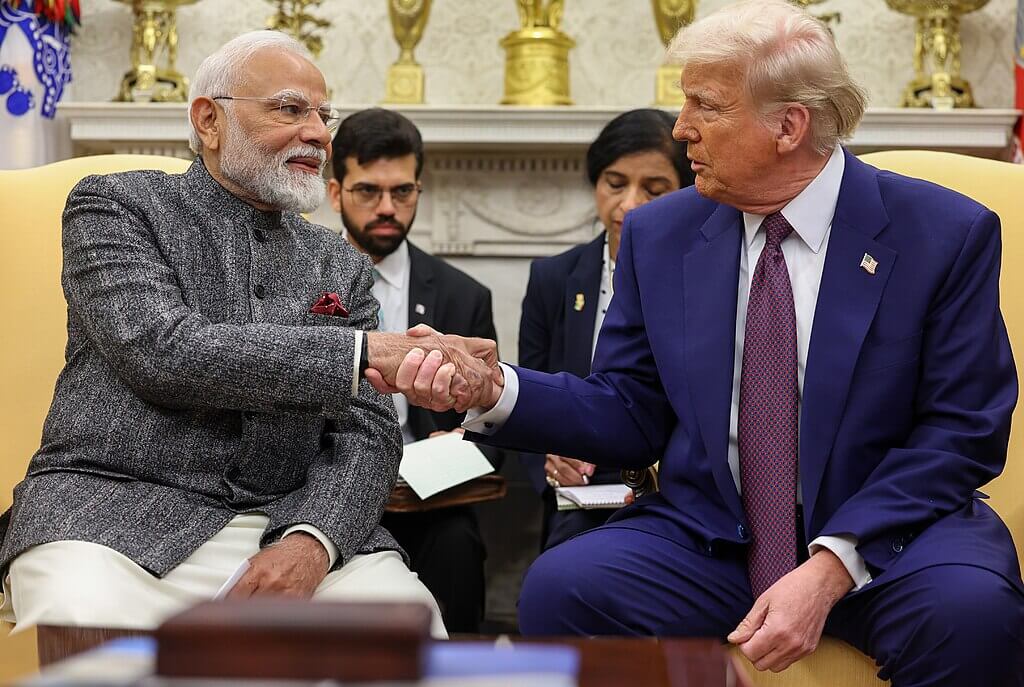
India’s frustration with the Trump administration is plain and easily understood. If today it is sparked by new US policies on H1-B visas, yesterday it was Chabahar port and punitive tariffs. Before that, it was Field Marshal Asim Munir’s lunch at the White House. Lest there be any misunderstanding, India’s concerns, irritations, and anger have registered in Washington, DC. There is no need to send more parliamentary delegations or blame India’s embassy. For those who care to listen, India’s message has always been loud and clear.
Nor has there yet been a sea change in wider US attitudes about the benefits of a closer US-India strategic partnership. That idea still enjoys a broad bipartisan consensus on Capitol Hill, and sympathy for India has the support of powerful political, commercial, and other interest groups across America.
Yes, over the years, Washington has also had policy differences and frustrations with New Delhi, including over some of the same issues now roiling the relationship (like trade and Russia). But President Trump’s decision to elevate these differences into hot disputes was his alone, not driven by domestic political imperatives or any powerful policy impulse in Washington. Only
Trump’s negotiating tactics, style, and interests can fully explain this past summer of discontent. Several of the President’s advisors, by now well known to Indian audiences, have proven themselves vocal cheerleaders for a tougher US stance on India, but they are mere extensions of Trump; they possess no independent power or authority to champion such views. This administration is a thoroughly top-down affair.
During meetings in New Delhi in September, I heard a high degree of convergence with what I tend to hear in DC. Knowledgeable experts, especially those close to the government, tend to characterise the recent downturn in US-India relations as a temporary blip. All take as a positive sign that even in moments of tension, neither President Trump nor Prime Minister Narendra Modi has so far attacked the other directly by name. They anticipate the coming weeks will yield progress on a concise trade deal, if not yet a tightly negotiated, exhaustive pact. India’s announcement of plans to purchase six new Boeing P-8I aircraft could sweeten the deal. Some analysts even believe that a quiet, mutually acceptable arrangement to reduce India’s purchase of Russian oil is already in the works, and the most optimistic voices expect to see Trump join a Quad summit in New Delhi after all, which seemed all-but-impossible just a few weeks ago.
This relatively sunny perspective came as a surprise. I had arrived in India primed to expect a resurgent anti-Americanism. And no doubt, India’s anxieties and irritations with Washington under Trump 2.0 are real. They reinforce the concerns of all those who have long doubted the value of partnership with the United States. Still, contrary to the naysayers, the bottom hasn’t fallen out of the US-India relationship, reflecting the simple fact that both sides have a lot to gain from working together.
Misreading Trump
Then again, India and the United States have always had good reasons to work together, and yet we know that the world’s oldest and largest democracies have often been estranged. It could happen again.
This prospect feeds anxieties about the future. It naturally raises the question of whether India can manage its relations with President Trump more effectively moving forward. Looking back for clues, how did India read Trump 2.0 so wrong?
To be clear, Indians are hardly unique in misunderstanding what Trump’s second term would look like. Many Americans also extrapolated from his first term and assumed his policies—especially on tariffs and immigration—couldn’t possibly be as far-reaching as promised during the campaign. Like his now largely-forgotten “great, great wall” along the southern US border with Mexico, Trump’s agenda was again expected to be slowed, watered down, or hemmed in by legal, institutional, and political guardrails. But that has not been the case. His power stands consolidated across all three branches of government, with majorities in the House and Senate as well as a solid contingent of friendly Supreme Court justices. And now Trump owns the Republican Party. He feels no need to leaven his cabinet picks or other appointments with compromise candidates to appease other factions of the party.
That kind of power means that Trump can bulldoze most normal political obstacles. That would have been true even without the DOGE-driven cuts throughout parts of the American administrative bureaucracy. Totally unexpected, DOGE wasn’t a feature of Trump’s election campaign. It never seems to have won much popular support, and Elon Musk and his famous chainsaw eventually found themselves at odds with Trump’s other appointees. Even so, DOGE’s effects on the American state could well be felt for generations to come. In a matter of a few months, Trump, Musk, and company eliminated longstanding functions of the US foreign policy and national security bureaucracy.
Many, possibly most, Americans have struggled to anticipate or make sense of these developments. With so much happening at once, they tend to follow events piecemeal, sensitive to where their own personal or group interests are being affected, but often indifferent to the implications for others and unable to fit the many pieces into a collective whole. The stunning pace of the Trump administration’s actions—its expressed intent to “flood the zone”—leaves everyone dazed. Lacking political power, unified strategy, or clear national leadership, there is not yet an effective opposition to the Trump machine.
Likewise, although it might at times seem that India has been singled out by Trump for special abuse, the reality is far different. India’s punitive tariffs came long after Trump’s tough line on Canada, Mexico, NATO partners, and so on. Yes, Trump wants a Nobel Prize for the India-Pakistan ceasefire, but the fact that he has also staked a claim on the prize for resolving other conflicts (not to mention his as-yet-unmet pledges to swiftly end the wars in the Middle East and Europe) should at least help India realise that its case is not unique.
Trump’s nonstop claims of having facilitated the May ceasefire between India and Pakistan are such an obvious torment to Prime Minister Modi that they can only be understood as a clear point of glee—and leverage—for President Trump. In this, the claims have more in common with Trump’s many other jibes, nicknames, and taunts that he uses liberally in domestic and foreign affairs. When he finds something that works, that cuts deeply and rattles his opponent, he won’t let up. Ask “Sleepy Joe” (Biden), or “Crooked Hillary” (Clinton). Trump believes these political tools can be turned on or off, and his life experience suggests that he expects not to pay a long-term political price for the disrespect. On this point, “Little Marco” (Rubio), now his loyal Secretary of State and National Security Advisor, bolsters Trump’s expectations. India, Trump believes, will do exactly the same when the time comes.
Watch US Transformation and Ties With China
How then do all the pieces add up for US-India ties? It is perfectly plausible that by late 2025, the consensus view among establishment policy analysts in both New Delhi and Washington will be borne out, at least narrowly. Tariffs, nasty Truth Social posts, and threats will be replaced by trade deals, summit visits, and hugs. All will be as it was, perhaps even better, at least on the surface.
Yet treacherous waters lie further ahead. On numerous occasions during my New Delhi visit, I was advised that Americans should not underestimate the long-term damage of Trump’s policies. His statements about India undermine trust, especially because they came amid hostilities with Pakistan. Washington’s longstanding challenge of convincing India to trust its reliability as a defence partner just took a big step in the wrong direction. And it doesn’t help that Russian-made systems, including the contentious S-400, performed well in May.
All of these messages have been dutifully conveyed by Indian diplomats to the expert community in Washington, but that barely registers for Trump and his team. The disconnect is stark. And herein lies the broader caution for India: Trump’s transformation of the American state and society is far-reaching. It is already overhauling established institutions, ideas, and practices. The domestic transformation is unfolding rapidly. Its global ramifications will take longer but will be profound.
In particular, India will need to keep a close eye on how Trump manages relations with China. Indian anxiety over a possible “G-2” condominium between Washington and Beijing surged at points during the Obama presidency, as China hawks in Delhi feared Obama would misapprehend and downplay the threat posed by China. But those fears were ultimately misplaced. The geopolitical competition between the United States and China has not only been the foundation for US defence and foreign policy for the past decade, but it has also become a key ingredient in the glue of the US-India strategic partnership. US competition with China led President Biden to prioritise US ties with Asian allies and partners (especially India) as critical bulwarks of American advantage.
Trump, on the other hand, has always perceived allies as freeloaders, and although he clearly prefers a world defined by American primacy, his vision of American leadership does not necessarily extend much beyond the Western hemisphere. He appears to place a greater emphasis on defending America’s southern border against illegal migrants than on balancing China’s influence in Asia. India must ask itself which parts of US-India ties will no longer make sense if the onetime glue of their shared strategic concerns over China comes unstuck.
More broadly, will India be more comfortable with an America that is unapologetically self-interested, transactional, and forever asking “what have you done for me lately”? Unless American politics takes an unforeseen political swerve in a new direction, that’s what’s in store for at least the next four years, and possibly well beyond.





Community Adaptation for a Water Festival Without Clean Water