
Summary Findings
Located on Madagascar’s eastern coast and home to the country’s principal port, Toamasina is critical to the economic security of the country. Known as “the lungs of Madagascar,” it is the country’s second-largest city, with an estimated 350,000 people in the city itself and another 275,000 living in the surrounding district. The potential for economic growth, the available vast human capital, and the ability to take advantage of the natural resources could support a strong sustainable blue economy in this coastal city and region. But first, the government needs to prioritize and fund basic infrastructure and services, poverty reduction, and disaster risk planning while building climate resilience and adaptation. Climate change is compounding challenges posed by Toamasina’s high level of poverty and rapid urbanization, as the city has already absorbed greater climate-related economic losses than any other city in Madagascar. To fully capture the intersection of climate vulnerability, urbanization, and economic and social issues as well as environmental challenges, the geographic area of this assessment includes both the Toamasina I District, which represents the core area of the city, and the surrounding Toamasina II District, in the Atsinanana region.
This CORVI assessment describes a detailed road map to help prioritize actions needed to address the greatest risks and vulnerabilities facing Toamasina. The assessment has identified four major clusters of risk and vulnerability1A complete list of the risk indicators used for this assessment is provided in Appendix 1. in Toamasina:
- The frequency and intensity of flooding;
- Reliance on a sustainable blue economy;
- Constrained economic opportunities and limited basic services; and
- Lack of coordination across government.
To address the lack of local and regional data, the CORVI methodology2Details about the CORVI methodology are provided in Appendix 3. builds on national-level data and fills in information gaps though extensive surveys and interviews3A list of organizations represented in the assessment (which included 82 expert surveys and 26 interviews) is provided in Appendix 2. with local experts, providing a more complete picture of the local and regional climate risks and vulnerabilities.4T. Rouleau, J. Stuart, M. Call, S. Yozell, N. Yoshioka, M. Maekawa, and N. Fiertz, “The Climate and Ocean Risk Vulnerability Index: Measuring Coastal City Resilience to Inform Action,” Frontiers in Sustainable Cities 4:884212 (2022), https://doi.org/10.3389/frsc.2022.884212.
The first cluster encompasses the increasing frequency and intensity of flooding in Toamasina, and its consequences for the city’s residents, economy, and ecosystems. Projected Sea Level Rise (SLR) will reach a total of 11 centimeters by 2030 and 22 centimeters by 2050 under a range of emissions scenarios,5Deutsche Gesellschaft für Internationale Zusammenarbeit, “Climate Risk Profile: Madagascar,” Inter-Sectoral Impact Model Intercomparison Project, German Federal Ministry for Economic Cooperation and Development, 2021, https://agrica.de/wp-content/uploads/2021/01/GIZ_Climate-Risk-Profile-Madagascar_EN_final.pdf. and experts rated it the second-highest risk in this assessment (score of 8.78; all scores out of 10.00). This increase in sea level rise threatens to inundate and undermine coastal communities and infrastructure. It will also increase the intensity of storm surge and coastal flooding, especially during tropical cyclones. Madagascar experiences an average of three to four cyclones per year, and experts rated the Number of Tropical Cyclones as the third-highest risk in this assessment (score of 8.72). Toamasina was hit by six in a 13-month period between January 2022 and February 2023.6Worlddata.info, “Cyclones in Madagascar,” accessed July 24, 2024, https://www.worlddata.info/africa/madagascar/cyclones.php. Inadequate management of solid waste and wastewater exacerbates the extent and duration of flooding in Toamasina. The city collects only an estimated 20% of its trash,7Focus group discussion in August 2023 in Toamasina. and 97% of the population uses latrines, most of which consist of no more than a 200-liter barrel sunk into the ground, which results in human waste flooding streets, rivers, land, and coastal areas.8Dirk Dirix, Francesca Rossi, and Harald Van Der Hoek, “Faecal Sludge Management in Toamasina, Madagascar: Emptying — Transport — Treatment,” Journal of Environmental Management 281 (March 2021): 111808, https://doi.org/10.1016/j.jenvman.2020.111808. The destruction and degradation of Toamasina’s ecosystems, especially its coral reefs and forests, also increases the intensity of both coastal and flash flooding. Much of Toamasina’s critical infrastructure is located in coastal or low-lying areas, making it vulnerable to flooding. This includes the city’s roads, which are regularly inundated during rainstorms, and the airport. The city’s dense informal housing is extremely vulnerable to flooding, particularly housing located in flood-prone areas, such as along the banks of the Pangalanes Canal, which runs through the center of the city.
The second cluster surrounds the eroding foundations of Toamasina’s sustainable blue economy. Local experts rated the Level of Coral Reef Coverage (score of 8.58) and Nearshore Fish Stock Status (score of 8.42) as the fourth- and fifth-highest vulnerabilities in this assessment, respectively. Coral reefs and other marine ecosystems like seagrass beds provide habitat for nearshore fish. Corals also attract tourists around Nosy Alanana (Ile aux Prunes) off the coast of Toamasina. Yet these ecosystems face numerous threats from climate change and human impacts.9Mahery Randrianarivo, François Guilhaumon, Johanès Tsilavonarivo, Andriamanjato Razakandrainy, Jacques Philippe, Radonirina Lebely Botosoamananto, Lucie Penin, Gildas Todinanahary, and Mehdi Adjeroud, “A Contemporary Baseline of Madagascar’s Coral Assemblages: Reefs with High Coral Diversity, Abundance, and Function Associated with Marine Protected Areas,” ed. Andrew Halford, PLOS ONE 17, no. 10 (October 20, 2022): e0275017, https://doi.org/10.1371/journal.pone.0275017. Climate threats include warming ocean temperatures, marine heatwaves and coral bleaching, ocean acidification, and damage from tropical cyclones. Non-climate threats include plastic debris and other solid waste that are disposed of directly offshore or are swept into the ocean by flooding. They also include runoff of untreated wastewater and sediment from deforestation. Damage to these marine ecosystems undermines the health of nearshore fisheries, which are a key source of food security and income generation. In addition to the loss of habitat, local fishers attribute the decline in coastal fisheries to overfishing, destructive fishing practices —especially from industrial shrimp trawlers — and rising ocean temperatures.10Edward Carver, “Madagascar: Opaque Foreign Fisheries Deals Leave Empty Nets at Home,” Mongabay Environmental News, October 9, 2019, https://news.mongabay.com/2019/10/madagascar-opaque-foreign-fisheries-deals-leave-empty-nets-at-home/. Limited fisheries management and threats to marine ecosystems and nearshore fisheries not only undermine food security and income generation, but also inhibit the growth of new industries, such as tourism.
The third cluster of risk and vulnerability relates to the limited economic opportunities and basic services in Toamasina. Madagascar is one of the poorest countries in the world, and that poverty is also present in Toamasina. The Percent of Population Below the Poverty Line was identified by local experts as the greatest area of vulnerability in this assessment (score of 8.82). Like much of Madagascar, Toamasina is dominated by a large informal economy, which accounts for 95% of employment nationally and 60% in urban areas like Toamasina.11World Bank, “Madagascar Urbanization Review: Leveraging Cities as Drivers of Growth and Structural Transformation,” 2024, https://www.pseau.org/outils/ouvrages/banque_mondiale_madagascar_urbanization_review_leveraging_cities_as_drivers_of_growth_and_structural_transformation_2024.pdf. Informal businesses are characterized by low levels of productivity and limited growth prospects, keeping people in poverty and pushing them toward destructive environmental activities, such as slash-and-burn agriculture, which undermines the sustainable blue economy and harms people’s health. Informal businesses are also difficult to regulate and generate little tax revenue needed for city improvements. Unavailable and unreliable basic services can also hinder the success of formal businesses. Local experts rated Adequate Access to Electricity as high risk (score of 7.61). The electricity access rate across the Toamasina I and II Districts is 53%, and the energy grid suffers from frequent outages.12Japan International Cooperation Agency, “Toamasina Port Development Project Ex-Ante Evaluation,” 2016, https://www2.jica.go.jp/en/evaluation/pdf/2016_MD-P5_1_f.pdf. Other basic services, particularly solid waste management (score of 6.10) and access to health care (score of 6.91), were rated as medium-high risks. Limited services coverage is in part attributed by local stakeholders to disempowered and underfunded local governments, which are dependent on the national government for most of their funding. People in poverty have few resources to protect themselves from climate impacts, a situation mirrored by overstretched government without sufficient resources to invest in robust climate adaptation.
The fourth cluster relates to the limited coordination and information sharing across the national, regional, and municipal governments. Climate change is an “all-of-society” risk that requires a “whole-of-society” response; incorporating all levels of government, the private sector, civil society, and the people of Toamasina in climate adaptation is essential. Yet local stakeholders repeatedly cited this coordination and cooperation in support of disaster risk preparedness and reduction as a key gap. The general public is perceived to have a low level of awareness around climate risks and how their actions contribute to or reduce that risk. Civil society reported that the government largely ignores their inputs. National, regional, and municipal government do not coordinate on climate adaptation projects. Those projects also often lack effective, transparent monitoring, reducing their long-term effectiveness.
Summary of Priority Recommendations
Based on the above risks and vulnerabilities, three priority areas of action were developed to build climate resilience in Toamasina. Local leaders should work with global financial institutions, international development organizations, and the UN to access climate funds to implement CORVI assessment recommendations and boost Toamasina’s blue economy.
Implement an Integrated Flood Management and Adaptation Strategy
Addressing the climate and non-climate causes of growing flooding risk in Toamasina will require an integrated approach that prioritizes the city’s most vulnerable residents. The following recommendations are designed to reduce the intensity and impacts of flooding while also strengthening flood management and response.
- Establish an emergency operations center to unify and coordinate flood response operations across government agencies and link disaster response planning to climate adaptation projects.
- Set up neighborhood disaster risk management committees to improve the reach of early warning alerts, education, and the implementation of early response actions.
- Provide anticipatory cash relief for the most vulnerable residents to pay for individual and community-level preparation measures immediately prior to an extreme weather event.
- Improve solid waste management by investing in waste collection trucks, support informal waste collection workers, construct new landfills, and develop innovative projects such as waste-to-energy plants.
- Relocate residents living in the most flood-prone areas, particularly in informal settlements, through a consultative process that also provides services and land rights to less flood-prone areas.
- Identify highly flood-prone areas through a partnership between government and civil society to improve mapping of informal settlements.
- Support nature-based solutions in Toamasina’s informal settlements to reduce flooding, treat wastewater, improve food security, provide income-generation opportunities, and strengthen local communities.
- Empower local adaptation strategies by strengthening local access to climate finance, supporting coordination, and building technical expertise.
Promote the Health of Coastal and Marine Ecosystems and Resources
Healthy marine ecosystems, including coral reefs, mangroves, and seagrass beds, and ocean resources, including coastal and offshore fisheries, can play an outsized role in reducing the impacts of climate change, particularly for coastal cities like Toamasina. The following recommendations are designed to support the beneficial management of these ecosystems and resources.
- Invest in restoring and protecting Toamasina’s vulnerable coastal and marine ecosystems, including coral reefs, seagrass beds, and coastal forests, by adopting best practices for ecosystem restoration and management. The Western Indian Ocean Marine Science Association and UN Environment Programme (UNEP) have helpful guides for the Western Indian Ocean region.
- Create locally managed marine areas (LMMAs) and marine protected areas (MPAs) to effectively expand marine protections and restore vulnerable marine ecosystems, using a community-led approach to siting and enforcing nearshore LMMAs and MPAs.
- Develop a fishery management plan to foster a more sustainable approach to managing the shrimp trawl fishery and reduce its negative environmental impacts through practices such as turtle excluder devices, bycatch reduction devices, and area-based closures.
- Undertake science-based stock assessment to support setting fishery effort limits and provide a deeper understanding of the current state of coastal and offshore fisheries that will support longer-term marine management goals.
Invest in Climate-Resilient Infrastructure and Economic Growth
Building climate resilience and promoting sustained economic growth are mutually dependent and reinforcing goals that require investment in infrastructure from the national government, international development organizations and financial institutions, and incentives to the local private sector. Such support should be provided to the municipal and regional governments for on-the-ground implementation in coordination with the national government. The following recommendations are designed to advance both goals and foster a virtuous cycle of sustainable and resilient economic development.
- Increase investment in renewable energy by leveraging international programs like USAID’s Power Africa to improve economic productivity, support education, and strengthen disaster management.
- Simplify national regulations for new power generation by accelerating the process to connect to the electricity grid; assist with siting new power plants, and reduce import burdens for power generation equipment.
- Protect and improve transportation infrastructure; restore natural ecosystems such as coastal forests and wetlands to protect the airport from flooding; and provide dedicated maintenance funding for the road and train network, and clear the Pangalanes Canal from debris for use as a viable waterway.
- Provide government support to local private sector businesses who offer climate adaptation products and services through affordable financing, public education, and project preparation services.
CORVI Analysis
Ecological Risk
Four of the seven highest risk scores in this assessment are in the Ecological Risk Area. The number of high and medium-high ecological risk scores not only reflects the poor health of existing marine ecosystems in Toamasina, but also illustrates the essential role that healthy coral reefs, mangroves, and seagrass beds can play in reducing the impacts of climate change. This is especially the case when considering the vulnerability of Toamasina to flooding from tropical cyclones, heavy precipitation events, and sea level rise. The information on ecological vulnerability in Toamasina in this report should be used in conjunction with the detailed information on climate hazards and exposure in the “Etudes de vulnérabilités des villes côtières et proposition de mesures d’adaptations adéquates: Cas des agglomérations de Toamasina et de Mahajanga,” funded by the World Bank in cooperation with Creocean.
- The ECOSYSTEMS category (expert weighted average score of 6.38) illustrated the vulnerability of the existing coral reef, mangrove, and seagrass bed ecosystems in Toamasina and the surrounding areas. For coral reefs, the highest risk score was related to the Level of Coral Reefs Coverage (score of 8.58), followed by the Health of Existing Coral Reefs (score of 6.31) and the Percent of GDP Protected by Coral Reefs (score of 6.05). For mangroves, the highest risk score was related to the Percent of GDP Protected by Mangroves, followed by the Health of Existing Mangroves (score of 6.25) and the Level of Mangrove Coverage (score of 6.07). For seagrass beds, the highest risk score was related to the Percent of GDP Protected by Seagrass Beds (score of 6.45), followed by the Level of Seagrass Bed Coverage (score of 6.34) and the Health of Existing Seagrass Beds (score of 6.10). Incidence of High Invasive Species Abundance was also scored as a medium-high risk (score of 6.16). These scores illustrate the importance of healthy, resilient marine ecosystems in reducing risk to climate change impacts.
- In the CLIMATE CHANGE category (expert weighted average score of 5.55), there are high and medium-high risk scores for the Number of Tropical Cyclones (score of 8.72), Number of Wet Days (score of 7.45), and Number of Flood Events (score of 6.04). These scores, particularly when considered together and with the high risk score for projected change in sea level rise, illustrate the outsized role that flooding plays in the vulnerability of Toamasina.
- In the GEOLOGY/WATER category (expert weighted average score of 5.36), there are high and medium-high risk scores for Projected Change in Sea Level Rise (score of 8.78), Percent of Bodies of Water with High Water Quality (score of 6.09), Degree of Soil Salinity in Arable Lands (score of 5.74), and Piped Water Supply Continuity (score of 5.20). These scores illustrate two contrasting realities: a Toamasina with too much (salt) water and not enough (fresh) water.
- In the FISHERIES category (expert weighted average score of 5.23), there are high and medium-high risk scores related to fisheries management, including Nearshore Fish Stock Status (score of 8.42), Percent of Fisheries Managed Sustainably (score of 6.00), the Number of Fisheries Access Agreements with Foreign Nations (score of 5.45), and the Capacity of Fisheries Enforcement Institutions (score of 5.33). These scores, when considered together with the medium-high risk score for Fish Consumption Per Capita (score of 6.21), show the importance of supporting a flexible and sustainable domestic fisheries management framework.
CORVI’s ecological risk indicators show risks for Toamasina clustered around the health of ecosystems, flood risk, and health and management of fisheries. Madagascar is in the southwestern Indian Ocean and, as a result, is highly exposed to a range of costly natural hazards, including cyclones, floods from heavy rainfall events, earthquakes, and drought. These hazards cost the country over $100 million in combined direct losses each year.13World Bank, “Disaster Risk Profile: Madagascar,” Southwest Indian Ocean Risk Assessment and Financing Initiative, Global Facility for Disaster Reduction and Recovery, November 2016, https://documents1.worldbank.org/curated/en/119311492590083804/pdf/114366-WP-PUBLIC-disaster-risk-profile-madagascar.pdf. Although relatively small on a global scale, these losses comprise about 7% of Madagascar’s GDP and can limit the potential for sustained economic growth. Madagascar experiences an average of three to four tropical cyclones each year and has the highest risk of cyclones of any African nation,14Global Facility for Disaster Reduction and Recovery and Environment Department of the World Bank, “Vulnerability, Risk Reduction, and Adaptation to Climate Change: Madagascar,” Climate Risk and Adaptation Country Profile, World Bank, April 2011, https://climateknowledgeportal.worldbank.org/sites/default/files/2018-10/wb_gfdrr_climate_change_country_profile_for_MDG.pdf. reflected in the Number of Tropical Cyclones (high risk, score of 8.72). Between January 2022 and February 2023, eight tropical cyclones made landfall in Madagascar, six of which affected Toamasina directly.15Worlddata.info, “Cyclones in Madagascar.” The most severe storms tend to occur during the monsoon season16Monsoon season in Madagascar is between November and April and is characterized by warmer temperatures and heavy rainfall. and cause water contamination, damage to health facilities, and increased food insecurity.17European Commission Humanitarian Aid Office, “Emergency Humanitarian Aid Decision: Assistance to the Victims of Cyclone Gafilo, Madagascar,” 2004, https://ec.europa.eu/echo/files/funding/decisions/2004/dec_madagascar_01000.pdf. The intensity, regularity, and substantial costs of storms like these make the process of building climate resilience — particularly with respect to infrastructure — very difficult.
The number of people affected by flood eventsin Madagascar has increased in the past 30 years, reflected in the Total Number of Flood Events (medium-high risk, score of 6.04). On average, flooding costs $13 million in total direct losses and $3.1 million in emergency costs each year. Flooding in Madagascar is expected to increase as a result of more intense climate fueled precipitation, and cyclones. Heavy precipitation events — which are the primary drivers of flooding — in Madagascar are projected to increase in both number and intensity, particularly in the northeastern and central regions near Toamasina.18Deutsche Gesellschaft für Internationale Zusammenarbeit, “Climate Risk Profile: Madagascar.” When these flood events are considered in the context of rising sea levels, Toamasina’s metropolitan area is at a significant risk for flooding, including the city’s public airport and some of the areas to the south of the city.19FloodMap, “Toamasina, Madagascar Flood Map: Elevation Map, Sea Level Rise Map,” accessed July 24, 2024, https://www.floodmap.net/?gi=1053384.
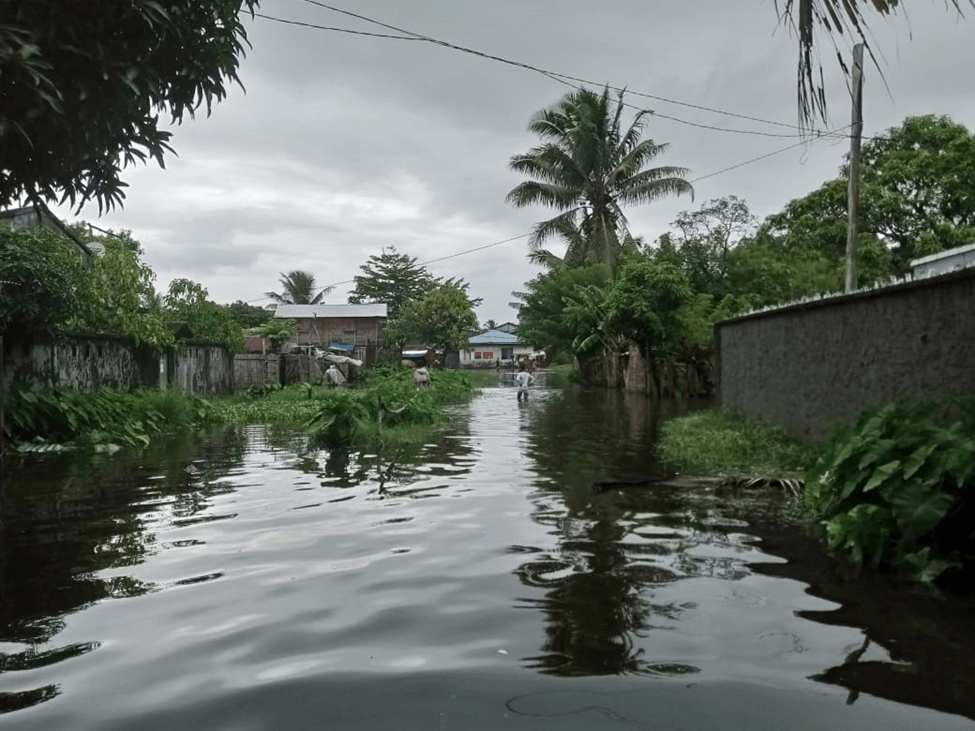
Flooding in Toamasina, March 2024. Credit: Leon Marcellin
Nationally, Projected Change in Sea Level Rise (SLR) (high risk, score of 8.78) in Madagascar will reach a total of 11 centimeters by 2030 and 22 centimeters by 2050 under a range of emissions scenarios.20Deutsche Gesellschaft für Internationale Zusammenarbeit, “Climate Risk Profile: Madagascar.” This indicator received the second-highest risk score in the assessment. SLR threatens the very existence of coastal communities like Toamasina, and was highlighted as a major vulnerability in local surveys as well. Coastal erosion caused by sea level rise puts existing roads and ports at risk, including those in Toamasina.21Global Facility for Disaster Reduction and Recovery and Environment Department, “Vulnerability, Risk Reduction, and Adaptation to Climate Change.” SLR may also cause saline intrusion in coastal waterways and groundwater reservoirs. Rising sea levels, increased precipitation, and tropical cyclones each contributes individually to Toamasina’s risk of flooding, but when taken together, these risks compound. As described by one interviewee, the key to understanding the full picture of climate risk and resilience in Toamasina is the combination of “[f]looding of low-lying and coastal areas, coastal erosion, intensified cyclone[s].”
Mangrove forests provide a wide range of ecosystem services, and this is especially the case in Madagascar. The Health of Existing Mangroves (score of 6.25), the Level of Mangrove Coverage (score of 6.07), and the Percent of GDP Protected by Mangroves (score of 6.52) were all identified as medium-high risks in this assessment. Mangroves are used for timber and fuel, provide breeding and nursery habitats, and protect communities from storms and floods and counter coastal erosion. As described by one interviewee, “forests are one of the most important ecosystems for reducing climate risks, so the key[to climate resilience in Madagascar]is to reforest and restore degraded forests.”22Interview with representative from the government of Atsinanana. Mangroves are estimated to contribute $530 million per year to Madagascar’s economy, including supporting the livelihoods of over two million people.23P. Erftemeijer, M. de Boer, and L. Hilarides, Status of Mangroves in the Western Indian Ocean Region, Wetlands International, July 2022, https://www.wetlands.org/publication/mangroves-latest-data-2021-mozambique-madagascar-kenya-tanzania/. Mangroves cover a total of 2,776 square kilometers, covering 45% of Madagascar’s coastline.24Global Mangrove Watch, “Global Mangrove Watch: Madagascar,” 2024, https://www.globalmangrovewatch.org/country/MDG. Between 1996 and 2016, Madagascar’s mangroves experienced an overall net loss, but have since seen a significant rebound.25Erftemeijer et al., “Status of Mangroves.” The primary drivers responsible for mangrove losses have been “non-productive conversion through unsustainable wood collection for charcoal production, timber and firewood (including for smoking of fish), and land clearance for agriculture and aquaculture.”26Erftemeijer et al., “Status of Mangroves.”
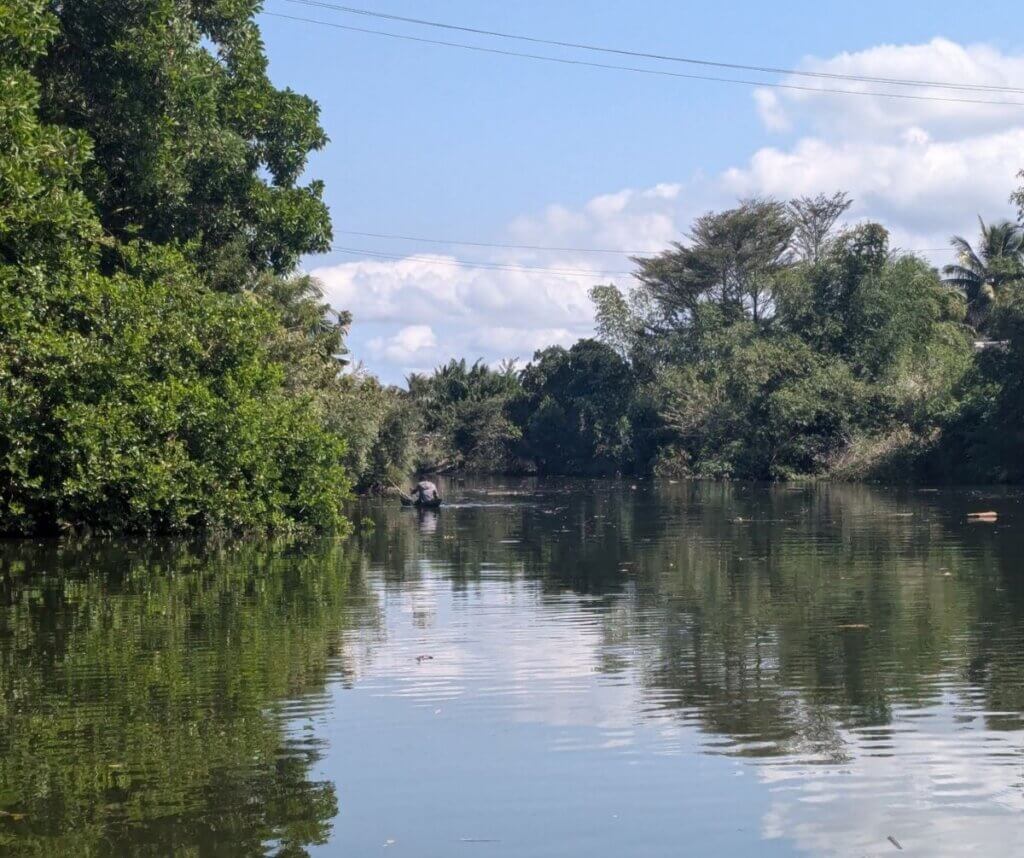
Forests along the Pangalanes Canal, August 2024. Credit: Natalie Fiertz
Madagascar has roughly 2,400 square kilometers of coral reefs in its territorial waters, including nearly 400 species of stony27Stony corals, also called hard corals or Sclearactinia, are marine animals in the phylum Cnidaria that build themselves a hard skeleton of the aragonite form of calcium carbonate. corals.28Randrianarivo et al., “Madagascar’s Coral Assemblages.” The Health of Existing Coral Reefs (score of 6.31), the Level of Coral Reefs Coverage (score of 8.58), and the Percent of GDP Protected by Coral Reefs (score of 6.05) were all identified as high or medium-high risk for this assessment. Since the 1980s, corals off the coast of Madagascar have declined as a result of large-scale disturbances, including heat-induced bleaching events, and human-induced stressors, such as overfishing.29Randrianarivo et al., “Madagascar’s Coral Assemblages.” The Change in Sea Surface Temperature (medium risk, score of 4.20) of the Western Indian Ocean is warming faster than for the Atlantic and Pacific Oceans, and these temperature changes have led to coral bleaching.30O. Hoegh-Guldberg, R. Cai, E. S. Poloczanska, P. G. Brewer, S. Sundby, K. Hilmi, V. J. Fabry, and S. Jung, “2014: The Ocean,” in V. R. Barros, C. B. Field, D. J. Dokken, M. D. Mastrandrea, K. J. Mach, T. E. Bilir, M. Chatterjee, K. L. Ebi, Y. O. Estrada, R. C. Genova, B. Girma, E. S. Kissel, A. N. Levy, S. MacCracken, P. R. Mastrandrea, and L. L. White (eds.), Climate Change 2014: Impacts, Adaptation, and Vulnerability. Part B: Regional Aspects. Contribution of Working Group II to the Fifth Assessment Report of the Intergovernmental Panel on Climate Change (Cambridge and New York: Cambridge University Press, 2014): 1655-1731, https://www.ipcc.ch/site/assets/uploads/2018/02/WGIIAR5-Chap30_FINAL.pdf. Heat stress events have rippling effects throughout the marine ecosystem. After the 1998 bleaching event, coral cover across the Western Indian Ocean declined by an average of 37.7%, though corals in the southwestern Indian Ocean (where Madagascar is located) showed less impact.31Hoegh-Guldberg et al., “2014: The Ocean.” Although Madagascar’s eastern sea (near Toamasina) has relatively lower sea surface temperature (SST) and variation, lower temperature rises, and higher coral cover and diversity,32T. R. McClanahan, M. Ateweberhan, J. Omukoto, and L. Pearson, “Recent Seawater Temperature Histories, Status, and Predictions for Madagascar’s Coral Reefs,” Marine Ecology Progress Series 380 (2009):117-128, https://doi.org/10.3354/meps07879. changes in coral coverage due to increasing SST are very likely to alter the productivity of Madagascar’s coastal fisheries.33Hoegh-Guldberg et al., “2014: The Ocean.”
Nearshore fisheriessupport food security, livelihoods, and communities throughout coastal Madagascar. Many nearshorefisheries are declining as a result of overfishing, harmful or destructive fishing practices, and habitat degradation,34Randrianarivo et al., “Madagascar’s Coral Assemblages.” reflected in Nearshore Fish Stock Status (high risk, score of 8.42). Many local fishers attribute the decline in Toamasina’s nearshore fisheries to industrial shrimp trawlers and tuna longline vessels,35Carver, “Madagascar: Opaque Foreign Fisheries Deals.” and to degradation of the reefs. One interviewee shared, “ . . . we can also see that fish products are diminishing because the reefs are being destroyed.”Commercial shrimp trawling has negative environmental impacts, including high levels of bycatch and the destruction of seagrass habitats.36Laurel Zaima, “Commercial Shrimp Trawling: The Profit Does Not Out Weigh the Damaging Effects on Rest of the Ecosystem,” Shark Research & Conservation Program, University of Miami, December 19, 2014, https://sharkresearch.earth.miami.edu/commercial-shrimp-trawling-the-profit-does-not-out-weigh-the-damaging-effects-on-rest-of-the-ecosystem/. The effects of climate change, particularly changes in SSTs, are a well-known reality for fishers in Madagascar. Higher SSTs are reducing catch and forcing a change in livelihood for some; as described by one interviewee, “ . . . we see the reduction in fishermen’s production [that is] caused by the temperature which is not very favorable and the species are forced to move and the fishermen are unable to follow them.” By 2050, under a medium emissions scenario, the fisheries catch potential in Madagascar is projected to decrease 6.3% relative to the catch recorded in 2000.37Manuel Barange, Tarûb Bahri, Malcolm C. M. Beveridge, Kevern L. Cochrane, Simon Funge-Smith, and Florence Poulain, eds., Impacts of Climate Change on Fisheries and Aquaculture: Synthesis of Current Knowledge, Adaptation and Mitigation Options, FAO Fisheries and Aquaculture Technical Paper, 627 (Rome: Food and Agriculture Organization of the United Nations, 2018), https://www.fao.org/3/i9705en/i9705en.pdf
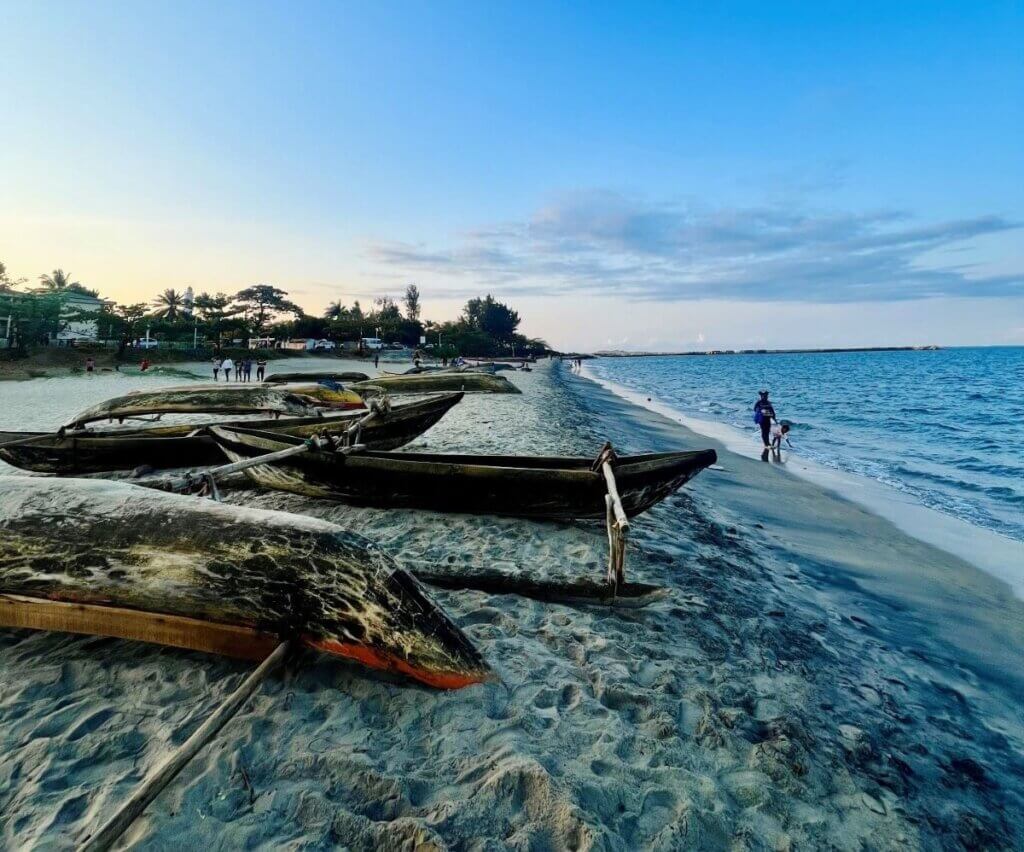
Fishing boats on Toamasina beach, August 2024. Credit: Carolyn Gruber
It is important to note that the opportunities and challenges related to fisheries are at the national and regional level, rather than at the city level. This is especially the case for offshore fisheries in Madagascar, which are targeted by foreign fleets from Japan, Taiwan, and South Korea.38Frédéric Le Manach, Charlotte Gough, Alasdair Harris, Frances Humber, Sarah Harper, and Dirk Zeller, “Unreported Fishing, Hungry People and Political Turmoil: The Recipe for a Food Security Crisis in Madagascar?,” Marine Policy 36, no. 1 (January 2012): 218-225, https://doi.org/10.1016/j.marpol.2011.05.007. A 2011 study found that catch from Madagascar in the early 2000s was underreported by at least 40%.39Le Manach et al., “Unreported Fishing.” Foreign commercial vessels, particularly longline vessels, have had considerable environmental impacts including bycatch,40Bycatch refers to the incidental capture of non-target species. Bycatch can include non-target fish species, e.g., catching flounder when trawling for shrimp, as well as other marine creatures, like dolphins, sea turtles, and seabirds. and are likely a leading culprit for the decline in catch for subsistence fishers.41Carver, “Madagascar: Opaque Foreign Fisheries Deals.” Global Fishing Watch data identified 706 unique vessels flying the flags of 94 different foreign nations in Madagascar’s Exclusive Economic Zone between July 2022 and July 2023, reflected in the Number of Fisheries Access Agreements with Foreign Nations (medium-high risk, score of 5.45). Yet at the local level, surveys provided by Toamasina experts supported relatively low risk scores for Offshore Fish Stock Status (medium risk, score of 3.76), Level of Unreported Catch Estimate (medium risk, score of 4.15), and Number of Incidents of Foreign Vessels Fishing in EEZ (medium-low risk, score of 2.90). These relatively low risk scores reflect the understanding that Toamasina’s blue economy is supported primarily by the port rather than by the fishing sector.
The most recent assessment of the Capacity of Fisheries Enforcement Institutions (medium-high risk, score of 5.33) in Madagascar was undertaken in 2017. It found that monitoring and enforcement for industrial fisheries had improved significantly over the prior two decades, reflected in the relatively lower score for Offshore Fish Stock Status (medium risk, score of 3.76). The assessment suggested that additional support was needed to better manage small-scale fisheries,42World Bank, “Project Appraisal Document: Second South West Indian Ocean Fisheries Governance and Growth Project — Region & Madagascar,” International Bank for Reconstruction and Development and International Development Association, March 7, 2017, https://documents1.worldbank.org/curated/en/188161490925693287/pdf/MADAGASCAR-SECOND-SOUTH-WEST-PAD-FINAL-03092017.pdf. reflected in the Percent of Fisheries Managed Sustainably (medium-high risk, score of 6.00). Madagascar established its first locally managed marine area (LMMA) in 2006 in Velondriake in the southwest.43Charlie J. Gardner, Garth Cripps, Liz Prémesnil Day, Katrina Dewar, Charlotte Gough, Shawn Peabody, Gilde Tahindraza, and Alasdair Harris, “A Decade and a Half of Learning from Madagascar’s First Locally Managed Marine Area,” Conservation Science and Practice 2, no. 12 (December 2020): e298, https://doi.org/10.1111/csp2.298. A recent assessment found that it has had some success along both social and environmental outcomes. The five permanent reef reserves within the LMMA saw a 189% increase in fish biomass six years after implementation and have seen increased value from octopus fisheries, though progress in addressing overexploitation for species such as shark and sea cucumber has been limited.44Gardner et al., “A Decade and a Half of Learning.” The LMMA has also built social capital within participating communities and has supported livelihoods, improved access to housing, and access to education.45Gardner et al., “A Decade and a Half of Learning.” However, local communities still rely on state authorities for enforcement and punishment of rule breaking. These authorities are often underresourced and suffer from allegations of corruption, limiting their usefulness.46Gardner et al., “A Decade and a Half of Learning.”
Given the role of fisheries in supporting communities and livelihoods, in 2021, Madagascar created the Ministry of Blue Economy and Fisheries and appointed Paubert Tsimanaoraty Mahatante, a scientist and civil society leader, as the Ministry’s first leader. Madagascar is also a candidate for the Fisheries Transparency Initiative (FiTI). As of December 2022, Madagascar has been accepted into the FiTI as an official Candidate Country, making it the third country globally to be granted this status. after Mauritania in 2018 and Seychelles in 2020.47Will May, “Madagascar Becomes Third FiTI Candidate Country! — FiTI — Fisheries Transparency Initiative,” December 6, 2022, https://fiti.global/madagascar-becomes-third-fiti-candidate-country. In December 2023, the government published its first FiTI report, making available information on fisheries laws and regulations, payments for industrial fishing activities, and a list of large-scale fishing vessels.48Yannick Memee, “Madagascar Publishes First FiTI Report, Demonstrating Commitment to Fisheries Transparency — FiTI — Fisheries Transparency Initiative,” January 26, 2024, https://fiti.global/madagascar-publishes-first-fiti-report-demonstrating-commitment-to-fisheries-transparency. As part of FiTI, the Malagasy government will have to publicly disclose fisheries agreements, which would help address a lack of transparency in the fisheries industry. These changes at the national level of fisheries governance in Madagascar can support similar prioritization of sustainable fisheries management at the local level.
As described by one interviewee, “Right now, everything is linked to climate change, it’s part of our daily lives.”
Economic Risk
Madagascar is one of the poorest countries in the world, and its national per capita income declined 45% between 1960 and 2020.49Marie-Chantal Uwanyiligira, Marcelle Ayo, and Francis Muamba Mulangu, “How Madagascar Can Break a Vicious Cycle of Poverty,” World Bank Blogs (blog), May 1, 2023, https://blogs.worldbank.org/en/africacan/how-madagascar-can-break-vicious-cycle-poverty. Although Toamasina is the country’s second-largest city, it suffers from many of the same economic challenges as the rest of Madagascar. These include limited coverage of basic infrastructure, lack of basic services, and a highly informal economy. The impacts of climate change further exacerbate these challenges by damaging houses, businesses, and critical infrastructure and inhibiting the circulation of goods and people.
- The INFRASTRUCTURE category (expert weighted average score of 6.05) highlights the limited coverage and vulnerability of Toamasina’s critical built infrastructure. The highest risk score in the category is Percent of Population with Adequate Access to Electricity (score of 7.61); 30% of the population lacks any access at all. The Effectiveness of Solid Waste Management Procedures (score of 6.94) scored as a medium-high risk. Debris clogs rivers, canals, and gullies, exacerbating the impacts of flooding in the city, damaging human health, and harming the environment. Local stakeholders highlighted risks around the Level of Resilience for Airports (score of 6.47), the Level of Resilience for Roads (score of 6.33), the Level of Grid Resilience (score of 5.97), and the Level of Water Distribution Infrastructure Resilience (score of 5.73). All are medium-high risk scores, demonstrating the widespread vulnerability of Toamasina’s infrastructure.
- In the MAJOR INDUSTRIES category (expert weighted average score of 5.98), the medium-risk score for Percent of National Economy Based in Port and Shipping Industries (score of 7.17) underscores the importance of Toamasina’s port for Madagascar’s economy. The port handles 90% of the country’s container traffic, linking it to the global economy. It exports the country’s major natural resources, especially agricultural, timber, and mineral products. Medium-high risk scores for Percent of National Economy Based in Agriculture (score of 6.20) and Percent of National Economy Based in Nearshore Fishing Industry (score of 5.95) highlight the importance of two sectors that are dominated by small-scale subsistence activity.
- In the ECONOMICS category (expert weighted average score of 4.72), National GDP per Capita (score of 7.99) is the highest risk score in the Economic Risk Area, reflecting Madagascar’s unproductive economy. A large part of the economy is informal, as indicated in the medium-risk score for Level of Informal Economy (score of 6.25), much of it in the form of subsistence agriculture and fishing. Tropical cyclones and other extreme weather events inflict major losses on the economy, as shown in the medium-high risk score for Market Losses from Extreme Weather Events (score of 5.53).
Madagascar is the ninth poorest country in the world, reflected in the National GDP per Capita (high risk, score of 7.99).50As of 2022, measured by GDP per capita, PPP; https://data.worldbank.org/indicator/NY.GDP.PCAP.PP.CD. Accessed August 2024. It is also one of only six countries in the world that has seen national income per capita fall since gaining independence (in 1960).51World Bank Group, “Country Partnership Framework for Republic of Madagascar,” March 2023, https://documents1.worldbank.org/curated/en/099040323142549791/pdf/BOSIB06727b8a603b0bbc50f9264b9412f9.pdf. The COVID-19 pandemic caused a recession that was three times as deep as in the rest of sub-Saharan Africa and drove 2.4 million people into poverty.52World Bank Group, “Country Partnership Framework.” As a result, the government of Madagascar has limited financial resources and numerous pressing challenges, leaving it overstretched. Madagascar’s cities, including Toamasina, the second-largest city, account for three-quarters of the nation’s economic activity.53World Bank, “Madagascar Urbanization Review.” This economic activity, however, is also driving the fastest urbanization rates in sub-Saharan Africa, and has increased poverty in Madagascar’s cities over the past decade. This increase has been especially large in the country’s secondary cities, like Toamasina.54World Bank, “Madagascar Urbanization Review.” Interview respondents described internal migration to the city resulting from inland people learning of new projects in the city, like the port expansion or growth related to mining, such as the Ambatovy refining plant. Too often, the jobs are already filled. yet the migrants remain, adding to Toamasina’s infrastructure and social challenges.
The informal sector dominates the Malagasy economy, reflected in the scores for the Level of Informal Economy (medium-high risk, score of 6.25). This sector encompasses all economic activity that is not regulated or protected by the government.55Simon Torkington, “What Is the Informal Economy and How Many People Work in It?,” World Economic Forum: Centre for the New Economy and Society, June 4, 2024, https://www.weforum.org/agenda/2024/06/what-is-the-informal-economy/. It includes those working in subsistence food production, street vendors, garment manufacturers, domestic workers, and a wide range of other workers operating without legally required permits or registration.56Torkington, “What Is the Informal Economy?” The informal sector accounts for 95% of national employment, according to estimates from the International Monetary Fund.57International Monetary Fund, African Department, “Republic of Madagascar,” IMF Staff Country Reports 2023, no. 118 (March 2023): 1, https://doi.org/10.5089/9798400236495.002. Within urban areas, an estimated 60% of jobs are informal, according World Bank estimates, driven by a lack of available formal jobs.58World Bank, “Madagascar Urbanization Review.” Interviews highlighted the rapid growth of the informal businesses in Toamasina,59Interview with a representative from the Ministry of Industrialization and Commerce. as well as the persistence of slash-and-burn agriculture (locally known as Tavy) and subsistence fishing.60Interview with a representative from the Toamasina Autonomous Port. Interviews highlighted the lack of other options to generate income and a lack of awareness about the consequences of environmental destruction as key drivers of this kind of activity.61Interviews with a representative from the Toamasina Autonomous Port and with a representative from the regional government. In addition, informal firms have limited available capital, which constrains their ability to recovery from climate impacts and invest in resilience. Since they are often untaxed, a large informal sector also limits available tax revenue. Interviews also highlighted that informal firms constrain the effectiveness of regulation.62Interview with a representative from the Ministry of Industrialization and Commerce.
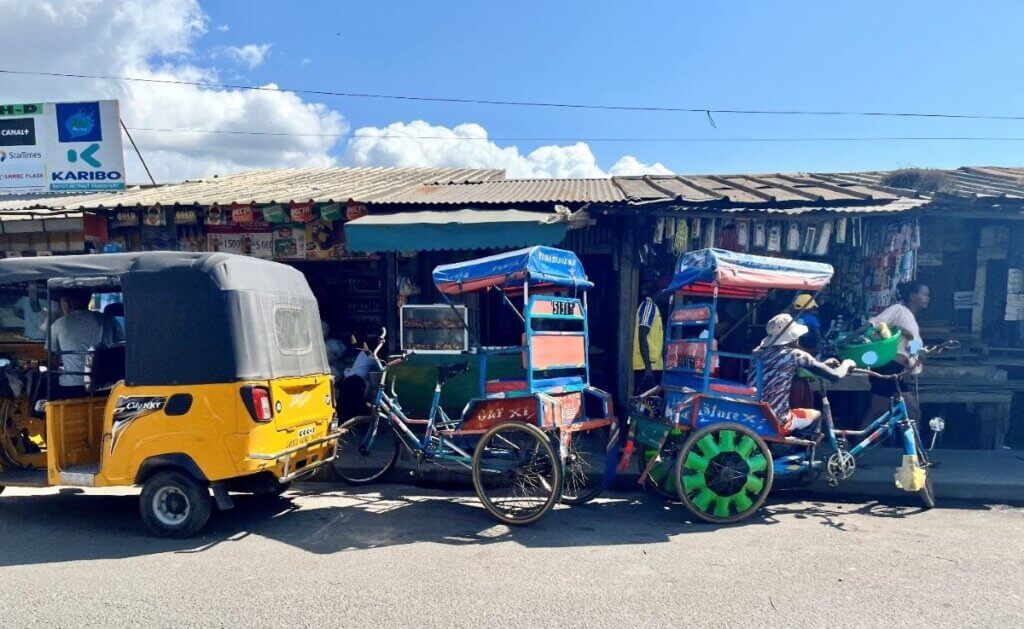
Roadside shops in Toamasina, August 2024. Credit: Carolyn Gruber
Although agriculture only employs less than 5% of the population in the city of Toamasina, it accounts for over a quarter of the national economy and 85% of national employment,63World Bank, “Madagascar: Making an Impact on Land Reform and Agriculture,” November 28, 2023, https://projects.worldbank.org/en/results/2023/11/19/madagascar-making-an-impact-on-land-reform-and-agriculture. reflected in the score for Percent of National Economy Based in Agriculture (medium-high risk, score of 6.20). Agriculture does occur in the areas around the city of Toamasina, however, in the district of Toamasina II, which covers the outskirts of the city and surrounding rural areas. These inland areas are mountainous, and deforestation driven by slash-and-burn agriculture will increase the frequency and severity of rainfall-driven flooding, particularly along the Ivoloina and Ivondro Rivers, which run north and south of Toamasina, respectively.
The fisheries sector accounts for approximately 7% of Madagascar’s economy,64C. C. C. Wabnitz, S. J. M. Harper, et al. Gender and Fisheries — the Republic of Madagascar, Country Fact Sheet, Ocean Risk and Resilience Action Alliance, 2023, https://oceanrisk.earth/wp-content/uploads/2023/05/Madagascar_factsheet_fin-1.pdf. but nearshore subsistence fishing is more important for coastal communities, such as those around Toamasina, reflected in the score for Percent of National Economy Based in Nearshore Fishing Industry (medium-high risk, score of 5.95). Interviewees reported that although beach seine fishing is illegal, enforcement is limited, and the practice continues in Toamasina, contributing to the decline of local fish stocks.65Interview with a local fisherman. In addition, the government of Madagascar is working to encourage fish farming in rural areas to create employment, strengthen food security and nutrition, and reduce pressure on local ecosystems.66Deutsche Gesellschaft für Internationale Zusammenarbeit, “Sustainable Aquaculture in Madagascar,” Global Programme Sustainable Fisheries and Aquaculture, December 2022, https://www.giz.de/de/downloads/giz-2023-en-global-programme-sustainable-fisheries-and-aquaculture-madagascar.pdf. Interviews report that tilapia fish farming is developing in the rural areas around Toamasina.67Interview with a representative from the Ministry of Fisheries and Blue Economy. The Ministry of Fisheries and Blue Economy also recently launched a plan to increase the country’s annual production of fish by 116% by the end of 2028, driven in large part by aquaculture.68Shem Oirene, “Madagascar Unveils Five-Year Plan to Double Seafood Output, Create Marine Protected Areas,” Seafood Source, August 12, 2024, https://www.seafoodsource.com/news/supply-trade/madagascar-unveils-five-year-plan-to-grow-fish-output.
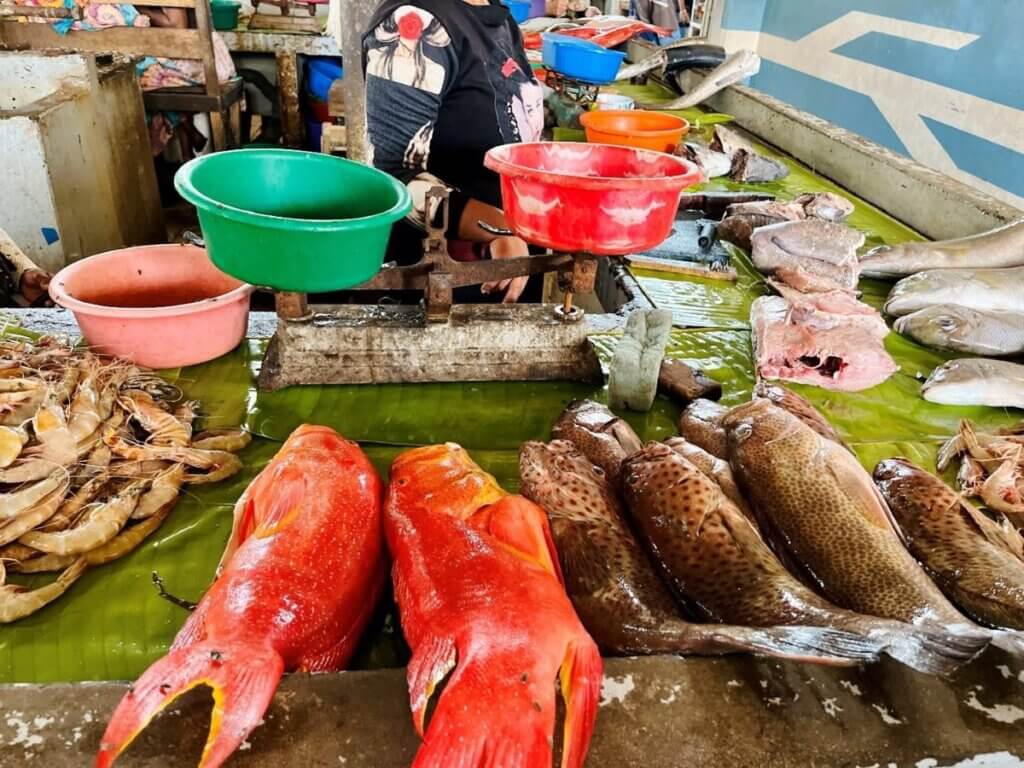
Fish market in Toamasina, August 2024. Credit: Carolyn Gruber
In addition to their sizeable informal sectors, Madagascar’s largest cities — including Toamasina — house the majority of the country’s formal employment. In Toamasina, the most important industries are the port and the Ambatovy mineral processing plant and refinery. Both are capital intensive, which means they can only create a limited number of formal sector jobs.
Toamasina is Madagascar’s largest port, handling an estimated “75 percent of domestic cargo and 90 percent of international cargo.”69Japan International Cooperation Agency, “Toamasina Port Development Project.” The port provided critical support during the country’s recent economic recovery following the deep recession caused by the COVID-19 pandemic. Post 2020, the economy grew more strongly than projected, driven principally by a growth in the export of mining and textile products.70Africa Ports, “Toamasina,” accessed July 24, 2024, https://africaports.co.za/toamasina/. The importance of Toamasina’s port, through which these exports are shipped, is reflected in the Percent of National Economy Based in Port and Shipping Industries (medium-high risk, score of 7.17). Shipping into and out of the port also poses risks to Madagascar’s unique biodiversity through invasive species transported in ballast water, thanks to the incomplete implementation of the Ballast Water Treaty.71Interview with a representative from the Agence Portuaire Maritime et Fluviale.
The port is currently undergoing a major expansion, funded in part by a $411 million loan from the Japan International Cooperation Agency.72Jacques Rombi, “Port of Tamatave: An Extension to 640 Million Dollars,” Economie Circulaire et Environnement dans L’ocean Indien (blog), May 13, 2021, https://www.lejournaldesarchipels.com/2021/05/13/port-of-tamatave-an-extension-to-640-million-dollars/?lang=en. The expansion will more than triple the port’s container processing capacity, from 300,000 containers per year currently to one million containers per year by 2035.73Interview with a representative from the Toamasina Autonomous Port. It will also add a dedicated berth for cruise ships and protect the port complex with a new breakwater that is 11 meters high and extends 25 meters underwater, along with 30- to 50-ton wave absorbing blocks.74Interview with a representative from the Toamasina Autonomous Port. These measures are reflected in a comparatively lower risk score for Level of Resilience for Ports and Shipping (medium-high risk, score of 5.18). The port expansion, however, has allegedly destroyed some of the coral reefs around Toamasina.75Stakeholder meeting in Toamasina, August 2024. The port is also a critical source of government revenue. Madagascar relies on import-export tariffs for 48% of its tax revenues, and as the country’s major port, Toamasina collects more than 75% of non-oil tax revenues. A recent World Bank study found that a single type of tax evasion scheme at the port cost Madagascar 3% of total tax revenue.76Cyril Chalendard, Ana M. Fernandes, Gael Raballand, and Bob Rijkers, Corruption in Customs, Policy Research Working Paper No. 9802, World Bank, Washington, DC, 2021, http://hdl.handle.net/10986/36388.
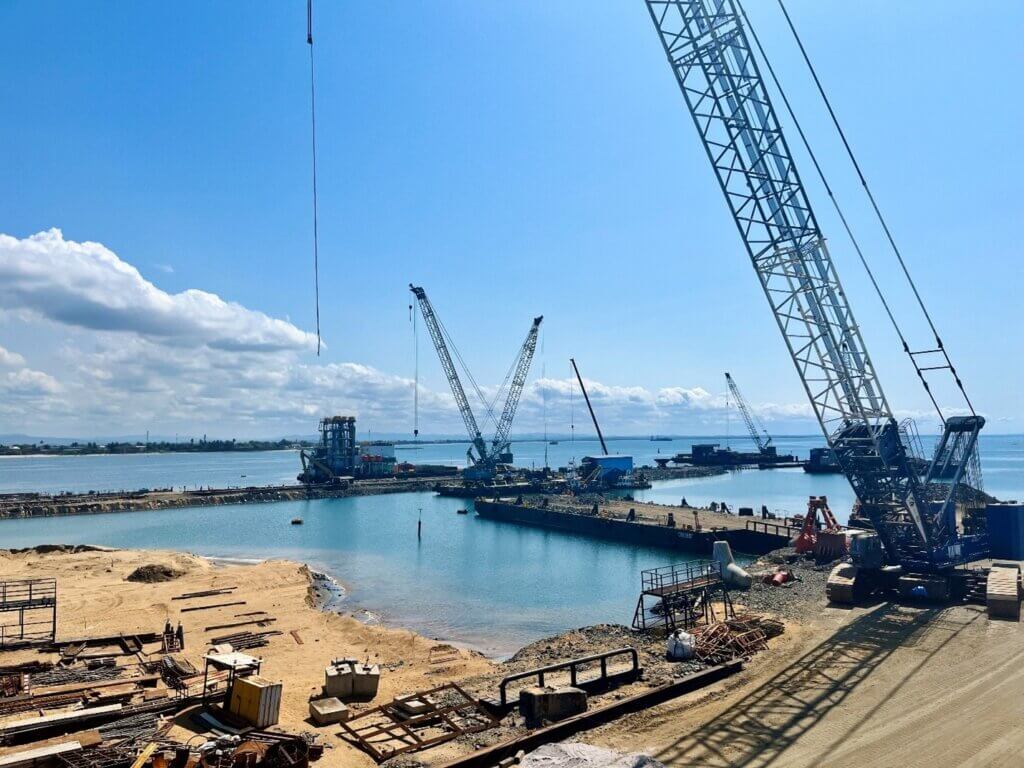
Toamasina port, August 2024. Credit: Carolyn Gruber
Another important component of Toamasina’s economy is the Ambatovy mineral processing plant and refinery. The Ambatovy mine is located 80 kilometers east of Antananarivo, outside the study area. It is connected via a 220-kilometer pipeline, most of which is buried to an average depth of 1.5 meters, to the processing plant and refinery located in Toamasina.77Ambatovy, “Operations and Facilities,” accessed July 24, 2024, https://ambatovy.com/en/operations/operations-components/. They process ore to produce approximately 40,000 tonnes of refined nickel and 4,000 tonnes of refined cobalt per year.78Ambatovy, “Operations and Facilities.” The mine tailings — leftover residue — is treated and stored at a site 10 kilometers west of the plant. Excess water from processing is discharged into the ocean. Local residents have complained of negative health effects from Ambatovy’s facilities following tropical cyclones, though the company has denied these allegations.79Laurence Soustras and Riana Raymonde Randrianarisoa, “Uncertainty around Madagascar Mine in Wake of Cyclone,” Mongabay Environmental News, June 27, 2018, https://news.mongabay.com/2018/06/uncertainty-around-madagascar-mine-in-wake-of-cyclone/.
Tourism has been another important driver of Madagascar’s economic growth in recent years,80World Bank, Macro Poverty Outlook for Madagascar: April 2024 (English), Macro Poverty Outlook, Washington, DC, http://documents.worldbank.org/curated/en/099534504052452726/IDU1935b78211c4df1495b1be9311424cbf5467d. though the sector makes up just 6.3% of the economy,81Travel Team, “Madagascar Travel Guide,” Outlook Travel Magazine, April 3, 2024, https://www.outlooktravelmag.com/travel-guides/133-madagascar-business-travel-guide. reflected in the Percent of National Economy Based in Tourism Industry (medium-high risk, score of 5.60). Few tourists stay in Toamasina, though the city is an important transit point for tourists going to popular attractions to the north and south.82Interview with a representative from the hotel industry. However, the government has set the goal of attracting 500,000 tourists to the country annually,83International Trade Administration, “Madagascar — Travel and Tourism Sector,” February 20, 2024, https://www.trade.gov/country-commercial-guides/madagascar-travel-and-tourism-sector. and the construction of a cruise ship berth at Toamasina’s port may help the city to attract more tourism and tourist revenues.
To attract international tourists, and to grow its economy more broadly, Toamasina will need to address the limitations and vulnerabilities of its infrastructure. An estimated 70% of the population in the city of Toamasina has access to electricity, but that figure is below 10% for the surrounding areas in Toamasina II District.84Japan International Cooperation Agency, “The Project on Master Plan Formulation for Economic Axis of TaToM (Antananarivo-Toamasina, Madagasikara),” Ministry of Regional Development, Building, Housing and Public Works, Government of the Republic of Madagascar, October 2019, https://openjicareport.jica.go.jp/pdf/12340733_01.pdf. A lack of investment in aging equipment results in frequent outages and distribution losses, reflected in Percent of Population with Adequate Access to Electricity (high risk, score of 7.61). The lack of generation capacity is exacerbated by the failures of JIRAMA, the state-owned electric utility, to pay private generation companies. This lack of investment also makes the electricity grid more vulnerable to the impacts of extreme weather events, including tropical cyclones and heavy rainfall, which can down power lines and flood generation and transmission equipment, reflected in the Level of Grid Resilience (medium-high risk, score of 5.97). Two-thirds of the electricity is provided by imported fuel oil and diesel.85Japan International Cooperation Agency, “The Project on Master Plan Formulation.” Ninety-five percent of the nation’s gasoline is also imported through the port of Toamasina. These fuels are vulnerable to leakage and spills at the port and when they are distributed country-wide, especially during extreme weather events, which harm human and ecosystem health.
Toamasina also faces contamination risks from uncollected solid waste, reflected in Effectiveness of Solid Waste Management Procedures (medium-high risk, score of 6.94). Estimates of solid waste collection rates vary, but local stakeholders stated that the city collects only 60 of the 300 tonnes of solid waste produced per day,86Focus group discussion in August 2023 in Toamasina. in line with national rates.87USAID, “Climate Risks in Urban and Urbanizing Geographies: Madagascar,” Climate Risk Profile, March 2018, https://pdf.usaid.gov/pdf_docs/PA00T13Q.pdf. Collection services are focused primarily on local markets and other densely populated areas.88Focus group discussion in August 2023 in Toamasina. Much of the waste that goes uncollected is disposed of illegally into the Pangalanes Canal along with other canals and drainage channels.89Interview with a representative from Direction Régionale de l’Eau, Assainissement et Hygiène à Toamasina. The Agence Portuaire Maritime et Fluviale clears the canal of waste at least twice daily, but is underresourced, and the combination of waste and sedimentation has narrowed the canal so much that boats cannot pass some points.90Interview with a representative from the Agence Portuaire Maritime et Fluviale. Obstructed drainage channels increase the intensity of flooding and slow drainage of floodwaters, which can increase the spread of mosquito- and water-borne diseases, like dengue. Uncollected or improperly stored solid waste is known to leach into and contaminate groundwater and contribute to the spread of diseases such as bubonic plague. Bubonic plague is endemic to Madagascar, and a 2017 outbreak caused more than 2,400 cases, including in Toamasina.91Van Kinh Nguyen, César Parra-Rojas, and Esteban A. Hernandez-Vargas, “The 2017 Plague Outbreak in Madagascar: Data Descriptions and Epidemic Modelling,” Epidemics 25 (2018): 20-25, https://doi.org/10.1016/j.epidem.2018.05.001. Uncollected solid waste also gets swept into the ocean, where it harms the health of coastal and marine ecosystems and of coastal fisheries and drives away potential tourists. The municipal government of Toamasina recognizes the urgency of improving solid waste management and is reportedly developing a solid waste management plan.92Interview with the Office of the Mayor of Toamasina. There are also plans for a small-scale biogas project and a new waste management facility that will be able to manage 60 tonnes of waste per day, though there is reportedly no equivalent investment in waste collection systems.93Interview with the Office of the Mayor of Toamasina.
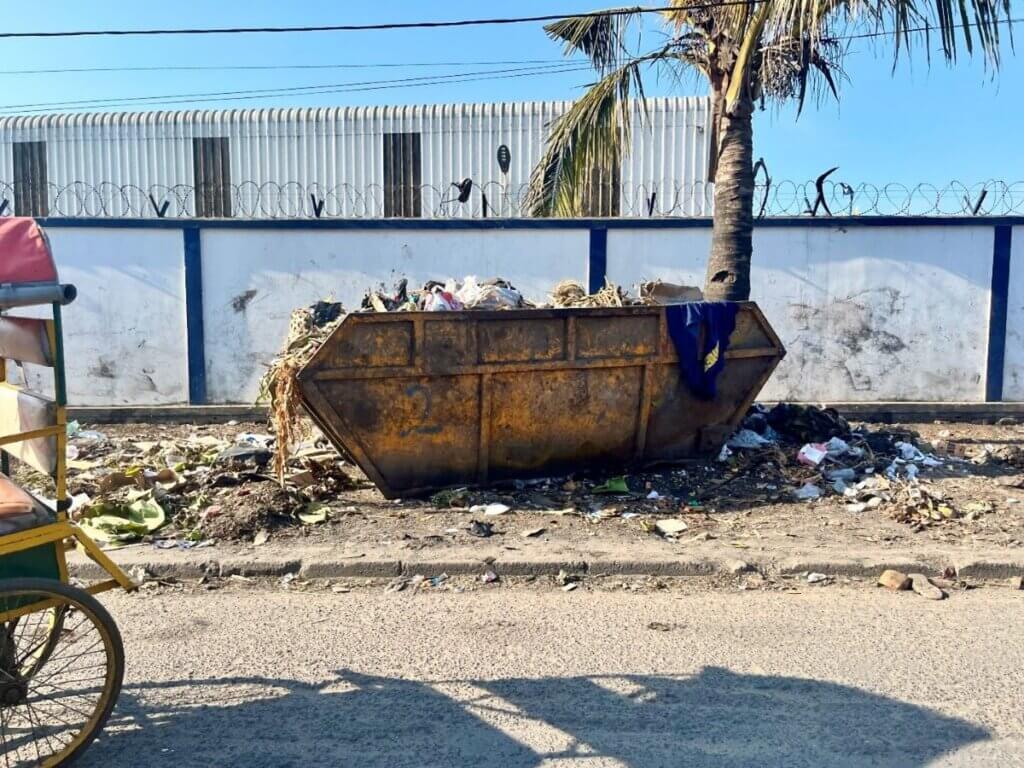
Overflowing solid waste management container, August 2024. Credit: Carolyn Gruber
Toamasina also has very limited sanitation infrastructure, reflected in the Proportion of Wastewater Safely Treated (medium-high risk, score of 6.10). Ninety-seven percent of the population uses latrines. Thirty-eight percent of these are septic tanks, with the remaining 62% single pit latrines, the majority of which are “tinettes,” consisting of a 200-liter oil barrel dug in the ground.94Nguyen et al., “The 2017 Plague Outbreak in Madagascar.” When the latrines are full, over three-quarters of households employ informal services that manually empty the latrines, while another 13% empty the latrines themselves.95Nguyen et al., “The 2017 Plague Outbreak in Madagascar.” Industrial waste and maritime dumping also contributes to the challenge of untreated wastewater in Toamasina. While Madagascar is a signatory to the “London Convention,”96Formally the Convention on the Prevention of Marine Pollution by Dumping of Wastes and Other Matter. implementation is still in its early stages.97Interview with a representative from the Agence Portuaire Maritime et Fluviale.
Untreated wastewater contaminates groundwater and is spread throughout the city when it floods. This is a major cause of diarrheal disease, such as cholera and typhoid fever, which is the fourth leading cause of death in Malagasy children under the age of five.98SEED Madagascar, “Water, Sanitation, and Hygiene (WASH),” accessed July 29, 2024, https://madagascar.co.uk/projects/water-sanitation-and-hygiene-wash. The World Bank and the government of Madagascar signed a $220 million National Water Project in 2022, but the project is targeted at the cities of Antananarivo, Antsiranana, and Mahajanga.99World Bank, “International Development Association Project Appraisal Document on a Proposed Credit in the Amount of SDR 79.6 Million (US$110 Million Equivalent) and a Proposed Grant in the Amount of SDR 79.6 Million (US$110 Million Equivalent) from the IDA Crisis Response Window to the Republic of Madagascar for a National Water Project,” May 4, 2022, https://documents1.worldbank.org/curated/en/935951653593610648/pdf/Madagascar-National-Water-Project.pdf.
To promote economic growth, Toamasina must also address the vulnerability of its transportation infrastructure. Stakeholders rated the Level of Resilience for Airports (medium-high risk, score of 6.47) as the sixth-highest area of economic vulnerability. Toamasina Ambalamanasy Airport (TMM) is the city’s primary airport, located in the northern part of the city. There is also a small private air strip located within the Ambatovy processing complex. TMM is approximately 1.2 kilometers west of the ocean and approximately 600 meters west of the Du Nord River. Another river runs to the west of the airport, between 1 (on the northern end of the runway) and 2 (on the southern end of the runway) kilometers away. TMM sits at a low elevation, making it vulnerable to flash flooding and storm surge from the ocean and the Du Nord River, particularly around the northern parts of the runway.100FloodMap, Toamasina. https://www.floodmap.net/?gi=1053384
Ground transportation networks are also at risk from climate impacts. Madagascar has one of the least extensive road networks in the world, with just 11.4% of the rural population living within 2 kilometers of an all-season road, reducing access to health care, stunting agricultural productivity, and increasing insecurity, which together help drive rural-to-urban migration.101Ziad Nakat, “How New Roads Are Changing Lives in Madagascar,” World Bank Blogs (blog), March 30, 2022, https://blogs.worldbank.org/en/nasikiliza/how-new-roads-are-changing-lives-madagascar. Although road networks are more developed within Toamasina, they suffer from frequent damage from overloaded trucks traveling to and from the port. They are also increasingly vulnerable to sea level rise, coastal erosion, and flooding, reflected in the Level of Resilience for Roads (medium-high risk, score of 6.33). These challenges are compounded by limited maintenance.102Interview with a representative from La Direction régionale des travaux publics. Regular road maintenance has fallen sharply in recent years as a result of the diversion of revenue from fuel taxes away from the Road Maintenance Fund (FER) to the national treasury.103Interview with a representative from the Embassy of the United States.
Only a single road, RN2, connects Toamasina to Antananarivo and the rest of the country, with another major road, RN5, extending north from the city and running north along Madagascar’s eastern coast before terminating at the town of Maroantsetra. Sinohidro is improving the road connection between Toamasina’s port and RN2, and the World Bank has invested $740 million in improving roads and other transportation infrastructure in FY20-FY22.104Nakat, “How New Roads Are Changing Lives in Madagascar.” Toamasina also has a rail line that runs south of the city, to the town of Ambila Lemaitso, where it turns west toward Antananarivo and other inland locations. South of the town of Tampina, the line runs across a narrow spit of land between the Indian Ocean (just over 100 meters away) and Lake Farihy Ampitabe (less than 20 meters away at the closest point). Rapid sea level rise, compounded by coastal erosion, threatens this connection.
Rapid urbanization has given rise to large informal settlements in Toamasina, just as it has in other cities in Madagascar. Nationally, over 60% of urban residents live in informal settlements, over 90% of which is built with fragile materials prone to damage from extreme weather events.105World Bank, “Madagascar Urbanization Review.” These dynamics are replicated in Toamasina, contributing to the Level of Housing Damage from Extreme Weather Events (medium-high risk, score of 6.41), the seventh-highest score in the Economic Risk Area. Informal settlements are often characterized by a lack of secure tenure and land rights, which limits investments in both services, such as waste management, and resilient construction materials. Many of Toamasina’s densest informal settlements lie along the Pangalanes Canal, in settlements like Ambolomadinika, Ambalakisoa, and Morarano. These settlements’ proximity to the canal, combined with the lack of services, contributes to the contamination of the canal with plastic, other solid waste, and untreated wastewater.

Pangalanes Canal running into the Indian Ocean, August 2024. Credit: Carolyn Gruber
Social/Political Risk
Many of Toamasina’s highest social and political risks are associated with the high levels of poverty and rapid population growth. The city also faces medium-high risk from limited investment in climate resiliency projects, political instability, and inadequate access to health care.
- The GOVERNANCE category (expert weighted average score of 5.84) has medium-high risk scores for Investment in Climate Resiliency Development Projects (score of 7.07), Access to Health Care (score of 6.91), and Level of Perceived Transparency within Government (score of 6.38), highlighting concerns of weak rule of law, and slow efforts to strengthen adaptation plans.
- In the SOCIAL/DEMOGRAPHICS category (expert weighted average score of 5.77), the high risk score for Percent of Population Below Poverty Line (score of 8.82) and medium-high risk scores for Percent of Urban Population Below 30 Years of Age (score of 6.79) and Urban Population Density (score of 6.55) show the risks associated with an increase in rural-urban migration combined with a lack of formal employment opportunities.
- The STABILITY category (expert weighted average score of 5.52) shows medium-high risk scores for the Number of Years that the Current Government Structure Has Been in Place (score of 7.20) and Percent of People Employed in Agriculture (score of 6.83), in Port and Shipping Industries (score of 5.75), and in Tourism (score of 5.47). These scores highlight the risks associated with the country’s history of political instability since their independence, and economic dependence on the shipping, tourism, and agriculture sectors.
Toamasina is the second-largest city in Madagascar and continues to grow rapidly, reflected in a medium-high risk score for Urbanization Rate (score of 6.36). Home to an estimated 350,000 people in the city itself and another 275,000 in the surrounding province, Toamasina accounts for roughly 15% of the total population of Madagascar. Other estimates put the city’s population at 800,000 or more. The city’s population growth rate is 4.9% per year,106“Toamasina, Madagascar Metro Area Population 1950-2024,” accessed July 29, 2024, https://www.macrotrends.net/global-metrics/cities/21796/toamasina/population. and the Urban Population Density (medium-high risk, score of 6.55) has doubled from 27.7/km2 in 1993 to 54.2/km2 in 2018.107Instat Madagascar, “Rapport thématique sur les Resultats du RGPH-3, Theme 01: Etat et Structure de la Population a Madagascar,” October 2021, https://instat.mg/documents/upload/main/INSTAT-RGPH3_EtatetStructuredelaPopulation.pdf. A very young population, reflected in Percent of Urban Population Below 30 Years of Age (medium-high risk, score of 6.79), means that population growth will continue to be rapid in the coming years. This rapid growth puts additional strain on already underdeveloped and highly vulnerable infrastructure, including the poor conditions of roads, limited clean drinking water resources, and minimal access to basic sanitation infrastructure. Interviewees highlighted the lack of a sufficient wastewater system in the city and the continued stress on solid waste management, leading to health and climate risks.108Interview with a representative from the Regional Directorate of Water, Sanitation and Hygiene. Continued growth, compounded by a lack of urban planning, will likely result in the expansion of the highly congested informal settlements in the neighborhoods of Ambalakisoa and Morarano along the Pangalanes Canal. In the suburban areas of Toamasina, this growth will likely also lead to more frequent construction without permits.
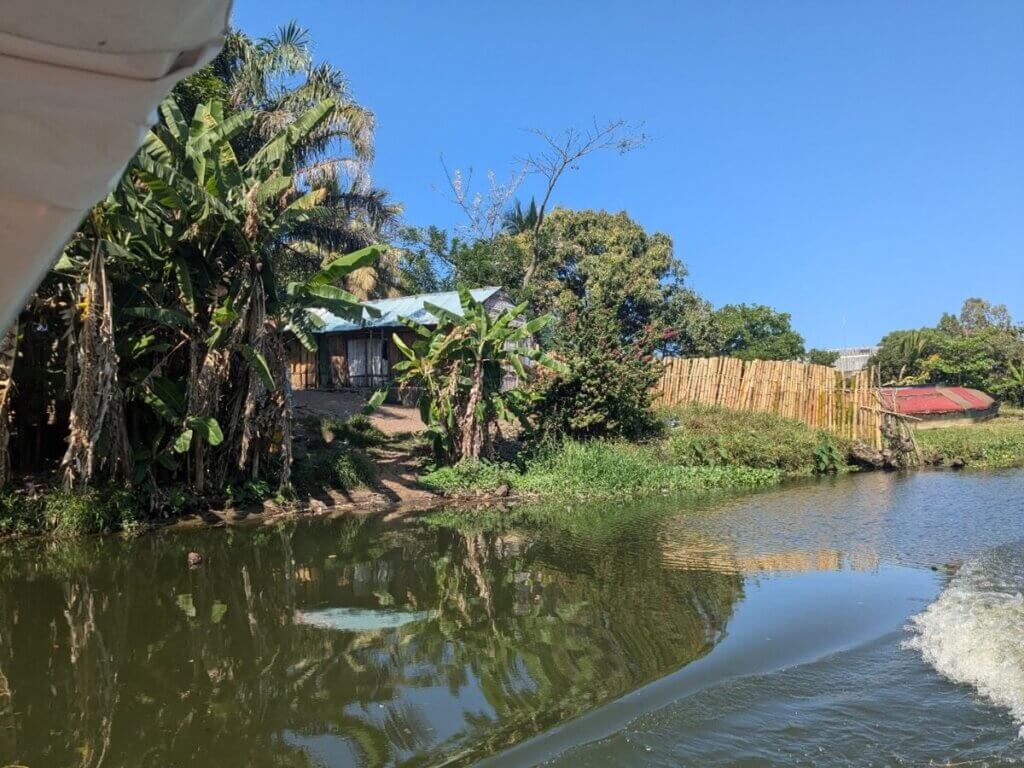
Informal housing on the banks of the Pangalanes Canal, August 2024. Credit: Natalie Fiertz
Madagascar’s public health system is characterized by fragmentation and instability. A 2018 World Bank report noted that the country saw four different Ministers of Health between 2009 and 2014 and that following the end of the National Health Strategy in 2011, it was informally extended with no updated strategy. The system also suffers from a lack of financing, inequitable service delivery, and poor quality of service.109World Bank, “Madagascar Climate Change and Health Diagnostic: Risks and Opportunities for Climate-Smart Health and Nutrition Investment,” Investing in Climate Change and Health Series, 2018, https://documents1.worldbank.org/curated/en/936661516004441146/pdf/121945-12-1-2018-11-21-5-WorldBankMadagascarClimateChangeandHealthDiagnosticJan.pdf. Domestic health spending rose from 2013 to 2017 before falling sharply in the following years before the pandemic. Even after a small increase in 2020, domestic government spending on health care per capita was below the 2013 level,110World Health Organization Global Health Expenditure Database, “Domestic General Government Health Expenditure per Capita (Current US$) — Madagascar,” 2024, https://data.worldbank.org/indicator/SH.XPD.GHED.PC.CD?locations=MG&view=chart. when external support accounted for 83% of public health expenditures.111World Bank, “Madagascar Climate Change and Health Diagnostic.” As a result, there is an increasing reliance on private (both nonprofit and for-profit) health services.
As a result of the constraints it faces, Madagascar’s health infrastructure is extremely limited. According to the most recent data available, Madagascar has the second-smallest number of hospital beds per capita (2010 data)112World Health Organization, “Hospital Beds (per 1,000 People) — Madagascar,” 2024, https://data.worldbank.org/indicator/SH.MED.BEDS.ZS?locations=MG&view=chart. and the 27th-smallest number of physicians per capita (2018 data).113World Health Organization’s Global Health Workforce Statistics, OECD, “Physicians (per 1,000 People) — Madagascar,” 2024, https://data.worldbank.org/indicator/SH.MED.PHYS.ZS?locations=MG&view=chart. More than 66% of health facilities report missing at least one essential medicine, over 40% of the population lives more than 5 kilometers from a health center, and only 50% of the population makes use of health facilities for reasons related to either availability or cost,114World Bank, “Madagascar Climate Change and Health Diagnostic.” reflected in Access to Healthcare (medium-high risk, score of 6.91). The prevalence of long-term, chronic malnutrition among children under age five is the ninth highest in the world, although the rate has been steadily falling over time.115UNICEF, WHO, and World Bank, “Prevalence of Stunting, Height for Age (Modeled Estimate, % of Children under 5) — Madagascar,” 2024, https://data.worldbank.org/indicator/SH.STA.STNT.ME.ZS?locations=MG&view=chart. Similar steady improvements have been made in maternal mortality116WHO, UNICEF, UNFPA, World Bank Group, and UNDESA/Population Division, “Maternal Mortality Ratio (Modeled Estimate, per 100,000 Live Births) — Madagascar,” 2000-2020, https://data.worldbank.org/indicator/SH.STA.MMRT?locations=MG&view=chart. and infant mortality.117UN Inter-agency Group for Child Mortality Estimation (UNICEF, WHO, World Bank, UN DESA Population Division), “Mortality Rate, Infant (per 1,000 Live Births) — Madagascar,” 1968-2022, https://data.worldbank.org/indicator/SP.DYN.IMRT.IN?locations=MG.
The majority of Malagasy people live in rural areas, reflected in the relatively low risk score of Urban Population (medium risk, score of 2.95). Population density is highest in Antananarivo and along the eastern coast of Madagascar.118Geo-Ref.net, “Map Madagascar — Population Density by Administrative Division,” accessed July 29, 2024, http://www.geo-ref.net/ph/mdg.htm. The Percent of Population Below Poverty Line (high risk, score of 8.82), which had fallen modestly before the pandemic, increased to 81.5% in 2021, almost twice the sub-Saharan Africa average rate.119International Monetary Fund, African Department, “Republic of Madagascar,” IMF Staff Country Reports 2023, no. 117 (March 2023): 1, https://doi.org/10.5089/9798400236013.002. People in poverty without access to electricity are dependent on wood harvesting for coal, timber, and firewood.120International Tree Foundation, “Tackling Poverty Is the First Step to Protect Madagascar’s Forests,” accessed July 29, 2024, https://www.internationaltreefoundation.org/news/tackling-poverty-first-step-to-protect-madagascars-forests. This reliance drives illegal deforestation and poaching activities and threatens Madagascar’s fragile ecosystems.121Ecosystems Services for Poverty Alleviation, “Why Tackling Poverty Is the Key to Saving Madagascar’s Forests and Their Iconic Lemurs,” accessed July 29, 2024, https://www.espa.ac.uk/news-blogs/news/2015-06/65546. Local expert interviewees highlighted this reliance on harmful subsistence practices as a recurring challenge to reducing climate vulnerability.122Interview with a representative from the government of Toamasina. Illicitly harvested timber is transported via the Pangalanes Canal from upstream to the city.123Interview with a representative from the Agence Portuaire Maritime et Fluviale. The World Bank specifically notes the increase in poverty in urban areas, attributing it to rural-urban migration, a lack of employment opportunities in cities, and a decline in the productivity of private enterprises.124World Bank, “The World Bank in Madagascar,” Overview, accessed July 29, 2024, https://www.worldbank.org/en/country/madagascar/overview.
Across many of the expert interviews, an overarching concern expressed by interviewees was the lack of education and awareness of the local population on how their actions impact the environment. Interviewees highlighted lack of education around oil spills and other marine pollution,125Interview with a representative from the University of Barikadimy. protection of natural resources,126Interview with a representative from the government of Toamasina. climate-resilient agricultural practices,127Interview with a representative from the Regional Directorate of Agriculture and Livestock. and water quality and hygiene.128Interview with a representative from the Regional Directorate of Water, Sanitation and Hygiene. Interviewees indicated that there are some campaigns run by NGOs and regional departments to raise awareness of a few of these topics but overall, more education is needed.
Madagascar has a history of political instability, reflected in the Number of Years that the Current Government Structure Has Been in Place (medium-high risk, score of 7.20). Since independence from France in 1960, the country has seen four major political crises, in 1972, 1991, 2002, and 2009, each with a change in regime and constitution and serious economic impacts. The crises usually involve urban protests and strikes, but most analysts believe they are typically driven by the elite.129Solofo Randrianja, “President Andry Rajoelina Is Driving Madagascar into Another Political Crisis,” The Conversation, August 13, 2021, http://theconversation.com/president-andry-rajoelina-is-driving-madagascar-into-another-political-crisis-165865.
Although the country has not seen a major political crisis since 2009, there are recent signs of political instability. An alleged assassination plot against President Rajoelina in 2021 resulted in the arrest of 21 people, including five generals.130Peter Fabricius, “Madagascar Needs to Change the Plot,” ISS Africa, August 6, 2021, https://issafrica.org/iss-today/madagascar-needs-to-change-the-plot. In December 2021, Rajoelina sacked all of his ministers.131News Wires, “Madagascar President Sacks All His Ministers, Citing ‘Failures in Government.’ ” France24, August 12, 2021, https://www.france24.com/en/africa/20210812-madagascar-president-sacks-all-his-ministers-citing-failures-in-government. There was another cabinet reshuffle in March 2022, the fifth in three years, though Rajoelina has retained most of his key ministers.132Khalid Al Mouahidi, “Madagascar: Rajoelina Appoints New Government,” MediaFrica Times (blog), March 18, 2022, https://medafricatimes.com/26100-madagascar-rajoelina-appoints-new-government.html.
Perceptions of widespread corruption and challenges around the weak Rule of Law (medium-high risk, score of 5.86) exacerbate the country’s challenges related to the illicit trafficking of natural resources. Despite Madagascar being an island nation, its porous borders and abundant valuable natural resources have given rise to organized criminal trafficking networks. The two most studied trafficked commodities are rosewood and tortoises, though gold, wildlife, precious stones, cannabis, and other timber trafficking also exist. In addition, the impacts of the COVID-19 pandemic have exacerbated environmental crimes.133CMI U4 Anti-Corruption Resource Centre, “Madagascar: Overview of Corruption and Anticorruption,” March 10, 2021, https://www.u4.no/publications/madagascar-overview-of-corruption-and-anti-corruption.pdf. Containment measures drove rural populations toward illicit activities such as trafficking of precious wood, sale of endangered animals, and farming in protected areas to earn a living.134Boris Ngounou, “MADAGASCAR: Covid-19 Exacerbates Environmental Crimes,” Afrik 21, April 30, 2020, https://www.afrik21.africa/en/madagascar-covid-19-exacerbates-environmental-crimes/.
A limited Level of Perceived Transparency within Government (medium-high risk, score of 6.38) impedes the regulation of these practices. Madagascar relies on border tariffs for 48% of its tax revenues, and as the country’s major port, Toamasina collects more than 75% of non-oil tax revenues. A recent World Bank study found that a single type of tax evasion scheme at the port has cost Madagascar’s central government 3% of total tax revenue.135Chalendard et al., Corruption in Customs. Further public incidents of corruption included the implication of the former Minister of Justice in a racketeering case and the exposure of a powerful businessman for allegedly bribing high-ranking civil servants and manipulating court decisions.136Velomahanina Razakamaharavo and Lalatiana Rakotondranaivo, “How Madagascar’s New Foreign Investment Law Will Perpetuate the Colonial Dispossession of the People,” African Arguments (blog), June 16, 2023, https://africanarguments.org/2023/06/how-madagascars-new-foreign-investment-law-will-perpetuate-the-colonial-dispossession-of-the-people/.
Agriculture, forestry, and fishing account for at least 70% of employment in Madagascar137International Labour Organization, “Employment in Agriculture (% of Total Employment) (Modeled ILO Estimate) — Madagascar,” 2024, https://data.worldbank.org/indicator/SL.AGR.EMPL.ZS?locations=MG. and approximately a quarter of GDP.138World Bank, OECD, “Agriculture, Forestry, and Fishing, Value Added (% of GDP) — Madagascar,” 2023, https://data.worldbank.org/indicator/NV.AGR.TOTL.ZS?locations=MG. The majority of the country’s agriculture is subsistence based,139International Fund for Agricultural Development, “Republic of Madagascar Country Strategic Opportunities Programme 2022-2026,” August 12, 2021, https://webapps.ifad.org/members/eb/133/docs/EB-2021-133-R-21.pdf. with many Malagasy farmers being smallholders who rely on the rainy season to grow crops.140USAID, “USAID/Madagascar Country Development Cooperation Strategy (CDCS) Annex F: Climate Change Analysis,” March 15, 2021, https://www.climatelinks.org/sites/default/files/asset/document/2021-03/2021_USAID_CDC%20Annex-Madagascar.pdf. Climate change is projected to extend the dry season across the island and increase the vulnerability of Madagascar’s food supply.141USAID, “USAID/Madagascar Country Development Cooperation Strategy.” In Toamasina, Tavy (slash-and-burn agriculture) is still widely practiced.142Interview with a representative from the University of Barikadimy. These risks, along with the potential inundation of agricultural land from SLR and heavy rainfall, are reflected in the risk score for Percent of Population Employed in Agriculture (medium-high risk, score of 6.83). The country also remains a food importer, with rice accounting for 5% of imports by value in 2021, the second-most of any product.143Observatory of Economic Complexity, “Madagascar (MDG) Exports, Imports, and Trade Partners,” accessed July 29, 2024, https://oec.world/en/profile/country/mdg?yearlyTradeFlowSelector=flow1. This makes the country vulnerable to price swings, with poor residents who are unable to afford market-price rice pushed into slash-and-burn agriculture.144Glenn Ashton, “Madagascar: Political Instability Speeds Destruction of a Unique Environment,” South African Civil Society Information Service (blog), September 24, 2009, http://sacsis.org.za/site/article/359.1.
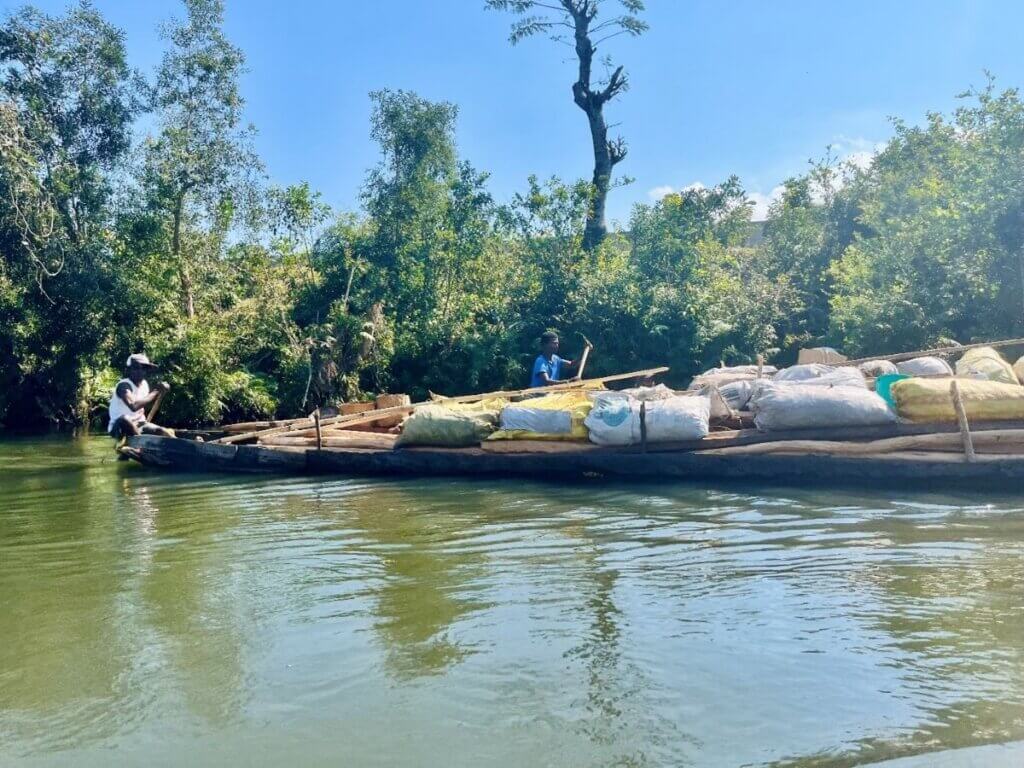
Transporting goods via the Pangalanes Canal, August 2024. Credit: Carolyn Gruber
Concerns around food insecurity played a role in the coup in 2009. In November 2008, amidst the 2007-2008 global food price crisis, the government signed a deal with Daewoo Logistics in which the company was given a 99-year lease on 1.3 million hectares — almost half Madagascar’s total arable land — to farm maize and palm oil for export at no cost.145Song Jung-a, Christian Oliver, and Tom Burgis, “Daewoo to Cultivate Madagascar Land for Free,” Financial Times, November 19, 2008, https://www.ft.com/content/6e894c6a-b65c-11dd-89dd-0000779fd18c. The revelation of the deal sparked widespread protests, and one of President Rajoelina’s first actions upon taking office in 2009 was to cancel the deal.146“Madagascar’s New Leader Says Daewoo Land Deal Off,” Reuters, March 18, 2009, sec. United States, https://www.reuters.com/article/world/us/madagascars-new-leader-says-daewoo-land-deal-off-idUSTRE52H56E/. A law passed in June 2023 and under review by the High Constitutional Court, however, allows foreign companies and investors to secure 99-year renewable land leases, and has drawn significant criticism.147Razakamaharavo and Rakotondranaivo, “Madagascar’s New Foreign Investment Law.”
Madagascar published its National Adaptation Plan (NAP) in May 2022. The NAP includes 12 “structuring programs,” including goals to strengthen resilience and adaptation efforts in Madagascar’s key economic sectors of fisheries, agriculture, and tourism.148Ministère de l’Environnement et du Développement Durable: Plan National d’Adaptation au Changement Climatique (PNA) Madagascar, Antananarivo, Madagascar, Décembre 2021, https://unfccc.int/documents/488094. However, national-level planning does not always translate into effective planning and implementation at the local level, reflected in the medium-high risk for National Climate Adaptation Plan (score of 5.31). There has been weak coordination in climate adaptation planning between the national, regional, and municipal governments. Limited technical capacity also inhibits the government’s ability to provide early warning services for weather emergencies. The Meteorological Department has suffered a major reduction in the available weather equipment; rain gauges have fallen from 340 at independence to just 60 today.149Interview with representative from the Ministry of Scientific Research. The communication channel for relaying weather and climate data from local stations to the national meteorological agency in Antananarivo also faces technical constraints.
Furthermore, the lack of deep local technical expertise means that development planning in Toamasina is often conducted by consultants and not focused locally nor designed with local partners, resulting in plans that are too vague to be useful. Disaster risk management, community development, and service provision are often delegated to development partners, with minimal government oversight. Furthermore, tax revenues go primarily to the national government.150USAID, “Building Urban Resilience to Climate Change: A Review of Madagascar,” Climate Change Adaptation, Thought Leadership and Assessments (ATLAS), March 2018, https://urban-links.org/wp-content/uploads/180327_USAID-ATLAS_Building-Urban-Resilience-to-CC_Madagascar_rev.pdf. Local stakeholders highlighted how this limited the funding available for local priorities.151Interview with a representative from the government of Atsinanana. This constrains their capacity and ability to provide essential services to the city, including disaster risk management, development planning, and preparing for climate change.
There have been three recent significant investments in resilience projects in Madagascar, including projects funded by the Adaptation Fund,152Alyssa Gomes, “Building Urban Climate Resilience in South-Eastern Africa (Madagascar, Malawi, Mozambique, Union of Comoros),” Adaptation Fund (blog), accessed July 30, 2024, https://www.adaptation-fund.org/project/building-urban-climate-resilience-south-eastern-africa-madagascar-malawi-mozambique-union-comoros-2/. the Green Climate Fund,153UNDP Climate Change Adaptation, “Advancing Medium and Long-Term Adaptation Planning in Madagascar,” accessed July 30, 2024, https://www.adaptation-undp.org/projects/advancing-medium-and-long-term-adaptation-planning-madagascar. and the Global Facility for Disaster Reduction and Recovery.154Global Facility for Disaster Reduction and Recovery, “Madagascar: Strengthening Urban and Coastal Resilience,” accessed July 30, 2024, https://www.gfdrr.org/en/madagascar-strengthening-urban-and-coastal-resilience. Yet none of the three projects focus on the city of Toamasina, the second-largest city in the country, as reflected in Investment in Climate Resiliency Development Projects (medium-high risk, score of 7.07), which is the third highest risk indicator in the social risk category. This can be attributed to the control by the central government, wherein local and municipal authorities like Toamasina have not had sufficient access to this type of climate finance.
The Status of Resilience Planning
The principal framework that guides climate adaptation planning in Madagascar is the country’s National Adaptation Plan, which was published in May 2022.155Ministère de l’Environnement et du Développement Durable: Plan National d’Adaptation au Changement Climatique. The Plan establishes twelve “structuring programs,” of which four are the most relevant to the climate risks and vulnerabilities of Toamasina identified in this CORVI assessment:
- Strengthening the adaptation of the fishing industry by developing warning systems and associated action plans,
- Improving access to drinking water in urban and rural areas,
- Bolstering protection of coastal infrastructure and economic activities (including tourism) against sea level rise, and
- Improving cyclone early warning systems, as part of a regional effort in the Indian Ocean.
Over the past several years, the government of Madagascar has taken several important steps toward the implementation of these programs, with the support of international partners. In 2021, the government established the Ministry of Fisheries and Blue Economy and issued a regulation prohibiting industrial fishing within two nautical miles of the shoreline.156Edward Carver, “Changes to Madagascar’s Trawling Sector Raise Questions and Hopes,” Mongabay Environmental News, December 29, 2021, https://news.mongabay.com/2021/12/changes-to-madagascars-trawling-sector-raise-questions-and-hopes/. That same year, the government announced its commitment to join FiTI. In 2022, Madagascar was accepted as an official Candidate Country, the third country to gain that status with FiTI.157May, “Madagascar Becomes Third FiTI Candidate Country!” In December 2023, the government published its first FiTI report, making available information on fisheries laws and regulations, payments for industrial fishing activities, and a list of large-scale fishing vessels.158Memee, “Madagascar Publishes First FiTI Report.”
To help strengthen the resilience of Madagascar’s coastal zones, the Global Environment Facility is supporting the country’s National Office for Climate Change, part of the Ministry of the Environment and Sustainable Development to implement the “project of adaptation of coastal zone management to climate change, taking into account ecosystems and livelihoods” (PAZC). In the Atsinanana region, PAZC is focused primarily on fisheries and aquaculture, particularly in Lake Ankotobona. The project is creating a community management structure, re-stocking the lake, and providing fishing and aquaculture equipment.159Pazc Madagascar, “Région Atsinanana,” accessed July 30, 2024, https://www.pazc-madagascar.mg/regions/atsinanana.htm.
The government of Madagascar, along with international partners, has initiated several projects to strengthen infrastructure threatened by tropical cyclones, flash flooding, and sea level rise. Together with the Japanese International Cooperation Agency, the government is undertaking a major expansion of Toamasina’s port, which will increase the port’s capacity and enhance its protection against sea level rise and storm surge.160Capmad, “Gateway to Growth in Madagascar: Discovering the Port of Toamasina,” February 21, 2024, https://www.capmad.com/case-studies/transport-en/gateway-to-growth-in-madagascar-discovering-the-port-of-toamasina/. Some stakeholders in Toamasina, however, expressed concerns that the port expansion has destroyed local coral reefs and narrowed the opening between the ocean and Toamasina’s coastline, potentially increasing incoming wave energy.161Stakeholder meeting in Toamasina, August 2024. Sinohidro is strengthening the road connection between the port and National Road 2, the highway that connects Toamasina to the rest of Madagascar.162Interview with a representative from the Toamasina Autonomous Port. The World Bank’s Road Sector and Sustainability Project is rehabilitating and improving important sections of Madagascar’s road and rail network, including National Road 2, along with parts of the electricity distribution network owned by JIRAMA, the state-owned electric utility and water services company.163World Bank, “Development Projects: Madagascar Road Sector Sustainability Project — P176811,” accessed July 30, 2024, https://projects.worldbank.org/en/projects-operations/project-detail/P176811. Another World Bank project, the Madagascar National Water Project, is increasing access to clean water in and around Antananarivo,164World Bank, “Development Projects: Madagascar National Water Project.” and a project funded by the Global Facility for Disaster Reduction and Recovery is integrating nature-based solutions and risk-informed design in Antananarivo.165Global Facility for Disaster Reduction and Recovery, “Madagascar: Strengthening Urban and Coastal Resilience.”
Climate adaptation efforts are not limited to the government of Madagascar. The Green Climate Fund supported a project to engage the private sector in the agriculture, health, coastal and ecosystem management, and water sectors in southern Madagascar.166UNDP Climate Change Adaptation, “Advancing Medium and Long-Term Adaptation Planning in Madagascar.” Local stakeholders also highlighted the work of NGOs in improving climate resilience in Toamasina, such as Tany Ifandova, which is working to promote nature-based solutions and raise awareness of the threats posed by climate change.
Priority Recommendations to Build Resilience
Toamasina faces high and growing risks from flooding, with threats from frequent tropical cyclones, rapid sea level rise, and flash flooding from extreme rainfall. This CORVI assessment highlights how these threats are exacerbated by high levels of poverty, loss of coral reef coverage, and inadequate infrastructure, especially for electricity provision and solid waste management. Flooding damages homes and businesses, makes it more difficult to access health care and other services, and impedes the circulation of people and goods.
Frequent and severe flooding, compounded by both climate hazards like warming oceans and non-climate hazards including habitat destruction and runoff of plastic debris and untreated wastewater, undermines economic growth, food security, and income generation in Toamasina. This assessment highlighted the high level of vulnerability of coral reefs and coastal fisheries, and local stakeholders also emphasized deforestation around the city. Degraded terrestrial and marine ecosystems also further increase flooding risk, creating a vicious cycle. The following recommendations provide a pathway for Toamasina to escape this cycle and foster durable, climate-resilient growth that can pull the people of this rapidly urbanizing city out of poverty.
Implement an Integrated Flood Management and Adaptation Strategy
Toamasina will continue to face increasing threats from flooding in the coming years. Local experts identified tropical cyclones, sea level rise, and incidents of heavy rainfall as some of the highest-priority risks facing the city. In response, Toamasina should implement an integrated flood management and adaptation strategy that strengthens its response to major flood events and addresses the compounding drivers of flood risk in the city. This strategy would include key steps to improve the Toamasina’s response to, and management of, major flood events:
- Establish a unified emergency operations center to unify the national, regional, and district-level agencies that have responsibilities relevant to flood planning, response, and recovery. This would help coordinate operations, reduce the time between early warning and response, and help link disaster response planning to efforts to address the multiple structural factors that worsen flooding in the city. These results, in turn, could help address the lack of solid waste management and the debris clogging canals, rivers, and gullies. For example, disaster response personnel could identify specific obstructed drainage channels that play a major role in exacerbating flooding, and this could inform which areas are prioritized for improved waste collection, particularly of harmful plastics. A useful and replicable example is the Lamu County Emergency Operations Center in Kenya, which was recently awarded the Averted Disaster Award.167“Lamu County Emergency Operation Centre,” Averted Disaster Award, May 2024, https://averteddisasteraward.org/wp-content/uploads/2024/06/ADA-Counterfactual_LamuCounty_Flood.pdf.
- Create neighborhood disaster risk management committees to strengthen early warning and response systems and reduce damages from flooding. Such committees have been effectively employed in Maputo, Mozambique.168International Federation of Red Cross and Red Crescent Societies, “Mozambique: Cyclone Early Warning System in Practice,” May 2007, https://preparecenter.org/wp-content/sites/default/files/cs-ewea-mozambique-en_0.pdf. These types of committees would be especially useful in Toamasina’s dense informal settlements, where government authorities have limited information and local residents can play an important role in communicating critical real-time information.
- Implement an anticipatory cash relief program. Anticipatory cash relief has been very effective in reducing the harm suffered by the most vulnerable residents during disasters in other countries throughout sub-Saharan Africa.169Sigal Samuel, “Climate Disasters Hit Poor People Hardest. There’s an Obvious Solution to That,” Vox, February 3, 2023, https://www.vox.com/future-perfect/23574798/climate-adaptation-anticipatory-cash-transfers-givedirectly. Anticipatory cash relief entails sending small payments before an extreme weather event hits, which can pay for preparatory measures like evacuating people and property, and have helped reduce food insecurity, lives lost, and loss of livelihoods after disasters like cyclones and extreme rainfall.170Somini Sengupta, “A New Kind of Disaster Aid: Pay People Cash, Before Disaster Strikes,” New York Times, July 3, 2023, sec. Climate, https://www.nytimes.com/2023/07/03/climate/cash-disaster-relief.html. This type of cash relief could be funded by innovative insurance products, potentially in partnership with international initiatives like the Global Shield against Climate Risks.
- Increase nature-based projects to address flooding. To reduce the impacts of flooding in Toamasina’s informal settlements, the government and international partners should support and implement nature-based solutions (NbS) in these neighborhoods. Good lessons can be learned from similar projects in highly dense cities in Southeast Asia.171Erich Wolff, Hanna A. Rauf, and Perrine Hamel, “Nature-Based Solutions in Informal Settlements: A Systematic Review of Projects in Southeast Asian and Pacific Countries,” Environmental Science & Policy 145 (July 2023): 275-285, https://doi.org/10.1016/j.envsci.2023.04.014. NbS such as constructed wetlands, community gardens, restoration of riparian vegetation, and swales — shallow channels to absorb water runoff — have helped reduce flooding, clean wastewater, and support ecosystems in low-lying, flood-prone informal settlements in countries like Indonesia. Involving the residents of informal settlements in decision-making around solution design and location has improved the successful implementation of these types of solutions. So too has emphasizing their benefits to food security, income generation, and community building, in addition to how they can improve climate resilience.172Spoorthy Raman, “For Urban Poor in Global South, Nature-Based Solutions Have Always Been a Way to Get By,” Mongabay Environmental News, June 8, 2023, https://news.mongabay.com/2023/06/for-urban-poor-in-global-south-nature-based-solutions-have-always-been-a-way-to-get-by/.
- Improve solid waste management to help ensure the success of NbS in informal settlements, reduce the extent and persistence of flooding throughout the city, and reduce the secondary impacts, such as the spread of disease. This will require increased investment in waste collection trucks, financial and social support for informal waste collection workers,173Sulan Chen, “Unsung Heroes: Four Things Policymakers Can Do to Empower Informal Waste Workers.” UNDP (blog), December 28, 2023, https://www.undp.org/blog/unsung-heroes-four-things-policymakers-can-do-empower-informal-waste-workers. and construction of new waste management facilities and landfills with appropriate measures taken to prevent chemical leaching into Toamasina’s groundwater. It should also include the development of waste-to-worth projects, including waste-to-energy plants,174Mark-Anthony Johnson, “Ethiopia Leads with Africa’s First Waste-to-Energy Plant,” FurtherAfrica (blog), February 29, 2024, https://furtherafrica.com/2024/02/29/ethiopia-leads-with-africas-first-waste-to-energy-plant/. biodigesters,175Nkweauseh Reginald Longfor, “From Trash to Power: How to Harness Energy from Africa’s Garbage Dumps — and Save Billions in Future Damage,” The Conversation, December 10, 2023, http://theconversation.com/from-trash-to-power-how-to-harness-energy-from-africas-garbage-dumps-and-save-billions-in-future-damage-219052. and factories that can convert PET bottles into plastic pellets for export.176Sandra Weiss, “Can the Circular Economy Help the Caribbean Win Its War Against Waste?,” Mongabay Environmental News, May 20, 2024, https://news.mongabay.com/2024/05/can-the-circular-economy-help-the-caribbean-win-its-war-against-waste/.
- Design community-based relocation efforts away from flood-prone areas. Some residents living in the most flood-prone areas, such as on the banks of the Pangalanes Canal, may need to be relocated out of harm’s way. Such a relocation process should proceed in consultation with the residents in and around these areas, to improve buy-in and help ensure that flood-prone areas are not reoccupied. The district government should also identify low-risk areas for relocated residents to move to, and provide services (e.g., waste collection), basic infrastructure (e.g., sanitation and electricity), and secure land tenure rights to those living in low-risk areas. The government and international partners should also provide affordable financing to residents relocated out of flood-prone areas to help them rebuild.
- Identify highly flood-prone areas with the help of improved mapping of Toamasina’s informal settlements, as the Humanitarian OpenStreetMap Team has done for informal settlements in cities like Monrovia, Liberia, and Dar es Salaam, Tanzania.177Coco Liu and Festus Poquie, “When Climate Disaster Strikes, Slums Are Vulnerable. Better Maps Help,” Bloomberg, June 13, 2024, https://www.bloomberg.com/news/articles/2024-06-13/when-climate-disaster-strikes-slums-are-especially-vulnerable. Such mapping efforts would also help strengthen disaster planning and response efforts by identifying vulnerable structures and guiding rescuers.
- Empower local climate adaptation. The national government of Madagascar should strengthen local access to climate finance through implementation of the LoCAL Climate Adaptive Living Facility in cooperation with the UN Capital Development Fund.178“UNCDF and Government Begin Design of LoCAL in Madagascar,” UNCDF, January 24, 2023, https://www.uncdf.org/article/8104/uncdf-and-government-begin-design-of-local-in-madagascar. The government should support coordination between with non-government actors by reinforcing the regional blue economy committee and Madagascar’s Information Fusion Centre. The government should also invest in local technical expertise in climatology and oceanography and build connections with universities throughout Madagascar and the wider Western Indian Ocean region. International partners should support the deployment of a greater density of weather instruments and meteorological equipment.
Invest in the Health of Coastal and Marine Ecosystems and Resources
Toamasina is particularly vulnerable to climate change impacts that are outside of its realm of control; local experts identified tropical cyclones, sea level rise, and incidents of heavy rainfall as some of the most concerning and costly risks facing the city. These natural hazards cost the country over $100 million in combined direct losses each year.179World Bank, “Disaster Risk Profile: Madagascar,” Southwest Indian Ocean Risk Assessment and Financing Initiative, Global Facility for Disaster Reduction and Recovery, November 2016, https://documents1.worldbank.org/curated/en/119311492590083804/pdf/114366-WP-PUBLIC-disaster-risk-profile-madagascar.pdf. As climate change continues globally, causing more severe weather, storm surges, heat domes, drought, and sea level rise in the countries located in the Western Indian Ocean, it is imperative that cities like Toamasina work to build resilience and adapt to the impacts of natural hazards. Healthy marine ecosystems, including coral reefs, mangroves, and seagrass beds, and ocean resources, including coastal and offshore fisheries, can play an outsized role in reducing the impacts of climate change, particularly for coastal cities like Toamasina.
- Stop destructive mangrove harvesting and plant new mangroves. Mangrove forests and other coastal forests in Toamasina can provide essential ecosystem services to coastal communities. Healthy and resilient mangrove ecosystems can protect Toamasina from flooding and storm surge, reduce damage from tropical cyclones and other extreme weather events, reduce — and even reverse — coastal erosion, improve nearshore water quality, provide essential habitat and nursery grounds for fish, and support the growth of a sustainable blue economy.
- Restore and protect Toamasina’s vulnerable coastal and marine ecosystems to foster and expand beneficial ecological services. The Toamasina local government and Malagasy national government, together with international partners and local community leaders, should support coral reef restoration projects, artificial coral reefs, and the planting of seagrass beds and mangrove forests. Adopting best practices that are tailored to conditions in the Western Indian Ocean, like those described in the UNEP’s “Guidelines on Mangrove Restoration for the Western Indian Ocean Region,”180UNEP-Nairobi Convention/USAID/WIOMSA, Guidelines on Mangrove Ecosystem Restoration for the Western Indian Ocean Region (Nairobi: UNEP, 2020), https://www.unep.org/resources/report/guidelines-mangrove-restoration-western-indian-ocean-region. and “Seagrass Ecosystem Restoration Guidelines for the Western Indian Ocean Region,”181P. L. A. Erftemeijer, “Seagrass Ecosystem Restoration Guidelines for the Western Indian Ocean Region,” UN Environment Programme, Nairobi Convention, Western Indian Ocean Marine Science Association, and Global Environment Facility. would be most useful.
- Expand locally managed marine areas (LMMAs) by replicating the success of the Velondriake LMMA in Toamasina and the surrounding coastal communities. This could effectively expand marine protections, restore vulnerable marine ecosystems, and foster local leadership in coastal and marine resource management. A recent assessment of the LMMA in Velondriake showed clear increases in fish biomass, which has resulted in better-supported coastal livelihoods. Applying an inclusive participatory or community-led approach to siting and enforcing nearshore LMMAs and marine protected areas (MPAs) has been used by other small island developing states to great effect. Many countries and regions are engaged in coastal conservation planning to expand their networks of protected areas. Some are trying to include ecosystem services, such as the benefits of mangrove forests, seagrass beds, and coral reefs, as a driver in site selection for LMMAs and MPAs. Good examples include the Caribbean Challenge Initiative, the Seychelles Marine Spatial Plan Initiative,182Nature Conservancy, Evaluation of Ecosystem Goods and Services for Seychelles’ Existing and Proposed Protected Area System, unpublished report to Government of Seychelles — MACCE and SWIOFish3 programme, 2022, https://seymsp.com/wp-content/uploads/2022/07/TNC_2022_MPA_Ecosystem_Services_Final.pdf. and Belize’s Nationally Determined Contribution.183Katie K. Arkema, Jade M. S. Delevaux, Jessica M. Silver, Samantha G. Winder, Lisa M. Schile-Beers, Nadia Bood, Stephen Crooks, et al., “Evidence-Based Target Setting Informs Blue Carbon Strategies for Nationally Determined Contributions,” Nature Ecology & Evolution 7, no. 7 (June 1, 2023): 1045-1059, https://doi.org/10.1038/s41559-023-02081-1. One of the primary challenges with the Velondriake LMMA is limited enforcement capacity. Choosing LMMA and MPA sites that provide greater ecosystem services to the community can incentivize and improve the enforcement of those protected sites, highlighting benefits to the coastal communities.184Alvise Dabalà, Farid Dahdouh-Guebas, Daniel C. Dunn, Jason D. Everett, Catherine E. Lovelock, Jeffrey O. Hanson, Kristine Camille V. Buenafe, Sandra Neubert, and Anthony J. Richardson, “Priority Areas to Protect Mangroves and Maximise Ecosystem Services,” Nature Communications 14, no. 1 (September 21, 2023): 5863, https://doi.org/10.1038/s41467-023-41333-3.
- Prioritize becoming a full member of the Fisheries Transparency Initiative (FiTI). In December 2022, Madagascar was accepted into FiTI as an official Candidate Country. As part of FiTI, the Malagasy government must publicly disclose the details of its fisheries access agreements. This, along with the other eleven FiTI transparency principles, including developing a public registry of fisheries laws, regulations, and policies and implementing a scientific assessment of fisheries resources, will improve fisheries management at the local and national levels.
- Develop a sustainable management plan for nearshore fisheries. Coastal fisheries support food security, livelihoods, and communities throughout Madagascar, including in Toamasina, but many nearshore fisheries are declining because of overfishing, destructive fishing practices, and habitat degradation, particularly of coral reef ecosystems and seagrass beds. According to interviews, shrimp trawling is a particular challenge, given the rate of bycatch and the role this gear type plays in damaging marine ecosystems. Rather than eliminate the trawl fishery altogether, which could have negative impacts on the fishing community and blue economy, the local government in Toamasina and the national-level Malagasy government should work together to develop a fishery management plan to foster a more sustainable approach to managing the shrimp trawl fishery. Examples could include using turtle excluder devices and bycatch reduction devices to help reduce bycatch of non-target fish species and marine creatures. Time-based closures linked to spawning times can support better fisheries management. Similarly, area-based closures that encompass at-risk marine ecosystems, like coral reefs, can support increases in biomass and ecosystem recovery. Sustainable nearshore fisheries management relies on community engagement and leadership, however. An inclusive approach that connects all relevant stakeholders will support the development of a locally relevant, enforceable, and achievable fishery management plan.
- Conduct a science-based assessment of marine ecosystem health. This would include a science-based fisheries stock assessment for coastal and offshore fisheries in the Atsinanana region area to improve fisheries management. Investing in a deeper understanding of the current state of coastal and offshore fisheries will support longer-term marine management goals and help determine fishing levels, gear types, closures, and areas for fish habitat protection. Beyond nearshore fisheries, investment is needed in restoration and protection of critical habitats and natural resources including coral reefs, mangroves, seagrass beds, and coastal and offshore fisheries. Supporting the health of existing marine ecosystems in Toamasina is paramount in building climate resilience and maintaining — and eventually growing — Toamasina’s sustainable blue economy.
Invest in Climate-resilient Infrastructure and Economic Growth
As one of the poorest and most climate-vulnerable countries in the world, Madagascar urgently needs to invest in climate-resilient infrastructure and economic growth to pull its people out of poverty. As the country’s second-largest city, chief seaport, and a potential major driver of economic growth, it is critical that Toamasina be a focus of this investment.
- Invest in the electrical grid. A lack of access to reliable electricity is a major constraint to the growth of private enterprises, especially in the formal sector,185World Bank — Subnational Studies, “Getting Electricity: Why It Matters?,” accessed July 30, 2024, https://subnational.doingbusiness.org/en/data/exploretopics/getting-electricity/why-matters. and was identified as one of the most important components of Toamasina’s climate vulnerability in this assessment. The lack of reliable electricity harms productivity, imposes additional costs through the purchase and operation of private generators, and limits the education of students who cannot study after the sun goes down. During extreme weather events, unreliable electricity is associated with increased mortality from heat, limits the operation of pumps, and makes rescue efforts more difficult. Working with the regional and municipal governments, the government of Madagascar should leverage programs like the World Bank–African Development Bank initiative to provide electricity to 300 million people in Africa,186World Bank, “New Partnership Aims to Connect 300 Million to Electricity by 2030,” April 17, 2024, https://www.worldbank.org/en/news/press-release/2024/04/17/new-partnership-aims-to-connect-300-million-to-electricity-by-2030. USAID’s PowerAfrica program to double access to electricity in sub-Saharan Africa,187U.S. Agency for International Development, “Power Africa,” June 28, 2024, https://www.usaid.gov/powerafrica. and the G20 goal to triple renewable energy capacity globally by 2030188International Renewable Energy Agency (IRENA), “G20 Leaders Endorse IRENA Recommendations for Global Renewable Energy Adoption,” September 11, 2023, https://www.irena.org/News/pressreleases/2023/Sep/G20-Leaders-Endorse-IRENA-Recommendations-for-Global-Renewable-Energy-Adoption. in order to mobilize international support to expand and strengthen the electricity grid in Toamasina.
- Create a supportive regulatory environment for the electricity sector, including for private operators. This includes simplifying the process for connecting to the grid (which took an average of 75 days in 2022),189World Bank, “Time to Obtain an Electrical Connection (Days) — Madagascar,” https://data.worldbank.org/indicator/IC.ELC.DURS?locations=MG. streamlining the requirements to set up new renewable energy plants (especially around securing land), and reducing import burdens for solar panels and other power generation equipment. Reforms at JIRAMA to ensure that private generators are paid fully and consistently for the electricity they generate are critical to the expansion of electricity access. Within the city of Toamasina, the government should build on the installation of solar PV at three heavy-fuel oil plants.190ESI Africa, “Solar PV at Oil Power Plants in Madagascar for Energy Efficiency,” ESI-Africa.Com, January 9, 2024, https://www.esi-africa.com/magazine-article/solar-pv-at-oil-power-plants-in-madagascar-increase-energy-efficiency/. In rural areas, where expanded access con also reduce deforestation, the World Bank’s Digital and Energy Connectivity for Inclusion in Madagascar Project can support microgrids and solar home systems.191World Bank, “Madagascar Set to Expand Access to Renewable Energy and Digital Services Thanks to $400 Million Credit,” April 7, 2023, https://www.worldbank.org/en/news/press-release/2023/04/07/madagascar-afe-set-to-expand-access-to-renewable-energy-and-digital-services-thanks-to-400-million-credit.
- Build reliable and resilient transportation systems to support sustainable economic growth in Toamasina and the surrounding region. The city’s airport was identified as the most vulnerable such system in the city. An assessment of specific areas of the airport vulnerable to flooding could identify where the government should protect or restore natural ecosystems in adjoining land to protect the airport. The city’s road and rail networks are also critical to its economic security. Funding should be dedicated for road infrastructure, including maintenance and relocation of highly flood-prone roads. Direct funding of fuel tax revenue to the Road Maintenance Fund should be restored, and investment made in keeping adjacent drainage channels clear of household debris and plastic waste to strengthen resilience to flooding.
- Use the Pangalanes Canal as a transportation corridor. The burden placed on Toamasina’s road network could also be reduced if Pangalanes Canal could serve as a reliable transportation avenue. Regular dredging of the canal, improved collection of debris and plastic waste, and increased capacity to treat wastewater could all help open the canal to regular traffic and enhance the city’s ability to manage floodwater. The Agence Portuaire Maritime et Fluviale recently dredged seven kilometers of the canal, but needs funding for further work, including at least four dredgers to maintain navigability.
- Encourage government support for adaptation small and medium-sized enterprises (SMEs) that provide climate change adaptation products and services, such as drip irrigation and drought-resistant seeds.192SEED, SMEs as Key Drivers of Climate Change Adaptation in Southern Africa. Market Opportunities and Challenges for Adaptation SMEs in Botswana, Malawi and Zambia, 2022, https://adelphi.de/system/files/document/SMEs-as-Key-Drivers-of-Climate-Change-Adaptation-in-Southern-Africa.pdf. Adaptation SMEs can also foster climate-resilient economic growth and poverty alleviation. They have helped mobilize private capital for climate adaptation and address the needs of underserved communities that are highly vulnerable to climate change in Botswana, Malawi, and Zambia.193SEED, SMEs as Key Drivers of Climate Change. However, adaptation SMEs face challenges in expanding their operations, particularly around accessing sufficient investment capital and public misconceptions about their products. To address these challenges, the government and international partners should help such firms create a pipeline of investable opportunities for global investors and educate the public about the benefits of the adaptation products and services these firms provide. The government should also engage with these firms to identify and reduce key regulatory barriers. With sufficient support, adaptation SMEs could create jobs and foster economic growth in Toamasina and promote climate adaptation in the city, the surrounding areas in Toamasina II District, and more broadly throughout Madagascar.
Appendices
Appendix 1: Full list of Indicators for CORVI Toamasina
Ecological Risk Categories and Indicators
| Category | Indicator |
|---|---|
| Climate | Cases of Vector-Borne Disease Infections |
| Change in Sea Surface Temperature | |
| Number of Droughts | |
| Number of Extreme Heat Events | |
| Number of Flood Events | |
| Number of People Affected by Extreme Weather Events | |
| Number of Tropical Cyclones | |
| Number of Wet Days | |
| Ecosystems | Health of Existing Coral Reefs |
| Health of Existing Mangroves | |
| Health of Existing Sea Grass Beds | |
| Incidence of High Invasive Species Abundance | |
| Level of Coral Reefs Coverage | |
| Level of Mangrove Coverage | |
| Level of Sea Grass Bed Coverage | |
| Percent of GDP protected by Coral Reefs | |
| Percent of GDP protected by Mangroves | |
| Percent of GDP Protected by Sea Grass Beds | |
| Rate of Occurrence of Harmful Algal Blooms | |
| Fisheries | Capacity of Fisheries Enforcement Institutions |
| Fish Consumption Per Capita | |
| Level of Unreported Catch Estimate | |
| Nearshore Fish Stock Status | |
| Number of Fisheries Access Agreements with Foreign Nations | |
| Number of Incidents of Foreign Vessels Fishing in EEZ | |
| Offshore Fish Stock Status | |
| Percent of Fisheries Certified Sustainable | |
| Geology/Water | Degree of Saltwater Intrusion in Coastal Aquifers |
| Degree of Soil Salinity in Arable Lands | |
| Level of Geophysical Risk of Landslides | |
| Percent of Bodies of Water with High Water Quality | |
| Percent of Landscape that is Arable Land | |
| Percent of Metropolitan Area at Risk of Flooding | |
| Piped Water Supply Continuity | |
| Projected Change in Sea-Level Rise | |
| Rate of Coastal Erosion |
Economic Risk Categories and Indicators
| Category | Indicator |
|---|---|
| Economics | Debt Ratio |
| Income Inequality | |
| Level of Informal Economy | |
| Market Losses from Extreme Weather Events | |
| National GDP Per Capita | |
| National Unemployment Rate | |
| National Youth Unemployment Rate | |
| Percent of GDP Generated in Coastal Cities | |
| Urban Unemployment Rate | |
| Infrastructure | Effectiveness of Solid Waste Management Procedures |
| Level of Commercial Infrastructure Damage from Extreme Weather Events | |
| Level of Grid Resilience | |
| Level of Housing Damage from Extreme Weather Events | |
| Level of Informal or Unplanned Settlement | |
| Level of Resilience for Airports | |
| Level of Resilience for Ports and Shipping | |
| Level of Resilience for Roads | |
| Level of Shoreline Development | |
| Level of Water Distribution Infrastructure Resilience | |
| Percent of Low-Income Housing in Relation to Flood Zones | |
| Percent of people living below 5 Meters above Sea Level | |
| Percent of Population with Adequate Access to Electricity | |
| Proportion of Wastewater Safely Treated | |
| Renewable Energy Share in Total Energy Consumption | |
| Major Industries | Diversity of Lodging Types |
| Percent of National Economy Based in Agriculture | |
| Percent of National Economy Based in Near Shore Fishing Industry | |
| Percent of National Economy Based in Offshore Fisheries | |
| Percent of National Economy Based in Port and Shipping Industries | |
| Percent of National Economy Based in Tourism Industry |
Social Risk Categories and Indicators
| Category | Indicator |
|---|---|
| Governance | Access to Healthcare |
| Capacity of Current Disaster Response | |
| Capacity of Ethics Enforcement Bodies | |
| Civil Society Participation | |
| Investment in Climate Resiliency Development Projects | |
| Level of Perceived Transparency within Government | |
| National Climate Adaptation Plan | |
| Rule of Law | |
| Voter Turnout | |
| Social/Demographics | Dependency Ratio |
| National Population | |
| National Population Density | |
| Percent of Adult Citizens Living Outside of the Country | |
| Percent of Population Achieving Proficiency in Literacy and Numeracy | |
| Percent of Population Below Poverty Line | |
| Percent of Population Engaged in Seasonal/Cyclical Migration | |
| Percent of Urban Population Below 30 Years of Age | |
| Urban Population | |
| Urban Population Density | |
| Urbanization Rate | |
| Stability | Level of Social Tension |
| Number of Incidences of Civil Unrest or Instability | |
| Number of Years that the Current Government Structure Has Been in Place | |
| Percent of People Employed in Agriculture | |
| Percent of People Employed in Artisanal and Subsistence Fishing | |
| Percent of People Employed in Port and Shipping Industries | |
| Percent of People Employed in the Commercial Fishing Industry | |
| Percent of People Employed in Tourism |
Appendix 2: Surveyed and Interviewed Organizations
| ADOPT – Tamatave |
| Agence Portuaire, Maritime et Fluviale |
| Association vogniala |
| CCIS Madagascar |
| Commune Urbane Tamatave |
| Bureau Régional du Commerce |
| Bureau des mines |
| Bureau régionale du tourisme |
| Direction Régionale de l’Eau, de l’Assainissement et de l’Hygiène Atsinanana |
| Faritra Atsinanana |
| GALANA |
| Fikambanana Indiana Misahana ny Fitsaboana Ala-Nenina (IAPC) |
| Mouvement Chrétien des Cadres et Professionnels (MCCP) |
| Ministère de l’industrie |
| ONG Crade |
| ONG Tany Ifandovana |
| Organe de Developpement du Diocèse de Toamasina |
| Pénitentiaire |
| Police Nationale |
| Gouvernement de la région Atsinanana |
| Bureau de tourisme |
| S2PC Peintures |
| Service Régional du Budget Atsinanana |
| Tsarahary sarlu |
| Universite de Toamasina |
| Mouvement pour la promotion du genre en politique et développement (VMLF) |
| Vondrona Miralenta ho an’ny Fampandrodrosoana |
Appendix 3: The Climate and Ocean Risk Vulnerability Initiative
It is clear that urban coastal areas are likely to experience the earliest onset and potentially most severe impacts from climate change. The risks associated with climate change for specific coastal cities, however, are much more difficult to untangle. In order for coastal cities to efficiently allocate resources and enact effective adaptation strategies, it is critical that they understand their multidimensional climate risk. However, these efforts are impeded by poor and incomplete data.194Alistair Hunt and Paul Watkiss, “Climate Change Impacts and Adaptation in Cities: A Review of the Literature,” Climatic Change 104, no. 1 (2011): 13-49. Data on climate risks is rarely available at the city level, and when it does exist, it is often poorly managed and stored in silos that make it difficult to access and use, even for city government officials.195Jorgelina Hardoy and Gustavo Pandiella, “Urban Poverty and Vulnerability to Climate Change in Latin America,” Environment and Urbanization 21, no. 1 (2009): 203-224. This issue is compounded by technical, financial, and capacity gaps, trapping coastal cities in a vicious cycle where they cannot develop holistic strategies to prioritize investment and access the funds needed to implement resilience actions.
Without data at the appropriate geographic scale, decision-makers are often left with the choice of either waiting for greater data availability, or attempting to downscale national level data, neither of which are ideal solutions for effective climate change adaptation. This problem is particularly acute in small and intermediate cities, which along with absorbing the bulk of East Africa’s future urban population growth, often lack the resources to gather and maintain necessary data.196World Bank, “Demographic Trends and Urbanization,” last modified May 19, 2021, accessed August 16, 2021, https://www.worldbank.org/en/topic/urbandevelopment/publication/demographic-trends-and-urbanization.
Despite these challenges, decision makers need to act now in the face of uncertainty to build resilience to the climate crisis. To do this, they need tools that will enable them to consider multidimensional climate risks, develop cohesive strategies, and utilize this information to unlock additional climate finance and implement resilience actions.
In response, the Stimson Center developed the Climate and Ocean Risk Vulnerability Initiative (CORVI). CORVI is a decision support tool which compares a diverse range of climate-related risks across the land-seascape to produce a coastal city risk profile. These risks are displayed across 10 categories, grouped under three risk areas: ecological, financial, and political (see figure 2). The 10 categories are in turn made up of close to 100 indicators, covering a range of issues including the vulnerability of vital infrastructure, the health of marine ecosystems, and urbanization dynamics in the chosen coastal city. Each indicator and category are scored using a 1-10 risk scale relative to other cities in the region, offering a simple reference point for decision-makers looking to pinpoint and categorize climate risks. The CORVI risk scores, which form the basis of a coastal city risk profile, are augmented with existing academic and grey literature, government documents, and key informant interviews to develop a comprehensive narrative and understanding of the coastal city’s climate risks and identify priority policy recommendations.
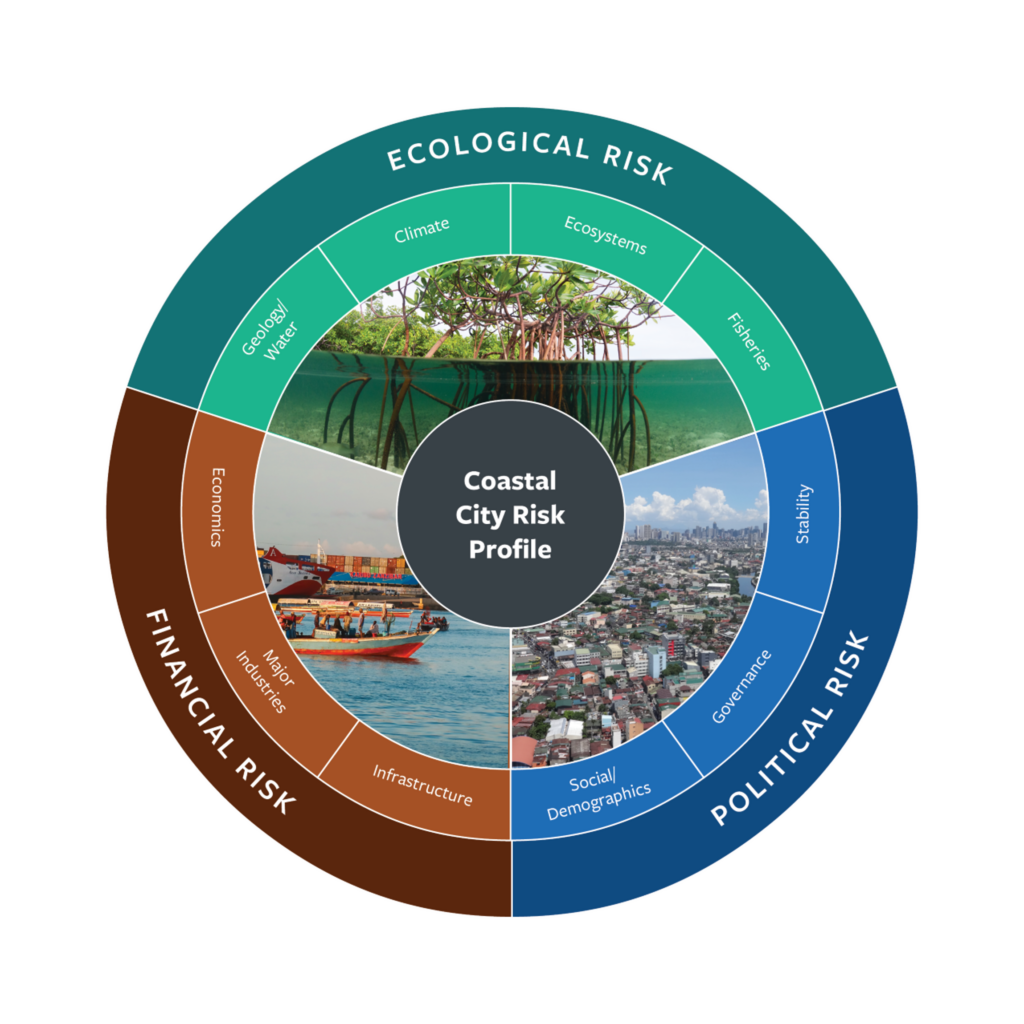
How CORVI is Different
CORVI builds on the work of previous indices but is distinct in three ways.
- Locally Based: Unlike many other indices which tend to focus on the national or regional level, CORVI is city or small island based, providing sub-national level detail on the nature and impact of climate and ocean risks. This focus is based on extensive interviews with potential issuers of the CORVI tool, who noted that climate change is local and the difficulty of down-scaling national level risk and vulnerability data to inform policy action to build climate resilience in specific communities.
- Holistic: CORVI looks across a broad set of ecological, economic, social and political risk factors connected to climate change impacts and that influence vulnerability of coastal cities and their residents. As part of the category and indicator selection process, indicator inclusion was primary based on its ability to capture and explain climate change risks in coastal cities, and not if data was available. This approach promotes a holistic understanding of climate change impacts to coastal cities.
- Data Driven: Through using Structured Expert Judgment (SEJ), CORVI is suited to producing actionable insights in data sparse environments. By combining empirical and survey data across a wide range of indicators, CORVI fill data gaps to provide a holistic assessment, while reducing data availability bias. This approach provides a contextual and data driven assessment of climate and ocean risk vulnerability.

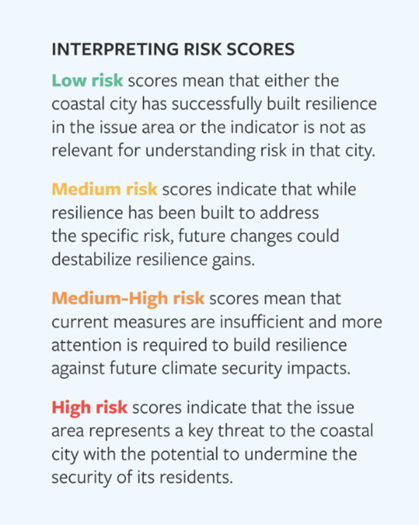
CORVI began in 2018, with the first two assessments – of Castries, Saint Lucia, and Kingston, Jamaica – completed and published in 2020. CORVI is now operating in 16 countries around the world, from the Caribbean to the South Pacific. The project now includes both full assessments, which incorporate around 100 risk indicators distributed across the 10 risk categories, along with rapid assessments, which incorporate 30-35 risk indicators across the same 10 risk categories.
Advancing the Sustainable Development Goals
CORVI also aims to contribute to the delivery of the SDGs – an essential framework to guide lasting, positive change. By providing data and information to measure climate risks in coastal cities, this project supports the delivery of the following SDGs:

CORVI operates in collaboration with national government authorities for every assessment. As a locally driven, comprehensive assessment of ocean and climate risk and vulnerability, the CORVI team engages with a wide range of partners on the ground, including national and local government, the private sector, civil society, and academia.
CORVI Rapid Assessments Completed
- Western Province, Sri Lanka
- Southwestern Urban Corridor, Barbados
- Tarawa, Kiribati
- Dominica
- Mauritius
CORVI Full Assessments Completed
- Basseterre, St. Kitts and Nevis
- Castries, St. Lucia
- Chattogram, Bangladesh
- Dagupan, Philippines
- Dar es Salaam, Tanzania
- Kingston, Jamaica
- Mombasa, Kenya
- Toamasina, Madagascar
- Suva, Fiji
CORVI Assessments Underway
- Aruba
- Belize City, Belize
Indicators
To ensure that the CORVI indicator scores provide a holistic risk rating, each is made up of five factors: current, past, and expected trends, the rate of change of the risk, and the impact of this risk on the coastal city.
- The BASELINE measures the current level of risk for each indicator relative to other coastal cities in the region. Baseline data for economic and social indicators is derived from the most recent year of complete data. Climate indicators use a longer time period of 15 years.197Thirty-year time horizons are traditionally used to calculate the seasonal cycle and other long-term averages of climate variables. However, as the climate changes, current conditions are more dissimilar to those from 30 years ago than they are to those from 10 years ago. In this environment, the optimum climate normals (OCN) method can be used to calculate the minimum number of years required to accurately produce the climatological average for climate variables. The National Oceanic and Atmospheric Administration suggests that a 10-year time series for temperature and a 15-year time series for precipitation are acceptable minimum limits to produce an accurate climatology within a non-stationary period. CORVI follows the same limits that NOAA uses in their experimental seasonal forecast product by using a similar 15-year time horizon to measure climate indicators. For more information on OCN, see Daniel S. Wilks and Robert E. Livezey, “Performance of Alternative ‘Normals’ for Tracking Climate Changes, Using Homogenized and Nonhomogenized Seasonal U.S. Surface Temperatures,” Journal of Applied Meteorology and Climatology 52, no. 8 (August 2013): 1677-1687, https://doi.org/10.1175/JAMC-D-13-026.1.
- PAST TREND assesses the trend of risk for the past 10 years, measured from the baseline year. The only exception to the 10-year trend measure are the climate indicators, which use a 15-year trend horizon to account for slow onset changes.
- EXPECTED TREND assesses the anticipated trend of risk in the next 10 years, measured from the baseline year. The only exception to the 10-year trend measure are the climate indicators, which use a 15-year trend horizon to account for slow onset changes.
- MAGNITUDE assesses the degree of expected future trend change relative to other cities in the region. Change that happens quicker than expected is assumed to increase risk when compared to changes that take place over a longer time scale. This assumes that longer time periods of change contribute to less risk, as decision makers have more time to adapt and build resilience.
- Finally, IMPACT assesses the importance of change for each indicator in describing future risk in the coastal city.
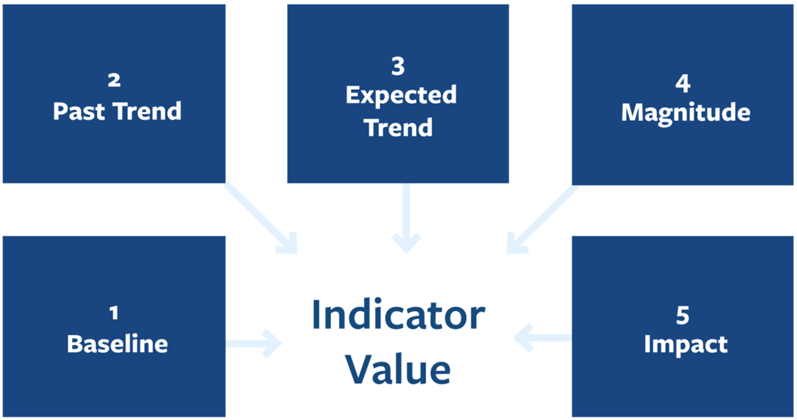
Data Collection and Structured Expert Judgement
To overcome data gaps, CORVI employs structured expert surveys to collect data that is otherwise unavailable. This primary data is combined with secondary data using the approach of structured expert judgement (SEJ) to produce a comparative score for each indicator in the assessment.198For an introduction to structured expert judgment, see Cherie Maestas, “Expert Surveys as a Measurement Tool: Challenges and New Frontiers,” in Lonna Rae Atkeson and R. Michael Alvarez (eds.), The Oxford Handbook of Polling and Survey Methods (Oxford: Oxford University Press, 2018). SEJ is well-established social science technique that seeks to quantify risk when pre-existing secondary data is inadequate. Through interviews and surveys, as well as a series of weighting procedures to ensure data is representative, SEJ allows researchers to quantify topics that might otherwise be challenging to study in such a systematic fashion.
To apply SEJ to CORVI, subject matter experts across academia, government, civil society, and the private sector are identified through research and extensive outreach to stakeholders in the target coastal cities. These experts then refer the project team to other experts and stakeholders with appropriate expertise using “snowball sampling.”199Snowball sampling or chain-referral sampling is a non-probability sampling technique used when samples have traits that are difficult to find. In this sampling technique, existing subjects provide referrals to recruit additional subjects required for a research study. To guard against confirmation bias, survey answers are compared to a regional secondary empirical dataset to weigh the expert responses by utilizing a coherence check.200Abigail Colson and Roger Cooke, “Expert Elicitation: Using the Classical Model to Validate Experts’ Judgements,” Review of Environmental Economics and Policy 12, no. 1 (2018): 113-132. This ensures that experts whose answers do not match secondary data are not weighed as highly as those who do.
This approach has several strengths. First, CORVI incorporates the views of subject matter experts and local stakeholders at each stage of its implementation. This allows the final product to better reflect the specific context which it is seeking to measure and provide more focused information for end users. Second, pairing primary survey data with secondary data through SEJ also allows CORVI to provide insight into risks relating to urban coastal environments that existing secondary datasets do not cover. While the use of SEJ allows CORVI to assess a diverse range of risks, it should not be regarded as a substitute for empirical data collection. Rather, SEJ is best viewed as an alternative research technique specialized to analyzing topics with significant data gaps.201H. Kunreuther, S. Gupta, V. Bosetti, R. Cooke, V. Dutt, M. Ha-Duong, H. Held, J. Llanes-Regueiro, A. Patt, E. Shittu, and E. Weber, “Integrated Risk and Uncertainty Assessment of Climate Change Response Policies,” in O. Edenhofer, R. Pichs-Madruga, Y. Sokona, E. Farahani, S. Kadner, K. Seyboth, A. Adler, I. Baum, S. Brunner, P. Eickemeier, B. Kriemann, J. Savolainen, S. Schlömer, C. von Stechow, T. Zwickel, and J.C. Minx (eds.), Climate Change 2014: Mitigation of Climate Change. Contribution of Working Group III to the Fifth Assessment Report of the Intergovernmental Panel on Climate Change (Cambridge and New York: Cambridge University Press, 2014).
Acknowledgements
This project was supported by the Ocean Risk and Resilience Action Alliance (ORRAA), with contribution from the United States Department of State.
This report was funded in part by a grant from the United States Department of State. The opinions, findings and conclusions stated herein are those of the authors and do not necessarily reflect those of the United States Department of State.
This project was supported by the Prince Albert II of Monaco Foundation.







Community Adaptation for a Water Festival Without Clean Water