

Highlights
4,801 MTU spent nuclear fuel in storage (2016)
11,772 MTU spent nuclear fuel projected by 2050
1962 First year of commercial nuclear operation
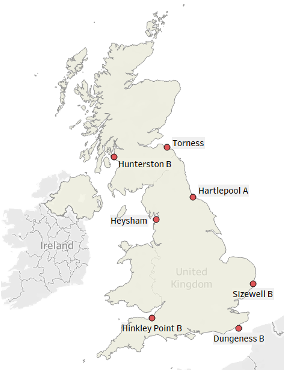
15 operating nuclear power reactors
1 operating research reactor
1 nuclear power reactor under construction
9 GW(e) installed nuclear capacity (2016)
17.72% nuclear share of domestic energy production (2018)
Regulator: Office for Nuclear Regulation
Power Operator: EDF UK
Management and Disposal of Spent Nuclear Fuel
Practices
- SNF from now-closed Magnox reactors is stored wet onsite before storage/reprocessing at the Magnox reprocessing plant
- SNF from advanced gas-cooled reactors is dry-stored briefly before being stored wet on-site and transferred to central interim storage
- Fuel from the single PWR is first stored in a pond and then put in a new dry independent spent fuel storage installation, constructed to keep up with the reactor’s lifetime output
- Reprocessing has become largely unpopular in the UK; there are no plans to replace the closed LWR and AGR fuel Thermal Oxide Reprocessing Plant (THORP) or the Magnox reprocessing plant, expected to close in 2020
- THORP’s annual reprocessing capacity was approximately 600 metric tons/yr from 1994-2018; from 1964 onward, the Sellafield MOX reprocessing plant has reprocessed Magnox fuel with an annual capacity of 1500 metric tons/yr
Obligations
- The U.K.’s voluntary offer safeguards agreement (INFCIRC/263) entered into force in 1978 and the additional protocol entered into force in 2004
- The U.K. signed the Joint Convention in 1997 and ratified in 2001
- The national SNF policy allows for SNF management and waste disposal to be reprocessed, meaning it is not considered waste
- New plants require robust plans for SNF management and waste disposal
- Spent fuel operators are responsible for determining SNF management
- In 2014 a white paper was released laying out initial implementation steps for eventual DGR development, which would fall under the purview of the Nuclear Decommissioning Authority


Community Adaptation for a Water Festival Without Clean Water