
Editor’s Note: Maiara Folly is the Co-founder and Executive Director of Plataforma CIPÓ, a Brazil-based think tank specialized in International Relations and climate policy. She is also a Co-Director of the Global Governance Innovation Network (GGIN). Folly holds an MSc from Oxford University’s Department of International Development and a BA in International Relations from PUC-Rio.
By Richard Ponzio, Senior Fellow & Director, Global Governance, Justice, and Security Program
Abstract
The Brazilian Presidency of COP30 has framed the Conference as an inflection point in global climate governance, articulating a vision of climate multilateralism that moves beyond a sole emphasis on the negotiation of new commitments towards the accelerated implementation of existing ones, while preserving consensus-based decision-making as the source of legitimacy.
Against this backdrop, this policy brief examines whether COP30 can be credibly regarded as a “COP of implementation,” and how future COP presidencies might build on the institutional innovations introduced by Brazil to consolidate a two-tier approach to climate multilateralism. It concludes with a set of recommendations to operationalize this model in ways that accelerate the implementation of agreed goals while also strengthening the UNFCCC negotiation process so that it can deliver meaningful decisions and continue to provide legitimacy and normative guidance.
These recommendations include: strengthening official UNFCCC participatory channels and deepening their connection with broader social mobilization efforts; consolidating the Global Ethical Stocktake and strengthening its connection to the multilateral process; ensuring continuity in the engagement of finance ministers and economic authorities in the UNFCCC, while clarifying mandates and strengthening governance inclusiveness; systematizing and publishing the technical inputs of the advisory councils and the Circle of COP Presidents; retaining the practice of appointing Special Envoys, while providing clearer mandates, coordination structures and reporting mechanisms; consolidating the reform of the Action Agenda, including through the Global Implementation Accelerator; and building on the political momentum of the roadmaps for transitioning away from fossil fuels and for halting and reversing deforestation, while addressing the limitations of voluntary arrangements.
Introduction
The ongoing crisis of multilateralism brings renewed attention to a long-standing challenge facing international cooperation: the persistent gap between the adoption of ambitious international agreements and their effective implementation in terms of policies, finance, and real-world outcomes.
Even amidst significant geopolitical tensions, this crisis has not prevented United Nations (UN) Member States from reaffirming a shared vision for addressing global challenges. Initiatives such as the Pact for the Future, adopted in 2024 to strengthen multilateral cooperation across key global priorities, and the Compromiso de Sevilla,1United Nations. General Assembly. Resolution adopted by the General Assembly on 25 August 2025. 79/323. Sevilla Commitment. A/RES/79/323. August 26, 2025. agreed at the Fourth International Conference on Financing for Development in July 2025, reflect efforts to mobilize global governance towards safer, more equitable, inclusive and sustainable pathways.
Yet trust in multilateral institutions remains fragile. While this erosion of trust is partly driven by political leaders who question international cooperation on what are often ill-founded ideological grounds, a broadly shared diagnosis has emerged that, since the end of the Second World War, global governance institutions have become increasingly effective at producing both voluntary commitments and legally binding agreements, while remaining far less successful at translating them into tangible results on the ground at the speed and scale required by today’s crises.2Kauffmann, Céline, Marta Torres Gunfaus, Maiara Folly, Simon Sharpe, and Paul Watkinson. COP30: Addressing implementation. IDDRI. September 2025.
In recent years, this implementation gap has become particularly evident in the field of climate governance. Over more than three decades of Conferences of the Parties (COPs) under the United Nations Framework Convention on Climate Change (UNFCCC), the international community has developed a complex and sophisticated normative framework, culminating in the Paris Agreement adopted in 2015 and its accompanying mechanisms. Since then, climate change has moved from the margins to the core of global policymaking, and collective emissions trajectories have shifted from earlier projections of more than 4°C of global warming towards a pathway closer to the range of 1.9-2.6°C.3United Nations Framework Convention on Climate Change. Conference of the Parties (COP). Mutirao Decision: uniting humanity in a global mobilization against climate change. Proposal by the Presidency. Draft negotiating text. November 18, 2025.
Yet, despite this progress, near-universal adherence to the UNFCCC and the Paris Agreement, and three cycles of nationally determined contributions (NDCs), advances in mitigation, adaptation and the provision of climate finance continue to fall short of what is required to meet agreed objectives. This persistent gap has increasingly translated into calls for renewed forms of multilateral cooperation capable of combining the legitimacy of consensus with faster, more flexible pathways for implementation.
It is within this context that the Brazilian Presidency of COP30 framed the Conference as an inflection point in global climate governance, articulating a vision of climate multilateralism as a complementary two-tier model — one that preserves consensus-based decision-making as the source of legitimacy, while enabling accelerated, large-scale implementation initiatives to move faster than formal negotiations alone.4COP30 Brasil. “Twelfth Letter from the President.” Letters from the Presidency. January 27, 2026. To support this ambition, the COP Presidency introduced a set of institutional innovations designed to strengthen the engagement of a diverse range of state and non-state actors in climate action and decision-making, while seeking to advance implementation-oriented outcomes within the formal negotiation process.
Against this backdrop, this policy brief examines whether COP30 can be credibly regarded as a “COP of implementation,” and how future COP presidencies might build on the institutional innovations introduced by Brazil to consolidate a two-tier approach to climate multilateralism.
The policy brief proceeds in three parts. First, it assesses the institutional innovations introduced by the COP30 Presidency, including the creation of Mobilization Circles, the appointment of regional and sectoral Special Envoys and the reform of the Action Agenda,5See further: COP30 Brasil. “Action Agenda.” August 28, 2025. the pillar of the UN climate process designed to mobilize voluntary action by actors that do not negotiate formal agreements but are important to implementing them. Second, it analyses COP30’s negotiated outcomes, and in particular the “Global Mutirão: Uniting humanity in a global mobilization against climate change” decision, adopted by consensus by UNFCCC Parties at COP30, to assess the extent to which the Conference’s implementation focus was reflected in formal negotiated texts.6United Nations Framework Convention on Climate Change. Conference of the Parties (COP). Mutirao Decision: uniting humanity in a global mobilization against climate change. Proposal by the Presidency. Draft negotiating text. November 18, 2025. Finally, it concludes with a set of recommendations aimed at sustaining momentum from COP30 and advancing a more implementation-oriented, two-tier model of climate multilateralism.
Reorienting Climate Governance Toward Implementation: Institutional Innovations Under the Brazilian Presidency of COP30
Brazil has established three priorities for its COP30 Presidency: (1) reinforcing multilateralism and the climate change regime under the UNFCCC; (2) connecting the climate regime to people’s real lives; and (3) accelerating the implementation of the Paris Agreement by stimulating action and structural adjustments across all institutions capable of contributing to its objectives.7COP30 Brasil. “Second Letter from the President.” Letters from the Presidency. May 8, 2025.
At the narrative level, these priorities were captured through the concept of mutirão — inspired by the Brazilian and Indigenous tradition of collective work, in which communities unite to solve challenges no one can address alone. Brazil invoked a mutirão as an invitation to the international community to engage in a global collective effort against climate change, grounded in cooperation among peoples and oriented towards the progress of humanity.
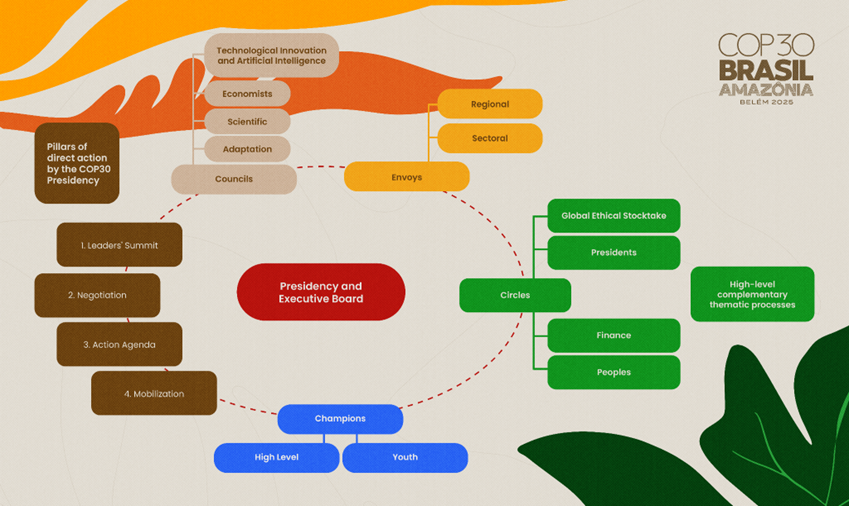
In practical terms, the COP30 Presidency sought to operationalize this call to action through a set of institutional innovations. These included the creation of technical advisory councils on topics such as technological innovation and artificial intelligence, economy, science and adaptation; the appointment of seven regional and 22 sectoral Special Envoys to conduct outreach across priority regions and constituencies — such as business, unions, women, and subnational governments — as well as the establishment of four Mobilization Circles (see figure 1 below).8The regional Special Envoys supported the engagement of stakeholders from the Middle East, South Asia, Africa, Oceania, North America, Europe, and Latin America and the Caribbean. In parallel, the sectoral Special Envoys conducted outreach across the following priority sectors and constituencies: civil society; forests; trade unions; human rights and just transition; the Amazonian private sector; energy; health; data integrity; women; Amazonian civil society; racial equality and marginalized urban communities; culture and creative industries; the bioeconomy; Amazonian subnational governments; business; oceans; sports; family farming; urban solutions; agriculture; the Brazilian Climate Change Forum; and Indigenous Peoples. See further: https://cop30.br/en/brazilian-presidency/special-envoys
Figure 1: COP30 Presidency Organizational Organogram
Source: COP30, “Structure of COP30: Understanding the Conference and Brazil’s Innovations,” October 10, 2025.
The four Mobilization Circles consist of the following: The People’s Circle sought to expand the participation of indigenous peoples, traditional communities, and Afro-descendant groups in climate decision-making processes. The Global Ethical Stocktake introduced ethical and moral dimensions into responses to the climate crisis. The Finance Circle9Brazil. Ministry of Finance. “Report of the COP30 Circle of Finance Ministers launched during IMF and World Bank meetings.” October 15, 2025. convened Ministers of Finance with the aim of identifying pathways to scale up climate finance and contribute to the Baku to Belém Roadmap to $1.3 trillion.10At COP29, Parties agreed by consensus to launch the Baku to Belém Roadmap to 1.3T and tasked the COP29 and COP30 presidencies with leading its development. The Roadmap was designed to identify concrete pathways for scaling up finance for climate action in developing country Parties from all public and private sources to at least $1.3 trillion per year by 2035. See the report in full: United Nations Framework Convention on Climate Change. The Baku to Belém Roadmap to 1.3T. November 2025. Finally, the COP Presidents’ Circle brought together former COP Presidents since COP21 to identify ways to strengthen global climate governance and the UNFCCC.
Taken together, these innovations reflected an effort to address structural limitations of the UNFCCC process. First, they sought to respond directly to one of its most persistent weaknesses: the gap between agreed commitments and the provision and mobilization of means of implementation, especially for developing countries. Engagement beyond climate negotiators, particularly with finance and economic authorities, was pursued in order to address fiscal, financial and regulatory dimensions of implementation. This broader involvement was structured around five priorities identified by Brazil’s Ministry of Finance, in consultation with member countries of the Circle, as inputs to the roadmap: the reform of multilateral development banks (MDBs); the expansion of concessional finance and climate funds; the creation of country platforms and the strengthening of domestic capacities to attract sustainable investment; the use of innovative financial instruments to mobilize private capital; and the strengthening of regulatory frameworks for climate finance.
Second, the institutional innovations sought to narrow the gap between scientific and practical knowledge, on the one hand, and decision-making within the COP process, on the other. The use of technical advisory councils and expert input was intended to inform and substantiate the COP Presidency’s strategic thinking and policy formulation on key thematic issues, while the involvement of former COP Presidents drew on practical experience with the UNFCCC system to inform discussions on governance reform.
Third, the innovations responded to growing concerns about the ethical and moral dimensions underpinning the erosion of trust in the multilateral system. In particular, they sought to surface debates on the ethical implications of adopting international commitments in the absence of sufficient political will or institutional capacity to implement them.
Fourth, these initiatives sought to address the constraints associated with a structural feature of global governance: its predominantly state-led nature, despite the growing role of subnational and non-state actors. While participation mechanisms for these actors have expanded over the years — both across global governance institutions and within the climate regime in particular — they have often proven insufficient to enable engagement that is meaningful, transparent, and capable of driving transformative change at the speed and scale imposed by the climate crisis.
In addressing these constraints, the COP30 Presidency did not seek to replace existing participation mechanisms within the UNFCCC, but rather to complement them in support of implementation-oriented outcomes. Within the climate COP ecosystem, engagement beyond formal negotiations has historically been pursued primarily, albeit imperfectly, through the so-called Action Agenda, designed to mobilize voluntary action by a wide range of actors, including states, subnational authorities, businesses, financial institutions, and civil society. COP Presidencies have traditionally enjoyed wide discretion in shaping the thematic priorities and governance arrangements of the Action Agenda.
In recent years, however, this model has generated valid concerns regarding transparency, effectiveness, and accountability. The proliferation of pledges and initiatives has often occurred in the absence of robust mechanisms to assess implementation, measure impacts, or evaluate contributions to agreed objectives under the UNFCCC. At times, the Action Agenda not only detracted from, rather than reinforced, the negotiation agenda, but also enabled greenwashing by allowing stakeholders to accrue visibility and political capital without clear intent to follow through on the pledges and initiatives they had announced.11Tubiana, Laurence, and Emmanuel Guérin. Le climat est un sport de combat. Paris: Albin Michel. 2025. 188-189.
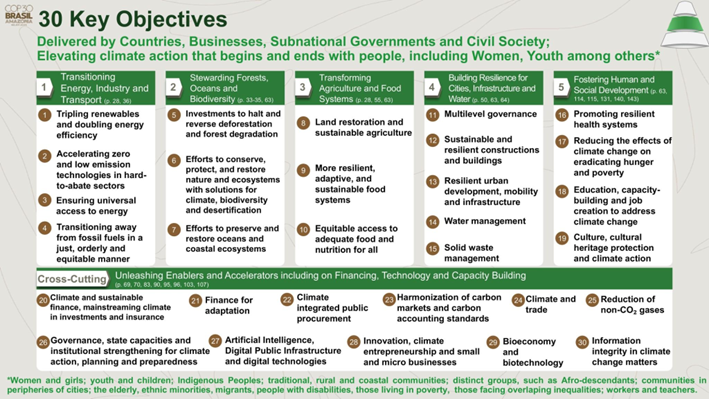
Against this backdrop, the Brazilian COP30 Presidency initiated a reform of the Action Agenda aimed at increasing transparency, strengthening its solution-oriented character, and reinforcing the implementation of outcomes already agreed under the UNFCCC by aligning it more closely with objectives established through the formal negotiation agenda. To this end, the Action Agenda was anchored in the thematic priorities and commitments identified in the first Global Stocktake of the Paris Agreement (GST), which were translated into six thematic pillars and 30 objectives (see figure 2 below).
Figure 2: COP30 Action Agenda’s Thematic Axes and Objectives
Source: COP30, “Action Agenda,” August 28, 2025.
In parallel, the Presidency undertook a mapping and assessment of existing initiatives, identifying approximately 700 initiatives launched over the past decade, of which 480 initiatives involving 190 countries were found to remain active and were subsequently aligned with the 30 objectives.12COP30 Brasil. “Presidência da COP30 e Dan Ioschpe apresentam avanços da Agenda de Ação na Pre-COP.” October 14, 2025. Each objective is supported by dedicated “activation groups” responsible for consolidating similar initiatives, tracking and demonstrating impacts, and supporting the scaling of existing solutions through concrete acceleration plans leading up to the second GST in 2028.13COP30 Brasil. “Grupos de Ativação.” Agenda de Ação. August 28, 2025. To date, around 120 acceleration plans have been developed, with 190 initiatives reporting concrete results. Together, these elements provided the basis for a five-year vision for the Global Climate Action Agenda for 2026-2030, developed by the COP29 and COP30 Climate High-Level Champions to strengthen the Action Agenda as a vehicle for operationalizing multilateral climate goals, with a focus on the Paris Agreement and the GST.14High-Level Champions for Climate Action. Global Climate Action Agenda 2026–2030: A five-year vision for accelerating implementation. United Nations Climate Change, November 9, 2025.
Finally, this emphasis on implementation informed the Leader’s Summit, where the leadership of Brazil’s President Lula was mobilized to secure support for concrete initiatives. These included the Tropical Forests Forever Facility (TFFF), aimed at providing financial compensation to countries that keep their forests standing; the launch of an Integrated Forum on Climate Change and Trade to promote an open and fair economic system as a driver of sustainability; as well as emerging proposals such as the roadmap for Transitioning Away from Fossil Fuels in a Just, Orderly and Equitable Manner, the roadmap for Halting and Reversing Deforestation and Forest Degradation by 2030, and the potential creation of a UN Climate Change Council “to aggregate means of implementation, processes, actors, and climate-related mechanisms, with a view to accelerating the implementation of decisions adopted under the Climate Convention and the Paris Agreement.”15COP30 Brasil. “Twelfth Letter from the President.” Letters from the Presidency. January 27, 2026.
Taken together, these developments indicate that the Brazilian Presidency made a significant effort to position COP30 as a Conference oriented toward implementation. Rather than relying solely on new pledges or symbolic announcements, the Presidency sought to improve and reform existing mechanisms — most notably the Action Agenda — while complementing them with new institutional arrangements aimed at mobilizing actors, resources and expertise beyond the negotiating rooms. The alignment of the Action Agenda with the outcomes of the GST, the introduction of activation groups and acceleration plans, and the emphasis on tracking results all point to an attempt to move from a logic of commitment proliferation towards one of delivery and follow-through. Similarly, initiatives such as the Mobilization Circles and the appointment of Special Envoys reflected an understanding that implementation depends on engaging actors across all sectors and levels of governance, from finance ministries and subnational authorities to businesses, civil society, and technical communities.
In Belém, the ambition to connect the climate regime to people’s real lives also materialized through strong social participation. This was reflected, first, in a vibrant Green Zone during the conference — which, unlike the Blue Zone where negotiations take place, does not require official accreditation and is often underutilized at COPs, but in Belém attracted nearly 300,000 visitors for educational and cultural activities. In addition, a Global March for the Climate mobilized approximately 70,000 participants, underscoring the broader societal engagement that prevailed in the lead-up to and during the Conference.16 COP30 Brasil. “Twelfth Letter from the President.” Letters from the Presidency. January 27, 2026.
At the level of mobilization, institutional design, and narrative framing, COP30 can therefore be credibly understood as an effort to operationalize a push towards implementation. The following section examines whether, and to what extent, this orientation was reflected in formal negotiated outcomes, and what this reveals about both the possibilities and the structural limits of advancing implementation through the UNFCCC.
COP30’s Negotiated Outcomes: Progress and Limits of Implementation Through Consensus
The climate crisis has repeatedly exposed the growing disjuncture between the pace of real-world transformations and the tempo of multilateral negotiations. While consensus-based decision-making remains the cornerstone of legitimacy within the UNFCCC, it has increasingly struggled to keep pace with the speed and scale of change demanded by climate urgency. This tension was explicitly acknowledged by the Brazilian Presidency of COP30, which framed the Conference as an effort to preserve consensus-based decision-making as the source of legitimacy, universality, legal clarity, and collective direction, while opening space for faster, implementation-oriented processes based on open and coordinated coalitions, rapid and large-scale resource mobilization, and the deployment of practical solutions.17 COP30 Brasil. “Twelfth Letter from the President.” Letters from the Presidency. January 27, 2026.
Within the climate regime, this dynamic is perhaps most clearly illustrated by the delayed political recognition of fossil fuels as a key driver of the crisis. It took 28 years for fossil fuels to be explicitly referenced in a COP decision, through paragraph 28(d) of the first GST, which calls for a transition away from fossil fuels in a just, equitable, and orderly manner so as to achieve net zero by 2050.18United Nations Framework Convention on Climate Change. Outcome of the first global stocktake. 1/CMA.5. December, 2023. This delay underscores the extent to which consensus-based negotiations have often lagged behind scientific evidence and lived realities, reinforcing the Presidency’s argument that implementation cannot wait for unanimity on every operational step.
Nonetheless, for many observers, COP30 could not credibly be regarded as a “COP of implementation” unless the implementation-oriented narrative and institutional innovations advanced by the Brazilian Presidency were reflected in substantive negotiated outcomes on issues that are central to promoting climate action in practice.
By COP30, Parties were expected to have submitted their third generation of nationally determined contributions (NDCs), raising questions about whether these emissions-reduction plans would be aligned with the 1.5°C temperature goal and the broader operational commitments of the first GST. At the same time, COP30 took place following the adoption of a New Collective Quantified Goal on Climate Finance (NCQG) at COP29 in Baku, set at $300 billion per year by 2035, while significant expectations were placed on the launch of the Baku to Belém roadmap, intended to outline pathways for scaling climate finance to $1.3 trillion annually by 2035.19United Nations Framework Convention on Climate Change. “COP29 UN Climate Conference Agrees to Triple Finance to Developing Countries, Protecting Lives and Livelihoods.” November 24, 2024. These debates unfolded against persistent divides within the regime: Developing countries continued to express frustration with the weak provision of climate finance and raised concerns over the punitive effects of unilateral trade measures on their development and climate action efforts, while developed countries largely adopted a defensive posture on finance, even as they called for greater ambition in NDCs and stronger language on fossil fuels.
In practice, for many, an implementation COP meant delivering progress on accelerating the transition away from fossil fuels, narrowing the anticipated “NDC ambition gap,”20Despite significant delays beyond the original February 2025 deadline for NDC submissions, 122 Parties had submitted their new NDCs by the end of COP30 in November 2025; however, taken together, the third generation of NDCs are not aligned with the 1.5°C temperature goal. and advancing means of implementation — particularly climate finance, including greater clarity and transparency around its provision by developed nations — while also engaging more explicitly with the negative externalities of unilateral trade measures.
Paradoxically, while central to advancing climate action in practice, none of these issues featured on the official COP30 negotiating agenda, which must be agreed by consensus among all UNFCCC Parties. To prevent these topics from disrupting negotiations despite their absence from the formal agenda, they were channeled, from the outset of COP30, into consultations. This deliberate isolation of the most contentious issues helped create a more constructive environment in the negotiation rooms, allowing mandated agenda items to progress at a steady and productive pace, particularly during the first week of the Conference.21The Presidency conducted consultations on the following issues: Implementation of Article 9, paragraph 1, of the Paris Agreement (finance provision from developed to developing country Parties); Promoting international cooperation and addressing the concerns with climate change related trade-restrictive unilateral measures; Responding to the synthesis report on nationally determined contributions and addressing the 1.5 °C ambition and implementation gap; Reporting and review pursuant to Article 13 of the Paris Agreement: Synthesis of biennial transparency reports.
Within a constrained negotiating space reflective of significant longstanding divisions among Parties, and further exacerbated by a complex geopolitical context, COP30’s formal negotiations adopted 56 decisions by consensus over the course of the two-week Conference, delivering progress across several areas. Notably, COP30 further advanced the integration of human rights and indigenous peoples’ rights considerations, including their land rights and traditional knowledge, into the climate regime. For the first time, a COP decision explicitly recognized the contribution of people of African descent to climate action, while also underscoring the importance of meaningful participation by a wide range of groups and the obligation to respect, promote, and fulfil a broad range of human rights when pursuing just transition pathways.22United Nations Framework Convention on Climate Change. Conference of the Parties serving as the meeting of the Parties to the Paris Agreement. United Arab Emirates just transition work programme. Draft decision -/CMA.7. Proposal by the President. FCCC/PA/CMA/2025/L.14. November 21, 2025. Against a broader global context marked by setbacks on the rights of women and girls, COP30 also approved the Belém Gender Action Plan,23UN Climate Change News. “The Belém Gender Action Plan: A launchpad accelerating ambitious, effective, and inclusive climate action.” December 12, 2025. which sets out objectives and activities to advance gender-responsive climate action and to promote the participation of women within the UNFCCC process.
COP30 also sought to elevate the profile of the adaptation agenda, having achieved the conclusion of the assessment of progress on National Adaptation Plans and the adoption of indicators for the Global Goal on Adaptation. Although the final set of indicators was reduced to 59 from the expected 100 and differed in several respects from the wording recommended by technical experts, thus requiring further refinement to ensure that the indicators are fit to measure adaptation progress.24Tanguy, Adèle, Christophe Buffet, and Alexandre K. Magnan. “Adaptation at COP 30: indicators at the heart of the debate.” IDDRI, November 27, 2025.
The negotiations also reached consensus on the establishment of a new mechanism aimed at strengthening international cooperation, technical assistance and capacity-building to enable equitable, inclusive and just transitions, as well as on initiatives such as the Belém Technology Implementation Programme (TIP), which sets out pathways to enhance international cooperation on technology development and transfer for climate action, with particular attention to the needs of developing countries.25United Nations Framework Convention on Climate Change. Conference of the Parties serving as the meeting of the Parties to the Paris Agreement. Belém Technology Implementation Programme. Draft decision -/CMA.7. Proposal by the President. FCCC/PA/CMA/2025/L.18. November 21, 2025.
To a large extent, the response to the most contentious issues that had been channeled into consultations was reflected in the adoption of the “Global Mutirão” decision.26United Nations Framework Convention on Climate Change. Conference of the Parties (COP). Mutirao Decision: uniting humanity in a global mobilization against climate change. Proposal by the Presidency. Draft negotiating text. November 18, 2025. In relation to trade, the Mutirão document reaffirms the importance of a supportive and open international economic system as an enabler of climate action and establishes a series of dialogues to consider opportunities, challenges, and barriers to enhanced international cooperation related to the role of trade. It also mandates a high-level event on the issue in 2028 and commissions a report summarizing the discussions.
With regard to climate finance, the decision calls on all actors to enable the scaling up of finance to developing country Parties to at least $1.3 trillion per year by 2035, including at least $300 billion in public resources. It also takes note of the Baku to Belém Roadmap to 1.3T — which was structured around five pillars, namely Replenishing, Rebalancing, Rechanneling, Revamping and Reshaping, and provides a framework to help advance that goal. In addition, the decision establishes a high-level ministerial roundtable on the implementation of the NCQG and launches a new two-year work program on climate finance. Notably, and somewhat unexpectedly, it also includes a “call for efforts” to at least triple adaptation finance by 2035, although without explicitly specifying a baseline year.
More broadly, the Mutirão negotiated text sends a strong political signal that, following the finalization of the Paris Agreement Rulebook, Parties have resolved to “decisively transition to a focus on the implementation of the Paris Agreement and decisions adopted since its first session.”27United Nations Framework Convention on Climate Change. Conference of the Parties (COP). Mutirao Decision: uniting humanity in a global mobilization against climate change. Proposal by the Presidency. Draft negotiating text. November 18, 2025. A key instrument in this regard is the launch of the Global Implementation Accelerator, conceived as a cooperative and facilitative initiative to mobilize and connect existing efforts, partnerships, and resources in support of accelerated implementation. Alongside initiatives such as the Belém Mission 1.5 led by the COP29, COP30 and COP31 troika, the Accelerator has been presented by the COP30 Presidency as a prototype for introducing an additional institutional speed within climate multilateralism, with its relevance ultimately to be measured by the regime’s ability to translate political commitments into faster and more effective implementation on the ground.
As anticipated given the absence of the issue from the negotiated agenda, and despite significant presidential diplomacy by President Lula, both at the Leaders Summit and during the second week of COP30, the formal negotiated outcomes did not make reference to fossil fuels. However, reflecting the broad support expressed by an estimated one third of Parties during COP30, alongside strong mobilization by civil society and social movements, the COP30 President assumed responsibility at the closing plenary for advancing a voluntary Roadmap for Transitioning Away from Fossil Fuels in a just, orderly, and equitable manner. Conceived as a political and technical platform, this roadmap aims to mobilize state and non-state actors around national and international planning processes to support the implementation of paragraph 28 of the GST.
Similarly, while negotiated outcomes offered only a procedural response to the need for greater synergies between the climate and biodiversity agendas, the COP30 Presidency announced a voluntary Roadmap for Halting and Reversing Deforestation and Forest Degradation by 2030, intended to support the implementation of paragraphs 33 and 34 of the GST and, along with initiatives such as the TFFF, move forests from the margins to the center of the global climate agenda.28COP30 Brasil. COP30 Executive Report. March 2026.
Taken together, while sending a strong political signal consistent with the vision of a “COP of implementation” the negotiated outcomes of COP30 point to incremental rather than transformative progress. Much of what was achieved took the form of work programs, dialogues, action plans, and voluntary or time-bound arrangements. This reflects, in part, the limits imposed by the issues formally mandated on the negotiating agenda, as well as the structural constraints of a consensus-based decision-making system operating in a highly polarized geopolitical context. At the same time, these outcomes signal a deliberate effort to consolidate existing commitments and to create pathways for future action, rather than to reopen foundational debates. In this sense, the results of COP30 underscore both the possibilities and the limits of advancing implementation through formal negotiations alone, reinforcing the case for operationalizing a two-tier approach to climate multilateralism, in which consensus provides legitimacy while implementation is pursued through more flexible and accelerated pathways, including through reforms within the UNFCCC process and the exploration of new implementation-oriented mechanisms, such as the Integrated Forum on Trade and Climate Change and the proposed UN Climate Change Council.
Key Takeaways and Recommendations for Advancing a Two-tier Climate Multilateralism
COP30 can be understood as an important attempt to reposition climate multilateralism around implementation without abandoning the centrality of consensus-based negotiations. The Brazilian Presidency did not seek to replace the formal multilateral process. Rather, it sought to complement it with a wider ecosystem of political mobilization, technical input, social participation, and voluntary cooperation capable of moving faster than negotiations alone. In this sense, the most significant conceptual contribution of COP30 may lie in the articulation of a two-tier approach to climate multilateralism: one tier anchored in negotiated decisions, universality, and legal legitimacy; the other in more flexible and implementation-oriented pathways involving coalitions, institutions, experts, subnational and legislative authorities and non-state actors. This broader vision was reflected in the Presidency’s organizational architecture, in the reform of the Action Agenda, and in the concept of mutirão as a method for accelerating cooperation.
At the same time, COP30 also revealed the limitations of implementation-oriented innovation when such efforts remain highly presidency-driven, insufficiently institutionalized, and only partially connected to the official channels of the UNFCCC. Many of the innovations introduced in Belém were politically significant and in some cases unprecedented. The mobilization of Indigenous Peoples was noteworthy, with 5,000 Indigenous participants in total, including 900 accredited to the Blue Zone. The Global Ethical Stocktake also broadened participation beyond formal channels, including 65 self-managed sessions across six continents involving 4,000 participants from 17 countries. The Action Agenda, in turn, benefited from a more structured architecture, with over 480 active initiatives, 120 Plans to Accelerate Solutions, and a five-year vision for continuity.29COP30 Brasil. COP30 Executive Report. March 2026. The Finance Circle helped keep ministers of finance and economic authorities engaged in implementation debates. The advisory councils, Special Envoys, and COP Presidents’ Circle expanded the Presidency’s ability to convene expertise, political leadership, and cross-regional dialogue. Yet in several of these cases, mandates, participation modalities, reporting channels, and feedback loops into formal negotiations remained unclear or underdeveloped. Their contribution was therefore concrete, but their institutional legacy remains uncertain.
This points to a broader lesson. If a two-tier model of climate multilateralism is to strengthen rather than fragment the regime, the relationship between its two tiers must be made clearer. Implementation-oriented mechanisms cannot become parallel arenas detached from the negotiated process, nor should they reproduce the weaknesses that have often affected participation and voluntary initiatives in global governance, including weak transparency, limited representativeness, insufficient accountability, and unclear pathways to influence decision-making. Their value lies precisely in their ability to reinforce negotiated outcomes, broaden ownership, and help translate consensus into delivery. The challenge for future presidencies, therefore, is not simply to preserve the innovations introduced at COP30, but to refine them in ways that make them more transparent, better coordinated, more continuous across presidencies, and more closely aligned with the priorities emerging from the formal multilateral track.
Against this backdrop, the recommendations below seek to support the operationalization of a more implementation-oriented two-tier climate multilateralism, while preserving consensus as the source of legitimacy under the UNFCCC.
Recommendations
- Operationalize two-tier climate multilateralism as a governance model designed to accelerate the implementation of agreed goals, while also improving the UNFCCC negotiation process so that it can deliver meaningful consensus-based decisions and continue to provide legitimacy and normative guidance. To make this vision operational, COP30, over which Brazil is still presiding until November 2026, and future presidencies, with the support of multistakeholder coalitions, should identify, map, and help coordinate emerging and existing initiatives, platforms, and governance arrangements capable of advancing implementation across key agenda areas, prioritizing those with the greatest potential for transformative change and scalability. This process should be accompanied by clearer mechanisms for coordination, transparency, and accountability, so that implementation-oriented efforts reinforce, rather than fragment or dilute, Party-led processes. In this regard, the Action Agenda and the Global Implementation Accelerator can serve as important vehicles for aligning voluntary efforts with negotiated priorities and for strengthening the coordination between the two tiers.
- Strengthen and improve official UNFCCC participatory channels, and deepen their connection with broader People’s mobilization. COP30 made an important effort to engage Indigenous Peoples, traditional communities, and Afro-descendant groups through the Peoples’ Circle, while also enabling robust social participation in Belém, including more than 5,000 Indigenous participants. Yet future presidencies should not only connect such mobilization more effectively to existing official mechanisms, such as the UNFCCC constituencies and the Local Communities and Indigenous Peoples Platform (LCIPP), but also support the strengthening and improvement of those mechanisms themselves. This is essential so that participation is not limited to visibility and engagement, but is better equipped – institutionally, financially and procedurally — to shape negotiations and implementation pathways in a more meaningful, representative and sustained manner.
- Continue and consolidate the Global Ethical Stocktake (GES) and strengthen its connection to the multilateral process. The GES broadened the climate debate beyond technical considerations by bringing ethical, cultural, Indigenous, and community perspectives more centrally into climate debates. Future presidencies should preserve this mechanism but refine its modalities so that its outputs can feed more clearly into the multilateral process. This could include aligning the guiding questions of both the official regional GES dialogues and the self-managed Global Ethical Stocktakes more closely with negotiating and implementation challenges and priorities, while creating clearer channels for reporting back to negotiators, including in ways that support the recognition of ethical considerations within the second Global Stocktake of the Paris Agreement. Over time, the GES process could evolve into a more permanent structure, such as a global citizens’ assembly.30Folly, Maiara, Andrea Ordóñez Llanos, Aishwarya Machani, and David Steven. Strengthening Citizen Participation in Global Governance. United Nations Foundation. 2024.
- Ensure continuity in the engagement of finance ministers and economic authorities in the UNFCCC, while clarifying mandates and strengthening governance inclusiveness. The continued engagement of finance ministers and economic authorities should remain a priority, given the centrality of means of implementation to the climate regime. At the same time, future iterations of the Finance Circle would benefit from clearer and more complementary mandates, greater transparency, and more inclusive participation. In particular, the distinction between presidency-led finance initiatives and Party-led UNFCCC processes should be made clearer, while participation should be open to all interested Parties and supported by more predictable channels for inputs from observers, civil society, and other non-state actors. Such mechanisms should be designed to support the implementation of negotiated commitments, as well as initiatives such as the Baku to Belém Roadmap to 1.3 trillion. The Finance Circle could also feed more directly into mandated processes, including through the submission of written inputs to relevant dialogues and work programs, such as the annual “Xingu Finance Talks” on the implementation of Article 2, paragraph 1(c), of the Paris Agreement and its complementarity with Article 9, as well as the two-year finance work program agreed at COP30. This should be done in a manner that reinforces and operationalizes the principles of the UNFCCC and its Paris Agreement, including Common but Differentiated Responsibilities and Respective Capabilities (CBDR-RC).
- Systematize and publish the technical inputs and outputs of the advisory councils and the Circle of COP Presidents. COP30’s advisory councils and former COP Presidents’ Circle were important vehicles for bringing technical and practical knowledge into the Presidency’s work and should be continued. Yet their contributions were not always sufficiently visible to Parties, observers, or the wider public. COP30 and future presidencies should therefore publish concise reports, recommendations, or synthesis notes from these mechanisms, while also creating more formal handover channels so that lessons learned can be documented to inform subsequent presidencies and support broader efforts to reform climate governance.
- Retain the practice of appointing Special Envoys, while providing clearer mandates, coordination structures and reporting mechanisms. The appointment of seven regional and 22 sectoral Special Envoys significantly broadened the thematic and political reach of the COP30 Presidency. This architecture should be strengthened and consolidated, but future presidencies should adopt more predictable coordination meetings, clearer workplans and objectives, and more structured forms of engagement between the Envoys and observers, constituencies, and other UNFCCC mechanisms. Regional envoys, in particular, could be used more strategically to anticipate political resistance, build support across negotiating groups and regions, and contribute more directly to creating the broader political conditions for successful negotiations.
- Consolidate the reform of the Action Agenda and secure continuity, including through the Global Implementation Accelerator (GIA). The reform of the Action Agenda has the potential to become one of COP30’s most important institutional legacies. Its alignment with the first Global Stocktake, the creation of activation groups, the development of Plans to Accelerate Solutions, and the adoption of a five-year vision point to a more structured and transparent approach to implementation. Future presidencies should protect and further consolidate this architecture, including by strengthening the Action Agenda’s links to the Global Implementation Accelerator, which could provide an institutional home for continuity, monitoring, broader stakeholder inclusion, and stronger connections between implementation efforts and future COP cycles and negotiation outcomes.
- Build on the political momentum of the roadmaps for Transitioning Away from Fossil Fuels in a Just, Orderly and Equitable Manner and for Halting and Reversing Deforestation and Forest Degradation by 2030, while addressing the limitations of voluntary arrangements. The Presidency’s decision to launch these voluntary roadmaps was politically significant and should be built upon, not only as a means of fostering implementation of the outcomes of the first Global Stocktake, but also as a way of ensuring that these issues remain visible and politically relevant in the lead-up to the second GST. For such initiatives to acquire greater legitimacy and practical value, however, the process should be conducted through inclusive consultations, seek broader support among Parties, and remain science and solutions-driven. Engagement with regional organizations such as the Amazon Cooperation Treaty Organization will also be important, as it can help translate globally agreed objectives into pathways that are more responsive to specific territorial, developmental and political contexts, especially in regions such as the Amazon, where implementation depends on coordinated responses across countries.31Plataforma CIPÓ. “Plataforma CIPÓ Submission: COP30 Presidency Roadmap for Transitioning Away from Fossil Fuels in a Just, Orderly and Equitable Manner.” April 10, 2026.
While COP30 did not fully resolve the implementation gap, it helped clarify what a more implementation-oriented form of climate multilateralism could look like. The challenge now is to determine whether the innovations introduced in Belém can be refined, institutionalized, and carried forward in ways that strengthen both implementation and consensus-based legitimacy under the UNFCCC. How this two-tier model evolves in the lead-up to COP31 and beyond will shape not only the legacy of COP30, but also the credibility of multilateral climate governance in responding at the speed and scale demanded by the climate crisis.






Community Adaptation for a Water Festival Without Clean Water