

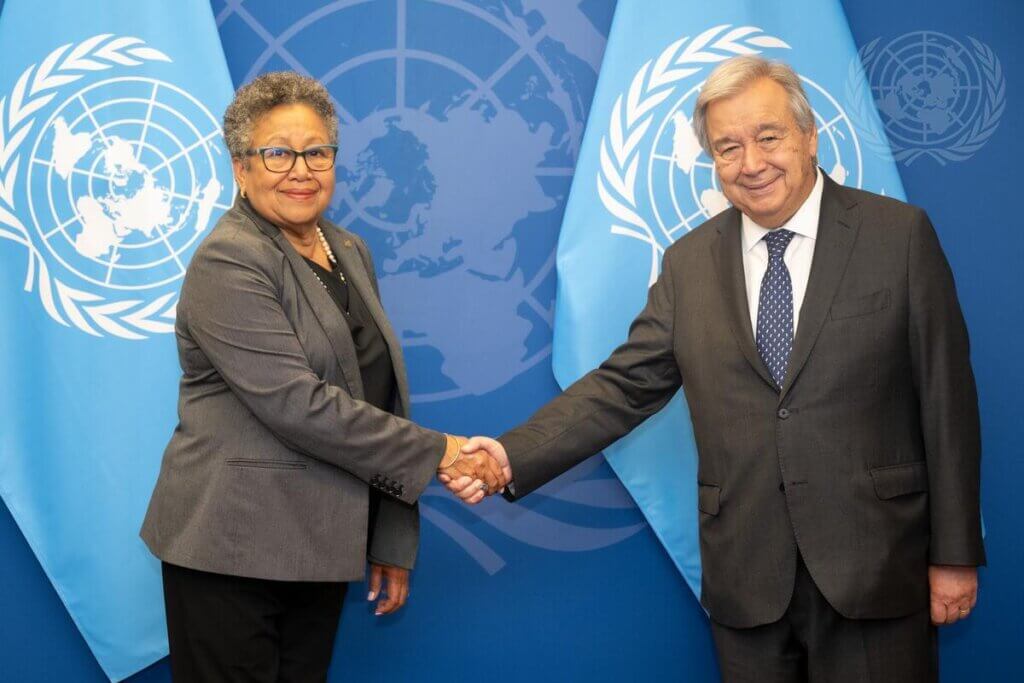
Editor’s Note: Dr. Nand C. Bardouille is manager of The Diplomatic Academy of the Caribbean in the Institute of International Relations at The University of The West Indies’ (UWI’s) St. Augustine Campus in Trinidad and Tobago. The views expressed in this article are those of the author and do not reflect the official policy or position of The UWI.1Author’s note: I thank my daughter, Annmarie, whose undergraduate curiosity and keen insight regarding the UNSC and the Caribbean inspired me to author this paper—a contribution to the International Relations literature on international cooperation. Thanks to Aude Darnal and the assigned editor for their generous and helpful comments on an earlier version of this paper.
By Aude Darnal, Project Manager, The Global South in the World Order
The United Nations’ (UN’s) security, development, economic, and humanitarian precepts are deeply ingrained in the Caribbean Community (CARICOM) bloc of countries’ foreign policy ethos, contributing to their international profile, development, and security. For decades, Caribbean governments have sought to bolster this linkage. As a result of this history, but also having considered the downside of aspects of a nearly 80-year-old UN schema, their leaders are front and center in the growing chorus of calls for reform of the institution and associated global governance processes. This policy memo—which focuses on UN Security Council (UNSC) reform from a CARICOM point of view—makes a threefold argument:
- As the match between the UN’s priorities and post-Cold War international realities has grown less favorable to CARICOM member states, these countries have ramped up calls for reform of this preeminent world body2NB: In the face of global challenges, states in this regional grouping have a long and proud tradition of diplomatic assertiveness on the international stage. As far back as the 1970s, Guyana and Jamaica in particular were, inter alia,at “the forefront of the demand for a New International Economic Order.”
- Just as multilateral partnerships give CARICOM member states a collective edge as UN members, those partnerships strongly influence how these states approach the issue of UNSC reform.
- Amid the shifting balance of power, CARICOM member states—all of which are small states—deem a seat at the UNSC table as working not just to their own advantage but to the advantage of some other countries as well. (Namely, others like them with whom they have made common cause in foreign policy-related issue areas.)
Heightened Diplomatic Contestation
The General Debate of the 79th session of the UN General Assembly (UNGA), the High-level Week’s side events, and several bilateral meetings were the latest opportunities for the aforementioned calls for UNSC reform to be made at the highest levels. Per the usual with leaders gathered for this summit, they made a point to highlight their respective countries’ domestic and international priorities. (These Caribbean small island developing states (SIDS), comprising 14 mostly Anglophone sovereign nations that gained independence from the 1960s to the 1980s, are among the smallest and most vulnerable of the UN’s 193 member states.) Prime Minister of Barbados Mia Amor Mottley was among those Caribbean leaders who did not mince words in sketching the horizon for change in the overall scheme of things, calling out structures that perpetuate the global governance-related status quo.
Pointing to the urgency of institutional reform at the UN level, Prime Minister Mottley emphasized the need to “ensure that global institutions give developing countries, especially small vulnerable ones like my own, seats at the tables of decision-making where we can be seen, heard, become active agents in our own cause and lead our own development paradigms.”
Caribbean leaders were not alone in this fresh show of impatience with global governance-related institutions and associated strictures which, to start with, were imposed by the (Western) powers that be in a much different era. Notably, when the postwar international order was being fashioned, many of today’s independent countries of the Global South were still colonies. For the most part, attendant institutions have not kept up with the times. Prime Minister Mottley said as much, contending that there is need for a “reset [that] must be characterized by institutional reform which has to start in this United Nations.”
The Power of Multilateral Diplomatic Partnerships
This moment further opens a window of opportunity for CARICOM member states, along with other interested parties, to make headway in negotiations on UNSC reform. (That the Gaza and Ukraine wars have ground on, with unintended consequences for CARICOM member states, and with wider humanitarian consequences for parties involved, adds even greater urgency to UNSC reform.) Regarding this kind of diplomatic engagement, many have correctly determined that for the UNSC to step into the future, the ongoing intergovernmental negotiations process must address the key asks of the L69 Group, which this author outlined in a previous analysis.
CARICOM leaders recently gave their strongest indication yet that reforming the UNSC is long past due. (Many interested parties take aim at, inter alia, the P5 UNSC members for preserving the status quo despite pressure to change.) In recent days, CARICOM leaders have taken steps to spur certain quarters of the international community to take action.
As longtime members of the L69 Group, several CARICOM member states have found a winning, partnership-based formula to propel their UNSC reform-related interests—attaining issue-specific and international influence dividends. As this author contends in a previous commentary, “Caribbean countries adopt a strategy of extending their diplomatic reach … leveraging status-seeking type foreign policy roles.”
Moreover, these states have placed a renewed emphasis on their leadership role in UN-anchored multilateralism. In throwing their full weight behind a requisite global accord, the significance of the recently held Summit of the Future for the UN and associated multilateralism was not lost on these states. With the adoption of the high-profile Pact for the Future, UN-anchored multilateralism got a much-needed shot in the arm.
This is where CARICOM member states’ criticism of outdated elements of the UN superstructure and these countries’ reliance on the UN come together, which is significant in two respects.
First, these states are among the staunchest supporters of the UN. Immediately following (and in furtherance of) their independence, joining the UN was among their first foreign policy-related steps. For example, when Jamaica was admitted to the UN in September 1962, it conveyed “its readiness to assume its obligations as a member of the international community, to contribute to the maintenance of international peace and security and to the promotion of economic and social progress through multilateral cooperation within the UN system.”
Following independence, CARICOM countries quickly defined their relationship with the UN and its multilateral processes. In the ensuing years, the world body and its brand of multilateralism have been instrumental to CARICOM member states’ decades-long, post-independence drive to advance their interests as small developing countries vis-à-vis the international system. Of the myriad intergovernmental processes pertaining to international regimes that CARICOM member states participate in, only UN-tethered ones have a truly global resonance for them.
This is not to suggest a one-sided relationship. History is marked by successive Caribbean governments, acting through their diplomatic agents, burnishing the UN’s member-state-driven agenda. Again, turning to the example of Jamaica, yet another element in its UN-related journey is that country’s important leadership role on the international stage. This is the case in a wide range of human rights matters, North-South dialogue, the Law of the Sea, environmental issues, combating illegal drugs, and the status of women—to name but a few of Jamaica’s “substantial contributions” to date. These foreign policy actions drew from a cross-section of civil society, spanning social, economic, and other nongovernmental actors, which have also lent to the strength of Jamaica’s well-respected voice on the international stage.
Not only do international organizations have an outsized place in CARICOM’s diplomatic playbook, but, more critically, many of the regional groupings’ members’ high-level diplomatic successes stem from their involvement in such organizations.
Second, in a context where survival qua security fundamentally informs the behavior of states in the modern world, the UNSC holds significant promise in checking aggression for CARICOM countries. Of note, the UNSC has contributed to the ability of CARICOM member states to successfully rise to the challenge of the anarchic international system. This is in a context where system-level factors such as balance of power dynamics do not necessarily promote such states’ interests, limiting their security, but also making the stakes of such states’ security even higher.
One for All, All for One
Even so, insofar as the UNSC of today is marked by a narrowing of cooperation that is weighing on its ability to “maintain or restore international peace and security,” CARICOM member states are demanding reform. The leaders of these states worry that in seemingly being ensnarled in prevailing geopolitical headwinds, the UNSC may routinely act in ways that privilege the dynamics of the moment over the interests of smaller nations. CARICOM also seeks to focus on a broader body of work in the Security Council, transcending conventional thinking on international security issues. For example, as Bahamian Prime Minister Philip Davis sees it “the [Security] Council’s mandate to maintain international peace and security goes far beyond the mere absence of war.” Moreover, President of Guyana Mohamed Irfaan Ali has underscored “[t]he interrelationship [among] climate change, food security, and peace and security.”
The salience of CARICOM’s stance on the security issues that the Security Council ought to be seized of has wide appeal, including among SIDS. Some CARICOM member states have made a savvy play for UNSC membership—and these states are all on record as committing to leveraging their seats on the UNSC to amplify the voices of SIDS.
It is noteworthy that in January 2024, Guyana joined the UNSC for the third time as an elected member for a two-year period. St. Vincent and the Grenadines set a record as the smallest-ever UNSC seat holder, serving in that capacity from 2020 to 2021. Jamaica served as a non-permanent Security Council member for the second time from 2000 to 2001. For its part, Trinidad and Tobago was a non-permanent UNSC member from 1985 to 1986.
Amid one of the most turbulent moments in the transition from the unipolar moment to multipolarity—wherein mounting great power competition is placing key tenets of the UN Charter under greater threat—The Bahamas announced its bid to serve as a non-permanent UNSC member for the 2032-to-2033 term. The country’s foreign minister, Frederick Mitchell, delivered a statement to this effect in The Bahamian Parliament, informing those assembled that the relevant election would take place in 2031 and that his country has “the support of other CARICOM countries.”
According to foreign minister Mitchell’s government, The Bahamas’ candidacy for the Security Council is guided by the themes of “resilience, relationships, and representation.” The government views this candidacy as “an opportunity to amplify these crucial messages and contribute meaningfully to the UN’s vital work in promoting peace, security, and sustainable development for all.” Evoking “the power of multilateralism,” the government sees a connection between its over fifty-year independence journey to date and its UNSC candidacy within the larger context of smaller nations’ ability to contribute significantly to “global progress.”
Climate-related issues loom large, too. For Prime Minister Davis, “[t]he link between climate change and global security is undeniable.” Further, in Nassau’s determination, a seat for The Bahamas at the Security Council table would lend itself to better positioning that body “to deal with the biggest crisis of our time.” This sentiment could not be more apt, taking stock of the stark terms with which UN Secretary-General António Guterres frames the imperative of taking action on climate change. This is at a juncture in which others point to climate change as the “defining issue of our time.”
Nassau also takes the position that “[c]limate considerations must be integrated into all aspects of the Security Council’s work”; climate change ought not just to be seen through the lens of an environmental threat. To this way of thinking, it is a “threat-multiplier” in many respects.
Conclusion
Based on the foregoing analysis, there is little question that as CARICOM member states see it, successful UN reform would bode well for their respective foreign policies. Tellingly, should that reform falter to a significant extent, these countries would face long-term foreign policy-related challenges. Thus, CARICOM member states are actively involved in UN reform, including in attempts to craft a better approach to structural dynamics at the heart of the Security Council.
Of course, “small state diplomacy … [is impacted by a] lack of resources (of all kinds).” That said, CARICOM member states’ UN reform-related diplomacy has been most effective when it has been marshaled and executed in concert with key partners, not the least of which are other Global South countries. That they are integrally involved in this manner is further testament to small states’ commitment, in the spirit of the UN Charter, “to steering the world on a better path.” Instructively, UN reform lends itself to this noble goal.
Ultimately, small states “attach the highest value to an effective, democratic, responsive and inclusive multilateral system, and to the primacy of the rule of international law.” As far as CARICOM member states are concerned, this stance is not mere rhetorical posturing. Far from it, in fact.
Finally, with Washington’s support for the creation of a newly elected seat on the UNSC for SIDS, Caribbean countries and SIDS writ large have achieved a high-profile UNSC reform-related win. This is the case especially because prior to the recently concluded UNGA annual high-level General Debate, the United States publicly committed to taking some additional steps. Yet on the issue of Africa and UNSC reform, Washington has exhibited little flexibility in its concessions. Such half-measures do not sit well with Global South countries, which comprise a sizeable constituency in the UN.
CARICOM diplomats and policymakers are under no illusions about what an uphill battle their respective countries and other Global South countries face as they continue to make the case for reform within the world body, but they are determined to press on. The national interest requires nothing less than their best effort to foster reform of the UN. Moreover, since the Council for Foreign and Community Relations of CARICOM “has continued to set the pace and the priorities of [the bloc’s] extra-regional interactions,” this organ has a vitally important role to play in advancing such efforts.







Community Adaptation for a Water Festival Without Clean Water