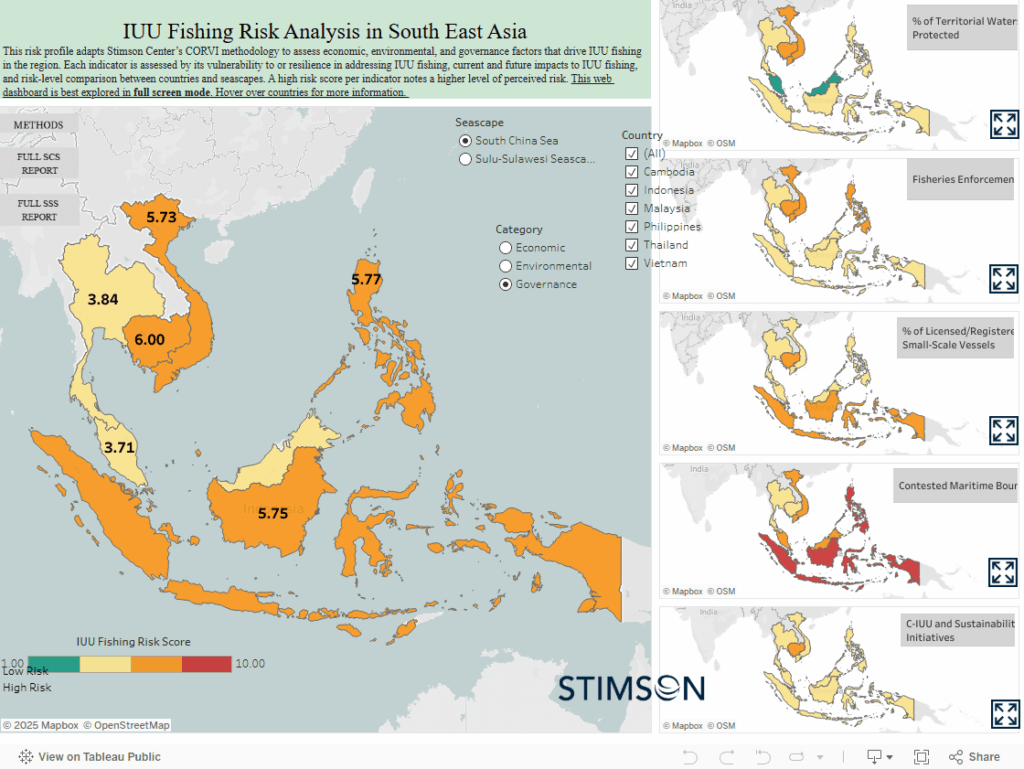
Illegal, unreported, and unregulated (IUU) fishing threatens marine ecosystems, food security, and regional stability in Southeast Asia. Driven by rapid economic growth in ASEAN member states and surging global demand, fish stocks are being pushed to the brink of collapse. Compounding the challenge, maritime boundary disputes in contested waters and transnational criminal networks hinder the effective regulation of marine resources. The clandestine nature of at-sea activities further obscures the full scope, geographic distribution, drivers, and consequences of IUU fishing.
To equip policymakers with actionable insights, the Stimson Center developed a data-driven IUU Fishing Risk Assessment framework, adapted from the Environmental Security Program’s Climate and Ocean Risk Vulnerability Initiative (CORVI). This methodology evaluates key economic, environmental, and governance risk factors, enabling targeted interventions in high-risk areas. The findings and resources of this project not only illuminate the scale and impact of IUU fishing but also provide practical policy recommendations to enhance maritime security and promote sustainable fisheries management across the region.

 Brian Eyler
Senior Fellow and Director, Southeast Asia and Energy, Water, & Sustainability Programs
Brian Eyler
Senior Fellow and Director, Southeast Asia and Energy, Water, & Sustainability Programs
 Carolyn Gruber
Fellow and Deputy Director
Carolyn Gruber
Fellow and Deputy Director
 Claire Doyle
Research Analyst, Environmental Security Program
Claire Doyle
Research Analyst, Environmental Security Program
 Lauren Herzer Risi
Senior Fellow and Director, Environmental Security Program
Lauren Herzer Risi
Senior Fellow and Director, Environmental Security Program
 Madelyn MacMurray
Former Research Assistant
Madelyn MacMurray
Former Research Assistant
 Regan Kwan
Research Analyst, Southeast Asia and Energy, Water, & Sustainability Programs
Regan Kwan
Research Analyst, Southeast Asia and Energy, Water, & Sustainability Programs
You can opt out at any time. We respect your privacy and will not sell your personal information. See our privacy policy for more.