
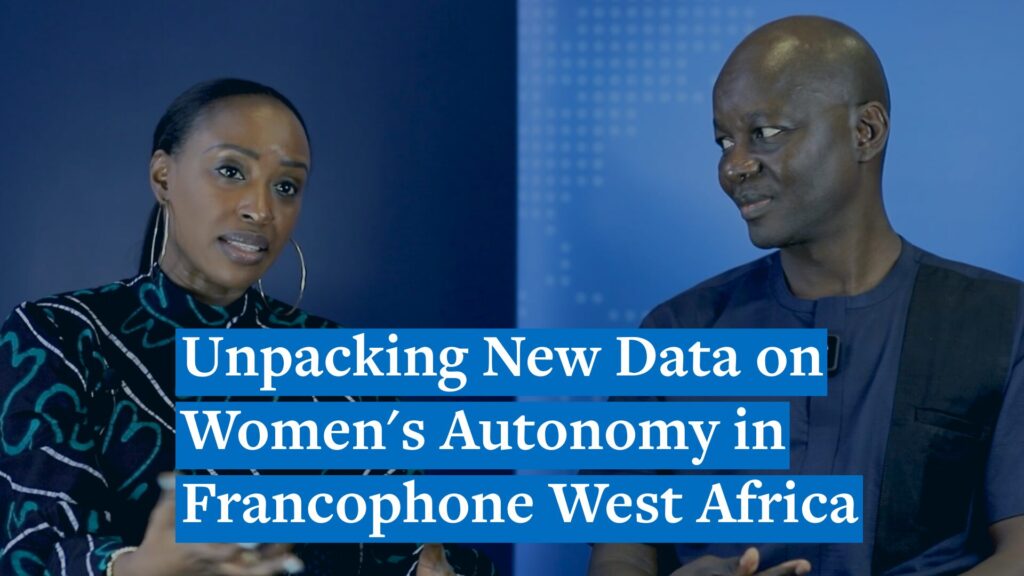
Nearly two-thirds of citizens across seven Ouagadougou Partnership countries say women should be free to decide if and when to marry, but fewer than half believe women should have the same say over how many children to have, or when. That gap, surfaced in Afrobarometer’s latest survey results, is at the center of a new conversation between Joseph Asunka, CEO of Afrobarometer, and Marie Ba, Director of the Ouagadougou Partnership Coordination Unit.
Francophone West Africa is one of the most consequential and underappreciated regions in US foreign policy. Home to nine countries whose populations are projected to grow by 55–88% over the next 25 years — among the fastest growth rates in the world — the region faces deep exposure to environmental and climatic stress, persistent instability across the Sahel, and growing pressure on governance and democratic institutions. It is also a region where foreign investment and international attention have historically lagged far behind need.
Research on education, family planning, and gender-based violence shows a consistent pattern: when girls stay in school, when people can plan their families on their own terms, and when women’s autonomy increases, the downstream effects strengthen economic productivity, political stability, and long-term development. In a region under pressure on each of these fronts, these are not peripheral concerns.
Yet on questions of marriage, childbearing, and women’s autonomy — questions central to the region’s trajectory — reliable public attitude data in the region has been hard to come by.
Afrobarometer, a non-partisan, pan-African survey research network, has spent over two decades surveying public attitudes on governance and democracy across the continent. Its most recent round of surveys included, for the first time, a dedicated module on gender and sexual and reproductive health. The findings were brought into conversation with the Ouagadougou Partnership — a regional initiative launched in 2011 to address high rates of maternal mortality and limited access to family planning across nine countries: Benin, Burkina Faso, Côte d’Ivoire, Guinea, Mali, Mauritania, Niger, Senegal, and Togo.
What follows is a conversation with Joseph Asunka, CEO of Afrobarometer, and Marie Ba, Director of the Ouagadougou Partnership Coordination Unit — covering what the data shows, what it challenges, and what it means for policymakers and practitioners engaged in the region.






Community Adaptation for a Water Festival Without Clean Water