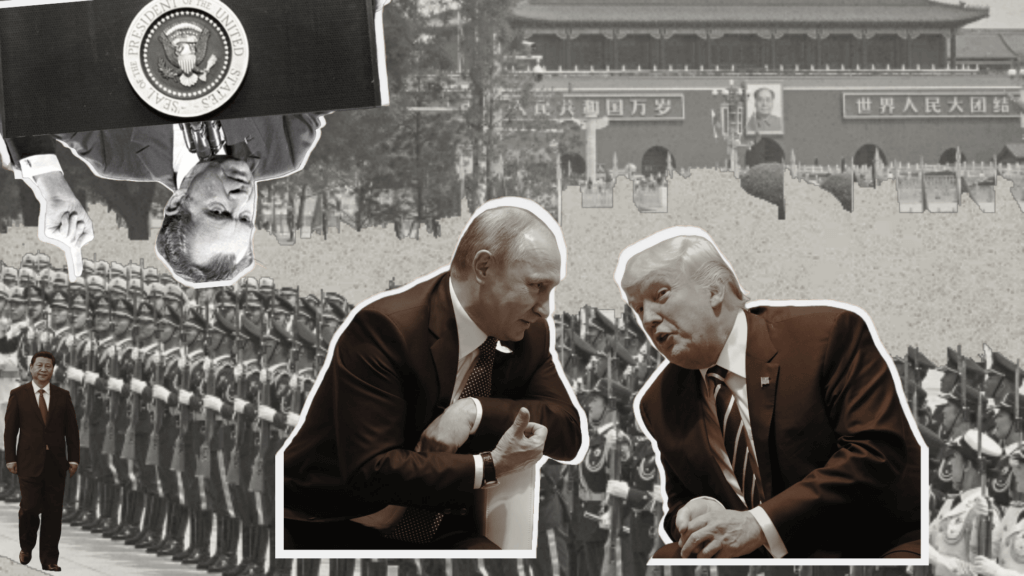
Ongoing tensions between Russia and the United States and its allies pose a major challenge to global peace and security. The lack of communication between the U.S. and Russia increases the risk of an unintentional armed conflict and hampers the resolution of important international security issues where Russia’s constructive engagement is essential. Amid the transition to a more multipolar world, bridging this ever-widening divide remains a critical task.
The Russia program provides a non-partisan platform for non-governmental dialogue between American and Russian experts and retired military leaders with the aim of overcoming strategic divides and addressing issues of common concern. This program was founded during the Cold War at the EastWest Institute (EWI) and relaunched at the Stimson Center in 2021. The program brings together leading representatives of the diplomatic, military, business, academic, and other professional communities from the U.S. and Russia for joint efforts to clarify mutual misperceptions, reduce the risk of inadvertent military confrontation, and develop constructive solutions to major security challenges

Federico Petroni, senior analyst at Limes, Italy's leading geopolitical journal, joins the Trialogue to discuss Europe’s anger over the U.S. attack on Iran, NATO’s fraught future, Italy’s Mediterranean strategy, and its regional rivalries with France and Turkey,
April 10, 2026

Zhao Hai, Director of the International Politics Program in the National Institute for Global Strategy at the Chinese Academy of Social Sciences, returns to the Trialogue to discuss the impact of the US-Israeli war with Iran, the state of US-China trade relations, the future of international institutions, and the prospects of stabilizing cross-strait relations, among other subjects.
March 27, 2026

Mathew Burrows, program lead of the Stimson Center's Strategic Foresight Hub, returns to the podcast for a forward-looking conversation. We discuss global demographic decline, the energy transition, the promises and limits of AI, the future of the transatlantic relationship, and China's role in a multipolar world.
March 6, 2026

Curt Mills, executive director of The American Conservative magazine, joins the Trialogue to discuss the evolution of anti-interventionist thought on the American right. In this conversation we cover the origins of American empire, the extent of U.S. global commitments, the future of NATO, competition with China, and the strategic direction of U.S. foreign policy in Trump’s second term.
February 20, 2026

The expiration of New Start on February 5 marks the end of over half a century of bilateral efforts to advance strategic arms control. On February 3, the Stimson Center and the Oppenheimer Project convened leading nuclear experts from the US and Russia to imagine what comes next. This episode was recorded as a live online event.
February 9, 2026

Fyodor Lukyanov, Editor-in-Chief of Russia in Global Affairs, returns to the Trialogue at the start of an already-eventful year to take stock of Russian strategy amid dramatic U.S. intervention in Venezuela, crisis in Iran, and negotiations over the future of Ukraine
January 23, 2026

Zhou Bo, a retired senior colonel in the PLA and a senior fellow in the Center for International Security and Strategy at Tsinghua University, returns to the Trialogue to discuss China’s calculations about recent events, including the release of the U.S. National Security Strategy, tense Sino-Japanese relations, the situation in Taiwan, and negotiations to end the war in Ukraine
January 14, 2026

Mike Kuiken and Josh Hodges, two commissioners on the congressionally appointed US-China Economic and Security Review Commission, join us to discuss the recommendations of the Commission’s 2025 annual report and the state of US-China relations more broadly.
November 22, 2025