
Peter Slezkine: Hi. I’m Peter Slezkine, director of the U.S.-Russia-China Trialogue Project at the Stimson Center. Since the middle of the twentieth century, relations among the United States, Russia, and China have had an enormous impact on each country separately and on the world as a whole. The purpose of the Trialogue is to better understand this extraordinarily complex and consequential relationship by directly engaging with experts from all three countries.
On this show, guests from across the political spectrum and from every corner of the globe share their views in their own voices, while the Stimson Center seeks to provide access to a wide variety of perspectives. It does not endorse any particular position. We leave it to listeners to judge the validity and value of the views expressed by our guests.
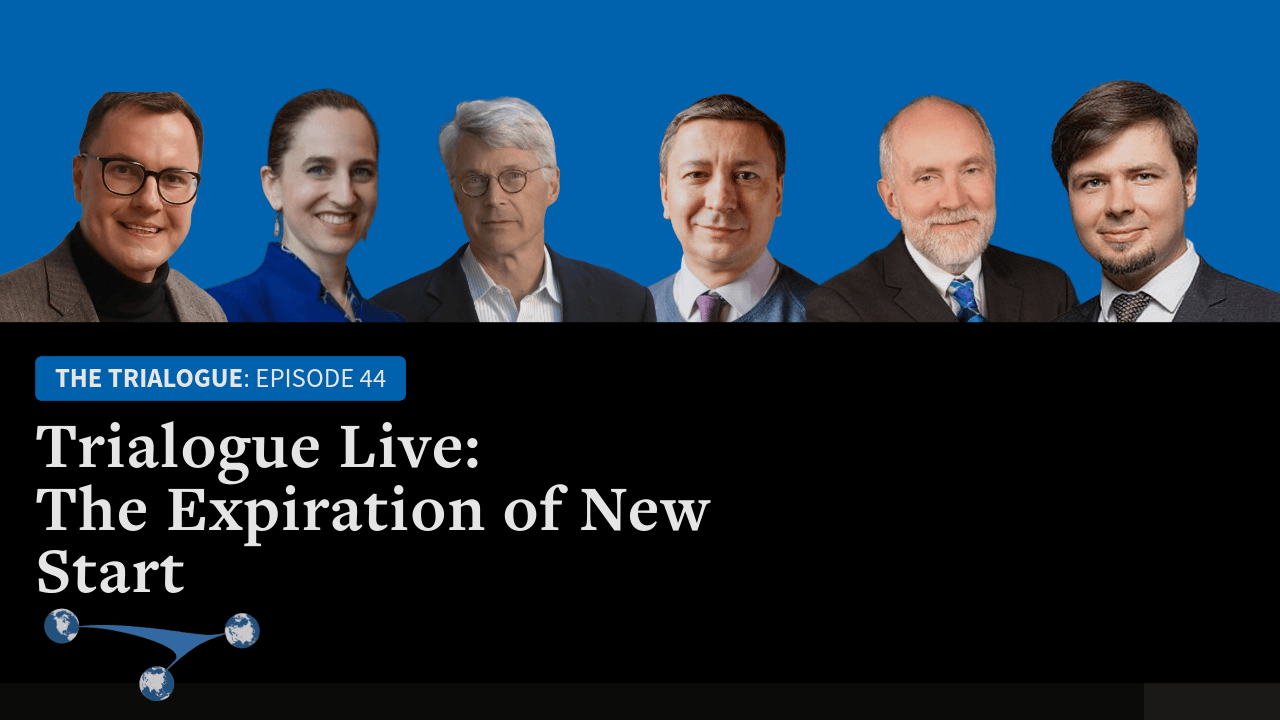
Peter Slezkine: Hi, all. Today’s episode was recorded as a live event on Tuesday, February 2. We had three American and three Russian nuclear experts discuss the expiration of the New START Treaty and implications for strategic arms control and nuclear nonproliferation going forward. I hope you enjoy the episode.
Peter Slezkine: We are joined today by Rita Guenther, Senior Program Officer at the National Academies; Scott Sagan, Professor of Political Science at Stanford University; Matthew Bunn, Professor of the Practice of Energy, National Security, and Foreign Policy at the Harvard Kennedy School; and on the Russian side, Anton Khlopkov, Director of the Center for Energy and Security Studies; Feodor Voitolovsky, Director of the Institute of World Economy and International Relations at the Russian Academy of Sciences; and Dmitry Stefanovich, Research Fellow at the same institution. So I will ask all six of our speakers a series of short questions. They will make their responses.
Then the American and Russian sides will pose questions directly to one another, engage in a brief exchange, and then we will field questions from the audience. As Rachel mentioned, the Q and A box is live, so please submit questions there. I will see them and pose them to our participants. If you would like the questions addressed to a particular speaker, please specify that in your question.
So, Feodor, I thought I would start with you. A lot has happened over the last four years since the start of the war in Ukraine. Putin has formally suspended Russia’s participation in New START, while at the same time declaring that Russia would voluntarily remain within the limits of the treaty. And recently, I think last September, declared that Russia was ready to stay within the bounds of the treaty for another year after the expiration of New START if the United States did the same.
The U.S. has not made an official response to this offer as of yet. So could you please clarify the Russian position on New START and strategic arms control over the last few years, and maybe let us know what to expect from Russia once this treaty does expire.
Feodor Voitolovsky: Thank you very much, Peter. First of all, I would like to say that I’m very grateful to the Stimson Center and to the Oppenheimer Project for inviting me to this very interesting roundtable concerning Russia’s position on the expiring START Treaty.
It is quite the same as it used to be last September when President Putin suggested keeping the limits of the New START Treaty after the expiration of this treaty. What does it mean? It means that Russia and the United States would have 1,550 strategic warheads and 700 delivery devices. I think it is a very rational position because it is a suggestion to have one more year after the expiration of the START Treaty to think what we can do together in this field, to keep strategic stability and to keep dialogue on arms control issues.
I believe that for the Russian side, it was absolutely clear that in current political conditions during the conflict in Ukraine, and in the period when relations between Russia and NATO and Russia and the United States have reached a very low level, I think the worst situation since very bad times of the Cold War, we cannot restart the dialogue on strategic stability and arms control immediately. But it can become, in some time, one of the pillars of building a new system of relations.
Of course, the situation is changing. Of course, the United States is facing an absolutely different strategic environment, and the same with Russia, but I believe that the Russian position is still giving a chance for the two countries to continue dialogue and to continue common efforts in this field. Since Donald Trump has expressed his positive reaction to this suggestion in public, but we did not see any other promotion of the American position on this issue. We are in quite a difficult position because there is nothing more to say from the Russian side. I think that Deputy Minister of Foreign Affairs Sergei Ryabkov has recently reaffirmed the same position during his press conference in Beijing.
Peter Slezkine: Also, the treaty will officially expire in two days. When does Russia’s offer to remain within its limits expire?
Feodor Voitolovsky: I think it is a good question for President Putin, not for me. I’m just a responsible academic. But I believe that Russian officials are still ready to discuss this suggestion. I believe that Russia’s position on dialogue on arms control and possible further steps, and strategic stability in general as the most significant condition of relations between our two countries in the security sphere, is still on the table.
Peter Slezkine: So the proposal now is to maintain the status quo, but there has been talk of something larger, a new deal that might be incorporated into a peace deal on Ukraine or come after a deal is reached. What is the consideration in Moscow on this subject?
Feodor Voitolovsky: I believe that Moscow’s position right now is even more flexible than it used to be in 2022 or 2023. I remember that at that time the Biden administration suggested continuing dialogue on strategic stability even during the conflict in Ukraine. At that time, Russia was not ready to continue such dialogue, and of course to have some consultations, preliminary consultations, for further negotiations on a new treaty.
Right now, Moscow is demonstrating its readiness to have dialogue with the United States on strategic stability even before the ending of the conflict in Ukraine. I believe that both sides are interested in ending the conflict in Ukraine with political and diplomatic measures. But even before that, Moscow is ready to discuss its suggestion about a moratorium on limitations on strategic nuclear warheads and delivery devices, and even to go further and to discuss some further steps which can lead us to a new treaty, which President Trump has described as possibly better than the previous one.
Peter Slezkine: So finally, and briefly, President Trump has also mentioned the possibility of bringing the Chinese into the conversation and crafting a trilateral strategic arms control deal. Are the Russians prepared to engage the Chinese on this subject? How realistic do you think a trilateral agreement might be?
Feodor Voitolovsky: I’m very skeptical about this position, which the previous Trump administration has expressed, also because the Chinese strategic nuclear potential is developing, and they are absolutely not interested in any limitations of its development, both in delivery devices and in warheads. They have five times fewer strategic nuclear warheads than Russia or the United States.
China and Russia are not having mutual nuclear deterrence. And there is one very significant factor which I would like to mention also. There is a question about the nuclear potential of France and Britain. If it were included, it would be not trilateral but multilateral nuclear limitations agreement, which also is looking not very realistic in current political conditions.
But on a bilateral level, I believe that the United States and Russia could much more easily reach progress in dialogue on further limitations or further steps to maintain strategic stability, because it is very hard to engage China. The Chinese are not having even a culture of dialogue in this field on strategic stability and arms control, and they are not interested in any borders or boundaries for the development of their potential, while it is much less than American or Russian.
Peter Slezkine: Okay, well, bilateral talks might be much easier than a multilateral alternative, but are difficult enough to require much more discussion from us at least. So, Matt, let’s turn to you. Do you think the United States should accept Russia’s proposal to extend New START for another year?
Matthew Bunn: I think that would be a good idea. I think it is useful to have a strategic pause to explore whether there are options for the more complex and challenging kinds of accords we are going to need in the future before a buildup gets locked in. And I think even if ultimately it proves that there is no deal available, and the United States decides that it does need to build up, it is going to take a little while. And so a year, two years, even three years does not really interfere with what the United States might need to do in the future. I do want to say that it is not just a numbers issue.
The process of arms control has, I believe, served American security, Russian security, and world security by reducing the intense hostility and fear between the two sides, by offering predictability and transparency that allowed each side to plan its nuclear forces in a less stressful and hostile environment than existed before, by limiting some of the forces that each side believed were most dangerous. And the mere fact of being able to talk about your biggest strategic concerns and actually have your adversary be willing to limit their forces if you limit your forces undermined the idea that your adversary was an implacably hostile enemy bent on completely obliterating you, and I think that reduced the dangers.
So I disagree with the notion that this is the end of the arms control era. I am very hopeful that it is a pause. It may be that we will find more complicated and perhaps more informal ways of limiting things in the future. I share others’ doubts about just a trilateral treaty where everybody is in the same treaty at the same time, but there are many different ways in which the various issues could be addressed with the various parties they need to be addressed with.
Peter Slezkine: Thanks, Matt. So what exactly do you think we should be aiming for during this pause? So we buy ourselves time. We presumably do not yet include the Chinese. Would a future bilateral agreement build upon this half-century history, or would we need something totally new because of changes in global conditions and technology?
Matthew Bunn: I think both. I think we will need to build on the history, but we will need to be creative and come up with some new ideas. We are in a world where I fear that Feodor’s view that the Chinese are so far back that we do not have to worry about them is not shared in Washington. It is expected that China will have 1,000 nuclear warheads, almost all of them strategic, by 2030. And letting the Chinese force completely run free while the United States limits its forces is going to be a real problem in Washington.
So we have to deal with a more multipolar environment than we have had before one way or another. Meanwhile, we have to deal with a variety of technologies that are making nuclear balances more complicated, that are non-nuclear technologies: missile defenses, precision conventional weapons, cyber, artificial intelligence, space and counterspace. And we have to deal with the expiration of the limits on intermediate-range nuclear forces. U.S. or NATO intermediate-range nuclear forces in Europe are strategic from a Russian point of view because they can reach major Russian cities, including Moscow, but China has a lot of intermediate-range nuclear forces.
So there are a lot of complications that we are going to have to deal with, but I remain optimistic that, not that we are going to have a 500-page negotiated treaty that is legally binding tomorrow, but that through a variety of reciprocal informal initiatives, executive agreements, et cetera, we may be able to maintain an era of nuclear restraint.
Peter Slezkine: Dmitry, if you could turn your camera back on, I would like to turn to you. You are our great technical expert in the group. So I would like to pursue the subject that we just raised with Matt about the technological shifts of recent years that might make any new agreement very different from those that we have had in the past. So what developments are these? Specifically, what problems do they pose? And from a Russian perspective, what are the primary concerns? Is it something like the Golden Dome? Is it AI? Is it strategic non-nuclear? So if you could address those questions, please.
Dmitry Stefanovich: Yeah, well, those are fine questions, and thanks for having me in this room. I think it is a very timely and useful event to have such a public exchange on these very sensitive and very important topics. I will start with answering your last question, which is the Russian principal concerns.
Well, actually, the problem is not one specific thing, but the combination of sophisticated capabilities that are being introduced in U.S. arsenals, in the arsenals of U.S. allies, and the integration that is being supported by artificial intelligence to make everything work seamlessly. Basically, this is something that I sometimes call a boogeyman scenario or a strawman scenario. There might be a situation where U.S. and U.S.-allied arsenals would be good enough to have a lot of non-nuclear capabilities, lots of allied non-nuclear capabilities, and lots of tactical nuclear capabilities to take out a significant part of strategic targets on Russian territory, then use what is left of strategic nuclear capabilities to take out everything else. And if anything is launched during a second-strike scenario, it would be intercepted by missile defenses, including space-based missile defenses and so on. I have called it something quite far off in the future, but it turns out that there are people in the U.S. who genuinely believe that it might be a good idea to develop such a system of systems that will threaten first- and second-strike capabilities in Russia and China and elsewhere.
Peter Slezkine: So the proposal now is to maintain the status quo, but there has been talk of something larger, a new deal that might be incorporated into a peace deal on Ukraine or come after a deal is reached. What is the consideration in Moscow on this subject?
Feodor Voitolovsky: I believe that Moscow’s position right now is even more flexible than it used to be in 2022 or 2023. I remember that at that time the Biden administration suggested continuing dialogue on strategic stability even during the conflict in Ukraine. At that time, Russia was not ready to continue such dialogue, and of course to have some consultations, preliminary consultations, for further negotiations on a new treaty. Right now, Moscow is demonstrating its readiness to have dialogue with the United States on strategic stability even before the ending of the conflict in Ukraine.
I believe that both sides are interested in ending the conflict in Ukraine with political and diplomatic measures. But even before that, Moscow is ready to discuss its suggestion about a moratorium on limitations on strategic nuclear warheads and delivery devices, and even to go further and to discuss some further steps which can lead us to a new treaty, which President Trump has described as possibly better than the previous one.
Peter Slezkine: So finally, and briefly, President Trump has also mentioned the possibility of bringing the Chinese into the conversation and crafting a trilateral strategic arms control deal. Are the Russians prepared to engage the Chinese on this subject? How realistic do you think a trilateral agreement might be?
Feodor Voitolovsky: I’m very skeptical about this position, which the previous Trump administration has expressed, also because the Chinese strategic nuclear potential is developing, and they are absolutely not interested in any limitations of its development, both in delivery devices and in warheads. They have five times fewer strategic nuclear warheads than Russia or the United States. China and Russia are not having mutual nuclear deterrence. And there is one very significant factor which I would like to mention also. There is a question about the nuclear potential of France and Britain. If it were included, it would be not trilateral but multilateral nuclear limitations agreement, which also is looking not very realistic in current political conditions.
But on a bilateral level, I believe that the United States and Russia could much more easily reach progress in dialogue on further limitations or further steps to maintain strategic stability, because it is very hard to engage China. The Chinese are not having even a culture of dialogue in this field on strategic stability and arms control, and they are not interested in any borders or boundaries for the development of their potential, while it is much less than American or Russian.
Peter Slezkine: Okay, well, bilateral talks might be much easier than a multilateral alternative, but are difficult enough to require much more discussion from us at least. So, Matt, let’s turn to you. Do you think the United States should accept Russia’s proposal to extend New START for another year?
Matthew Bunn: I think that would be a good idea. I think it is useful to have a strategic pause to explore whether there are options for the more complex and challenging kinds of accords we are going to need in the future before a buildup gets locked in. And I think even if ultimately it proves that there is no deal available, and the United States decides that it does need to build up, it is going to take a little while. And so a year, two years, even three years does not really interfere with what the United States might need to do in the future. I do want to say that it is not just a numbers issue.
The process of arms control has, I believe, served American security, Russian security, and world security by reducing the intense hostility and fear between the two sides, by offering predictability and transparency that allowed each side to plan its nuclear forces in a less stressful and hostile environment than existed before, by limiting some of the forces that each side believed were most dangerous. And the mere fact of being able to talk about your biggest strategic concerns and actually have your adversary be willing to limit their forces if you limit your forces undermined the idea that your adversary was an implacably hostile enemy bent on completely obliterating you, and I think that reduced the dangers.
So I disagree with the notion that this is the end of the arms control era. I am very hopeful that it is a pause. It may be that we will find more complicated and perhaps more informal ways of limiting things in the future. I share others’ doubts about just a trilateral treaty where everybody is in the same treaty at the same time, but there are many different ways in which the various issues could be addressed with the various parties they need to be addressed with.
Peter Slezkine: Thanks, Matt. So what exactly do you think we should be aiming for during this pause? So we buy ourselves time. We presumably do not yet include the Chinese. Would a future bilateral agreement build upon this half-century history, or would we need something totally new because of changes in global conditions and technology?
Matthew Bunn: I think both. I think we will need to build on the history, but we will need to be creative and come up with some new ideas. We are in a world where I fear that Feodor’s view that the Chinese are so far back that we do not have to worry about them is not shared in Washington. It is expected that China will have 1,000 nuclear warheads, almost all of them strategic, by 2030. And letting the Chinese force completely run free while the United States limits its forces is going to be a real problem in Washington. So we have to deal with a more multipolar environment than we have had before one way or another.
Meanwhile, we have to deal with a variety of technologies that are making nuclear balances more complicated, that are non-nuclear technologies: missile defenses, precision conventional weapons, cyber, artificial intelligence, space and counterspace. And we have to deal with the expiration of the limits on intermediate-range nuclear forces. U.S. or NATO intermediate-range nuclear forces in Europe are strategic from a Russian point of view because they can reach major Russian cities, including Moscow, but China has a lot of intermediate-range nuclear forces.
So there are a lot of complications that we are going to have to deal with, but I remain optimistic that, not that we are going to have a 500-page negotiated treaty that is legally binding tomorrow, but that through a variety of reciprocal informal initiatives, executive agreements, et cetera, we may be able to maintain an era of nuclear restraint.
Peter Slezkine: Dmitry, if you could turn your camera back on, I would like to turn to you. You are our great technical expert in the group. So I would like to pursue the subject that we just raised with Matt about the technological shifts of recent years that might make any new agreement very different from those that we have had in the past. So what developments are these? Specifically, what problems do they pose? And from a Russian perspective, what are the primary concerns? Is it something like the Golden Dome? Is it AI? Is it strategic non-nuclear? So if you could address those questions, please.
Dmitry Stefanovich: Yeah, well, those are fine questions, and thanks for having me in this room. I think it is a very timely and useful event to have such a public exchange on these very sensitive and very important topics. I will start with answering your last question, which is the Russian principal concerns. Well, actually, the problem is not one specific thing, but the combination of sophisticated capabilities that are being introduced in U.S. arsenals, in the arsenals of U.S. allies, and the integration that is being supported by artificial intelligence to make everything work seamlessly. Basically, this is something that I sometimes call a boogeyman scenario or a strawman scenario.
There might be a situation where U.S. and U.S.-allied arsenals would be good enough to have a lot of non-nuclear capabilities, lots of allied non-nuclear capabilities, and lots of tactical nuclear capabilities to take out a significant part of strategic targets on Russian territory, then use what is left of strategic nuclear capabilities to take out everything else. And if anything is launched during a second-strike scenario, it would be intercepted by missile defenses, including space-based missile defenses and so on. I have called it something quite far off in the future, but it turns out that there are people in the U.S. who genuinely believe that it might be a good idea to develop such a system of systems that will threaten first- and second-strike capabilities in Russia and China and elsewhere.
Dmitry Stefanovich: But back to the technological part. Of course, strategic conventional weapons are all the rage. We know that they can be used to take out significant targets. Some people in Russia believe that you can take out even ICBM silos with conventional weapons. Actually, some people in the U.S. believe that it is possible, but with totally different implications. But mainly they are good for so-called soft targets. If we move to more sophisticated capabilities, again there are some things that people are very much concerned about here. A combination of different technologies. For example, you have some sort of hypersonic delivery vehicle that can deploy a number of loitering munitions over a selected area, and they will find a road-mobile ICBM launcher on their own. So things like that. This combination of all sorts of technologies is of concern. But the problem is that you can address any possible technology with your counter-technology or develop the same technology of your own, but this is a path to nowhere. This is basically how arms races are carried out, and this is actually what we see right now. I agree that we will not see a dramatic increase in numbers of strategic weapons immediately, but we have seen quite a significant qualitative increase in capabilities for a while. And to move to quantitative racing, I think we lack the absence of any limits. So I think it is quite possible that not this year, not the next year, but in five years, if nothing changes, a quantitative arms race will replace a qualitative one, including because of technological developments. Because again, this is not really a strategic thing, but it is very important, that it seems that in the U.S. and elsewhere people are looking for solutions to address the so-called arsenal depth, to have new manufacturing capabilities, new technologies implemented to produce more and more of both offensive and defensive weapons. And if you couple this trend with the absence of limitations on nuclear weapons, we might end up in something not to be happy about. On Golden Dome, I am less concerned actually, because I think most Americans, most American experts, will agree that it is quite far from any reality so far at the moment, and it really depends on what will be the trends. As far as I understand, even the U.S. Congress has some questions about whether there is an understanding in the U.S. government of what it should look like. So it remains to be seen. But missile defense is important, and space ISR, AI, everything contributes to more and more sophisticated first-strike capabilities. And this is the major concern of Russia, and probably of China, that people in Washington might believe that they are capable of a successful first strike against Russia, and against China for that matter.
Peter Slezkine: So not only do we have more actors involved, China primarily, but the technology has become much more complicated since the days of Oppenheimer and Stimson. So there is certainly much more to deal with. Rita, you have been leading expert engagements among Americans and Russians for years. Given the moment we are in now, what do you make of that history, and what are the prospects for productive Track II and public engagement going forward? What might that lead to? How might it be useful?
Rita Guenther: Thank you. First, I would like to thank you and the Stimson Center for including me in today’s excellent panel with my colleagues from Russia and the United States. I am grateful to be here with all of you to discuss this important moment. The experience that we have had at the National Academy of Sciences with our counterparts in the Russian Federation with regard to Track II has really revealed, I think, a core important element of engagement, and that is that we have to stay engaged, stay engaged through these difficult times, to really understand what the real challenges are. And the way that I think about it can be boiled down to three primary elements. One, through this engagement, we can learn what one another’s core threat perceptions are and our opportunities for engagement and for further development of solution sets.
Second, we can explain the thinking from our own capitals. It does not necessarily mean that each of the individual participants endorses one policy or another, but we can explain the thinking from one another’s capitals. And third, we can explore opportunities for addressing these challenges in depth. And I think the primary opportunity going forward is that if we stay engaged, if we really work hard to focus our attention on possible solutions, we can untangle some of the very complicated challenges that Dmitry has rightly pointed out. It is very easy to become overwhelmed by the complicated set of problems we have before us, but if we take them one by one, sort through them, and look for solutions to address these challenges, we can start to make progress where there are openings.
And I do not know where that will be going forward, because it is not clear what the policy space will allow at one moment or another. But to the earlier points that both Feodor and Matt made, one important opening is to accept the offer and the proposal by President Putin to allow us both time to further engage, and that can happen constructively through Track II engagements as well as other types of engagements. You mentioned public engagements, and here I would like to make a very clear distinction. A lot of these issues that we are discussing today require not only public engagement, and I am very honored and grateful that there are so many members of the public tuned in today to participate in this event. But some of these issues also require quiet discussions. And so I think being discerning about the way in which public figures discuss these types of issues can be helpful in making progress going forward. So I think there is a distinction between the more quiet engagement of Track II dialogues as well as the more public engagement with citizens and with public figures.
Peter Slezkine: Thank you very much, both for your remarks and for the engagement that you have led. I hope it continues and that it leads to new discussions and new deals. Scott, what does the expiration of New START mean for nuclear nonproliferation?
Scott Sagan: Well, we will have the NPT Review Conference in April and May this year, and I predict it is going to be extremely contentious. But it has been a contentious set of meetings for quite some time, and I do not think the expiration of New START means that the treaty will be broken. There is, I believe, a widespread myth about the Nonproliferation Treaty, which is what I call the grand bargain myth, the idea that the core of the treaty is that the non-nuclear states agreed that they would not get nuclear weapons if the nuclear states entered in good-faith negotiations under Article VI of the treaty. There is a tension there, obviously, but that is not really the core of the treaty. In my view, the core of the treaty is a bargain between the non-nuclear states that I will not get nuclear weapons if you do not get nuclear weapons. And to me, that means that what happens with Iran and what happens with the nuclear umbrella states that are contemplating getting nuclear weapons is more important than the New START expiration. And that is going to be the contentious issue. Will what is going on in Iran lead to a peaceful resolution, or will there be another attack? I do not think we know that. Every day, you pay attention to what is happening in Iran, with the mass killings of protesters, with President Trump’s threats. And what happens there is extremely important, and that is more important to me, I think, than the expiration of New START in terms of its effects on the nonproliferation regime.
Peter Slezkine: What sort of deal do you think might be possible with Iran, and what role could Russia play, if any?
Scott Sagan: Russia can play a very important role. We know just from recent reporting that Larijani has spoken with President Putin, suggesting that the Iranians, as they did in the past, might be willing to send some enriched uranium to Russia for storage. There is renewed interest in some kind of possible international enrichment facility somewhere else in the Middle East. That could be a diplomatic way out for Iran to say that they have not totally backed down, and Russia could help support that. Whether that will be enough for President Trump, I do not know. We have a risk-prone president, one who makes rash decisions and is willing to use force when other presidents have not been willing to use force. There was even a pretty interesting discussion in the Wall Street Journal yesterday, with David Albright saying that if there is an attack, it will be necessary to have international cooperation to try to secure the materials. Now that is a pessimistic way of using cooperation, but nonetheless, it is something that we do need to think about, and I applaud David for raising that question.
Peter Slezkine: Well, thank you. Anton, let’s discuss the same subject from the Russian side. What is Russia’s current position on nonproliferation, its attitude toward Iran, and has anything changed since Midnight Hammer?
Anton Khlopkov: Thank you, Peter, and thank you for inviting me to join this panel. First of all, I do not think that Russia’s policy in the field of nonproliferation has changed recently. It is not in Russia’s interest to have new nuclear-armed states, whether friendly states like Iran or unfriendly states. And I hope it is the same for the U.S. So it is not only about unfriendly states to prevent them from improving their nuclear capability. The same thing applies to the Iranian situation. Russia’s policy has not changed during the last few years. I think Russia is interested in seeing a non-nuclear Iran, Iran with no nuclear weapons. Russia is ready to contribute constructively to resolve the situation, but the requests and expectations from the other side should be realistic. If this is about surrender, I do not think Russia may help with that. But if this is about defining a compromise, to have a deal where all sides make necessary concessions, I think this is where Russia could help. One of the opportunities that has already been mentioned is that Russia in the past removed low-enriched uranium, excessive low-enriched uranium, from Iran. My personal view is that Russia could do the same if there were a need to remove highly enriched uranium from Iran. But again, the expectations and requests from the other side, which means from Washington, should be realistic. And here again, I would like to emphasize that Russia’s policy has not changed. I would like to see the IAEA, which works on a regular basis in Iran, and see IAEA-safeguarded materials in Iran.
Peter Slezkine: To switch from Iran to another friendly state from Russia’s perspective. Why doesn’t Russia just recognize North Korea as a nuclear power at this point? The treaty of alliance has been signed. The fact that North Korea has these weapons is obvious. What is the point of Russia maintaining its previous position?
Anton Khlopkov: Well, I have a similar question. Why should Russia recognize North Korea as a nuclear weapon state? Because the NPT says clearly that nuclear weapon states are those which tested a nuclear device before January 1, 1969. So again, from that point of view, it is not Russia’s choice how to categorize DPRK as a nuclear weapon state or non-nuclear weapon state. I think the NPT says it clearly. But what I think is important to keep in mind is that if we are serious about engaging North Korea on security issues, to have a multilateral dialogue in Northeast Asia, I think we should remove denuclearization as a top priority issue. Some countries like Japan still introduce that because this is not the issue which DPRK is ready to discuss, and I think it just prevents us from discussing many other very important issues. So again, from that point of view, there are realities on the ground, but at the same time, we should not forget about the NPT and the implications our decisions may have on the NPT and its other members.
Peter Slezkine: Well, that’s why we invite the world’s preeminent experts in order to gain these clarifications to naive questions that I try to channel for the audience. Anton, one final question. It looks as if the U.S. might be retrenching from Europe, which I imagine Russia perceives as a positive, but one possible result would be further nuclearization on the European continent. How big of a concern is that for Russia?
Anton Khlopkov: Well, withdrawal of the U.S., fully or partially, from Europe, from my point of view, should not mean that new nuclear weapon states we will see in the region. We already have two, France and the U.K. And for me personally, other European states, members of the NPT, non-nuclear weapon states, I would expect them to meet their legal obligations from that point of view. So again, for me, there is no automatism between U.S. withdrawal, fully or partially, from the region and nuclearization of, let’s say, Poland or Germany, as sometimes media discuss. At the same time, I should recognize that again, this is not in Russia’s interest, especially close to Russia’s borders, to have new nuclear weapon states, either friendly or unfriendly states.
Peter Slezkine: Scott, what do you make of a friendly proliferation possibility?
Scott Sagan: I’m worried because of statements that President Trump has made. The whole Greenland crisis has made NATO say, is the United States still our partner, or is this a potential adversary or a bully trying to get its way? So I think that the so-called nuclear umbrella has a couple big holes in it right now, and they’re holes of our own making with respect to our allies. And I think we have to ask ourselves, why has the Trump administration not accepted Putin’s offer to extend New START? And I think there are three possible reasons. They’re not mutually exclusive. One is that there are some who would like to load up more nuclear weapons on ICBMs, and they would welcome the expiration because they think that’s the best way to try to deter China over the long term. Those people are playing for the ear of the president. And I think it’s helpful to also remind the president that if that happens, the Russians are going to load up reserve weapons as well, and that’s called an arms race, and that’s in no one’s interests. The second reason is what President Trump has said repeatedly about New START and what he said about the JCPOA, which is he could get a better deal. He doesn’t like New START because it is an old deal that a Democrat made, and he can always do better. And the third reason why I think it hasn’t been accepted is that the White House is busy. It’s got other things that it’s doing, and it’s not particularly paying much attention to these kinds of issues. And that’s pretty disturbing too. So I think that it would be very good if we accepted the deal. I think the most important thing now is to keep talking about all the complications, including the complications that a Golden Dome strategy will present for arms control in the future, and not do anything precipitous that would get the arms race going even faster, like loading up new weapons onto American systems.
Peter Slezkine: Matt, you wanted to respond.
Matthew Bunn: I wanted to offer a fourth reason, which is they may be trying to think through whether they can push the Russians to make the proposal a little better. And what particularly they would want to add to the proposal is verification and data exchange. As it stands, it doesn’t have any verification or data exchange, and U.S. intelligence has an extremely good understanding of how many launchers are out there in Russia. But over time, with no inspections, the number of warheads on those launchers will become more and more uncertain. And so I think one of the things that I would like to see over time would be a return to data exchanges, which could be done voluntarily even after the treaty expires, and then arrangements to do voluntary visits. Once the treaty expires, there won’t be the same in-place provisions for all of the specifics of inspections and protection for inspectors from various kinds of hazards, but there are opportunities that could be pursued for voluntary visits to help reduce uncertainties on both sides. I think one thing beyond the numbers that would be quite important to maintain would be the ban on interfering with national technical means of verification. New START is the last treaty prohibiting such interference, and it will expire in a couple of days.
Peter Slezkine: Rita, could you perhaps add to this conversation by suggesting a few practical steps that the United States could take in the near term? After expiration, what are some immediate actions that the United States could take that you see as positive and possible?
Rita Guenther: Well, thank you. I think first and foremost, we need to remind ourselves that it is possible to work cooperatively absent the New START Treaty to make progress on our central security concerns. One of the things that we can practically do is set a short-term list of priorities that we want to work on together. The security challenges are not reducing; they are multiplying, as we have been discussing thus far. We need to think together about what the first priority areas are that we want to work on and then work through those priority areas in a detailed fashion. For example, if we want to return to data exchanges, what are the issues we need to address to get to that point? Political agreement or political will is one thing, but there are other issues we can work through as well. Any of the issues raised here are good candidates for that. They are all very complicated, but the good news is that we have the technical capabilities in both of our countries. We have the diplomatic and military experience and expertise to work through these issues. So we need to actually sit down and figure out what the core issues are that we want to work on and focus on those. If, for example, we want to anticipate some areas where a future agreement might go, should that be an area that we can focus on? There are many issues we need to contend with, such as monitoring and verification. We need to think about how we want to address new delivery systems that have been developed since the advent of the New START Treaty. We need to think about how we want to deal with issues that may have to do with other parts of a treaty. For example, are we going to think about limiting only certain types of weapon systems, or will we expand to include tactical nuclear weapons, which were not part of the New START Treaty? So again, I think the first priority area, which is very possible and very realistic, is to set a priority list that is palatable to both of our political capitals and move forward on working through the details there. Separate from that, I think another area we need to focus on right away is areas where we can make progress on some of the other thorny issues in our relationship that have been mentioned this morning. There are many, and they all have practical solutions, some easier to reach and some more difficult. But one area I would like to highlight across all of these is the engagement of the technical community that is going to be needed to understand how we can present practical solutions that are responsive to today’s complicated and increasingly complicated security environment. So those are some areas I would highlight. First and foremost, we have to stay at the table with one another to figure out what our priority areas are and then keep moving on those.
Peter Slezkine: Well, Dmitry is one such technical expert, and he reminded me over chat that he had forgotten to propose solutions to the challenges that he discussed. So we will let him contribute a positive note at the end of this round. But first, Feodor and Scott want to add to questions that have already been raised. So, Feodor, you first.
Feodor Voitolovsky: Thank you very much, Peter. Concerning the issues that Rita has mentioned and that other American colleagues have mentioned in their presentations, I think a very significant challenge, which is of course very concerning for the Russian side, is the strategy of Donald Trump’s administration towards two issues very interconnected with strategic stability and the New START Treaty. The New START Treaty, as a pillar of strategic stability, was much more successful together with the INF Treaty. Since the United States left the INF Treaty and decided to deploy ground-based intermediate-range missiles in both Europe and the Asia-Pacific, Russia has become very concerned about this issue. The second issue is what the United States will do with systems that can be both conventional and nuclear, for example long-range standoff missiles. If there is deployment of such systems based on modernized B-52s, for example in Greenland, it will be a very challenging factor for strategic stability and Russian national security.
The same is true with ground-based intermediate-range missiles. If they are deployed in Europe, and not only in the Asia-Pacific, it will also be a very significant challenge. I do not believe it will drive further dialogue between Russia and the United States on strategic stability and damage control. It will cause a reciprocal approach from the Russian Federation, and I think it will be a very significant accelerator for a further arms race for both sides. So I do not see any clear position from the American side on both of these issues. And since the Trump administration is planning to realize both of these projects together with developing the Golden Dome system of strategic missile defense, I think it will be a very bad cocktail for strategic stability and arms control negotiations or further deals.
Peter Slezkine: Well, you raised the specter of a reciprocal Russian reaction. Let us be more specific about what has already been developed. We have a couple of questions in the chat about the Burevestnik and Poseidon missiles. Can you please explain to the audience what they are and what they are a response to?
Feodor Voitolovsky: I believe that Dmitry Stefanovich can do it much better than I can.
Peter Slezkine: Well, fantastic. Let us have Dmitry answer that question and then immediately propose solutions to all of our technical problems.
Dmitry Stefanovich: Well, that is quite a significant task, especially given that we are not having too much time. Burevestnik and Poseidon and some other weapons actually came into being as a response to unrestrained development of U.S. missile defenses. And now we have even more reasons to believe that it was the right course, despite the fact that none other than President Putin himself called such weapons quite barbaric back in 2008 when talking to George W. Bush. Burevestnik is basically a cruise missile powered by some sort of nuclear propulsion that is capable of unlimited range and sophisticated trajectories. Poseidon is basically a nuclear-powered, uncrewed underwater vehicle which is allegedly capable of delivering multi-megaton warheads to adversary shores or adversary aircraft carriers. It remains to be seen how many of those will be deployed, although there are signs that Burevestnik is nearing the deployment stage. However, judging by official statements, it is still under development, and the concept of operations for this weapon is still under development.
With Poseidon, we have dedicated submarines for this weapon and other assorted uncrewed underwater vehicles being constructed. Some of them have already been floated out. And this is exactly where technology meets strategic issues and the absence of strategic limitations. The problem is that whenever someone tries to get an upper hand, others will follow suit and develop contingencies against such threats. Another weapon developed in response to U.S. missile defenses, the Avangard hypersonic glide vehicle carried by a ballistic missile, was actually introduced into New START by the Russian side back in the day when it was still in force. There was even a U.S. inspection of this sophisticated weapon. So it is a great example that existing mechanisms can be used to address other technologies.
Dmitry Stefanovich: Speaking about solutions, one option is to return to the idea of a security dialogue proposed by Russia during the first Trump administration. That would be a combination of unilateral, bilateral, multilateral, legally and politically binding mechanisms that could address all strategic offensive and defensive capabilities, nuclear and non-nuclear, with a focus on avoiding first-strike incentives. It is impossible to believe that we can have some sort of mega-START that will address everything considered strategic with multiple actors. It should instead be a system of interconnected mechanisms interacting with one another to create a more stable situation. The problem is that we all like to cherry-pick the issues that interest us and avoid talking about the issues that our adversaries or partners are interested in.
One example happened during the previous U.S. administration, when there was a proposal for unconditional discussion on strategic stability, including within the P5. But in the same speech it was said that the United States would ensure its superiority in all other technological domains, cyber, space, and so on. That is not how it works. I cannot imagine a situation where Russia, China, or even France would acknowledge superiority by another country.
Peter Slezkine: Could you very quickly add a couple of remarks on another Russian missile, the Oreshnik, which we have now seen twice in action more or less?
Dmitry Stefanovich: Well, actually, it is also quite complicated to provide significant extra information apart from what is available in the public domain. I think it is also an example of how the destruction of arms control mechanisms leads to arms racing and to new capabilities that people get very much concerned about. Basically, it is an intermediate-range ballistic missile capable of delivering quite significant payloads regionally, and probably extra-regionally, depending on its deployment areas. What we have seen used in these tests and then in strikes against Ukrainian targets looks like systems that have been under development in the U.S. and other countries for a while, basically kinetic penetrators used to hit targets like airfields and so on. So it is not really something very sophisticated, but it does its job. And actually, it is a good reminder that we are definitely not safer without any limitations on INF. It is also a reminder that it appeared only now, after the Russian post-INF moratorium initiative was proposed. Had it been embraced by the U.S. or by Europeans, we might have ended up in a different reality compared to where we are now.
Peter Slezkine: Scott has a comment, and then Anton has a question for the American side. So, Scott.
Scott Sagan: I just wanted to make a point that Ben Wilson, the Harvard historian, in his new book Strange Stability, makes an argument that strategic stability as a term is a delivery vehicle to which different people attach different kinds of weapons and then say that that is okay. This community of outside experts really needs to do a lot more work on figuring out different dimensions of strategic stability with different kinds of weapon systems that are emerging and the offense-defense relationship. We can be skeptical about Golden Dome as a perfect defense, and I think we should be skeptical, but it is moving forward in one form or another. The question is how it can be done in a way that does not create incentives for other states to overreact. That is an interaction that we have seen in the past and that we are seeing already today. I think this intellectual community of outside experts needs to do even more work in figuring out how to make different forms of stability possible with emerging systems.
Anton Khlopkov: Most speakers today, in one form or another, already mentioned the importance of dialogue, and I very much agree with that. Dialogue among experts intellectuals, but also dialogue among the officials. And here the question I have, who are the people in this US administration to work with on strategic stability issues? Because, unfortunately, I personally, and apologize for my literacy. I don’t know many people in this administration who has necessary background to whom Russian side can deal with.
This is first. And second, the same with Iran the issue, because, as we already started discussion, there are many technical issues, enrichment, level of enrichment. I know that Mr. Witkoff is the lead person to negotiate the deal, but who are the technical experts with whom related issues could be discussed? Because I personally do not observe many technical experts in his team when he traveled to meet Araghchi or other colleagues. So again, from that point of view, if there are any particular names American colleagues could share, I think it would be very useful, because from the Russian side, when it comes to strategic stability, arms control, not all, but many people are still the same. Those people who negotiated New START or what part of the negotiation process, and I’m not sure that this is the case from US side. So I would appreciate colleagues, if you will share information on that.
Peter Slezkine: Well, it is possible that some such people might even be on this call, so maybe they will reach out afterwards. But in the meantime, Matt, can you supply some names?
Matthew Bunn: Just the official ones. We now finally have people confirmed in some of the key posts. Thomas DiNanno is the Under Secretary for International Security and Arms Control, the same position that Rose Gottemoeller held when she was the chief negotiator for the New START Treaty. Chris Yeaw is the Assistant Secretary for Arms Control, and he has been involved in strategic issues for a and he’s been involved in strategic issues for a long, long, long time in one way or another, on technical issues related to Iran. Those would mostly be handled at the National Nuclear Security Administration. The person in charge of Non Proliferation there now is confirmed, Matt Napoli is the eputy Administrator for Defense Nuclear Nonproliferation. I believe it is. And over at the Defense Department, we finally have the person, the Assistant Secretary in charge of nuclear, Chem and bio matters, matters confirmed. Bob Kadlec is in that slot. Those are the people who are officially supposed to be in charge of these issues. As you note, the Witkoff team tends to travel without a lot of technical backup support, as does the president and the secretary of state. How plugged in those people are to the real decisions the president may make, I am unable to answer.
Peter Slezkine: Well, not being able to answer does not stop you from posing a question. I know you have one for the Russians.
Matthew Bunn: So I just wanted to understand because the sort of verification and data exchange issues are important politically on the U.S. side, for the ability to move forward. I wanted to understand better, at least, opinions of my Russian colleagues, under what circumstances might it be possible to return to some of the kinds of data exchanges we’ve had in the past, or have sort of voluntary visits to help reduce uncertainties about how many warheads are loaded onto different missiles and so on. I think, I personally think that would help the political case for staying within the limits on the U.S. side.
Feodor Voitolovsky: Thank you, Matthew, for this question. I believe that the main conditions for decisions on the Russian side about information exchange, verification measures, or other confidence-building measures are much less military or technical. They are political. And I believe that if we would have better situation in bilateral relations, for example, after the end of conflict in Ukraine and after we would have dialogue on European and Eurasian security, and after we would have some decisions in this field, which will not get us back to the balancing on the on the brink of direct Military clash in Europe, it will be much more easy to think and to discuss these confidence building measures and information exchanges. So I believe that if we would have progress in other bilateral issues, we will get back to the track on strategic stability and all these confidence building measures further.
Peter Slezkine: Do you have a question of your own for the Americans?
Feodor Voitolovsky: I think I asked my own question. I made it in the in a in the form of remark, what do you think about plans of Donald Trump’s administration to deploy intermediate range missiles, which can be both conventional and nuclear in Europe and in Asia Pacific, and how it will go together with, for example, other plans to deploy some new systems in Greenland or in Europe or in Japan?
Peter Slezkine: Rita, would you like to address that question?
Rita Guenther: I see Matt’s hand.
Matthew Bunn: So far, what the United States is planning are not dual-use systems but conventional intermediate-range systems like the Gryphon Tomahawk launcher. Tomahawks no longer have nuclear capability, and the Army’s Dark Eagle hypersonic missile is also conventional. Russia, on the other hand, has already deployed and used a ballistic missile that is INF-range and dual-capable. I would like to see an accord that says neither of us will deploy nuclear-armed INF-range missiles in Europe. I think INF is out of the bag at this point, and there will be many countries with conventional INF-range missiles, but there is still a chance to limit nuclear-armed INF systems, which pose the greatest decapitation risk.
Peter Slezkine: We have a couple of questions in the chat about the possibility of a new strategic arms control agreement that would limit tactical nuclear weapons as well as strategic ones. Dmitry, Anton, would either of you like to address that?
Dmitry Stefanovich: I can start. I believe everything is possible. It’s not taboo to talk about such issues. President Putin has said publicly, including during the Valdai meeting, that this is a possible topic of discussion. He mentioned other systems as well, including nuclear-armed submarines and cruise-missile submarines. There is an understanding that if there is readiness to address our concerns, we are ready to address the concerns of others. Arms control is only a means to an end. It works as long as it serves national security interests. It would be surprising to ask a country to engage in arms control if there is no belief that it serves its security. This is where the expert community can do a better job explaining that arms control is not about moral approval or reputation. It’s about mutual security. On non-strategic nuclear weapons, it is totally possible to engage in discussion. The problem is whether other countries are ready. There were simple proposals that went nowhere, for example removing U.S. B61s from forward deployment in Europe and placing them in central storage. They are political weapons, not intended for use, and that is part of the problem.
Peter Slezkine: We are approaching the end. Do any of you have final remarks?
Rita Guenther: I would like to add one point. Over decades of arms control work, we have developed deep expertise in both countries. Some of that expertise risks being lost as generations transition and as formal treaties lapse. On-site inspections, for example, are very technical and very detailed processes. Beyond that, it is important to share experience with new experts so that this enterprise can continue. Even absent a formal agreement, we can work to preserve and transmit this expertise.
Peter Slezkine: Feodor, your final remark.
Feodor Voitolovsky: I am an optimist. By my training, I am a historian, and we used to have periods when we didn’t have any treaties in this field. But what was positive, even during very complicated periods, such as the beginning of war with Afghanistan in 1979, and other periods when we didn’t have treaties on bilateral level, we used to have negotiations and dialogue between experts. I believe we will have progress in the field of strategic stability and arms control if we maintain regular contacts at both official and Track II levels. I believe the United States and Russia can make more progress with each other than with others.
Matthew Bunn: I want to re emphasize, especially for American audiences, that arms control is not something you do for its own sake. It’s not some, you know, absolute moral good. It’s something you do to try to improve your security, you’re willing to limit your own forces in order to get limits on the forces of other countries that you fear. We don’t bother with arms control with the British and the French because we don’t worry about their nuclear forces. But it’s totally understandable that Russia would have a different view about the nuclear forces of Britain and France. And so the notion that, oh, we can’t do arms control with those nasty Russians because you can’t trust them, as far as you can spin it doing terrible things in Ukraine, that’s exactly the kind of people you want to do arms control with in order to limit the forces that are potentially arrayed against you. And I remain optimistic that ways will be found over maybe not today, maybe not tomorrow, but over the course of time to maintain some level of nuclear restraint among the largest nuclear forces on the planet.
Peter Slezkine: Thank you. Well, let’s end with a trustworthy Russian, Anton.
Anton Khlopkov: Thank you, Peter. It’s easy to be a pessimist nowadays when it comes to nuclear Non Proliferation, but I think it’s neither in the interest of Russia or us to see new nuclear weapon states, and I would like to remind that our countries continue to be depositories of NPT, in addition to the U.K. In this context, I hope there will be a space to revive nuclear Non Proliferation cooperation between our countries, as we did in the past, because of the reasons I’ve just mentioned. And in this context, I would like to remind that NPT Review Conference is approaching, so hopefully our countries can work pragmatically to try to secure a positive outcome, whatever it means as result of the NPT Review Conference. Because I would like to remind that two previous conferences finished with no final document, and I do believe that more kind of experience like during the two previous conference we have are more vulnerable the NPT and the whole nuclear regime will be so hopefully our countries will be able to revive cooperation the field of Non Proliferation, because it faced so many challenges nowadays. Thank you well.
Peter Slezkine: Thank you, Anton, thank you to all of our speakers. Thank you to our audience for joining us today. The imminent expiration of New START provided a very good reason for us to gather today. But even after the Treaty expires, the conversation will continue. So we have to have hope to have more of these dialogues. We can even bring the Chinese in. I understand the likelihood of getting something accomplished on a deal level is low, but conversations online perhaps might be a low stakes start. In any case, we will continue this conversation, both in public and in private, and so I look forward to seeing all of you again soon.
Peter Slezkine: Thanks for listening to the Trialogue Podcast. Make sure to subscribe so you do not miss any episodes. The Trialogue Podcast is hosted by the Stimson Center and produced by University FM.





Community Adaptation for a Water Festival Without Clean Water