
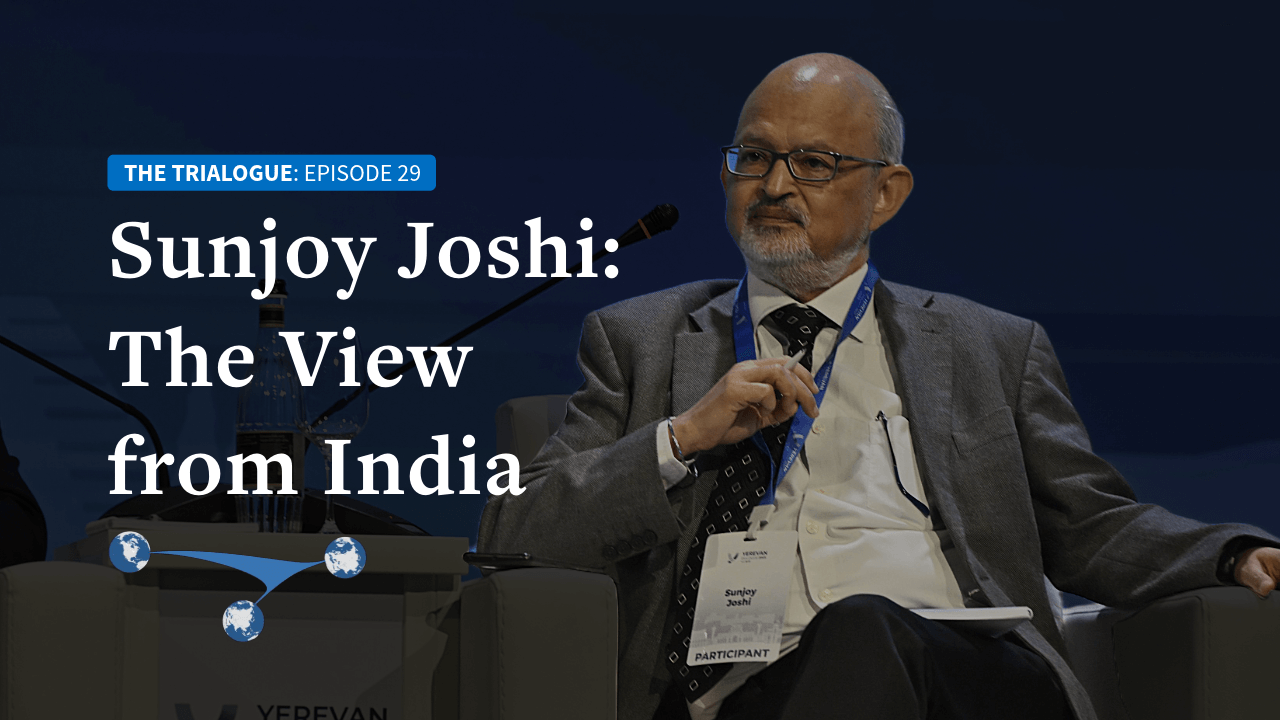





Transcript
Peter Slezkine: I’m Peter Slezkine, Director of the U.S.-Russia-China Trialogue project at the Stimson Center. Since the middle of the 20th century, relations among the United States, Russia, and China have had an enormous impact on each country separately and on the world as a whole. The purpose of the Trialogue is to better understand this extraordinarily complex and consequential relationship by directly engaging with experts from all three countries.
In this show, guests from across the political spectrum and from every corner of the globe share their views in their own voice. While the Stimson Center seeks to provide access to a wide variety of perspectives, it does not endorse any particular position. We leave it to the listeners to judge the validity and value of the views expressed by the guests. I hope you enjoy the podcast.
My guest today is Sunjoy Joshi, Chairman of the Observer Research Foundation, India’s most influential think tank. India is an ancient civilization, the world’s most populous country, and an increasingly active player on the international stage. India is a key partner of both the United States and Russia, and has a complex and contentious relationship with China.
In many ways, India’s traditional policy of non-alignment makes the country an interesting case study for the emerging multipolar world. Please, keep listening to hear Sunjoy’s perspectives on these and other matters.
Sunjoy, welcome to the podcast!
Sunjoy Joshi: Thank you, Peter. Lovely to be on this podcast with you.
Peter Slezkine: Thanks so much for joining me. Can you begin by briefly describing the purpose and history of the Observer Research Foundation?
Sunjoy Joshi: Well, the Observer Search Foundation has a history. It began in 1990, so it’s over 35 years old today. And 1990 was a period of India’s economic crisis. And it’s interesting because there are acute parallels to what is happening to the economies of the world today. India in 1990 was going through a very similar situation where it was hugely in debt, there was a major foreign exchange crisis, its reserves were running extremely low. And India, from 1947 to 1990, had been a closed economy — high walls, high barriers, high tariffs, living in its own insular world. And when this crisis hit, at that point of time, India had reserves to just about pay for two weeks of imports. The Gulf War had just ended. Oil prices were extremely high and it was importing huge amounts of oil. Russia’s economy had collapsed because the Soviet Union had collapsed. India had a very large trade with Russia at that point of time, almost 25% of the trades were with Russia.
So, in that situation, it was absolutely necessary. India pledged the school reserves to take $400 million worth of loans from various banks. And from there began the story of India’s reforms. Now, India has a very fractured economy. They were a fractured country, politically. We had political parties which would never agree with anyone on what cause to take, you know. Even our gods bicker amongst themselves. Our politicians bicker even more.
So, in that situation, one of India’s largest corporate houses, reliance industries, at that point of time, thought, “This is the time to see the think tank in India, which can somehow forge a consensus on some of the essential agendas on which there is no rolling back, that you have to go ahead. Otherwise, we are sunk as an economy. There’s no future.”
So, that is how ORF was seeded, by a ground from one of India’s largest corporates.
Peter Slezkine: But so this was India’s opening up, which coincided or followed Russia’s opening up economically and China’s opening up economically.
Sunjoy Joshi: Yeah. ORF got people together. And that’s important to hear the story, because what did ORF do? ORF’s mandate, primarily, was, okay, do not get into ideological conflicts. We will need to work with ideas, not with ideologies, because it was a fractured coalition of governments.
Peter Slezkine: This was, in a sense, a 1990s admission that history was over, that the Soviet Union had collapsed, that technocratic solutions to the global economy were necessary.
Sunjoy Joshi: Absolutely. And those technocratic solutions had to be found in the think tank through people who needed to get down and form a consensus. And there, somehow, the consensus was forged by lots of discussions, the first, in fact, blueprint for reforms. A very rudimentary paper was created on ORF at that point of time. And that was followed through. Lots of other things also happened. I will not say that ORF took all the credit for it. A lot of things happened. A lot of good political leadership came in. And then, within four years, all of India’s goals actually came back.
So, that is the birth of ORF. From that point in time, ORF has always remained a think tank, which has been open to all ideologies, to all ideas, and tries to create consensus across the broad political spectrum. That is what ORF is.
Peter Slezkine: And ORF’s work is associated with all parts of the globe. Are there any national partners that you work with more than others?
Sunjoy Joshi: Well, there are certain regions which are more important for us. That, again, depends on the shifting tides. But ORF has a global outreach. We work across every continent today.
Peter Slezkine: You’ve spent much of your career in the Indian government before joining ORF. So, can you briefly describe your trajectory?
Sunjoy Joshi: Well, I worked for about 25 years in the government of India as an officer in the Indian Administrative Service. I joined them in 1983. Before that, actually, I was happily teaching English literature at the University of Allahabad.
Peter Slezkine: Let’s move forward to the present day. India has always exerted a very strong gravitational force on the world. It is massive. It is ancient. But now, particularly, its economy is growing by leaps and bounds. It has recently become the most populous country on earth. And it seems to be more assertive and active on the international scene. So, what vision does India or Modi himself have for the world and for India’s place within it?
Sunjoy Joshi: When you talk about, what is India’s worldview, what is Modi’s worldview, or whatever even has been the larger worldview within the Indian foreign policy domain across many decades, you need to understand something about, where does India come from as a civilization? And a phrase which is very often used for India when we start talking of, what is India’s worldview, we say it is “Vasudhaiva Kutumbakam,” which primarily is translated as the world is one family. But actually, “Vasudhaiva Kutumbakam” is a little more complex than that. “Vasudhaiva Kutumbakam” is not about the world being one family. It’s about the earth being one family. Earth and all living things and all entities there in living and on living — rivers, mountains.
See, India, as I said, is a civilization where we have, well, the count goes 330 million gods, not one. And these gods are often at odds with each other. So, it is a very pluralistic vision of what the world is. It’s a very pluralistic vision of what cycles of time are. And it is this vision which really colors how India approaches its place in the world.
So, when Prime Minister Modi speaks about “Vasudhaiva Kutumbakam”, you must understand what this “Vasudhaiva Kutumbakam” means. The two or three important things about this whole concept is, the first is the idea of imminence. What is divinity? Where is it inherent? It’s inherent in everything in the world around us. And not only is it inherent in everything, this is a complex world. You cannot think in terms of binaries of good and evil. There can be no pariahs in this world. People who are outcasts, who we don’t talk to. Everyone is part of it. The predator and the prey are one and the same. Opposites do come together. Opposites are needed. And the cycle of change is always the only permanent thing.
And if you start thinking in terms of the Indian epics, it’s primarily about the very complex nature of morality, which is ambiguous, where there are no clear lines between what is right and what is wrong. And the call between right and wrong is taken on the battlefield of Kurukshetra, which is an Indian Epic Mahabharata. In this debate between Krishna and Arjuna, Arjuna does not want to fight because he sees his family members rage on the opposite side. He sees his teachers rage on the other side. He even sees his eldest brother, Karna, also on the other side, on the side of what is supposed to be evil. So, Krishna does not tell him that Karna is not evil. This is not a fight between good and evil. This is a call for duty. Time demands this duty. Do not hate your enemy. But decisions have to be taken, and the decisions have to be taken impassionately, impersonally, knowing within your heart what is right and what is wrong. And that is what it is. It all depends on context. It can change from time to time. These are cycles of time, which keeps changing.
So, this is the worldview which India brings when it approaches it foreign policy. And therefore, many times, when people get confused about what stance India is taking, and what does India mean by strategic autonomy, what does India mean by taking a particular stance, say, in the case of Ukraine or in the case of West Asia, or on happenings around the U.S. or on BRICS. You must understand where India is coming from.
Peter Slezkine: Very interesting. So, I understand the point about pluralism, the interdependence of the various pieces of the globe, but as you say, even the gods bicker. So, is there some theory about how order might emerge from a pluralistic polyphonic, sometimes cacophonic, global society?
Sunjoy Joshi: So, India believes in the theory of cycles. Again, as I said, everything contains a seed of its opposite. So, the important point is balance — balance between seeming opposites. Male and female are one and the same. They’re actually united. It means, together, they create. And therefore, also, creation and destruction have ultimately come together. They move from one cycle to the other. And like an earthquake, seismic events ultimately rejuvenate the earth. The earth would be dead if there were no earthquakes in geology.
So, destruction and creation are a part of the process of life and a part of the process of the universe. So, this is primarily the Indian vision. So, when you ask about what India’s position really means, and in the hurricanes and tsunamis, which are actually raging around us today, well, India’s position is precisely to maintain that balance. It’s like walking a tight trope in the middle of an earthquake. It’s a difficult act.
Peter Slezkine: India does not seek to intervene directly in these processes, which are more or less natural, but more or less maintain its own balance?
Sunjoy Joshi: It’s not that decisions have to be taken, decisions have to be taken when the time comes to go into battle then yes, actions even may need to be taken against your friends, against your family.
Peter Slezkine: So, what is the ultimate driver of action? Is it the national interest? Is it the preservation of Indian civilization? What is the motivation to act or to intervene in this pluralistic, set of actors in a repeating series of cycles?
Sunjoy Joshi: Well, the larger motivation is actually for the greater good of all, but within a national context? Yes. India as a country, first of all, is a coherent, cohesive society needs to remain, needs to move forward in a difficult time.
Peter Slezkine: Westland tries to investigate these principles in a practical context. South Asian civilization is old and extended across the entire subcontinent and, and and quite a ways north. And after the British left and the area was partitioned, we ended up with a series of states which now have a more or less complicated relationship.
So, what is India’s policy toward other South Asian states specifically?
Sunjoy Joshi: Remember that this was all basically part of cultural influences of the subcontinent and the influences of countries around the subcontinent, right? All the way from Persia to Central Asia, all the way up to Armenia.
They were very much part of Indian civilization, Indian ethos.
Peter Slezkine: All the way up to Armenia?
Sunjoy Joshi: Oh, yes. oh yes. All the way up to even beyond. See, when you start talking of the spice trade, India was actually the center of globalization at that point of time. And it was a globalization which lasted centuries. It was not a globalization which lasted 20, 25 years and disappeared.
Peter Slezkine: What time are you talking about?
Sunjoy Joshi: This is before the 15th century, before colonialism took root and the predators came from the West and the predators, yes, the predators will come no problem.
Predators will also disappear. They will coming in the future too. So, that is-
[00:13:05] Peter Slezkine: But the predators include the Moguls before the Brits?
[00:13:09] Sunjoy Joshi: The Moguls came. If you start looking at the history, India has always been a big melting pot. And that is why it survived as a pluralistic society and survive till this day. And when India talks about civilization, it is talking about civilization, which is thousands of years old.
[00:13:23] Peter Slezkine: When you can say that the Aryans or the Indo Europeans who arrived in the subcontinent were the first predators who laid a foundation for this entire civilization.
[00:13:31] Sunjoy Joshi: Yes, yes. they laid the foundations, and the Indo, the Indo European groups of languages comes from Sanskrit. They all have Sanskrit roots. So, that is where it was born.
So, what I was trying to say is that there are deep cultural links between all the countries in the region. Islam in India took on very different kinds of roots because it was colored by Indian civilization. Christianity in India has taken on very different roots because it was also colored by Indian civilization. So, the stamp of the civilization has remained on all of this.
So, it’s a complex relationship which India has with its neighbors. Many of these, partition created countries which did not exist before they were artificial countries. And another country called India got created, and many of the disputes, which you today talk about, whether it is with China, whether it was Pakistan, all relate to the time, which goes back to part of India, the defining of India’s boundaries.
And India is not alone here. I think the process of decolonization created these conflicts in many other parts of the world, including in West Asia, including across the entire African continent. So, whereas, you know, many other regions are still struggling with these legacies, India somehow has managed to survive as a democracy, right?
Through many of these challenges, posed by these legacies and moved on to being where it is today, you know, now they say the third largest economy, perhaps almost in the world.
Peter Slezkine: So, in India obviously has complicated relations with Pakistan. There was a short, I suppose we could call it war very recently, but it is also surrounded by Bangladesh, Sri Lanka, the Afghanistan, if you go further north, they were all part of the subcontinent that Britain once controlled and we’re all partitioned after the British left.
Does the Indian government think of the subcontinent separately from the rest of the world? Is there a particular strategy toward these peoples who have emerged from the same civilization, or is Pakistan its own problem, Bangladesh its own, and so on?
Sunjoy Joshi: Yes and no. As far as, as I said, the cultural links go. The people to people, links go, across this region. They’re very strong and they remain strong to this day. And India has a special place even within Pakistan. See, people to people, links are strong, cultural links are extremely strong.
Bollywood songs are extremely popular in Pakistan. In many ways, they talk the same language, speak in the same idioms. They understand each other instinctively perfectly. Even the marriage customs are in many ways similar.
So, please understand the cultural links across the, whether they talk of Nepal, whether they talk of Bangladesh, which has extremely strong cultural links,with West Bengal, Sri Lanka, all over the, see, those links cannot go away. And those people to people links remain extremely vibrant even to this date.
There’s a legacy of nationhood we created. So, Pakistan is yes, one of our most difficult problems, because of the very vexed history of partition, and everything that, went with the process of partition.
So, India then emerged from the partition as a secular, multicultural country. Pakistan chose to become a country defined by its religion and created that kind of an entity. India moved on to becoming a democracy, Pakistan faltered as a democracy.
The military in Pakistan became a very potent political force, where most things came to be controlled by the army. And in many cases, the way for the existence for the army was this other side across the border, which always was created as a threat.
So it is a history, you know, which goes back to what happened during these last seven years, and that has not gone away. I think the Pakistani army cannot stop thinking of India as enemy number one. Otherwise, there’s no rationale for the army to be in power. So, any attempt to make peace with Pakistan has always run into problems.
And the terrorist threat is extremely real. We know what happened in Pahalgam. We know what happened before that also. So, India today is in a position where it said, okay, we are not going to take this lying down if this happens. It is not that we are going to be back to talking with you and, you know, tithing over a few more years, we are going to say that yes, we have a strong hand and we are going to take action.
It is not about being quiet and waiting for the cycle to sort itself out. Carl Chara does not operate that way. You take decisive action when the call comes for action. No matter who it is. No matter what it is.
So this is India’s new doctrine. When you start talking of, you know, India’s strategy of non-alignment or multi alignment, what does it mean? Bear this in mind. It is not about not acting. It’s about taking decisions forcefully when the time comes.
So, yes, Pakistan is a problem and Pakistan need to be handled, but Pakistan is ultimately peripheral to India’s story. It is a nuisance. Yes, it does tend to hold us back, but we don’t see it really as an enemy. We see terrorism as a threat and we will do everything to contain it.
But otherwise, as far as India’s concerned, our priorities are very, very different. India needs to grow. India needs to become economically strong nation. India has a problem of poverty still existing. India has a problem of making sure that, 1.45 billion people have good opportunities in a progressive and forward-looking world.
Peter Slezkine: But so your argument is that for Pakistan, because of its national identity, because of its military government, India is a necessary threat—a central component of Pakistani policy. Whereas for India, Pakistan is one problem among many a nuisance. You called it, sort of, a peripheral issue.
Sunjoy Joshi: It’s a nuisance. It’s a peripheral issue. We will handle it, and I don’t think it really bothers us that much beyond a point. But yes, it is a nuisance. it is, like, a monkey on our back.
Peter Slezkine: What about Sri Lanka? The Civil War is over. There was a great crisis, a year or two ago when the presidential palace was stormed. Bangladesh has just had a change of government. So what do you make of your other South Asian neighbors?
Sunjoy Joshi: See, for all these country, let us try to understand whether it is Nepal, whether it’s Sri Lanka, whether it’s Bangladesh or for that matter, whether it is Pakistan. There’s an other giant neighbor also looming which is China.
There is a game for playing for influence in the region, which, you know, India calls the string pulse, Syria, the summer somehow to be able to isolate India. And we will go into that question later about the India’s complicated relationship with China.
But there will definitely been a attempt for other countries, like, China to start building influence there. So, it is a matter of, India also counteracting these attempts at infancy. We do not say that these attempts to infants will not happen.
But yes, India always comes forward, as someone who in a crisis will lend a helping hand and has done so repeatedly with neighbors, like Sri Lanka. India helped build them out of crisis when they were in the recent past.
And Sri Lanka acknowledges it is not there to build huge ports and huge airports, which are not going to fetch any returns. We are there to fill solid, small scale projects, which will give immediate returns, which alleviate an energy crisis, which is the reason when they were short of petrol, when they were short of oil, we went in and stepped in those situations. So it’s a stable relationship with Sri Lanka, which I think we’ve gone into.
Peter Slezkine: And what about the new government in Bangladesh?
Sunjoy Joshi: The new government of Bangladesh initially, I think, you know, began with certain amount of negativity with India. And India, of course, was really shocked by some of the actions with the minority community there. That became an issue within India.
And that will always become an issue in India for obvious reasons. But hopefully, I think things will sort themselves out because in the long term, Bangladesh, where it is located strategically, the Bay Bengal always shares with India that strong cultural links, which has with West Bengal. They remain there, you know, that, that’s where I said the people to people connect, always plays in. So, Bangladesh at the moment, yes, has become something to think about, but I think the problem should be resolved. Will be resolved. Let us see what happens when the next government comes in, let there be elections, let there be a fair government in Bangladesh, not a caretaker government. Then we can take a call.
Peter Slezkine: But you were talking about the people to people context, the great connections across the border between say Bengal and Bangladesh. But is that part of India’s foreign policy that you might have squabbles, but this is considered one family, and if you are positioning yourself relative to China, do you describe them as alien outsiders and yourselves as close siblings and members of one family, or these are all sovereign nations as far as formal foreign policy is concerned?
[00:22:07] Sunjoy Joshi: See, you have to respect the sovereignty. If you do not respect the sovereignty, you’re not going to get along very well with them. So, in a modern and national system run by the United Nations, sovereignty is basic fact.
And a sovereignty must be recognized, whether it is for Nepal, whether it is for Bangladesh, there’s no question of us trying to overwrite that sovereignty under normal circumstances. So that holds true for all nations. So, both the people to people connect matter, but the sovereignty of the nation is never at stake. Let’s be very clear about it. Indian foreign policy works on that principle.
Peter Slezkine: Well, so let’s pivot to China, which has its own long civilizational history, which has always been India’s neighbor. Buddhism has traveled from India to China and has been terribly influential. But these are two very different civilizations, ultimately in the two great powers in Asia, now and into the future.
So, China and India obviously have a border dispute, but there is much more going on, geopolitically economically. So, describe India’s relationship with China.
Sunjoy Joshi: A complex relationship, an extremely nuanced relationship. So, you’ll find lots of contradiction in India’s approach to China from time to time. And, whether India is a member of the quad and whether India engaging in the various other formats. Yes, China in many ways is a strategic rival to India as far as competition for influence is concerned, influence in the region, influence across countries in Africa.
India and China have had a history of, in the last few years, it’s not a very long history, but say the last 30, 40 years, the longest history talk of 3000 years. In 3000 years, China and India did not really have any major conflict except 1962.
1962 changed the trend and that there were two extremely peaceful nations, living together with lots of exchange of ideas. Buddhism went from India to China, and yes, there was a lot of cultural interaction, a lot of respect of the people of the two countries for each other.
And in many cases, yes, that respect still carries on. It is not that China does not respect India as a people, India does not respect China as a people. We do respect them. We do respect the immense amount of progress which they have made in the last few years, the way they’ve changed, the way they’ve eliminated poverty.
There is a lot of admission in India for all those positives of China But yes, geostrategically, because of what is happening around us, we do find ourselves in this situation rivals even as we have an extremely vibrant trade relationship. And the trade relationship does not really see signs of stopping. There may be ups and downs, you know, once in a while. But otherwise it’s been fairly steady. And the problem with India’s China’s trade is that the trade is extremely one sided, and that is India’s problem is the kind of problem the US has with China too.
Peter Slezkine: So, when India looks at China, what is the greatest challenge? Is it the border dispute? Is it the unbalanced economic relationship? Or more specifically, reliance on China for critical components in elements of high tech? Is it the larger region and geopolitical rivalry there?
What is the rankings of challenges that China presents?
Sunjoy Joshi: See, elements of high tech India does not depend on China. It’s very using Chinese technology because of strategic reasons. And in fact, India is the only country which actually went and banned certain apps Chinese because they thought that there was a price to pay for that. Very few other countries did, but India boldly went ahead and did that. That’s what I said—that when India needs to take action, it does not hesitate from taking that kind of action no matter who it is. Friend of who that does not make China foe incidentally, in the Indian scheme of things, because we look at the world very, very differently.
But the fact is that when decisions have to be taken, they may even have to be taken against friends. So, no, that is very clear. So, in technology, no trade, unbalanced trade. India has for years been negotiations with China to try and balance that trade. And, there are various discussions which have taken place from time to time because that one way dependency for any country is not good. whether it is a technological dependency on any one country, not good at all. And India is actually seriously thinking about those issues. Also today, when it starts thinking of, how it is to build, its, Industrial complex, how it’s move ahead into the future. Those are general questions, which India today is asking when it talks about making in India so that India is not basically dependent on any major country.
Forget China, any major country, for some of the most critical elements in the supply chain, that is a, kind of, global trend, which is happening everywhere also. But India is looking at it very differently because of the particular neighborhood it is in and the larger geopolitical framework in which, with which it’s operating. But trade opportunities, yes. India, China trade in many ways has, expanded India’s markets. it’s not that India’s markets been weakened. A a lot of cheap goods have come into, India and where the cheap goods there has been, a case of dumping. India has protested and India’s protested strongly, and India has imposed.
Huge anti-dumping duties in China. ’cause it does not want to be sworn by those kinds of products, but products which are needed in India and do not fall in the category of anti-dumping, which are necessary also in many ways, to help India create the manufacturing base.
they have always been welcome. So, it’s, a completely leadership. India never will say no to China as far as trade is concerned. So, that is the tide trope, which India is trying to walk. And there India needs friends, not just in China. India is friends in the US too.
Peter Slezkine: To what extent is India’s relationship with the US now a function of both countries? Fear of China, because I mean, obviously the US indie relationship is long and complicated. The US was closer to Pakistan during, much of the Cold War. Now China is, close to Pakistan and the US and India have grown, more intimate.
Sunjoy Joshi: as far as Pakistan is concerned, India feels that China and US have, kind of, the same strategy towards Pakistan. They’re lost to give it up, and they’ve never really abandoned Pakistan. No matter what India says, or what India feels about it.
So, that is a complex equation which India has to work out both with China and the us.
Peter Slezkine: but so you don’t feel, like, the US has pivoted from Pakistan to India in its international relationship and priorities.
Sunjoy Joshi: at times, yes, we do feel that, but then at times, like, soon after Operation du the feeling is, that perhaps, you know, there are US interest in Pakistan still alive. And it is not easy for the US to give up Pakistan.
for certain geostrategic reasons which are necessarily not aligned with India’s geo strategic reasons.
US will go on needing Pakistan for quite some time and therefore it is not in a position to give up on Pakistan.
Peter Slezkine: So, what are those reasons, is that China? Because obviously when the US was fighting for decades in Afghanistan, then having a presence in Pakistan over the border could be useful. Although that was a complicated relationship. But now that we are hopefully out of Afghanistan for good, what’s the strategic necessity for our relationship with
Sunjoy Joshi: Well, it’s, an extremely complicated region. You can never say you’re outta the region for good and for how long, remember what happened in Syria?
So, for that reason. It’s difficult to say that we are outta that region for good. never say the last word on that
Peter Slezkine: well, that’s the problem is that we never quite leave it. We always remain around the areas that we leave, which then tempts us to go back in or create some problem that then forces the US to return.
Sunjoy Joshi: These are larger games for influence being played in the region, between Russia and the United States and European powers, which have gone on, not. Just last few years, but have gone onfor a long time, since colonial times, these, conflicts have existed.
So, there’s a long, deep seated history to these conflicts. Unfortunately, that has left West Asia in extremely disturbed and delicate position. And yes, India is worried about it and that is one region, whether it is Pakistan, whether it is, Afghanistan, or whether it is a region further west of that.
India will be wary and will not always agree with what the interests of Europe and US are in the region. So, that is where now the whole idea of strategic autonomy comes from, that there are certain interests here in this region where India will have to look after itself, have to look after its alliances in the area, and build those alliances separately from the concerns of its other quad members
So, that is how India will continue to operate. So, when people start to understand why India talks of strategic autonomy, this is the region. Because as far as to some extent, the Indo-Pacific is concerned, the eastern side of the Indo-Pacific, up to the bi Bengal, there is more or less greater consensus between India and the US and certain of the European port partners move beyond that into their agency.
There’s a problem. No Indo-Pacific, as far as they’re concerned, should stop from Hollywood to Bollywood, not go beyond that. India disagrees with that, and that disagreement will be there as a disagreement, for which reason they are going to be differences between India and its friends.
Peter Slezkine: And India always insists that those disagreements should not be allowed to break our relationships. But, so the American and Indian strategic visions obviously don’t align, completely or everywhere,
Sunjoy Joshi: Align completely in certain parts of the world, in other parts of the world. They may align-
Peter Slezkine: Well, so regarding China, they align more or less you’ve mentioned the quad several times. What is the value of the Quad to India and what is its future now that Trump is in power? There’s a slightly different logic in Washington.
Sunjoy Joshi: While India talks about strategic rivalry, with China, India persistently and for a long time, consistently has been advocating that we do not want to see the court, a security alliance aimed against anyone, including China. They’re very clear on that this is not a security alliance. It, it,cannot become a NATO, kind of, security alliance against China. And that, that they’ve resisted, time and time again. So, there is rivalry, there is strategic rivalry, India has no intention and there’s no question, unless it is forced into, you know, getting into.
A confrontation into war, even across the border. We would, like, our border issues to be resolved as mature adults by conversations, by talking to each other, by building, you know, ness, between the two partners. That is the ideal way, but should the time come for us to take a stand, then we will not hesitate.
And that is what the new doctrine is, that we will not hesitate to take a stand and take a tough stand on it, including, any option.
Peter Slezkine: But that’s the border dispute where you have Indian and Chinese forces on both sides, those are the two actors that matter. The quad presumably isn’t of any use in the Himalayas. So, what is the
quad for? You say that it’s not an alliance against China. What is the purpose of the quad? Is it just to create more outlets in the region to balance China in general?
Well, the importance of the quad is primarily because As far as the Indian Ocean is concerned, as far as naval prison, Indian Ocean is concerned. The quad needs India, and India needs the quad.
Peter Slezkine: Because India has the coastline in, is in the region
Sunjoy Joshi: We have the coastal and we also have the navy. You see? So, therefore both sides need each.
Peter Slezkine: Well, the other participants have more of a navy. If you have both the coastline and the Navy, then you don’t need the-
Sunjoy Joshi: Strong navy, but we can, do withmore assistance and other people coming in to patrol these very, very difficult waters. So, the quad, a as a maritime construc, extremely important. Secondly, on issues of technological alliances, on alliances between, democratic nations of the world building partnerships, for technology, for trade, for building, a counter to a very hegemonic construct called the BRI, which actually makes deep in roads Central Asia, into Africa, and just completely leaves out huge swades of the Indian subcontinent. There is a problem there. So, we do not want India to be isolated and actually be rendered an island by a march of a huge infrastructure project which excludes us.
So, that’s why the trust to align with other partners, to build alternative connectivity projects as not well, you can say they’re a challenge to the BRI, but they’re also complimentary trade ultimately flows through various routes and through all kinds of complementary directions.
So, that is why we have deliberately become part of the IMEC. We are part of the I2U2 Alliance, and West Asia. Those are particular ideas where we are one with the US on some of these concepts, the I2U2 alliance is important for us.
Peter Slezkine: What is that?
Sunjoy Joshi: The I2U2, this, which is the, India, UAE, US and Saudi Arabia. So, no, these are ideas and the IEC also is part of that India Middle East corridor. So, these are ideas which, yes, we are important to build our presence in a very important part of Eurasia whereWhere India, otherwise risks having been cut off. That does not mean we are going to give up, projects, like, the North south corridor,with Iran or with, or Russia or with other countries in Central Asia, because that’s not the route
There’s the entire hinterland of Afghanistan,which has to be there. And that we, need a presence there. So, are areas where you will find we will have similarities and then we will have differences to, and they will continue.
Peter Slezkine: You mentioned the importance of this alliance of democracies in the quad. but then you talked about other groupings that included the Arab Gulf States. Is the emphasis on democracy just, to assuage the American partners during the Biden era, does it make any difference who your partners are in that respect? If the pragmatic relationship is positive for you?
Sunjoy Joshi: Well, that’s for the US to decide. Should it value democracy or has democracy changed?
Peter Slezkine: No, but that was a big part of the declared relationship with India. In every speech, when India is mentioned, it is always described as the world’s largest democracy. And then it is put in this framework of democracy versus autocracy. Perhaps that moment has passed. Do these divisions matter for India?
You were saying before that a world based on binaries is not one that you appealing as a people.
Sunjoy Joshi: It does not because if, India does not, make that to handle, to beat anyone with the same, you’re not a democracy. India has no qualms about it. India has friendships across India is close to Russia, and the US will say Russia has not a democracy. India.
Peter Slezkine: Well, let’s get to Russia in a moment, but first to finish on the US relationship with India. There seems to be a drive to, in some respects, make India the new China as the warehouse of the US economy to move Apple from China to India. It seems, like, it hasn’t been going smoothly.
So, what are the prospects for that? What does India think of this trajectory?
Sunjoy Joshi: See, it depends on what happens to ideas of near-shoring because there is certain amount of confusion, in US policy on that. Is it about shifting all production back to the US because in that case, countries like India, Vietnam, which have become ordinance, centers for production, which ultimately, yes, over the years will move up the value chain. It is not that they will remain confined to the last end of the value chain. The China move, the value chain. They will also move the value chain and India is actually making very strong efforts through that, and India is far ahead of the curve as far as that process is concerned, because India has strong, vibrant economy and strong companies who are putting in money, in clambering up the value chain as fast as they can.
So, a lot of that is going to depend on, US policy from here into the future. Meanwhile, India is going to be talking also to other regions of the world. And that is where, its alliances and BRICS become important. It is not part the Southeast Asian alliance, of the AAN countries, the AEP, trade grouping, which has come out, but it has very strong trade partnerships to most of these countries. So, these engagements with,Southeast Asia, with Japan, with West Asia, which is actually, growing influence, particularly, Saudi Arabia, United Arab Emirates, all these other countries, India is developing very, very strong trade linkages.
See, trade will expand in various directions. And that is going to happen. you will find of global trade happening over time, and the push will come towards that. So, that is where India is in conversation with all these partners, including, intense discussions with Europe on what to do, how to move ahead with trade, depending on where US policies move from here, because, some of us are concerned.
What we think is that maybe the changes within the US which are happening on trade, they’re not passing phases. there are deeper reasons where these are going to continue, and we are going to have to live with it.
Peter Slezkine: Obviously the US cannot immediately produce everything on its own soil, and there has clearly been an effort to find relatively cheap labor that would be based somewhere other than China, and either Apple comes to India from China or doesn’t.
So, let’s just take the case of Apple. One of the largest export was Apple iPhones out of India.
But, so is India interested in having Apple and other companies, like, that move from China to India? Are they seeking to incentivize these companies to come over? Are they putting conditions on these companies, some, kind of technology transfer?
Sunjoy Joshi: See, eventually India is looking at models of core production and that goes, across a whole host of technologies, which includes, by the way, defense technologies too, There is going to be increasing emphasis on, co-production ventures, because the old model of, buying from abroad does not really work anymore, especially in strategic sectors.
And technology too is a strategic sector. Today. So, yes, as far as climbing of the value chain goes, India will definitely be, grabbing a lot of attention there. And The Indian private sector is scouting for opportunities of acquiring r and d through acquisitions and using that in a fair manner on a market-based manner to get much more production co-located right here in India.
So, that is the path which India is going to be pursuing. Again, a lot depends on where we move from here. See where do the demand centers for the next. movement in manufacturing really arise when AI comes into play.
What happens to the shape of manufacturing? Now, as far as many of us can see, manufacturing itself does not remain manufacturing. It actually becomes a service. It becomes a service economy. with the fourth industrial revolution, when it becomes a service economy, then India definitely has certain strengths there. ‘ cause India’s largest growth, right? Through, you know, this period with this very high trajectory of growth has been in the services sector. So, there are big opportunities for India, which, we are looking at very, very closely. And if you’d ask me what India’s model would be, that would be India’s model.
Peter Slezkine: Is the seek to take advantage of the upcoming AI revolution, which will privilege the service sector, which India, I wouldn’t say has dominated, but has, made a huge part of its economic rise in recent decades.
Sunjoy Joshi: It’s a very competitive sector ultimately, which is India’s most competitive sector. it is not really labor arbitrage. It is more the services arbitrage, which is played and played very effectively.
Peter Slezkine: But isn’t there a possibility that, at least from the American perspective, you call a helpline, you end up with somebody with a South Asian accent on the other side. That’s how you encounter this Indian service sector. And from what I understand, the idea is that all of those Indians will be replaced by AI chatbots.
Sunjoy Joshi: No, that’s that. That has already happened. See, that was the old model. that model no longer works when India’s no longer looking at that model. India’s now looking at the model where you, when you start going into, things, like, 3D manufacturing distributed, and manufacturing at know centers of demand.
And when those kinds of things start happening there, you require a whole host of services. See, it, becomes largely a services led manufacturing sector. More and more. That is a transformation, which I’m really talking about.
Peter Slezkine: So, India is obviously central to us. Foreign policy is mentioned more and more in American political speeches about the state of the world, about its important alliances, and partnerships. But India has also become very present, inside of the United States in politics in Silicon Valley, on both the right and the left of the political spectrum.
Vivek Ramas Swami JD Vance’s wife; the head of the FBI, Kash Patel; Pete Shai, the head of Alphabet; Zoran Momani, who may become the mayor of New York City. Does this matter to Indians in India that all sorts of Indian Americans are now in, top positions
Sunjoy Joshi: Peter, the Americans first, Indians last. Let’s be very clear about it.
I think America should be and is their priority number one, and that is the country they’re living in. I think we are very clear on that.
So, we do not claim any patriarchal rights over them. they are independent individuals and the US is a very individual society anyway, and it’s great what they’ve achieved. they’re bright minds, great people, and I think they are America’s fortune. They’ve been good for America. So, I think America should be celebrating the presence there. We are proud of them. Yes, because they have heritage in India. So, yes, that makes us proud of them.
And is that celebrated, say in Indian media and Indian TV when Sundar Phai becomes the CEO of Alphabet? When Zoran Ani achieve spectacular political success? Is this something that is disproportionately covered on Indian tv?
It would be, yes.
Peter Slezkine: But there’s no special efforts to use these links.
Sunjoy Joshi: There are special efforts. What is good for business will happen.
Peter Slezkine: It is easier to create business deals, business context?
Sunjoy Joshi: In a certain sense, of cultural linkages, yes, it would be easier, but ultimately hard sense prevails on both sides. economic sense,
Peter Slezkine: Well, speaking of hard economic sense and perhaps sentimental, historical ties, let’s turn to, ind India’s relationship with Russia. So, it does seem that from the Soviet period, there was an intimacy, a special relationship with Russia, an educational relationship with Russia, where many of the textbooks that people of a certain generation grew up on had been produced in the Soviet Union.
There’s obviously the military relationship, or which much of the Indian military equipment was made in the Soviet Union and is still provided by Russia. and then since the start of the war in Ukraine, India has been one of the big purchasers of Russian oil. So, characterize the relationship with Russia for me, sort of, in a historical context and in a strategic, pragmatic economic, setting going forward.
Sunjoy Joshi: See in the historical context, yes, it’s an extremely strong relationship and Russia did a lot for India during the first few decades. Of its independence when it became an industrial economy, while the US was keen to bring a set up Foco wall of factories in India, Russians came in with hard infrastructure factories.
They set up their steel mills. a lot of the,the entire story growth of India, nascent oil industry has a lot to do with Russia and technology, which came in for the Russians. So, they help build India’s industrial backbone,
And that is a debt which, India will never forget because it’s a generational debt. It’s a certain generation recognizes the great role that Russia played. India is not just its defense program. India space program also owes a lot to them. So, these are ties which will not go away.
Peter Slezkine: Please understand that as far as Russia is concerned, Russia is a Asian power. It is not. Oceans away from us. And India’s efforts right from, for many, many years have been to build inroad into Russia, build the connectivity corridors into Russia, whether through Iran, whether through various other roots.
Sunjoy Joshi: It has always been trying. That’s one point of Afghanistan has also tried. So, there have been various attempts to start those linkages and they have not died down
Peter Slezkine: Russia’s recent recognition of the Taliban government, is that partly, a first step in seeking to create a logistical corridor to India? Is that one of the motivations you think for Russia’s recognition of the Taliban government?
Sunjoy Joshi: It may be. And, for that matter, India also has got over its initial hesitation with Taliban. It not happy With what happened, with the US withdrawal, from Afghanistan. It didn’t agree again, agree with the US position on choosing to withdraw when it did, because it felt, it left the region in a complete lurch, changes times.
So, you know, there was a lot of resentment within India for that, and for good reason. But over the years, India has got over its initial fears, initial suspicions. And India today Yes. Has channeled the communication with Taliban itself. it is talking to them. India’s more open to them. As I said, no, India does not regard this whole idea of people being completely.
to be made barriers at any point of time. And that is where it also does not, like, any country, including Russia, to be made into a Paris and to be completely discarded. And, no one talk to Russia. Russia is an important partner in Asia and will always remain in Asian power. And for that reason, India will maintain relationship with Russia no matter what happens.
And the relationship, will be trade to some extent more than trade. Yes, it is going to be a strategic relationship also to balance China, just as India uses the US to balance China. Russia is also a very important counter force when India will have problems, does have problems with China, and these relationships have helped India in the past.
I don’t see this going away.
Peter Slezkine: Is the sentimental connection to the Soviet Union and Russia, does that remain strong in younger generations or is that something that is only keenly felt by those who studied with Soviet textbooks, who listened to Soviet-
Sunjoy Joshi: It changes. Today, most Indians realize that Russia is not what it was in the times of the Soviet Union. And Russia has a changed country, and, Russia has changed country in many ways. changed for the better in many directions. There are opportunities there too. So, Indian companies, by the way, have been engaging with Russian companies for a long time, especially in the oil and gas sector.
Indian and public sector companies have been engaging with Russian companies and nothing to do with the Soviet legacy. it is, far beyond the Soviet legacy. So, those partnerships have continued. And, many of these, India never actually. Agreed to sanction Russia. India has been bitterly opposed to the whole idea of sanctions. India has also been very opposed to the idea of using the interbank system as a weapon of war. Now this is fundamentally something which destroyed trust and trade and set global economies backed by many years, and actually disastrous consequences for the entire countries of the South. as far as food was concerned, fertilizer was concerned. Supplies of essential goods, medicines were concerned. It was disastrous. the impacts were far reaching. It’s a very ill thought move is just the fact that Russia was so important in the supply chain of many of these energy, food, and fertilizer products for many of these countries. So, there again, as I said, differences with Europe and differences with. the USA on these things have remained with India,
Peter Slezkine: How active was the United States under Biden and now under Trump in pressuring India to follow the sanctions? How big a threat have secondary sanctions been? What do you think of this bill that may or may not pass Congress that would apply 500% tariffs to India if it buys Russian oil? So, how active has the United States been in trying to pressure India to economically isolate Russia? Or do they basically realize that India is such an important strategic partner, that India is an exception, it can do what it wants.
Sunjoy Joshi: So far I know they have been indulgent. And so, most of the times, as far as the oil trade was concerned. In fact, it is not that, they were indulgent for the sake of India. They were probably indulgent also for the sake of their own markets because a lot of the Russian crude, which is coming to India, was actually being refined in, exported to Europe and America and kept prices down at the pump.
You cannot tamper with the global economy like this. You see, you cannot interfere with markets. And that realization, hits hard. And therefore there were good reasons why a lot of the oil and gas, which ultimately got traded, which got swapped, found its way back into European, markets. And frankly, both European politician, American politician knew what was happening, and they did not come in with any secondary sanction, that process.
So, that is one part of it. But as far as India is concerned, India has always, whether it is with the oil trade, with Iran or with the oil trade with Russia. Or with various other issues, India has fundamentally a post sanctioned and asked for leeway on them.
And in most cases it has got that leeway. It even got, if you remember, it, got the leeway as far as the, submissions were concerned.
Peter Slezkine: Was concerned?
Sunjoy Joshi: The substitutes of the Patriots-
Peter Slezkine: Oh, the Russian-
Sunjoy Joshi: radio
Peter Slezkine: system.
Sunjoy Joshi: And system. So, it got that waiver. So, I think even America understands, and that’s the good part, that amongst friends, these understanding should be there. you regard each other as friends, we have to realize that, we actually walk in each other’s boots and see where we are situated. We have certain conditions where we will not agree with you. We will have differences for our own reasons. And it is important that friends take care of each other’s security concerns.
Otherwise, the friendship does not stay. So, that is important. Mature diplomacy, mature relationships across nations. And I think to the credit of both sides, more or less, there have been some, tickling points, which, we have rubbed each other the wrong way.
Otherwise it has gone on fairly smoothly.
Peter Slezkine: Do you think India will continue to mostly purchase military equipment from Russia? Will it balance these purchases with. American equipment will, American equipment end up predominating in a number of years and displace Russian military, provisions.
Sunjoy Joshi: Well, I told you right at the beginning that India will now be looking at more and more, towards whoever gives it, the best chances at co-production. ’cause India wants to really make in India and this will always be a very important clause in any negotiation which India enters into, and this has been happening for quite a few years.
Peter Slezkine: So, where is their greater willingness to, engage Indian co-production, Russian or American military industries?
Sunjoy Joshi: As I said right from the beginning, Russians have been extremely forthcoming. The entire BRAMOS program, which is a very successful co-production program. bramos missiles, which India has been exporting now to various countries, was actually co-production program, which began with Russia.
Peter Slezkine: Are there any co-production programs with the US yet, or no?
Sunjoy Joshi: Well, some elements of core production are there. It is, you know, people, waking up to it, I think. But that is a trend which is going to increase and should be increasing. And after that, yes, whoever offers the best deal, India is open. We are a good market, good production capabilities.
Peter Slezkine: It seems like a very pragmatic and, promising position. So, finally, there was just a BRICS summit in Brazil. The next BRICS summit will be in India. What does BRICS represent? For India, what is its purpose? It’s obviously a complicated grouping of very different states. India and China are both members. at the BRICS summit in Russia last year, she and Modi sat together and seemed to have lowered the temperature on the, conflict along the border, at least to some extent.
So, what is BRICS for India? What is its purpose?
Sunjoy Joshi: You’ve put your finger on it. BRICS is important for India because yes, the leaders are two sides can get to talk to each other. And discuss some of these very thony issues, which keep coming up as spin BRICS. No, that is one part. The other part is in spite of all our reliability, in spite of all our problems, we do have a very important trade relationship with each other but BRICS is larger than just these two countries, India and China.
Interestingly, this last BRICS summit, I think is important precisely for the reason that both President Putin and presidency stayed away. They did not participate. And you saw a declaration come outta BRICS at the end of it. many people felt that BRICS will be a damp squid.
Nothing will happen in BRICS. But they came out with a fairly forceful declaration. They were careful,Trump might say that this is anti-America, but they’re very careful to phrase it in ways, which did not name any country. They did not say we are anti-America. Even on the issue of the attack on Iran, which was actually, a violation of the UN charter And a lot.
Peter Slezkine: is now a member of BRICS.
Sunjoy Joshi: Iran is not a member of BRICS, but also on the war, Gaza, on everything else. BRICS came out with a strong statement, but did not name the us it tried to step around the problem to say, yes, we don’t want to call Walmart here and give call by any other name,
but they came out with fossil spaces on all these fronts. So, multipolarity has become a reality, and multipolarity means not just Russia and China. Multi polarity means a lot of other nations when now part of BRICS. So, BRICS becomes important because it is definitely the rise of multipolarity and multipolarity is going to be important to shape.
The new international order. BRICS is the one grouping, which all the time discusses about what to do with the multilateral development banks, what to do with the World Bank, how to change the shareholding patterns, how to get greater participation as far as economic development is concerned.
key front free features I talk about is, you know, infrastructure, funds, growth, climate change, how to tackle the problem of the future, technology issues. They all get discussed in BRICS. So, that is why BRICS is becoming important as a force, which will ultimately change a very slow moving multilateral system, which is resistant to reform.
Maybe move it out, do something and reshape it. They don’t wanna supplant it, but they wanna reshape it into becoming a more potent and a more equitable force.
Peter Slezkine: But so BRICS on its own isn’t a poll. It’s more of a discussion platform for those who are interested in creating a post unipolar
Sunjoy Joshi: Yes. And it’s a very potent discussion forum because,many common positions get taken here, get formed here. That is the advantage of many of these pre lateral forum. you may even say that SEO for that matter, and SE is a more contentious forum as far as
India and yeah, the Shanghai cooperation as far as India and China are concerned.
But India is a member of the SEO, Pakistan is also a member of the SCO, that does create a lot of friction at times, but again, that becomes important as a foreign for raising certain issues and discussing certain issues.
Peter Slezkine: Well, thank you And discussing so many issues, with me today. It was great to have you on.
Sunjoy Joshi: Thank you, Peter. It’s a pleasure talking to you.
Peter Slezkine: Thanks for listening to the Trialogue Podcast. Make sure to subscribe to the show so you don’t miss out on any episodes.
The Trialogue Podcast is hosted by the Stimson Center and produced by University FM.






Community Adaptation for a Water Festival Without Clean Water