
Peter Slezkine: I’m Peter Slezkine, Director of the U.S.-Russia-China Trialogue Project at the Stimson Center. Since the middle of the 20th century, relations among the United States, Russia, and China have had an enormous impact on each country separately and on the world as a whole. The purpose of The Trialogue is to better understand this extraordinarily complex and consequential relationship by directly engaging with experts from all three countries.
In this show, guests from across the political spectrum and from every corner of the globe share their views in their own voice. While the Stimson Center seeks to provide access to a wide variety of perspectives, it does not endorse any particular position. We leave it to the listeners to judge the validity and value of the views expressed by the guests.
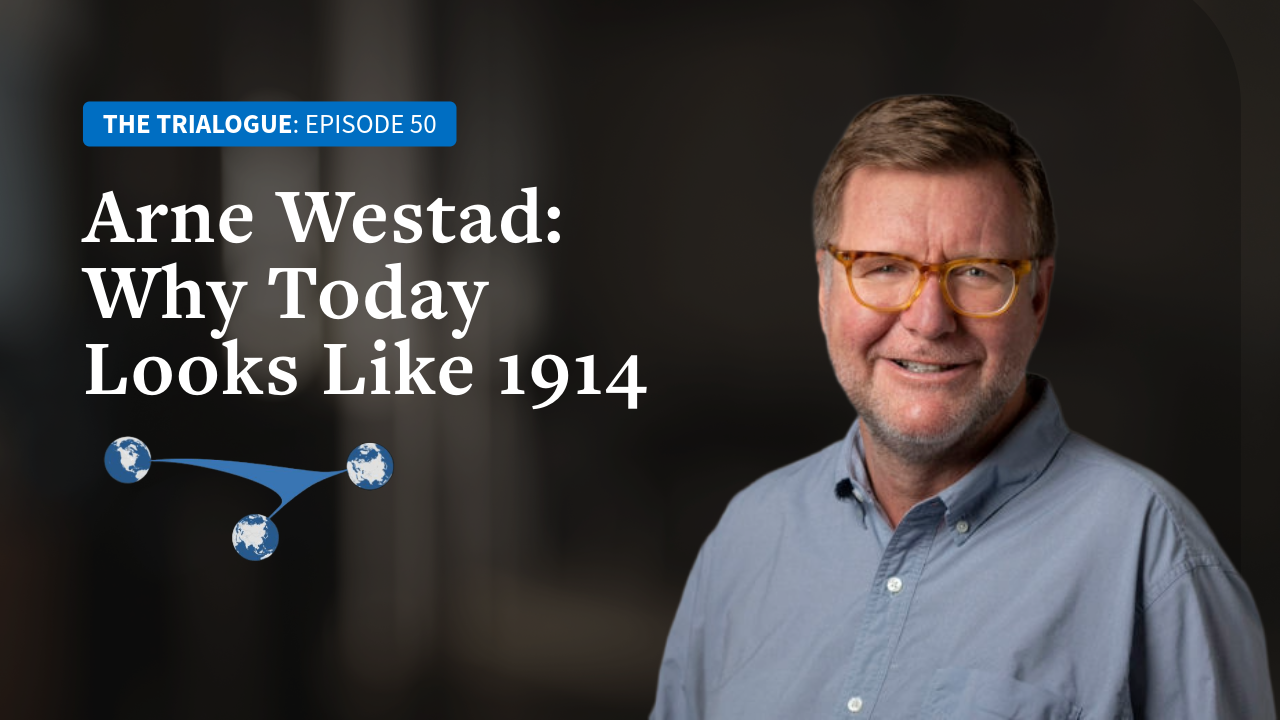
My guest today is Arne Westad, Elihu Professor of History and Global Affairs at Yale University. Professor Westad is one of the world’s preeminent historians and the rare scholar who can write confidently and expertly about China, Russia, the United States, Europe, and just about every other region of the globe.
Today, we discuss his recently published book, The Coming Storm: Power, Conflict, and Warnings from History. I hope you enjoy the episode.
Arne, welcome to the podcast.
Arne Westad: It’s good to be with you, Peter, as it always is.
Peter Slezkine: So, you’ve just published a fantastic book entitled The Coming Storm: Power, Conflict, and Warnings from History. And the warning that you and history provide is that our current multipolar moment closely parallels the period that preceded the First World War. To start, perhaps, you give us a rough outline of your arguments, explain who you think might play what role in this dramatic reenactment of the early 20th century.
Arne Westad: So, this is a book that was written from the very best motive possible, which is sheer irritation with the Cold War parallel or analogy, or similarly, that’s often used today. I don’t think the current international situation reminds me much of a Cold War of any kind.
So, as historians often do, particularly historians who have an interest in contemporary international affairs, I was rummaging around for better parallels, not exact in any way, but better, in order to help us think about the predicament we are in at the moment. And it seems to me, for several reasons, that the time we’re in now has quite a lot of things in common with the time period in the late 19th century and very early 20th century before World War I.
It’s multipolar in terms of orientation, not bipolar like the Cold War. It happens within the same economic system, an expanded form of market-oriented capitalism. And it doesn’t have the ideological divides that you saw during the Cold War, at least not in the form that ideologies determined much of the action in terms of what was going on.
So, those are some of the similarities, I think, with the early 20th century and differences from the Cold War. Of course, there are some similarities with the Cold War as well, which we could explore later on. But as a tool for trying to help us think through the current situation, I think the early 20th century, in many ways, unfortunately, is a better model for what we see today.
Peter Slezkine: Yeah. Well, we certainly hope that your prediction helps us avoid the outcome that we got last time around. So, again, who’s who in this arrangement?
Arne Westad: So, I think the most striking similarities are the ones between Britain and the United States today, and China today and Germany back then. Again, these are not exact comparisons. I mean, there are all differences, obviously, but the main structural similarities seem to hold pretty well.
The United States, like Britain back before 1914, is a former hegemon who starts to get into a situation where both its political class and its population in general start to feel that the predominant power, Britain and, you know, the United States now, does not get enough out of the international system that it itself has created.
So, just like what happened back then, you have this tremendous pressure against 19th-century globalization before 1914, just like you find now in the early 21st century with the United States rethinking its role with regard to the international system, especially the international economic system that it helped create in the 20th century.
There are other similarities we may explore later between Britain and the United States as well. It connects very closely, in terms of my argument, to what Graham Allison put forward when he was writing about Destined for War in the relationship between China and the United States.
But I’m more preoccupied than what Graham is with, you know, the reasons why people choose war under those kinds of situations. So, the agency part of it. I mean, what Taylor talks about at the end of his great book, where he says, you know, “War came because everyone thought that war would solve their problems.” That’s closer to my understanding of that structural relationship.
Germany and China have a lot in common, and I always stress to my Chinese friends that I’m talking about Imperial Germany, not Nazi Germany. You know, I’m talking about a rapidly modernizing, industrializing state that had tremendous success in coming out of next to nothing and then, within one generation, really becoming the predominant power in what was then the world’s most important region, Europe, just like China has done with regard to what, in my view, is the most important region today, East Asia.
Both countries laid claim to a leadership role, which is not by itself unreasonable, within the continent in which they grew up. Both of them used rhetoric that the neighbors often found very threatening, although in reality, their own territorial claims, after they had completed their period of intense early growth, were rather minimal.
And both of them then, unfortunately, ended up being closely linked to a great power in decline right next door. Germany back then, with Austria-Hungary, the Habsburg monarchy, and China today with Russia. And, of course, this is part of what created disaster back in 1914. It was not Germany’s own aims. It could rather be seen on the German side as being the failure of establishment powers, Britain, France, Russia, to accommodate the growth in German power that was the reason for some of the structural conflicts. But it was Germany’s fatal alliance with Austria that created a war.
Peter Slezkine: The parallels between the U.S. and Britain, between China and Germany, I think, are clear. You state them very convincingly, but other parallels are possible. Why wouldn’t China be the United States in the early 20th century? So, Germany was not the only rising power rapidly industrializing within a world dominated by the British empire. The U.S. was doing the same thing, and if we take the pessimistic parallel, China is Germany, but a more optimistic analogy would be China as the U.S., far away, deeply economically entangled in a relationship that doesn’t blow up.
Arne Westad: I am not even sure that’s the more positive parallel because I could easily see ways in which Chinese power being used in ways that the United States now is throwing its power around in the world could also lead to global disaster. But that aside, I think the main problem with drawing that analogy is the enormous difference in terms of the structural relationship that exists between the two.
So, in the early 20th century, Germany was a power that grew tremendously. So was the United States. It’s true that there was an ocean between the United States and Europe, but that, of course, didn’t prevent, in the end, the United States from also getting drawn into the very same war, though it was not one of the causes for actually unleashing it. So, I think…
Peter Slezkine: And pulled in by Britain rather than—
Arne Westad: Very much pulled…
Peter Slezkine: …contend with Britain.
Arne Westad: Absolutely. And I think for China today, there is a very significant physical distance between China and what goes on in the Middle East or goes on in Europe.
But the problem is that many of the conflict points that we are looking at today, those that could be similar in many ways to the kind of Bosnia or Balkan events or Belgium before World War I, they are now within China’s own area, within its own region. So, that’s fundamentally different, I think, from the position of the United States, and one that we should notice.
And I think this is one of my main worries, as you have known from reading the book, in terms of dynamics, is that, you know, we have all these structural tensions that have been building for quite some time, and then we have these potential flashpoints, many of whom are very, very close to China’s own borders. And that’s, of course, the real problem in terms of creating the basis for armed conflict, the way I see it.
Peter Slezkine: And those potential flashpoints are Taiwan, the Korean Peninsula, and the South China Sea.
Arne Westad: In the immediate region, yes. Though I could also foresee, maybe, especially now, I was in Beijing not long ago, the Chinese reaction to Japan’s obvious realignment in its strategic positioning with regard to China, that further conflict could come out of that relationship.
And then, of course, slightly further away, but quite important in many ways to the argument in the book, is China’s relationship with India and the potential for a real serious conflict between those two rising great powers, which indeed both of them are, with a particular emphasis that a lot of people in Beijing now believe, just like the Germans believed about Russia before the First World War, that in terms of the moment, Indian power with regard to the South Asian region will be rising very fast over the next generation, which creates increased tension with China because of China’s very, very close relationship with Pakistan.
So, there’s lots of potential conflict in that surrounding area that really worries me.
Peter Slezkine: If you just look at the size of China and India, it seems like rivalry is inevitable. I mean, it already exists and could erupt into conflict, which it already has. On the other hand, China and India have existed side by side for thousands of years and avoided great-power war. Skirmishes in the Himalayas are a different matter.
So, the Himalayas are an obvious and insurmountable obstacle, even with modern technology. So, do you think that the pressures are just building and these two giant entities are bound to clash, or is it going to be some sort of indirect scenario where it’s India-Pakistan, with Pakistan as a Chinese proxy and not a direct Indian-Chinese clash at their common border?
Arne Westad: It’s very hard to say. If you try to approach this particular rivalry rationally, of course, from both perspectives, Pakistan would come across as much more significant in overall strategic terms than the relationship in the higher Himalayas.
But even so, there is something about national borders, and particularly national borders when it comes to a post-colonial society like India and a recently arrived great power like China, that makes these particularly explosive, as we’ve seen on more than a few occasions over the past generation or so, or two generations almost by now.
I think what is starting to get the attention of people in Beijing, now, traditionally, as you know, the situation here has been that India has paid a great deal of strategic attention to China, and China has paid almost no strategic attention, except in times of crisis, to India. That’s now starting to change.
And part of the realization, I think, that has brought that about on the Chinese side is the simple fact that, in a generation and a bit, India’s population is going to be close to three times that of China. And it’s going to be a young population, very different from China’s exceptionally rapidly aging population. And, of course, this will have an impact on the power relationship between the two sides.
It’s not going to happen overnight. It’s going to be a slow process, but it forces, I think, at least some of the people I speak to in Beijing to re-envisage their overall relationship with India going forward in ways that I hadn’t really expected to see at this particular point.
Peter Slezkine: The raw numbers in the Indian case are obviously impressive, and they don’t have the demographic problems that China does, again, if you just look at absolute terms. But in the book, you mention the problem of the Hindu-Muslim divide within India and in South Asia more generally.
There are many other divisions within India by caste and community and language and so forth, which make counting numbers different qualitatively than in China, where it’s 80% Han and becoming ever more homogenous over time. So, sort of, a billion here and a billion there aren’t exactly the same thing because India, in some sense, is internally fragmented more than Europe is, whereas China is the largest nation-state in the world.
So, when you talk to the Chinese, and they worry about Indian demographics, do they ever, sort of, consider this difference, or for them, all that matters is the Excel spreadsheet and the huge numbers that they see across the Himalayas?
Arne Westad: So, I think there is a point in this. I mean, I think China’s great uniformity in ethnic terms, if you think about it in terms of numbers, 92%, 93% Chinese or Han, as they now call themselves, is very different from India’s composition. On the other hand, I think that’s…
Peter Slezkine: Yeah. There’s 80%… I think that’s the Russian figure. There’s 80% ethnic Russians in Russia and 90% Han in China.
Arne Westad: Exactly. I think, I mean, on the Indian side, of course, this is a tension, but it’s a tension mainly in, sort of, broader regional terms. I wouldn’t claim in any way that India has resolved its ethnic and religious tensions, but it is still striking to see the degree to which, even under the current very difficult circumstances, non-Hindu Indians link in with the Indian state.
I was struck at this most recently in a hearing on the recent Indo-Pakistani clashes, where the Indian military were represented by a presenter in uniform who was a young Muslim Indian officer, female officer. And the main presenter of the Indian strategic position was a young female Indian Sikh officer.
And I thought this was really striking. I mean, it doesn’t mean that there aren’t problems in these terms with regard to the current Modi government in India, but it would be very, very different than anything that you could imagine possible in China.
So, I’m not so sure. I mean, the traditional idea in China, as you may know, is that India isn’t a real country. I mean, India is a colonial concoction put together by the British that doesn’t have enough cohesion in it to challenge China as a great power. I think that’s wrong.
I mean, I think over time, both of these will have forces that will threaten to pull them apart politically, maybe especially more than ethnic. But I think that India has more opposition overall in terms of its domestic composition, its economic growth, its education levels, its use of English in reality as a national language, that it will be a formidable challenger to China, particularly with regard to South Asia.
It’s South Asia that, in reality, is the issue here, possibly with regard to Southeast Asia as well. But, of course, these are areas that are of crucial significance to China as well as to India.
Peter Slezkine: There’s always a danger in Orientalizing and assuming that the non-West is somehow special and then perhaps more Pacific than the eternally riven West. But to what extent is there sort of a criticism of your story that this is a universalization of a particular Western condition, that World War I, because of the power of the West spread throughout the world, and again World War II, but what extent is globalization now so strong a force that the whole world is like Europe 100 years ago?
Arne Westad: So, I think one has to be careful with seeing too much difference. Of course, there are differences. I mean, there are cultural, historical differences in terms of lessons, in terms of the idea of how you can learn from your own background and history between China and, say, European countries.
But this idea, often promoted by the Chinese government, that China is a particularly peaceful civilization, is something that I think most historians of China have never quite bought.
If you look at the map of China, as I sometimes do together with my students both in China and the United States, you should wonder why an empire, a country, has become that big simply through some kind of peaceful osmosis of its culture. That’s not been the case.
China has, just like Europe, varied between time periods of intense warfare and periods of relative peace. I do not think that there is any lack of expansionist drive historically when you look at China.
Now, how that is going to play itself out in our day is very, very hard to tell. I mean, I think it is possible to make an argument that says that China, in and by itself, as I alluded to earlier on, does not have significant territorial demands against all the powers. They do have territorial demands, but not of the size that indicates that China would go on some kind of rampage in Eastern Asia or all over Asia to establish territorial conquests.
I mean, it thinks about power in very different terms today from what, for instance, Russia does. But I’m not sure that we could rule out the use of force. I mean, I think with regard to Taiwan, which is seen as a question of reunification by more Chinese, the issue of Korea, where the big question is what happens when North Korea goes, in all of these settings, South China Sea, for instance, I think there will be a strong temptation on the Chinese side to use force to achieve one’s aims when that force is available and when one thinks that that force can be employed without getting into a larger great-power conflict.
And that, of course, again, brings us back to the situation before 1914 because this is what was generally thought, that if, you know, one could have a successful small great-power war, which would not really develop into a world war, then sometimes, under some circumstances and conditions, that risk might be worth taking. And that’s what worries me in terms of China’s position.
Peter Slezkine: Well, it’s clearly true that people are violent all over, that the West isn’t necessarily unique in its love of warfare and conquest. The Chinese great text Three Kingdoms is all about war in that area. The Bhagavad Gita is about a battle. So, the Indians are not immune either.
But to return to the question of geography and globalization, is it not perhaps unusual that European wars spilled out into the world during this long colonial period, where, through technological imbalances, they dominated? Otherwise, there have been many wars in South Asia, many wars in what is now China, many wars on the European continent, and so on and so forth, that mostly stay where they are.
And then, just to push that point further, there are any number of fires around the world at the moment, Ukraine, Palestine, Iran, India, Pakistan, and so far, there are interconnections, but essentially they’re all more or less separate. So, why do you think they’re going to combine into one big world war and not just remain regional as they have been for much of human history?
Arne Westad: So, I think on that point, what is really striking, I think, with our own time is the potential for several of these regional conflicts to come together in a global configuration. I mean, in a way that is similar in a world that was somewhat smaller in the period before 1914.
I mean, everyone then thought that regional wars, regional conflicts, could be kept regional until they could no longer be kept regional under a set of circumstances that no one could foresee. The acute crisis coming out of a black swan terrorist action in the summer of 1914 made these conflicts come together in ways that were profoundly destabilizing. And I think the same thing is very much true with regard to our world today.
You know, for almost as long as I’ve been studying these things, there was this idea that what happens in the Middle East, terrible as it is, stays in the Middle East. That’s no longer the case. And I see, you know, that very clearly with the current U.S. war on Iran, that the potential of this becoming a much wider conflict under the wrong kinds of circumstances is definitely there.
The same thing with the Russian war in Ukraine. The potential for it to spill over has often been seen as being very limited, but under circumstances that are ever-changing in terms of the global constellation, I could easily see how that one could contribute as well to a much bigger disaster.
So, this is part of the argument in the book, is that given what we know about the past, it is imperative for us to find some kind of settlement, at least in ceasefire terms, of these regional conflicts because if we don’t do that now, I’m very fearful that if a world-class crisis of some kind that no one could really foresee at the moment should come along, the chances are that we would not be able to pull back, much in the same way as we were not able to pull back in 1914, and that the ongoing conflicts would contribute to a global disaster.
Peter Slezkine: I mean, it’s clearly true that the more fires we have blazing, the greater the danger that they feed into one another and the whole forest burns down. On the other hand, what has really been striking over the last, let’s say, five years is how they have almost all remained confined to the original area because in the World War I scenario, you would see Russia and China involving themselves directly in the war in Iran or China involving itself directly in the India-Pakistan conflict from a while ago.
Ukraine has been amazingly limited to the borders of Ukraine, despite the large number of actors involved. So, it does seem that, at least for now, there is a strong tendency for these regional conflicts actually to remain regional and for nominal allies and partners of parties involved in the conflict to maintain a certain distance. And this is not a dance that we want to go on forever because it’s such a dangerous one, but it’s an interesting dynamic.
Arne Westad: I think that’s absolutely right, and the parallels are almost exactly what happened before 1914, that the Balkan Wars, the Boer War, other kinds of warfare that were taking place, were seen as being very regional until they, you know, were not, in the sense that they contributed to the kind of climate, the kind of idea on the side of all great powers that they had to take offensive action. If not, you know, they would be left behind in colonial terms or in European terms.
And I think this is the danger that we are running at the moment, is that it’s so easy to see the current conflicts in regional terms, which indeed they are, I mean, in terms of their background and their origin and the format that they have, and therefore incapable in that bigger sense to contribute to a global configuration.
But I think one of the warnings from 1914 is, in many ways, exactly the opposite, that under the right or the wrong kind of circumstances, these conflicts that are not necessarily seen as being strategic in a global sense in nature help create the kind of framework, the kind of overall positioning that makes a global war possible.
Usually, there has to be an exceptional trigger for that kind of thing to happen, right? But I don’t think we should be drawing parallels too closely with what has happened in the past. My purpose, in a way, is to warn people about what happened in this particular first disastrous world war and how that came to be, in terms of the conflicts that were ongoing beforehand. Because in that case, there was a trigger. If it hadn’t been that particular trigger, my own view is that probably within a reasonable period of time, it would’ve been something else.
So, the problem is the high level of tension that is created by ongoing conflicts and by other forms of structural rivalry and fear and resentments that I talk about in the book, creating a climate under which world war is in no way certain, but increasingly likely.
Peter Slezkine: To what extent do you worry that your warnings, similar warnings by your former colleague Graham Allison at the Kennedy School, might contribute to the conflict?
So, you could issue a warning, drench everybody in cold water, and get them to wake up from this, sort of, mesmerized condition. Or you could contribute to the general feeling of anxiety that then puts everybody on a hair trigger.
So, is there a dangerous sort of game that you have to play here, that you have to provide your counsel carefully enough that it doesn’t create an atmosphere of total anxiety that then helps set the conditions for future war, for which you will then be blamed?
Arne Westad: I think what I’m writing, Peter, is a warning, not a prophecy. I point out in the book that I think there are still a lot of things that people can do, both at the leadership level and at the more general level, in order to try to move us away from the kind of development that I now see as a real possibility going forward. So, this is not about prediction. It is about warning, and it’s about getting people to take these kinds of things seriously.
Look, I mean, almost no one alive today has experienced great-power war. We’ve experienced a lot of other disastrous wars, and, you know, they’ve been terrible for people who have gone through that nightmare. But we haven’t experienced great-power war, which is war and suffering on a completely different level in terms of numbers than what other conflicts would lead to.
I often make this point that, in the first two weeks of the Battle of the Somme in the summer of 1916, more soldiers were killed than in all great-power wars put together over the past hundred years. And I do think that’s the kind of warning that we need to take seriously. It’s not a prediction, but it is a sense of what actually could happen.
I think my worry is mainly this, that there are so many people today, maybe especially people who think back to the Cold War era and people who experienced the Cold War era, of whom there is a great number alive today, who believe that this system that we are in now is much more stable than what it actually is, right? And therefore, the outcome could be similar to the kind of outcome that we got in the late 1980s and early 1990s with regard to the Cold War. I do not think that’s possible.
I still hope that it will be possible to avoid global conflict of the kinds that we lived through in the 20th century. But if we are going to do that, then we have to think through how we can avoid it. I mean, what kind of measures do we need to take in order to abate the kind of situation that we have today?
So, that’s the spirit in which it is written. Now, I do generally tell people, especially here in Europe, where many people are likely to take my advice on this at least, that, you know, if you read a book at night, you should at least have some strong drink next to you. It’s not a happy book, though it’s a necessary book.
Peter Slezkine: So, two final questions. You draw a parallel between Britain in the early 20th century and the U.S. today. And the parallel is strong, and in some sense it’s not even a parallel, but one continuous line because the U.S., in many ways, inherited the British Empire, was a product of it, and now has, sort of, taken over much of that system that Britain created.
On the other hand, there are strong structural differences. Britain was a global hegemon, ruled the sea, but it was a tiny island right next to a big, complicated continent. So, the unraveling of empire was an existential threat, whereas the United States was immensely powerful on its own in the Western Hemisphere before it assumed these global burdens, and perhaps drawing them back will be very painful and could produce all sorts of awful conflict, but it might not need to because, again, unlike Britain, it could, in theory, cast off a lot of these global interests and responsibilities.
The places that you name in Asia, for example, as most likely to lead to great-power conflict, are very far away from the United States. So, what is the, I guess, optimistic case for a difference between the United States and Britain if the world wars are construed as sort of symptoms of the British Empire in decline?
Arne Westad: That’s a really good point, and it’s also, I mean, it’s entirely correct in the sense that one of the things that I point to in the book that should be able to provide us with at least some hope is exactly that structural difference, and it is a significant difference.
I mean, the United States today is much more of a global power in terms of its friendships and its alliances and its established positions than what Britain ever was. Britain had a huge empire, but it had to fall back on that empire in order to think about itself globally. The United States doesn’t need to do that, or at least hasn’t needed to do that up to very, very recently.
So, my worry now is that, at least in some of the directions taken in U.S. foreign policy, the United States is discarding exactly those unique abilities that the United States has to keep the world more safe. Not entirely safe. The United States has made some terrible mistakes and misjudgments in terms of its foreign policies since the Second World War. But overall, particularly since the Cold War ended, the United States has generally been seen as a force for stability within a gradually fragmenting international system.
I think over the past few years, it’s pretty clear that that’s no longer the case. And I think that will have very significant effects for the world, and I think it will have very significant effects for the United States, not in the direction, as you correctly observed, that this drawback would necessarily impede U.S. national security in a limited sense, but it would be hugely destabilizing in a global sense.
I mean, think about Eastern Asia, for instance. If there is one thing that part of the world does not need at the moment, it is uncertainty about American alliances and friendships, because that would be exactly what could make China move in the direction of what would almost certainly be terrible mistakes in terms of its use of power against others.
Again, this is a parallel to what happened in the early 20th century, but it’s a parallel in a slightly different sense. This is not about the comparison between the United States now and Britain back then.
The United States today, if it wants to develop in that direction, has much more power internationally than what Britain ever had, you know, even beyond its military capabilities that were global in a way that Britain never were. But the question is, is there the political will in the United States to think, at least in a limited way, systemically about the kind of situation that we are in now?
And I’m not saying this because I think the United States is, sort of, doomed forever to be the world’s policeman. I think much of what has happened since the mid-2010s has made sense to me. I mean, the fact that the United States wants to concentrate more on its own domestic issues and challenges, including the absolute necessity of providing better for its own population, is quite logical, and there is absolutely nothing wrong in that.
The problem is that if that leads to a sense of uncertainty in terms of America’s engagement in the world over a short period of time, I think that could be tremendously destabilizing. And that’s what I hope we won’t see with regard to Eastern Asia, where it’s particularly important, but also with regard to Europe.
Peter Slezkine: Well, I actually think that certainty that the U.S. will retrench to more defensible borders would make stable future equilibria all over the world more likely than if the U.S. seeks to maintain positions that it can’t possibly sustain. But we can engage in that argument—
Arne Westad: I disagree with you on that, Peter. It’s a question of time. It’s not a question of direction, but it’s a question of time.
Peter Slezkine: Very good. Well, so one final question. Of the great powers that you list in the book — U.S., China, India, Russia, and Europe as a whole — who has the best prospects on a 50-year timeline?
Arne Westad: Probably, if you look at it in a global comparative sense, in terms of the starting points that you’re seeing now, I would say India.
I think, in many ways, if India avoids a great-power war, which would be essential because it’s still in the early stages of its development, and if it avoids the kind of fracturing at home, which is a distinct possibility, then I think it has all of the factors connected to it that, relative to others, it would do remarkably well.
But look, the overall point here is that I think if war is avoided at a great-power level and if these countries concentrate on trying to put what happens within their own borders in order, all of them have tremendous power and tremendous opportunities, including Russia, which is the one that is going downhill the fastest.
But then they have to do that, and they have to do it in a meaningful kind of way that connects not just to what happens domestically in a limited sense, but happens to connect to the stability of the world overall. That’s a challenge. That will be the challenge over the next generation.
Peter Slezkine: Well, fantastic. That’s an optimistic note, so we don’t have to end with a depressing draft of stiff whiskey, but a celebratory champagne.
Arne Westad: I like that.
Peter Slezkine: Well, thank you very much.
Arne Westad: It’s been a great pleasure. Thank you.
Peter Slezkine: Thanks for listening to The Trialogue Podcast. Make sure to subscribe to the show so you don’t miss out on any episodes. The Trialogue Podcast is hosted by the Stimson Center and produced by University FM.



Current Geopolitics Shift Deep-Sea Mining Debates