Each shaded box corresponds to a year the country appeared on the CSPA list and what types of waivers it received, if any.
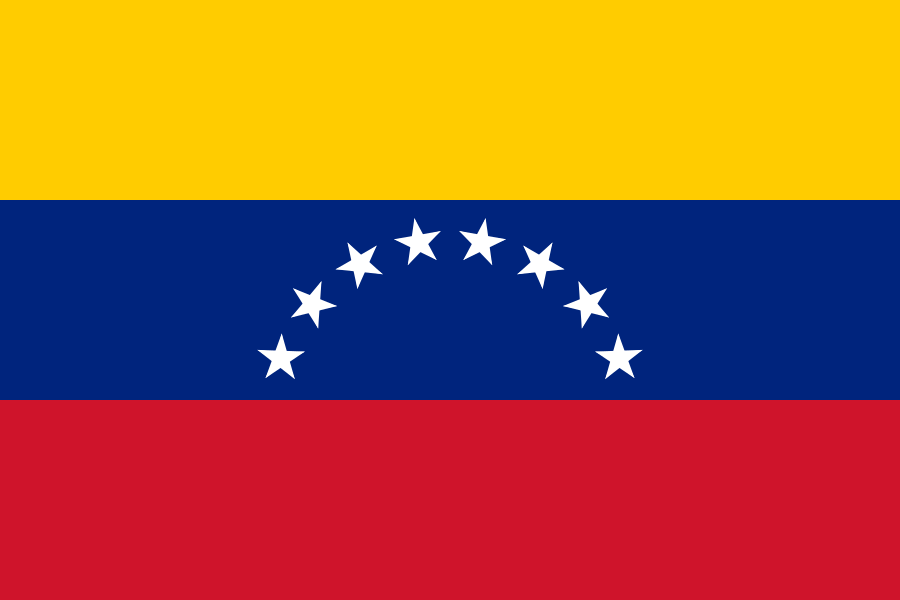
Venezuela has appeared on the CSPA list for five consecutive years beginning in 2021. The U.S. president has not waived CSPA prohibitions against the provision of U.S. arms sales and military assistance to Venezuela for any of the years it was listed, although, according to public data, the country has not been slated to receive arms sales or military assistance subject to the CSPA since being listed. As a result, it is likely that no U.S. arms sales or military assistance to Venezuela have been waived or prohibited due to the CSPA.1These calculations are based upon publicly available data. See the ‘Methodology’ page for an in-depth review of the Tracker’s methodology and sources.
According to the U.S. State Department, as recently as March 2025 (the end of the reporting period for the 2025 Trafficking in Persons Report) Venezuelan authorities under the Nicolás Maduro government provided support and a permissive environment to non-state armed groups that recruit and use child soldiers, including the National Liberation Army (ELN), Segunda Marquetalia, and Revolutionary Armed Forces of Colombia — People’s Army (FARC-EP).2Government of the United States, U.S. Department of State. “Venezuela – Trafficking Profile,” in Trafficking in Persons Report 2024, https://www.state.gov/reports/2024-trafficking-in-persons-report/venezuela/.; Government of the United States, U.S. Department of State. “Venezuela,” in Trafficking in Persons Report 2025, https://www.state.gov/reports/2025-trafficking-in-persons-report/venezuela/. Non-state armed groups, including the ELN and FARC, are alleged to have forcibly recruited children and used child soldiers in combat to grow their operations and strengthen their influence in Venezuela as well as in neighboring countries with limited governance.3Government of the United States, U.S. Department of State. “Venezuela – Prosecution,” in Trafficking in Persons Report 2021, pp. 603-604, https://www.state.gov/wp-content/uploads/2021/09/TIPR-GPA-upload-07222021.pdf (https://www.state.gov/reports/2021-trafficking-in-persons-report/venezuela/).; Government of the United States, U.S. Department of State. “Venezuela – Trafficking Profile,” in Trafficking in Persons Report 2023, https://www.state.gov/reports/2023-trafficking-in-persons-report/venezuela/.; Government of the United States, U.S. Department of State. “Venezuela – Trafficking Profile,” in Trafficking in Persons Report 2024, https://www.state.gov/reports/2024-trafficking-in-persons-report/venezuela/. High-ranking officials linked to former president Nicolás Maduro, members of Venezuela’s security forces, and local authorities reportedly colluded with, tolerated, and allowed these groups to operate in the country with impunity since at least 2019.4Government of the United States, U.S. Department of State. “Venezuela – Trafficking Profile,” in Trafficking in Persons Report 2021, pp. 604-605, https://www.state.gov/reports/2021-trafficking-in-persons-report/venezuela/.; Government of the United States, U.S. Department of State. “Venezuela,” in Trafficking in Persons Report 2025, https://www.state.gov/reports/2025-trafficking-in-persons-report/venezuela/. In 2019, Venezuela’s armed forces also allegedly ordered army, national guard, and various militia members in states bordering Colombia to avoid engaging unspecified allied groups in Venezuelan territory, some of which may exploit children as soldiers, and encouraged the armed forces to aid and support their operations.5Government of the United States, U.S. Department of State. “Venezuela – Trafficking Profile,” in Trafficking in Persons Report 2020, pp. 531-532, https://www.state.gov/wp-content/uploads/2020/06/2020-TIP-Report-Complete-062420-FINAL.pdf (https://www.state.gov/reports/2020-trafficking-in-persons-report/venezuela/).
For more information, see the U.S. State Department’s 2025 Trafficking in Persons Report and 2024 Country Reports on Human Rights Practices.
You can opt out at any time. We respect your privacy and will not sell your personal information. See our privacy policy for more.