Introduction
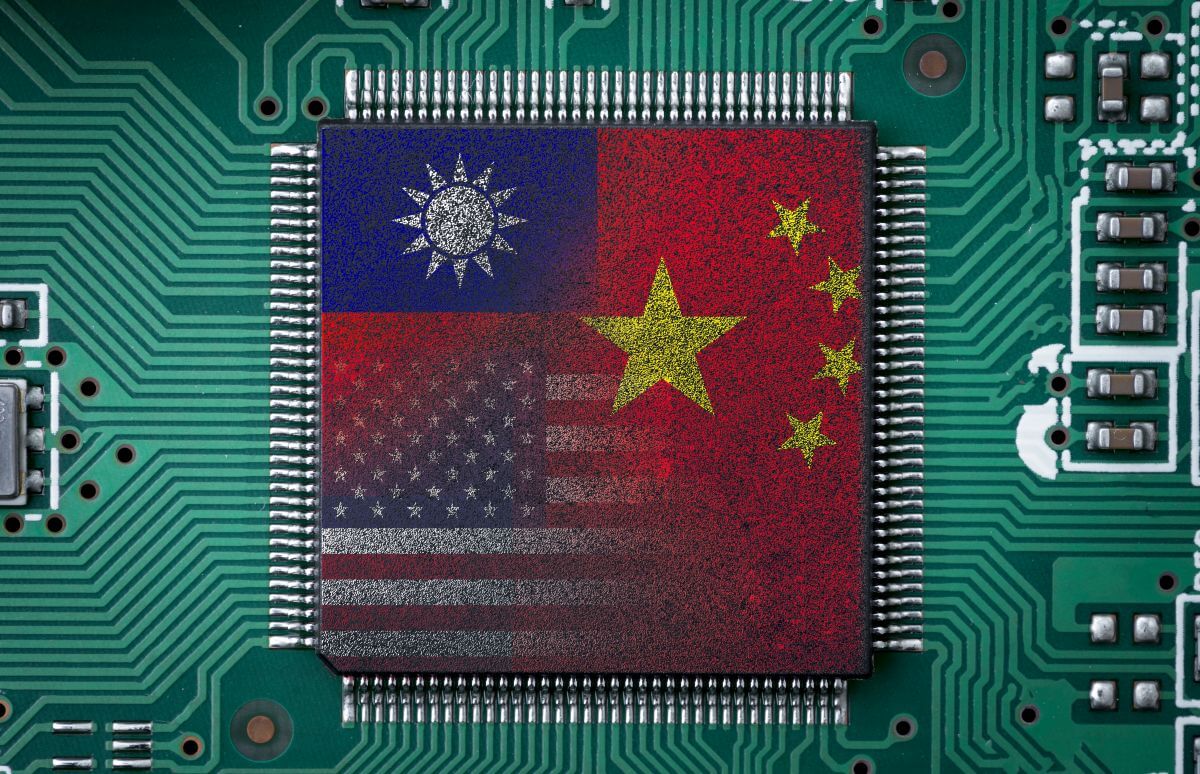
Could Taiwan’s massive investments in a semiconductor manufacturing hub in Arizona weaken its famous “silicon shield,” or will it better enable the United States to assist Taiwan? The U.S. Secretary of Commerce, Howard Lutnick, expressed the logic of the Trump administration on the silicon shield in a September 27 interview, noting that Taiwan produces 95% of the global supply of advanced semiconductors:
“[The production concentration] is not healthy for you [Taiwan] or healthy for us [the United States] because we protect you, and for us to protect you, you need to help us achieve reasonable self-sufficiency. … Let’s get to 50-50. We’re producing half and you’re producing half. We’re still fundamentally reliant on you because we can’t live without the other half. But if we have half, we have the capacity to do what we need to do, if we need to do it.”1NewsNation, “Lutnick talks economy, H1-B visas, Trump-Musk with Batya Ungar-Sargon,” via YouTube, uploaded September 27, 2025, https://www.youtube.com/watch?v=dPbY-YQAIOA. For the Taiwan and silicon shield segment of the interview, start at 03:51.
The administration’s onshoring effort is accelerating. In March, concerned about looming U.S. tariffs, Taiwan’s largest semiconductor manufacturer, TSMC, pledged an additional $100 billion investment in its Arizona compound, bringing the total to $165 billion — a significant jump from its initial $12 billion investment in 2020. TSMC is a large company in high demand, producing more than half of the world’s semiconductors, but this is a staggering investment. It reflects not only the importance of the United States as the country where TSMC sells the most advanced chips but also the United States’ status as Taiwan’s most important international partner.
The silicon shield concept is central to understanding how Taiwan views its semiconductor industry. There is no doubt that the semiconductor industry is critical for Taiwan’s economy: The entire industry is 18% of Taiwan’s GDP and accounts for 60% of its exports,2Gary Chen, “Silicon shield to ‘global TSMC’,” Taipei Times, March 10, 2025, https://www.taipeitimes.com/News/editorials/archives/2025/03/10/2003833151. driving Taiwan’s economic growth as other sectors of the economy weaken in an uncertain environment exacerbated by the shifting U.S. tariffs.3For the August 2025 assessment of Taiwan’s economy, see: Taiwan Institute of Economic Research, “Economic Forecast – Monthly,” updated September 25, 2025, https://english.tier.org.tw/eng_forecast/monthly.aspx. Whether the industry is critical for Taiwan’s security is open for debate, but many Taiwanese believe the silicon shield provides a real source of deterrence and security.4“二月份民本調查-國際現勢,” Foundation for the People, February 24, 2025,
https://ffpeople.org/%e4%ba%8c%e6%9c%88%e4%bb%bd%e6%b0%91%e6%9c%ac%e8%aa%bf%e6%9f%a5%ef%bc%8d%e5%9c%8b%e9%9a%9b%e7%8f%be%e5%8b%a2/.
Experts have closely examined the silicon shield dynamics in recent years as cross-Strait tensions have increased, assessing whether it bears out in reality.5For illustrative examples, see: Stella Robinson, “Is the ‘Silicon Shield’ Real?” Domino Theory, September 6, 2024, https://dominotheory.com/is-the-silicon-shield-real/; S. Weil, J.S. Gottwald, and M. Taube, “The European Union, Taiwan, and the Silicon Shield argument: a conceptual assessment through the lens of grand theories,” European Politics and Society, 26(3), 2024, 537-563. https://doi.org/10.1080/23745118.2024.2417028; Richard Cronin, “Semiconductors and Taiwan’s ‘Silicon Shield,’” Stimson, August 16, 2022, https://www.stimson.org/2022/semiconductors-and-taiwans-silicon-shield/. The silicon shield has two components, deterrence and indispensability. The shield helps to deter China from attacking Taiwan directly because China would want to avoid damaging the island’s valuable chip industry and disrupting its own tech supply chains, which are closely integrated with Taiwan’s chip industry, especially in the production of the legacy chips. Taiwan’s indispensable role in the semiconductor supply chain would also give other countries a reason to object to an attack, to avoid losing their access to these chips. By this logic, the United States, whose companies purchase most of the advanced chips, would have the greatest interest in the protection of Taiwan’s chip industry.
Both parts of the silicon shield have valid counterpoints. China views Taiwan as a core interest and unification as “inevitable,”6“Xi says no one can stop China’s ‘reunification’ with Taiwan,” Reuters, December 31, 2024, https://www.reuters.com/world/china/xi-says-no-one-can-stop-chinas-reunification-with-taiwan-2024-12-31/. so the silicon shield ultimately may not dissuade China from military action. The silicon shield also does not defend against China’s many gray zone tools to pressure the island without attacking.7For an overview of China’s gray zone toolbox, see: Chin-Kuei Tsui, “China’s Gray Zone Activities and Taiwan’s Responses,” Stimson, December 12, 2022, https://www.stimson.org/2022/chinas-gray-zone-activities-and-taiwans-responses/. Besides that, China is building its own domestic chip industry, so in the future, China might not need to be so reliant on Taiwan’s industry, and China’s current lack of access to advanced chip manufacturing technology might even be more incentiveto capture the island.8Chen-Yuan Tung (ed.), “Taiwan and the Global Semiconductor Supply Chain: China’s Pursuit of Semiconductor Self-Sufficiency,” Taipei Representative Office in Singapore, April/May 2025, https://www.roc-taiwan.org/uploads/sites/86/2025/04/250401_April_May_Issue_final.pdf.
For other countries, despite the growing demand for semiconductors,9Semiconductor Industry Association, “State of the U.S. Semiconductor Industry 2025,” 2025, 24, https://www.semiconductors.org/wp-content/uploads/2025/07/SIA-State-of-the-Industry-Report-2025.pdf. there is no direct line between needing chips and what any given country would be willing to do to mitigate the possibility of or respond to a conflict in the Strait. Many other factors would play into countries’ decisions around a contingency, particularly the risk of escalation. Despite Lutnick’s assurance that the United States protects Taiwan for access to the chips, Washington has favored strategic ambiguity for decades, leaving the U.S. response to a cross-Strait contingency, and therefore its role in the silicon shield, unclear.
But the risk that a conflict poses to the semiconductor supply chain is very real. The high concentration of chip production in Taiwan has prompted the United States to attempt onshoring more of the supply chain. Of the two parts of the silicon shield, it is the potential threat of hollowing out Taiwan’s chip industry by the U.S., its unofficial but highly consequential partner, that has generated anxiety in Taipei this year. The ultimate impact of TSMC’s unprecedented Arizona investments on the silicon shield will take years to play out, and a close look at the dynamics of TSMC’s investments in the U.S. suggests that the silicon shield is safe for now. Yet Washington’s demands are shaking Taiwan’s confidence in the United States. In the long run, that is a much bigger and potentially defining problem.
Is Taiwan Replaceable in Chip Production? The Not-So-Simple Economics
Taiwan’s semiconductor foundries, including TSMC, have cornered 78% of global market share10Taiwan Semiconductor Industry Association, “Overview on Taiwan IC Industry: 2025 Edition,” July 8, 2025, 3, https://www.tsia.org.tw/EN/PublOverview?nodeID=60. and 92% of the manufacturing capacity for the most advanced chips.11Lin Jones and Sarah Krulikowski, “Taiwan—The Silicon Island,” U.S. International Trade Commission, Executive Briefing on Trade, February 2024, https://www.usitc.gov/publications/332/executive_briefings/ebot_silicon_island_taiwan_semiconductor.pdf. (Taiwan is also a major player elsewhere along the supply chain, with nearly half of packaging and testing revenue and 17% of design revenue.) American companies, especially the tech giants of Silicon Valley, are TSMC’s best customers by net revenue, designing the semiconductors that TSMC’s foundries produce. While TSMC declines to break out the U.S.’s share of its net revenue, North America as a whole was 70% in 2024.12TSMC, “Annual Report 2024,” March 12, 2025, 17, https://investor.tsmc.com/sites/ir/annual-report/2024/2024%20Annual%20Report-E.pdf. Revenue is a key metric to consider because of the high cost of advanced chips (defined for now as ≤10 nanometers13Raj Varadarajan et al., “Emerging Resilience in the Semiconductor Supply Chain,” Boston Consulting Group and the Semiconductor Industry Association, May 2024, 33, https://web-assets.bcg.com/25/6e/7a123efd40199020ed1b4114be84/emerging-resilience-in-the-semiconductor-supply-chain-r.pdf. ) compared to legacy chips (≥28 nm), which have significantly cheaper production costs per chip.
Most of the chips produced globally each year are legacy chips, made with older, well-established semiconductor manufacturing technology and processes, but the advanced chips receive the most capital investments14Raj Varadarajan et al., “Emerging Resilience in the Semiconductor Supply Chain,” Boston Consulting Group and the Semiconductor Industry Association, May 2024, 13, https://web-assets.bcg.com/25/6e/7a123efd40199020ed1b4114be84/emerging-resilience-in-the-semiconductor-supply-chain-r.pdf. and are critical for technological advancements. And though China has the greatest share of fabrication capacity for legacy chips, global capacity is still diverse.15Raj Varadarajan et al., “Emerging Resilience in the Semiconductor Supply Chain,” Boston Consulting Group and the Semiconductor Industry Association, May 2024, 14, https://web-assets.bcg.com/25/6e/7a123efd40199020ed1b4114be84/emerging-resilience-in-the-semiconductor-supply-chain-r.pdf. The story is very different for advanced chips like those made by TSMC. Most of TSMC’s chips are currently produced in fabrication plants located in Taiwan. Though the first of TSMC’s six planned Arizona fabs is in operation, the hub is still years away from completion and its full production capacity.
In the meantime, U.S. demand will far outstrip what the Arizona fabs and other US-based chip manufacturing can supply, with American companies responsible for more than half of the total global semiconductor revenue. The rapid growth in semiconductor manufacturing on U.S. soil is only estimated to reach about 14% by 203216Raj Varadarajan et al., “Emerging Resilience in the Semiconductor Supply Chain,” Boston Consulting Group and the Semiconductor Industry Association, May 2024, 14, https://web-assets.bcg.com/25/6e/7a123efd40199020ed1b4114be84/emerging-resilience-in-the-semiconductor-supply-chain-r.pdf. — certainly a significant increase for the United States, which has specialized in chip design for decades, but not enough for supply to meet domestic demand. The United States can expect to import semiconductors from Taiwan for years to come; Lutnick even observed that the U.S. would remain “reliant” on Taiwan for its chips.
Moving beyond the law of supply and demand, there are several other challenges that TSMC faces with its U.S. investments that will preserve Taiwan’s position on top of the foundry market. The first is Taiwan’s dominance of advanced chip production. The road to a new fab is long, requiring several years of construction and time to bring its yield — the percentage of chips on a wafer that are successfully produced — to a level that ensures profitability. TSMC says that the first Arizona fab’s yields for 4 nm chips are similar to its Taiwan-based fabs,17TSMC, “Annual Report 2024,” March 12, 2025, 7, https://investor.tsmc.com/sites/ir/annual-report/2024/2024%20Annual%20Report-E.pdf. but the more advanced the chips become, the more difficult it is to achieve higher yields. The United States has a high demand for advanced chips, particularly for defense and aerospace equipment, and that demand will only grow with the expanding research and development of AI, quantum computing, and other cutting-edge technologies.18Jimmy Goodrich, “Don’t Be Fooled, Advanced Chips Are Important for National Security,” RAND, February 10, 2025, https://www.rand.org/pubs/commentary/2025/02/dont-be-fooled-advanced-chips-are-important-for-national.html). Indeed, part of the rationale behind the Biden administration’s 2022 CHIPS and Science Act was to help secure U.S. access to advanced chips. The most advanced chips, currently TSMC’s 2 nm, are produced only in Taiwan at present, and it will be 2028 at the earliest before the 2 nm chip begins production in Arizona. Taiwan, with an eye to its silicon shield, prohibits the overseas production of its most advanced semiconductors. This rule means that the chips produced by Taiwanese companies in the United States will be a generation behind those made in Taiwan.19Lisa Wang, “TSMC cannot make 2nm chips abroad now: MOEA,” Taipei Times, November 8, 2024, https://www.taipeitimes.com/News/biz/archives/2024/11/08/2003826545.
The pipeline of workers is also a concern. A single fab requires several hundred engineers, who will have education and experience ranging from bachelor’s degrees to PhDs. The labor-intensive production process requires engineers to work onsite, so the TSMC hub in Arizona will eventually need thousands of engineers living in the area. For several years already, analysts have warned about a looming shortage in the semiconductor workforce as TSMC and other companies expand their manufacturing operations in the United States.20For example, see: “Chipping Away: Assessing and Addressing the Labor Market Gap Facing the U.S. Semiconductor Industry,” Semiconductor Industry Association and Oxford Economics, July 2023, https://www.semiconductors.org/wp-content/uploads/2023/07/SIA_July2023_ChippingAway_website.pdf; Rahul Rao, “4500 Fab Jobs Could Go Unfilled in U.S. by 2030,” IEEE Spectrum, May 22, 2024, https://spectrum.ieee.org/configuring-and-controlling-complex-test-equipment-setups-for-silicon-device-test-and-characterization. Significant workplace culture differences between the U.S. and Taiwan, especially with TSMC’s infamously long shifts, might further impede hiring enough American engineers, who can find other opportunities in Silicon Valley.21John Liu, “Why TSMC Has Struggled to Manufacture Chips in Arizona,” New York Times, August 8, 2024, https://www.nytimes.com/2024/08/08/business/tsmc-phoenix-arizona-semiconductor.html. TSMC plans to continue bringing engineers from Taiwan, though experts in Taiwan are divided on whether working in Arizona will be a desirable career move for Taiwanese engineers when the cutting-edge R&D remains in Taiwan.22Discussions with experts in Taipei, August 2025. And despite the Trump administration’s push for TSMC’s investment, counterproductive America First policies, like the $100,000 fee for H-1B visas, announced in late September 2025, will only make it harder for TSMC to get the engineers it needs.23Maria Aspan, “Trump’s new $100K fee on H-1B visas will hurt the tech companies trying to woo him,” NPR, September 20, 2025, https://www.npr.org/2025/09/20/nx-s1-5548568/h1b-visa-fee-trump-tech.
The pipeline of everything else required to manufacture a semiconductor is an even more significant concern. Semiconductor supply chains are complex and stretch across the globe, from design firms like those in Silicon Valley, to the sole advanced photolithography machine company in the Netherlands, to the fabs in Taiwan. A constellation of companies upstream from the foundries provide the raw materials and equipment required to produce chips, and downstream are the packagers and testers. Over the past few decades, Taiwan has developed a sprawling semiconductor industry ecosystem of more than 300 companies, many of them small and medium-sized enterprises (SMEs).24Shu-Ching Jean Chen, “Meet Taiwan’s Little-Known But Elite Semiconductor Makers,” Forbes, August 28, 2023, https://www.forbes.com/sites/shuchingjeanchen/2023/08/28/meet-taiwans-little-known-but-elite-semiconductor-makers/; Taiwan Semiconductor Industry Association, “Overview on Taiwan IC Industry: 2025 Edition,” July 8, 2025, 5, https://www.tsia.org.tw/EN/PublOverview?nodeID=60. Though TSMC may be a giant, its work in Taiwan is made possible and secured by this well-established and relatively complete supply chain.
Replicating such an idiosyncratic situation in the United States will be extremely difficult. Some Taiwanese companies plan to join TSMC in investing in US-based operations,25Elaine Huang, “TSMC Suppliers from Taiwan Team Up to Survive in the United States,” Commonwealth Magazine, April 2, 2025, https://english.cw.com.tw/article/article.action?id=4041. but many SMEs lack the capital necessary for international expansion, even with TSMC’s assurance of productivity. Supplies shipped from these smaller Taiwanese companies to Arizona will likely face the Trump administration’s 20% tariff on Taiwanese exports — another shortsighted America First policy. This tariff rate, which is much higher than the 15% tariff on Japanese and South Korean exports, will make some Taiwanese companies uncompetitive in the global market, essentially forcing TSMC’s U.S. operations to look elsewhere to reduce the cost of production. This might make working with companies in the United States more cost-effective, but it reduces TSMC’s ability to access the high-quality supply chain that already exists in Taiwan, which could slow the process of bringing the Arizona fabs up to the quality and quantity of production that the Trump administration wants.
Precisely how TSMC decides to build the supply chain for the Arizona hub will depend on how these economic factors develop over the next few years. TSMC has enough capital and clout to bring the Arizona investments to fruition; reports emerged in August that the company considered returning the $6.6 billion in CHIPS Act subsidies to the U.S. government if the Trump administration asked for an equity stake, like the agreement with Intel.26“TSMC Considers Returning U.S. Government Subsidies,” Wall Street Journal, August 21, 2025, https://www.wsj.com/livecoverage/stock-market-today-dow-sp-500-nasdaq-08-21-2025/card/tsmc-considers-returning-u-s-government-subsidies-3D1zczoltbIr7EIlPrcq. TSMC has also been willing to align with U.S. government efforts to restrict China’s access to advanced chips, including restricting exports of certain chips to China and removing Chinese suppliers from 2nm chip production.27Chen-Yuan Tung (ed.), “Taiwan and the Global Semiconductor Supply Chain: China’s Pursuit of Semiconductor Self-Sufficiency,” Taipei Representative Office in Singapore, April/May 2025, 71-72, https://www.roc-taiwan.org/uploads/sites/86/2025/04/250401_April_May_Issue_final.pdf; Crystal Hsu, “TSMC says it complies with
laws, export controls,” Taipei Times, October 19, 2024, https://www.taipeitimes.com/News/biz/archives/2024/10/19/2003825509; Cheng Ting-Fang, “TSMC cuts Chinese tools from cutting-edge chip production to avoid US ire,” Nikkei Asia, August 25, 2025, https://asia.nikkei.com/business/technology/tsmc-cuts-chinese-tools-from-cutting-edge-chip-production-to-avoid-us-ire. The company seems intent on building a productive relationship with the United States, but even massive investment in the U.S. will not displace the silicon shield.
The Silicon Shield’s Trust Factor
Lutnick’s proposed 50-50 advanced chip manufacturing capacity split was not well received in Taiwan, with the lead negotiator asserting that it had not been discussed in the ongoing trade talks and lawmakers arguing that it would hollow out the industry.28Wu Jui-chi, Lai Yu-chen and Hsiao Hsu-chen, “Taiwan won’t agree to U.S. ’50-50′ chip idea, vice premier says,” Focus Taiwan, October 1, 2025, https://focustaiwan.tw/politics/202510010013. The strong reaction from Taiwan is a timely reminder that the cold numbers behind business decisions are not the only factor to consider when assessing the silicon shield. There is an intangible element as well, and this is where the United States is arguably doing more damage.
The Trump administration’s pressure on TSMC to move increasing portions of its advanced chip production to U.S. soil is fueling a growing perception in Taiwan that the United States is not a reliable partner. Historically, Taiwanese have viewed the United States favorably, but polls in recent years show a decline in the belief that the U.S. is dependable.29Chi-hui Lin, “Taiwan poll shows dip in US trust amid growing concern over China,” The Guardian, November 23, 2023, https://www.theguardian.com/world/2023/nov/23/taiwan-poll-shows-dip-in-us-trust-amid-growing-concern-over-china. In 2024, 50% of Taiwanese did not see the U.S. as trustworthy. In 2025, that number jumped to 60%.30Wu Hsin-yun and Sunny Lai, “Over 40% of Taiwanese doubt U.S. security support under Trump: Survey,” Focus Taiwan, May 2, 2025, https://focustaiwan.tw/politics/202505020026. These trends have clearly accelerated under the Trump administration,31Bonnie S. Glaser and Jennifer Lan, “Taiwan’s Growing Distrust of the United States,” German Marshall Fund of the United States, August 18, 2025, https://www.gmfus.org/news/taiwans-growing-distrust-united-states. as the unofficial partnership has taken hit after hit: accusations that Taiwan has “stolen” the U.S. chip industry,32“Trump says Taiwan took away US chip business and he wants it back,” Reuters, February 13, 2025, https://www.reuters.com/business/trump-says-taiwan-took-away-us-chip-business-he-wants-it-back-2025-02-13/. steep hikes in tariffs, a Section 232 investigation of semiconductors, strongarming TSMC into increasing its U.S. investments,33“Trump: TSMC would face up to 100% tax if it didn’t build in the US,” Reuters, April 8, 2025, https://www.reuters.com/video/watch/idRW528009042025RP1/. and more — these are merely the most prominent examples from the trade-related bilateral issues.
The Taiwanese public’s increasing doubts about the United States are evident through discourse about the semiconductor industry and TSMC. A narrative argues that TSMC is already an American company. The reasoning includes that half of the company’s 10 board members are Americans, a majority of its shareholders are not Taiwanese, and that TSMC’s investment in the U.S. is due to the Trump administration’s pressure.34Discussions with experts in Taipei, August 2025. This view then leaps from the U.S. pressure to U.S. control of TSMC to tech outflow from Taiwan and the subsequent weakening of the silicon shield. A consensus that this narrative is actively circulating in society has emerged among Taiwanese experts as of the summer of 2025.35Discussions with experts in Taipei, August 2025. Of course, TSMC is a Taiwanese company, and in fact, its largest shareholder is the National Development Council (6.38% of shares), the body in the Executive Yuan that kickstarted TSMC’s initial investment in 1987.36TSMC, “Annual Report 2024,” March 12, 2025, 70, https://investor.tsmc.com/sites/ir/annual-report/2024/2024%20Annual%20Report-E.pdf. And despite early successes, the long road to completing the Arizona fabs suggests that there would need to be much more to making TSMC “American” than the will of the U.S. government. But the point is not TSMC’s charter location; it is the implication that the United States could betray Taiwan’s silicon shield.
Undergirding these concerns is the long circulating “skepticism about the United States” (疑美論),37“特朗普與台積電宣布加碼美國投資1000億美元 台灣「疑美論」為何再起?” BBC, March 3, 2025, https://www.bbc.com/zhongwen/articles/cly81ny00kjo/trad. which encompasses numerous narratives casting the U.S. as an unreliable partner for Taiwan.38Chihhao Yu, “US Skepticism Narratives and Where They Come From,” IORG, updated November 8, 2023, https://iorg.tw/_en/a/us-skepticism-238. These narratives are often created or amplified by Chinese mainland actors on the internet as targeted disinformation/misinformation campaigns. But the skepticism certainly can be — and currently is — worsened by the United States’ own actions. Experts and officials in Taiwan have dissected how the United States’ maneuvers with TSMC feed the skepticism that is apparent in the polls cited above.39Wang Guochen, “《民主之盾》台積電赴美與經濟疑美論者,” Chung-Hua Institution for Economic Research, March 19, 2025, https://www.cier.edu.tw/issues-ch/26611/; Li Yawen, “台積電在美投資引熱議 陸委會:「疑美論」操作,” CNA, March 18, 2025, https://www.cna.com.tw/news/acn/202503180301.aspx. This skepticism plays upon fears that the U.S. will hollow out the chip industry and abandon Taiwan, that Taiwan will lose its edge in high tech manufacturing, and that Taiwan will be left vulnerable to China — ultimately weakening the silicon shield.
These narratives are important to watch because of the deep trust that the Taiwanese place in the silicon shield. A poll in February 2025 by the Foundation for the People found that a majority of respondents believe that the semiconductor industry helps to protect Taiwan (84%) and that Western countries would aid Taiwan in the event of an attack because of the silicon shield (63%).40“二月份民本調查-國際現勢,” Foundation for the People, February 24, 2025, https://ffpeople.org/%e4%ba%8c%e6%9c%88%e4%bb%bd%e6%b0%91%e6%9c%ac%e8%aa%bf%e6%9f%a5%ef%bc%8d%e5%9c%8b%e9%9a%9b%e7%8f%be%e5%8b%a2/. These findings reflect the reality that chips are the central pillar of Taiwan’s economy, forming the lion’s share of its exports and boosted by strong international demand — thus the view that the industry is indispensable domestically and globally, and that it contributes to Taiwan’s security.
It is critical for Washington to take into consideration the various ways Taiwanese perceive the Trump administration’s approach to semiconductors and the reliability of the United States. The concern expressed by people in Taiwan that the U.S.’s efforts to onshore chip manufacturing are weakening the silicon shield could have lingering effects on not only confidence in the United States but also in Taiwan’s ability to defend itself. Though the effectiveness of the silicon shield is worth scrutinizing through empirical research, a fatalistic outlook will not help Taiwan help itself, nor will it help Taiwan be a high-tech innovating partner for the United States.
Rebuilding a Partnership
The United States’ onshoring of semiconductor manufacturing does not have to come at the expense of Taiwan’s industry and trust. For years, American tech companies have worked closely with Taiwan’s manufacturers in a mutually beneficial relationship, in which chip designers map out a chip’s many transistors and define the production requirements for the fabricator/manufacturer to mass produce. US-designed, Taiwan-produced chips end up in thousands of products sold worldwide, from microwaves to computers to cars to missiles. Taiwan’s cutting-edge R&D has continually produced smaller and more advanced chips to meet the challenges of U.S. designers, especially as the AI revolution takes off. And Taiwanese companies have shown their willingness to work with the United States to make the semiconductor supply chain more robust and secure.
Rather than taking a heavy-handed approach to one of the most prominent parts of the US-Taiwan relationship, the U.S. can partner with Taiwan to improve semiconductor industry resilience together. A good place to start is collaboration in research and development, where the U.S. and Taiwan have complementary expertise. This will also require workforce development and training, which is desperately needed to fill the coming shortfall predicted in not only engineers but numerous other jobs, like electricians and pipefitters, necessary for constructing and operating fabs — a prime opportunity to create jobs for Americans. Encouraging the exchange of workers by removing burdensome regulations like the new visa fee will facilitate production in the short-run and closer cooperation between Taiwan- and US-based operations. Alignment in supply chain due diligence can go a step further than placing restrictions on Chinese equipment or sales by cultivating new supply chain relationships that fit U.S. requirements, especially with Taiwanese SMEs. Removing the 20% tariffs on Taiwanese exports to lower production costs and enable better integration with Taiwan’s high-performing chip ecosystem will be critical to this effort, as will continuing the CHIPS Act subsidies for semiconductor innovation and investment up and down the supply chain.
Recognizing that the silicon shield concept is ultimately about Taiwan’s precarious position vis-à-vis China, U.S. strategic messaging about semiconductor industry partnership is key to pushing back on skepticism in Taiwan about the U.S.’s reliability. If the United States can demonstrate that it has an abiding interest in Taiwan’s semiconductor ecosystem through collaboration, this will help reassure Taiwanese that the U.S. is not in the process of hollowing out the industry and, by extension, not on the verge of abandoning Taiwan. The Trump administration will need strong and sustained leadership to send this message, and it may pay off with a more confident and stronger Taiwan. Otherwise, the United States will find that achieving resiliency is a much harder task without trusting friends.
Notes
- 1NewsNation, “Lutnick talks economy, H1-B visas, Trump-Musk with Batya Ungar-Sargon,” via YouTube, uploaded September 27, 2025, https://www.youtube.com/watch?v=dPbY-YQAIOA. For the Taiwan and silicon shield segment of the interview, start at 03:51.
- 2Gary Chen, “Silicon shield to ‘global TSMC’,” Taipei Times, March 10, 2025, https://www.taipeitimes.com/News/editorials/archives/2025/03/10/2003833151.
- 3For the August 2025 assessment of Taiwan’s economy, see: Taiwan Institute of Economic Research, “Economic Forecast – Monthly,” updated September 25, 2025, https://english.tier.org.tw/eng_forecast/monthly.aspx.
- 4“二月份民本調查-國際現勢,” Foundation for the People, February 24, 2025,
https://ffpeople.org/%e4%ba%8c%e6%9c%88%e4%bb%bd%e6%b0%91%e6%9c%ac%e8%aa%bf%e6%9f%a5%ef%bc%8d%e5%9c%8b%e9%9a%9b%e7%8f%be%e5%8b%a2/. - 5For illustrative examples, see: Stella Robinson, “Is the ‘Silicon Shield’ Real?” Domino Theory, September 6, 2024, https://dominotheory.com/is-the-silicon-shield-real/; S. Weil, J.S. Gottwald, and M. Taube, “The European Union, Taiwan, and the Silicon Shield argument: a conceptual assessment through the lens of grand theories,” European Politics and Society, 26(3), 2024, 537-563. https://doi.org/10.1080/23745118.2024.2417028; Richard Cronin, “Semiconductors and Taiwan’s ‘Silicon Shield,’” Stimson, August 16, 2022, https://www.stimson.org/2022/semiconductors-and-taiwans-silicon-shield/.
- 6“Xi says no one can stop China’s ‘reunification’ with Taiwan,” Reuters, December 31, 2024, https://www.reuters.com/world/china/xi-says-no-one-can-stop-chinas-reunification-with-taiwan-2024-12-31/.
- 7For an overview of China’s gray zone toolbox, see: Chin-Kuei Tsui, “China’s Gray Zone Activities and Taiwan’s Responses,” Stimson, December 12, 2022, https://www.stimson.org/2022/chinas-gray-zone-activities-and-taiwans-responses/.
- 8Chen-Yuan Tung (ed.), “Taiwan and the Global Semiconductor Supply Chain: China’s Pursuit of Semiconductor Self-Sufficiency,” Taipei Representative Office in Singapore, April/May 2025, https://www.roc-taiwan.org/uploads/sites/86/2025/04/250401_April_May_Issue_final.pdf.
- 9Semiconductor Industry Association, “State of the U.S. Semiconductor Industry 2025,” 2025, 24, https://www.semiconductors.org/wp-content/uploads/2025/07/SIA-State-of-the-Industry-Report-2025.pdf.
- 10Taiwan Semiconductor Industry Association, “Overview on Taiwan IC Industry: 2025 Edition,” July 8, 2025, 3, https://www.tsia.org.tw/EN/PublOverview?nodeID=60.
- 11Lin Jones and Sarah Krulikowski, “Taiwan—The Silicon Island,” U.S. International Trade Commission, Executive Briefing on Trade, February 2024, https://www.usitc.gov/publications/332/executive_briefings/ebot_silicon_island_taiwan_semiconductor.pdf.
- 12TSMC, “Annual Report 2024,” March 12, 2025, 17, https://investor.tsmc.com/sites/ir/annual-report/2024/2024%20Annual%20Report-E.pdf.
- 13Raj Varadarajan et al., “Emerging Resilience in the Semiconductor Supply Chain,” Boston Consulting Group and the Semiconductor Industry Association, May 2024, 33, https://web-assets.bcg.com/25/6e/7a123efd40199020ed1b4114be84/emerging-resilience-in-the-semiconductor-supply-chain-r.pdf.
- 14Raj Varadarajan et al., “Emerging Resilience in the Semiconductor Supply Chain,” Boston Consulting Group and the Semiconductor Industry Association, May 2024, 13, https://web-assets.bcg.com/25/6e/7a123efd40199020ed1b4114be84/emerging-resilience-in-the-semiconductor-supply-chain-r.pdf.
- 15Raj Varadarajan et al., “Emerging Resilience in the Semiconductor Supply Chain,” Boston Consulting Group and the Semiconductor Industry Association, May 2024, 14, https://web-assets.bcg.com/25/6e/7a123efd40199020ed1b4114be84/emerging-resilience-in-the-semiconductor-supply-chain-r.pdf.
- 16Raj Varadarajan et al., “Emerging Resilience in the Semiconductor Supply Chain,” Boston Consulting Group and the Semiconductor Industry Association, May 2024, 14, https://web-assets.bcg.com/25/6e/7a123efd40199020ed1b4114be84/emerging-resilience-in-the-semiconductor-supply-chain-r.pdf.
- 17TSMC, “Annual Report 2024,” March 12, 2025, 7, https://investor.tsmc.com/sites/ir/annual-report/2024/2024%20Annual%20Report-E.pdf.
- 18Jimmy Goodrich, “Don’t Be Fooled, Advanced Chips Are Important for National Security,” RAND, February 10, 2025, https://www.rand.org/pubs/commentary/2025/02/dont-be-fooled-advanced-chips-are-important-for-national.html).
- 19Lisa Wang, “TSMC cannot make 2nm chips abroad now: MOEA,” Taipei Times, November 8, 2024, https://www.taipeitimes.com/News/biz/archives/2024/11/08/2003826545.
- 20For example, see: “Chipping Away: Assessing and Addressing the Labor Market Gap Facing the U.S. Semiconductor Industry,” Semiconductor Industry Association and Oxford Economics, July 2023, https://www.semiconductors.org/wp-content/uploads/2023/07/SIA_July2023_ChippingAway_website.pdf; Rahul Rao, “4500 Fab Jobs Could Go Unfilled in U.S. by 2030,” IEEE Spectrum, May 22, 2024, https://spectrum.ieee.org/configuring-and-controlling-complex-test-equipment-setups-for-silicon-device-test-and-characterization.
- 21John Liu, “Why TSMC Has Struggled to Manufacture Chips in Arizona,” New York Times, August 8, 2024, https://www.nytimes.com/2024/08/08/business/tsmc-phoenix-arizona-semiconductor.html.
- 22Discussions with experts in Taipei, August 2025.
- 23Maria Aspan, “Trump’s new $100K fee on H-1B visas will hurt the tech companies trying to woo him,” NPR, September 20, 2025, https://www.npr.org/2025/09/20/nx-s1-5548568/h1b-visa-fee-trump-tech.
- 24Shu-Ching Jean Chen, “Meet Taiwan’s Little-Known But Elite Semiconductor Makers,” Forbes, August 28, 2023, https://www.forbes.com/sites/shuchingjeanchen/2023/08/28/meet-taiwans-little-known-but-elite-semiconductor-makers/; Taiwan Semiconductor Industry Association, “Overview on Taiwan IC Industry: 2025 Edition,” July 8, 2025, 5, https://www.tsia.org.tw/EN/PublOverview?nodeID=60.
- 25Elaine Huang, “TSMC Suppliers from Taiwan Team Up to Survive in the United States,” Commonwealth Magazine, April 2, 2025, https://english.cw.com.tw/article/article.action?id=4041.
- 26“TSMC Considers Returning U.S. Government Subsidies,” Wall Street Journal, August 21, 2025, https://www.wsj.com/livecoverage/stock-market-today-dow-sp-500-nasdaq-08-21-2025/card/tsmc-considers-returning-u-s-government-subsidies-3D1zczoltbIr7EIlPrcq.
- 27Chen-Yuan Tung (ed.), “Taiwan and the Global Semiconductor Supply Chain: China’s Pursuit of Semiconductor Self-Sufficiency,” Taipei Representative Office in Singapore, April/May 2025, 71-72, https://www.roc-taiwan.org/uploads/sites/86/2025/04/250401_April_May_Issue_final.pdf; Crystal Hsu, “TSMC says it complies with
laws, export controls,” Taipei Times, October 19, 2024, https://www.taipeitimes.com/News/biz/archives/2024/10/19/2003825509; Cheng Ting-Fang, “TSMC cuts Chinese tools from cutting-edge chip production to avoid US ire,” Nikkei Asia, August 25, 2025, https://asia.nikkei.com/business/technology/tsmc-cuts-chinese-tools-from-cutting-edge-chip-production-to-avoid-us-ire. - 28Wu Jui-chi, Lai Yu-chen and Hsiao Hsu-chen, “Taiwan won’t agree to U.S. ’50-50′ chip idea, vice premier says,” Focus Taiwan, October 1, 2025, https://focustaiwan.tw/politics/202510010013.
- 29Chi-hui Lin, “Taiwan poll shows dip in US trust amid growing concern over China,” The Guardian, November 23, 2023, https://www.theguardian.com/world/2023/nov/23/taiwan-poll-shows-dip-in-us-trust-amid-growing-concern-over-china.
- 30Wu Hsin-yun and Sunny Lai, “Over 40% of Taiwanese doubt U.S. security support under Trump: Survey,” Focus Taiwan, May 2, 2025, https://focustaiwan.tw/politics/202505020026.
- 31Bonnie S. Glaser and Jennifer Lan, “Taiwan’s Growing Distrust of the United States,” German Marshall Fund of the United States, August 18, 2025, https://www.gmfus.org/news/taiwans-growing-distrust-united-states.
- 32“Trump says Taiwan took away US chip business and he wants it back,” Reuters, February 13, 2025, https://www.reuters.com/business/trump-says-taiwan-took-away-us-chip-business-he-wants-it-back-2025-02-13/.
- 33“Trump: TSMC would face up to 100% tax if it didn’t build in the US,” Reuters, April 8, 2025, https://www.reuters.com/video/watch/idRW528009042025RP1/.
- 34Discussions with experts in Taipei, August 2025.
- 35Discussions with experts in Taipei, August 2025.
- 36TSMC, “Annual Report 2024,” March 12, 2025, 70, https://investor.tsmc.com/sites/ir/annual-report/2024/2024%20Annual%20Report-E.pdf.
- 37“特朗普與台積電宣布加碼美國投資1000億美元 台灣「疑美論」為何再起?” BBC, March 3, 2025, https://www.bbc.com/zhongwen/articles/cly81ny00kjo/trad.
- 38Chihhao Yu, “US Skepticism Narratives and Where They Come From,” IORG, updated November 8, 2023, https://iorg.tw/_en/a/us-skepticism-238.
- 39Wang Guochen, “《民主之盾》台積電赴美與經濟疑美論者,” Chung-Hua Institution for Economic Research, March 19, 2025, https://www.cier.edu.tw/issues-ch/26611/; Li Yawen, “台積電在美投資引熱議 陸委會:「疑美論」操作,” CNA, March 18, 2025, https://www.cna.com.tw/news/acn/202503180301.aspx.
- 40“二月份民本調查-國際現勢,” Foundation for the People, February 24, 2025, https://ffpeople.org/%e4%ba%8c%e6%9c%88%e4%bb%bd%e6%b0%91%e6%9c%ac%e8%aa%bf%e6%9f%a5%ef%bc%8d%e5%9c%8b%e9%9a%9b%e7%8f%be%e5%8b%a2/.