
TOPLINE
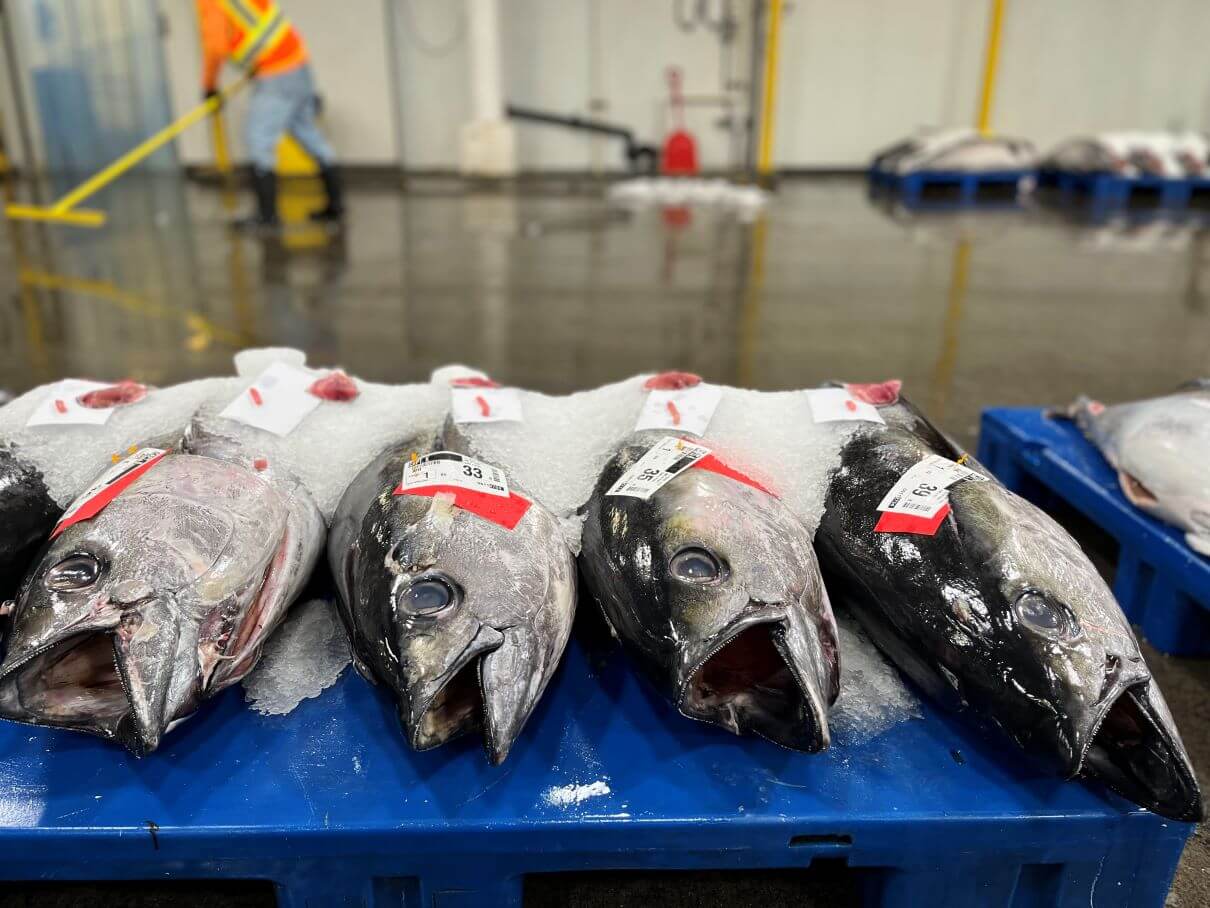
American consumers – and consumers around the world – do not want to eat seafood that is caught illegally or that is the product of forced labor. The consequences of illegal, unreported, and unregulated (IUU) fishing ripple throughout increasingly complex supply chains. But the U.S. can use the tools of today and tomorrow to set the pace for global seafood traceability.
As a leading market state, the United States has tremendous power to transform global fishing practices and improve monitoring, control, and surveillance. The United States can – and must – do much more to provide consumers with the confidence that the seafood they consume is safe, legal, and sustainable.
The Problem
Illegal, unreported, and unregulated (IUU) fishing can take many forms – from local, small-scale boats misreporting catch, to large-scale, industrial foreign-flagged vessels under-reporting their catch. Beyond this, there are also coordinated efforts supported by flag state governments or transnational crime syndicates. IUU fishing is a “crime of convergence,” and has been linked to other criminal and illicit activities such as the smuggling of guns, drugs, and wildlife; human trafficking and forced labor; as well as money laundering and tax fraud.1Royal United Services Institute for Defence and Security, “Below the Surface: How Illegal, Unreported, and Unregulated Fishing Threatens our Security,” Cathy Haenlein, (2017). https://static.rusi.org/201707_rusi_ below_the_surface_haenlein.pdf
It is estimated that IUU fishing accounts for up to a third of the world’s total fishery harvests and is valued at more than $30 billion annually.2Gina Fiore & Peter Horn, “6 Facts You May Not Know About Illegal, Unreported, and Unregulated Fishing,” Pew, June 7, 2023. https://www.pewtrusts.org/en/research-and-analysis/articles/2023/06/07/6-facts-you-may-not-know-about-illegal-unreported-and-unregulated-fishing. IUU fishing directly contributes to overfishing, threatening the sustainability of fish stocks and damaging marine ecosystems. The consequences of IUU fishing ripple throughout increasingly complex supply chains, far beyond the point of harvest. It harms the economic, food, and environmental security of coastal communities. IUU fishing destabilizes the security of maritime states, supports organized criminal networks, fuels corruption, destabilizes good governance, distorts markets, and drives labor and human rights abuses in the fishing industry.
Ultimately, IUU fishing occurs because it remains profitable, loopholes persist, and the opaqueness and complexity of the global seafood supply chain have made it difficult for governments, businesses, and consumers to find effective solutions
Essential Context
In 2022, the commercial fishing and seafood industry in the United States generated economic impacts of $183 billion in sales and supported 1.6 million American jobs.3National Marine Fisheries Service. 2024. Fisheries Economics of the United States, 2022. U.S. Dept. of Commerce, NOAA Tech. Memo. NMFS-F/SPO-248A, 28 p. https://s3.amazonaws.com/media.fisheries.noaa.gov/2024-07/FEUS-2022-v04-0.pdf The demand for seafood is greater than ever; in 2022, the United States imported 340,000 metric tons of seafood, valued at just over $30 billion.4United States Department of Agriculture, “Seafood Market Update,” Shinsuke Kitada (Tokyo, 2023). https://apps.fas.usda.gov/newgainapi/api/Report/DownloadReportByFileName?fileName=Seafood%20Market%20Update_Osaka%20ATO_Japan_JA2023-0020.pdf.
Fueling this demand are distant water fishing (DWF) fleets. The details of these fishing operations are largely obscured as they target fish stocks far from shore, often with little oversight from their home countries or accountability in the regions where they fish. The five largest DWF fleets – from China, Taiwan, Japan, South Korea, and Spain – target four main regions of the ocean: the Pacific, West Africa, East Africa, and South America.5Yozell & Shaver, “Shining a Light.” These five nations spend an estimated $1.5 billion dollars each year in subsidies to support the activities of their fleets, which amount to more than 2 billion kilowatt hours of fishing effort6Hours of effort is the hours spent fishing by DWF fleets multiplied by the power of the engine vessels, abbreviated as kilowatt hours (kWh).7”Most Long-Distance Fishing in Foreign Waters Dominated by Only a Few Governments,” Pew Charitable Trusts, 27 May 2022, https://www.pewtrusts.org/en/research-and-analysis/issue-briefs/2022/05/most-long-distance-fishing-in-foreign-waters-dominated-by-only-a-few-governments.
The full impact of China’s DWF fleet, which is by far the largest global DWF fleet, is difficult to parse; the details of the joint venture and sometimes state-owned enterprises that support these vessels, the conditions aboard the vessels, nor the fisheries access agreements these fleets use, are publicly available. Recent analysis of activities by China’s DWF fleet in the South-West Indian Ocean illustrates direct contradictions between China’s stated goals of supporting a sustainable blue economy in the region and the realities on board many of its fishing8“Tide of Injustice: Exploitation and Illegal Fishing on Chinese Vessels in the Southwest Indian Ocean,” Environmental Justice Foundation, April 2024, https://ejfoundation.org/resources/downloads/Tide-of-Injustice-SWIO-report.pdf. Of the 95 PRC-flagged longliners authorized to target tuna in the region, 47% are linked to cases of IUU fishing and human rights abuses. In interviews with fishers who work onboard the fleet, 100% reported abusive working and living conditions, 96% reported excessive overtime, and 55% reported instances of physical violence.
The challenges these DWF fleets pose to coastal countries’ marine resources will persist and worsen unless there is measurable shift towards improved fisheries management, accountability of flag-state responsibilities, and overall transparency throughout the seafood industry and supply chain.
Against this complicated backdrop, U.S. consumers – and consumers around the world – do not want to eat seafood that is caught illegally or that is the product of forced labor. U.S. producers are less competitive in global markets when faced with foreign seafood caught and processed with forced labor.9Sally Yozell, Sara Lewis, Michele Kuruc, Carolyn Gruber, Lindsay Ceron, Noah Fritzhand, Alyssa Withrow, and Lily Schlieman, 2024, Workshop Summary Report: Reimagining the Seafood Import Monitoring Program, Workshop I. The Stimson Center, Washington D.C., USA. In fact, 72% of U.S. consumers support increased traceability for seafood; they want all parts of the industry to be fair and equitable, especially for the harvesters, processors, and merchants who follow the rules.10Morning Consult, “World Oceans Day Summary Findings,” Deborah Beck, (2022). https://www.walto nfamilyfoundation.org/about-us/newsroom/walton-family-foundation-urges-action-on-seafood-traceability-ahead-of-world-oceans-day.
Policy Recommendations
Transform global practices for traceability. In 2015, the Task Force on Combating IUU Fishing and Seafood Fraud created the Seafood Import Monitoring Program, which is managed by NOAA Fisheries. Now in operation for six years, the Seafood Import Monitoring Program covers about 45% of U.S. seafood imports in 13 species groups at risk of IUU fishing and seafood fraud. As a leading market state, the United States has tremendous power to transform global fishing practices and improve monitoring, control, and surveillance. The United States can do so much more to provide consumers with the confidence that the seafood they consume is safe, legal, and sustainable.
Lead by example on tracking and traceability. As more seafood tracking and traceability systems are implemented around the world, other countries are looking to the United States as a global leader in this space. A model seafood traceability system that is standardized, streamlined, and synchronized will benefit industry, consumers, and workers.
Importers, harvesters, and businesses in the seafood supply chain are well aware, data and information about seafood is collected and stored by numerous U.S. agencies. The data points that industry representatives, brokers, and retailers must collect and retain are sometimes duplicative, always hard to manage, and rarely effective in supporting counter-IUU fishing efforts.
The process for dealing with all these data points is equally as complicated. NOAA Fisheries examines seafood data from the point of harvest to when it enters the U.S. market; the U.S. Coast Guard uses automatic information systems (AIS) and radar to track fishing vessels at sea; the Department of Labor monitors forced labor allegations and evidence of human rights abuses; the Food and Drug Administration collects seafood data relating to human health and food safety; and the Treasury Department follows the money, which could provide insights into beneficial ownership of IUU fishing enterprises.
Despite all this data and all these programs, the International Trade Commission estimated that $2.4 billion worth of IUU-caught products entered the U.S. market in 2019 alone.11United States International Trade Commission, “Seafood Obtained via Illegal, Unreported, and Unregulated Fishing: U.S. Imports and Economic Impact on U.S. Commercial Fisheries,” Renee Berry et al., (Washington, 2021). https://www.usitc.gov/publications/332/pub5168.pdf.
Standardize – and digitize – for a better tracking system. One key barrier to a better system is the lack of standardization of the data the U.S. government collects. Standardized data is needed – from different points in the supply chain – that is appropriately granular and verifiable so that it can be communicated across agencies in a timely manner. Moreover, the paper-based system that exists today hinders success. A recent study found that companies that digitize their supply chains boost their annual revenue growth by 2.3%.12Gezgin, Enis, Xin Huang, Prakash Samal, Ildefonso Silva. Digital transformation: Raising supply-chain performance to new levels. McKinsey & Company, 2017, https://www.bibguru.com/g/chicago-report-citation/ In today’s world, how many multi-billion-dollar industries lack digitization and rely on paper-based records?
A cohesive system requires a globally standardized list of fish species at risk for IUU fishing and mislabeling. This is critical as more international traceability programs come online. IUU fishing is inherently a global problem; illegally caught or mislabeled species entering one major market state are very likely to enter other global markets. For example, Japan’s new counter-IUU fishing regulation covers pacific saury, squid, mackerel, and sardine. None of these species are included in the U.S. program. On the other hand, Japan’s list of species considered at risk for IUU fishing does not include sharks and tunas, which are covered by the U.S. program. The scale of our solutions needs to match the scale of the global problem; gaps in our collective efforts will only allow IUU fishing to continue to thrive.
Streamline the data collection process. As regulators work towards standardizing data, they must be cognizant of the burden these data and information requirements have on harvesters and businesses. Streamlining the data collection process is imperative and creating a digitized, interoperable system is essential. Simply aligning data elements across trade tracking programs could open the door to vastly improved interagency data sharing and collaborative enforcement, while reducing the burden on law-abiding industry. There is no need to reinvent the wheel. Risk analytics systems already exist and are used by other federal agencies. For example, the Food and Drug Administration screens more than 50 million imports a year for health and safety, including seafood. The FDA uses the PREDICT system, which electronically reviews trade data and targets risk screening for fraudulent and adulterated products.
Create a synchronized system between and among partners. The multidimensional problem of IUU fishing needs an equally multidimensional solution. Viewing risk in a more holistic way is the key to rooting out bad actors and reducing burdens for law-abiding industry. Beyond focusing only on species considered at risk, the United States should widen the aperture of what is considered a “risk” in the seafood supply chain. Risks can include vessel histories, ownership information, and land- and sea-based processing. Transshipment, ports, flag state activities, the role of middlemen and intermediaries, also present risk. Creating a synchronized system that can communicate risks between relevant agencies and businesses, including with international partners, is critical to success. Armed with a more detailed understanding of these risks and how they interact, the U.S. government can better focus its resources to target and root out bad actors and prevent IUU-caught fish from entering our markets, while rewarding those who follow the rules.
No seafood trade tracking system is perfect. As technology advances there will be new opportunities for improvement. There are some incremental changes that can be made now to achieve a broader, more holistic vision to prevent IUU-caught fish from entering U.S. markets.
- Create a globally standardized list of fish species at risk for IUU fishing and mislabeling.
- Streamline data requirements and move to a fully digitized seafood traceability system.
- Broaden what is considered “risk” in the seafood supply chain.
- Use existing risk-based analytics to better target bad actors.
- Improve information sharing among the relevant government agencies.13United States of America, Maritime Security and Fisheries Enforcement Act, Washington, October 23, 2019, https://uscode.house.gov/view.xhtml?path=/prelim@title16/chapter99&edition=prelim.
Beyond providing confidence to consumers that the seafood they are buying is legally harvested, creating an effective seafood traceability system can positively impact economic, human, and environmental security around the world. The United States can lead the efforts to move the global seafood supply chain out of the shadows.






Community Adaptation for a Water Festival Without Clean Water