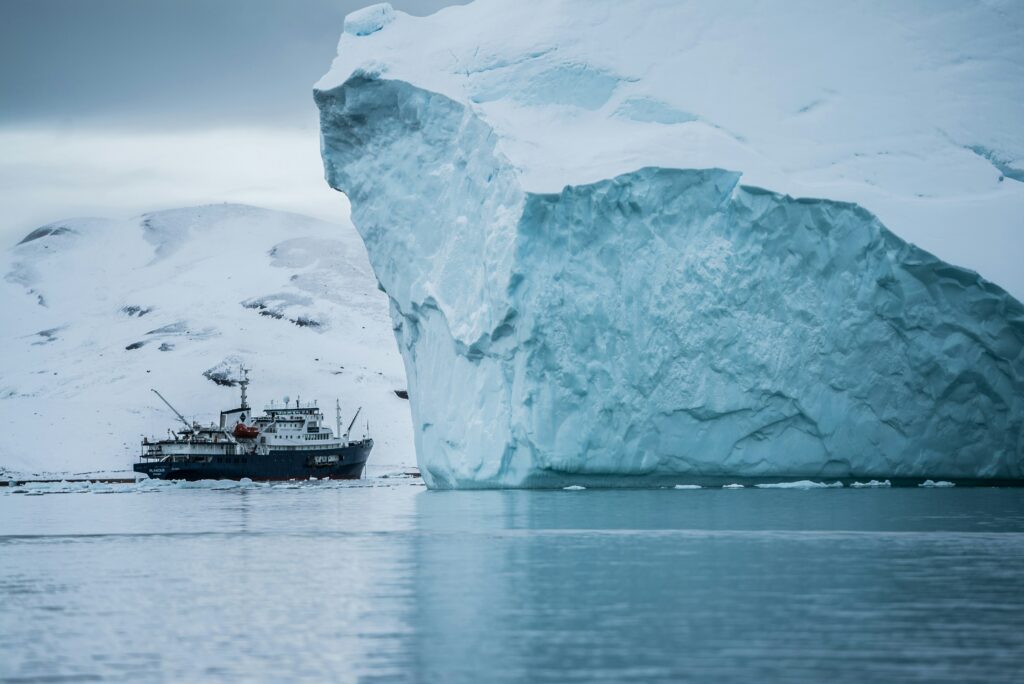
Sixty-five years ago, the Antarctic Treaty established a multilateral governance system for the region, designating the continent as a scientific preserve dedicated to peace and prohibiting military activity. Since then, our understanding of Antarctica’s critical role in regulating the planet’s health has deepened. Simultaneously, events in recent years have shown that Antarctica is not immune to challenges of geopolitical competition, which can shape national priorities and constrain collective progress on environmental goals.
As the impacts of climate change intensify, so too does the imperative for strong international cooperation to safeguard Antarctica’s environment. The continent sits at the intersection of environment, geopolitics, and multilateral cooperation, and a holistic perspective on its current and future needs can help advance broader national and global security objectives.
Following the October meeting of the Commission for the Conservation of Antarctic Living Resources (CCAMLR), this event will examine the most pressing environmental issues facing Antarctica and consider how national governments and the international community can work together to address them in the years ahead.
Featured Speakers

Lauren Risi, Senior Fellow and Director, Environmental Security Program, Stimson Center

Mallory Stewart, Executive Vice President, Council on Strategic Risks

Benjamin Gedan, Senior Fellow and Director, Latin America Program, Stimson Center

Evan Bloom, Marine Protected Area Policy Advisor to the Antarctic and Southern Ocean Coalition & Senior Advisor, Centre for the Ocean and the Arctic, UiT The Arctic University of Norway

Mahlet Mesfin, Nonresident Fellow, Environmental Security Program, Stimson Center (Moderator)
Event Takeaways
Lauren Risi
“New research published just last week in Nature Geoscience found that more than 5 miles of glacial ice in Antarctica vanished in only two months. That is 10 times faster than the previous record.”
“[Yet] the environment can also be an entry point to cooperation and collaboration between communities, countries, and sectors. Through the Antarctic Treaty, Antarctica has emerged as a focal point that captures the intrinsic connections between environmental protection, scientific research and exploration, and cooperation among countries.”
Mahlet Mesfin
“There was a time when global tensions were high [and] 12 countries came together to create the Antarctic Treaty, which established a foundation for the continent focused on peace, science, cooperation, and non-nuclearization, and created a multilateral system of governance. From that initial Antarctic Treaty, a whole system was created that helps address other significant issues in the region.”
“The treaty itself is an exceptional achievement. It’s been a shining example of the world coming together in spite of conflicts, and a time where we put science and collaboration ahead of politics.”
“This current moment is one that’s marked by intense stress in the global system as well as potential conflicts across a number of fronts. … In the face of all those challenges, there’s an awareness of the importance of the Antarctic region, our need to protect it and to ensure that there are governance structures around Antarctica that are strong to meet this moment.”
Evan Bloom
“Over past years … there has been a pronounced focus on marine protected areas. In 2002, [CCAMLR] made a commitment to try to establish a network of marine protected areas in the Southern Ocean. Now, two such MPA have been created, one of which is the Ross Sea protected area …, which is still the world’s largest high seas MPA, and it is a key example going forward in various aspects of international oceans policy.”
“There’s been a focus on krill over the past months because, for the first time, something called the trigger level—a certain level of fishing for krill—was reached for various reasons, particularly because of increased fishing by China and Norway […]. Krill is the basis of the food chain and key to the entire ecosystem. So in CCAMLR over the last two weeks, the question was, ‘how do we deal with this aspect of krill management?’”
Mallory Stewart
“The Antarctic Treaty was one of the original arms control treaties. Article 1 prohibits any measures of military nature, Article 5 prohibit any nuclear explosion, Article 7 sets up this amazing inspection regime […]. We have no other arms control treaty that, one, hasn’t been violated since its creation and, two, has an inspection regime for ‘anywhere, anytime and no notice.’”
“There’s a pure environment in the Antarctic to have clear access to satellite communications, to instruct satellites, to receive information from satellites. This reflects something that was not anticipated during the Cold War, which is facilities manned by military personnel talking to satellites. And we are assuming—because that is the commitment in the treaty—that it is all for peaceful purposes and science. But we cannot be sure, and this is where I think Antarctica is really at a crossroads.”
“There are growing rumors of distrust and potential misuse of Antarctic facilities, and that is where we really have to focus some of our concern in the treaty support arena—to make sure this doesn’t degrade the treaty, and to make sure it doesn’t provide an excuse for others to take actions inconsistent with the treaty.”
Benjamin Gedan
“For Argentina and Chile in particular, the Antarctic is a real part of national identity […]. These are not countries that are always major players in globally significant discussions, but on [MPAs] they have really played an essential role in keeping the conversation alive.”
“Promoting a leadership role for particularly some of the South American countries that are part of this system … would be a strategic investment of US diplomacy in empowering countries that share a lot of US objectives when it comes to the conservation agenda […]. My pitch would be to let countries like Chile, Argentina and Brazil, which have the right strategic positioning, continue to play an even more enhanced role in some of these questions.”