
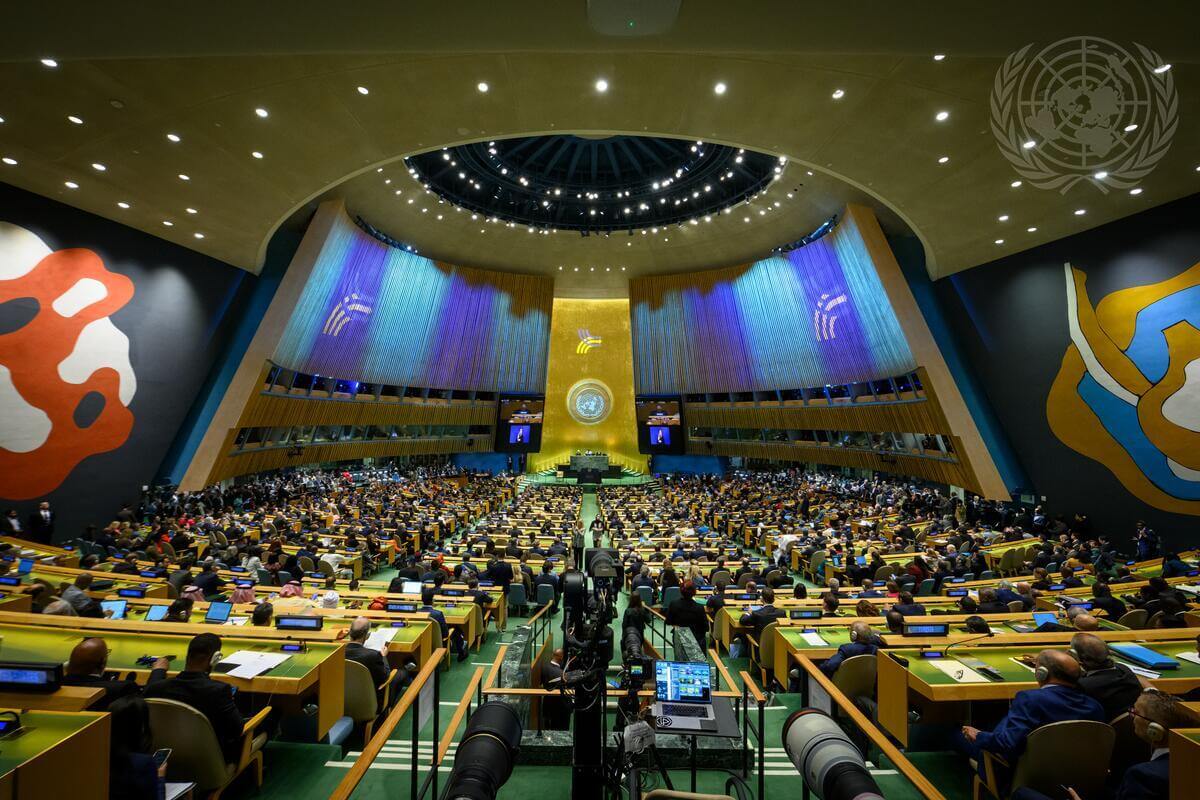
In recent weeks, the United Nations’ longstanding financial crisis has suddenly morphed into an extreme liquidity crisis. Annual budget shortfalls could run as high as 30 to 40 percent in humanitarian and other UN bodies, severely hampering the world body’s work to confront devastating wars, runaway climate change, unconstrained artificial intelligence and other factors fueling longstanding inequality and injustice.
The deepening fiscal crisis is even more jarring when juxtaposed against recent signs of renewed multilateral commitment. At the World Health Assembly, member states adopted the first agreement to prevent and respond to future pandemics, while the International Maritime Organization finalized a legally binding commitment to cut greenhouse gas emissions. Paradoxically, the proposed draconian cuts to the UN nearly coincide with last September’s Summit of the Future in New York City, where, after several years of negotiation, world leaders adopted a Pact for the Future, Global Digital Compact and Declaration on Future Generations to rebuild trust and reinvigorate the multilateral system.
Against a backdrop of divisive politics and mistrust among major powers, the Pact for the Future can be a proxy for the defense of reformed multilateralism — and as a strong support against forces seeking to dismantle the idea of cooperative global governance launched 80 years ago today, UN Charter Day, in San Francisco. The pact provides both a positive narrative and a practical focus on achieving near-term global governance breakthroughs in response to catastrophic global risks. Moreover, the pact adds the voices of many people who were missing at the table eight decades ago.
Specifically, it offers a roadmap for long-overdue, systemwide structural changes, including on reforming the international financial architecture, the Security Council, the Peacebuilding Commission, and as a guide on how the international community responds to global shocks. The pact’s full realization helps ensure a UN system able to keep pace and empower people and nations to better grapple with today’s challenges and opportunities.
In response to the UN’s extreme liquidity crisis, Secretary-General António Guterres unveiled in March 2025 his UN80 Initiative to modernize and streamline the UN system’s structure, priorities and operations to try to meet the challenges of our times. The initiative wields the potential to reinforce the Pact for the Future by focusing on the UN’s core strengths, fostering systemwide efficiencies, relocating staff to where needs are greatest and encouraging a new Grand Bargain to reinforce the multilateral system — reflecting renewed concerns about another Cold War or even a third world war, as well as environmental destruction, population growth and migration.
In our new report, Global Governance Innovation Report 2025: Advancing the Pact for the Future and Environmental Governance, we introduce a unique approach to assessing and promoting implementation of the pact and consider ways for the UN80 initiative to help carry out the agreement.
Read the full article on PassBlue.





Current Geopolitics Shift Deep-Sea Mining Debates