
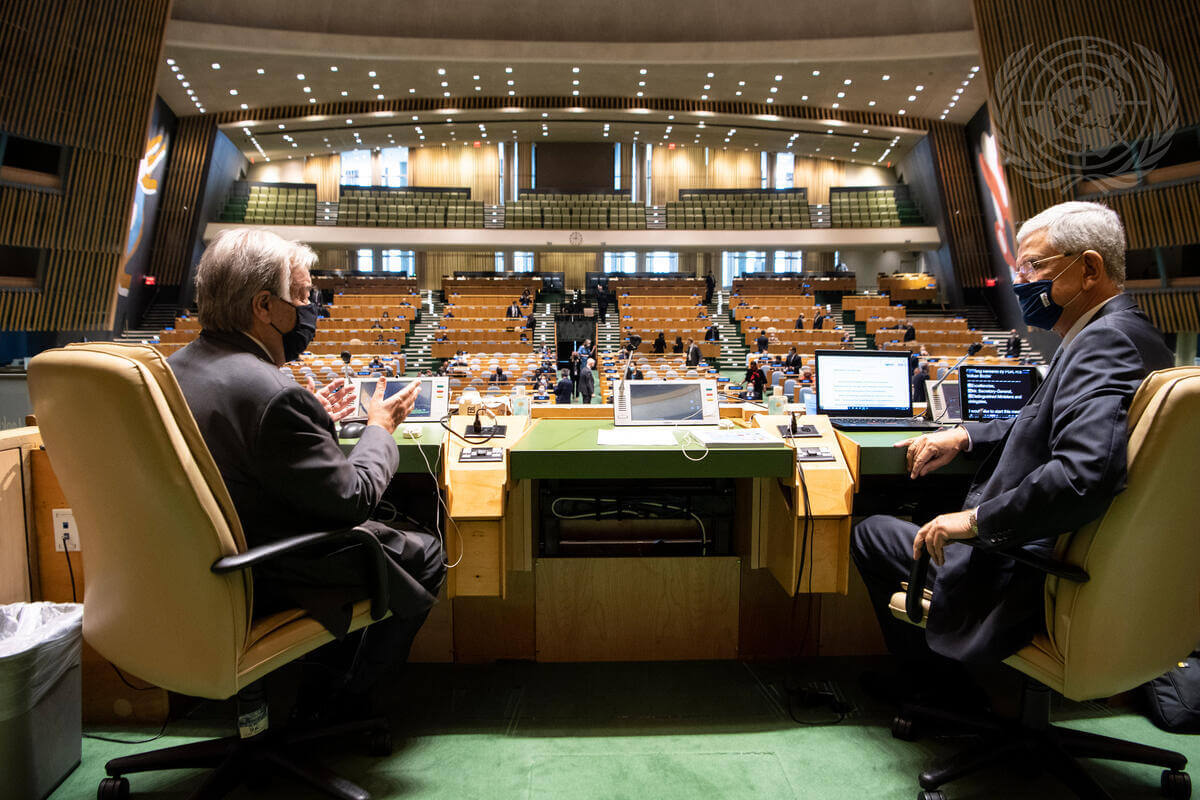
Commemorating the 75th Anniversary of the UN: Multilateralism in the Backdrop of Complexity
The 75th Anniversary of the United Nations in 2020 occurred during a time of great upheaval. The COVID-19 pandemic claimed the lives of 3 million individuals, stuttering the global economy and pushing millions into extreme poverty. Global development outcomes, already under significant strain, deteriorated considerably. Widespread school closures caused 101 million children to fall below the minimum reading proficiency level, further widening the gender divide. Simultaneously, climate disruptions increased the frequency of weather-related disasters, inflicting approximately USD 44 billion in economic damages worldwide. What incremental progress had been made in achieving the Sustainable Development Goals (SDGs), threatened to backslide.
Against the backdrop of overlapping crises and decreasing global trust in social institutions, the UN Secretary-General Antonió Guterres called for a re-evaluation of the United Nations in 2020. The 75th Anniversary of the UN offered a unique opportunity for “the organization to listen directly to the people it serves.” Accordingly, the UN launched a Global Listening Exercise in January 2020—the largest and most diverse democratic consultative effort of its kind. Targeting over 1.5 million individuals across 195 countries, the exercise led to the amalgamation of a coalition of ideas to shape, in the Secretary-General’s own words, “the future we want, and the United Nations we need.”
This initiative kick-started a multi-year process that will culminate in the form of a once-in-a-generation Summit of the Future, held in September 2024. Over the course of the past four years, the understanding of the role played by the UN in the multilateral system has evolved in light of the challenges faced in the twenty-first century. This article attempts to chart the path of this evolution, exploring how key ideas have been shaped and reshaped in the multilateral system between significant actors such as the UN Secretary-General, Member States, and civil society.
The UN75 Declaration and Our Common Agenda
The UN’s Global Listening Exercise served as the first step in a broader process of transformation, intended to better understand people’s “hopes and fears for the future.” The exercise culminated in the form of a final report in January 2021, which highlighted global perspectives on the perceived role of the UN in addressing current challenges, with an objective of informing the decisions of policymakers towards instituting transformative change.
UN Member States engaged in their own reflection over the UN’s capacity to address current challenges by adopting a Declaration on the Commemoration of the Seventy-fifth Anniversary of the United Nations on September 21, 2020 (UN75 Declaration). Co-facilitated by the states Qatar and Sweden, the declaration identified twelve priority areas for the institution ahead of its centenary in 2045 (see figure below). Member States used the Declaration as an opportunity to task the Secretary-General to report back with, essentially, a game plan to achieve these priorities by 2045. The Secretary-General responded a year later with the Our Common Agenda report.
***
The Theory of Change: A Step Back on the Process’ Key Debates
While this article principally aims to trace the origin and development from UN75 to the Summit of the Future, it is a worthwhile exercise to evaluate how the theory of change itself has evolved. Doing so may help illuminate pitfalls and turning points, while also highlighting where future efforts should be concentrated to gather momentum toward a productive outcome.
Read the full chapter on Human Development Forum’s A Better World (Volume 10)







Current Geopolitics Shift Deep-Sea Mining Debates