
Though Taiwan dominates U.S. defense planning, few U.S. national security conversations reflect its physical reality. In April 2025, Research Associate MacKenna Rawlins and Senior Fellow and Director Dan Grazier traveled to the island, observing cities, terrain, and infrastructure that would shape any potential conflict. This field note offers a firsthand look at why Taiwan’s geography may be its greatest military asset.
Much of the debate in Washington around a potential conflict over Taiwan emphasizes air and naval power. But any scenario involving force must also grapple with the realities on the ground. As we traveled the island, it became clear that Taiwan presents formidable challenges to any invading force. If China was able to land in force on the island, they would be immediately confronted by two difficult scenarios. A direct landing into a city would immediately trigger urban warfare, denying the invaders time to generate sufficient combat power ashore. Should they choose to land outside of a city, the invaders would have to try to stage military equipment in and around rice paddies with very little cover and concealment. Neither scenario bodes well for a successful invasion.
During our travels, we visited six cities spread across every region of the country. We spent time in Taipei and Keelung in the north, Luodong on the Pacific Coast, and then Taichung, Chiayi, Tainan, and finally Kaohsiung along the west coast facing the Taiwan Strait. We observed daily life across Taiwan—from night markets to outlet malls—where normalcy prevailed amid growing geopolitical tension. At each stop, we asked how an amphibious landing might unfold. The answer was always the same: low odds of success, followed by an entirely different and equally challenging obstacle. So even if China were to breach the beach, miles of rice paddies or dense urban dwellings lie beyond the sand—each requiring a different toolkit to overcome.
From a military perspective, the island of Taiwan is complex. Its topography is dominated by the Central Mountain Range, which spans the island and covers 60% of its land surface—posing a significant obstacle to any sustained ground campaign. Taiwan’s mountains are the tallest in east Asia. The highest peak, Yushan, tops out at nearly 13,000 feet. Despite their beauty, they create land-use challenges, even for the island’s inhabitants.
We took a somewhat harrowing bus ride from Chiayi to Alishan in the heart of the Central Mountain Range, where a dense forest blanket drapes the craggy peaks in most places which produces a gentle haze at lower elevations. The higher elevations take on a distinct alpine feel with ancient Cypress forests and terraced tea fields. Watching the sun rise over Jade Mountain should be on everyone’s bucket list.
With so much of the island unsuitable for significant development, 40 percent of the island not covered by mountains must be carefully managed to support the island’s nearly 24 million inhabitants.
Almost every square inch of flat terrain is covered with either urban development or devoted to agriculture. Taiwan’s cities are generally quite dense and large. Greater Taipei, the massive urban enclave surrounding the capital, sits in an ancient lakebed surrounded by mountains. Instead of the water that once filled the basin, steel skyscrapers and heavily reinforced concrete buildings spread out filling every available inch until the development crashes into the sides of the mountains.
Outside urban centers, nearly all flat terrain is devoted to agriculture—much of it rice paddies or terraced fields. It is unlike in the United States, where someone travelling outside the city will need to travel miles of suburbs before seeing farmland. Seeing rice paddies next to a high-rise is a common sight in Taiwan. The urban and the rural appear to coexist as a seamless whole.
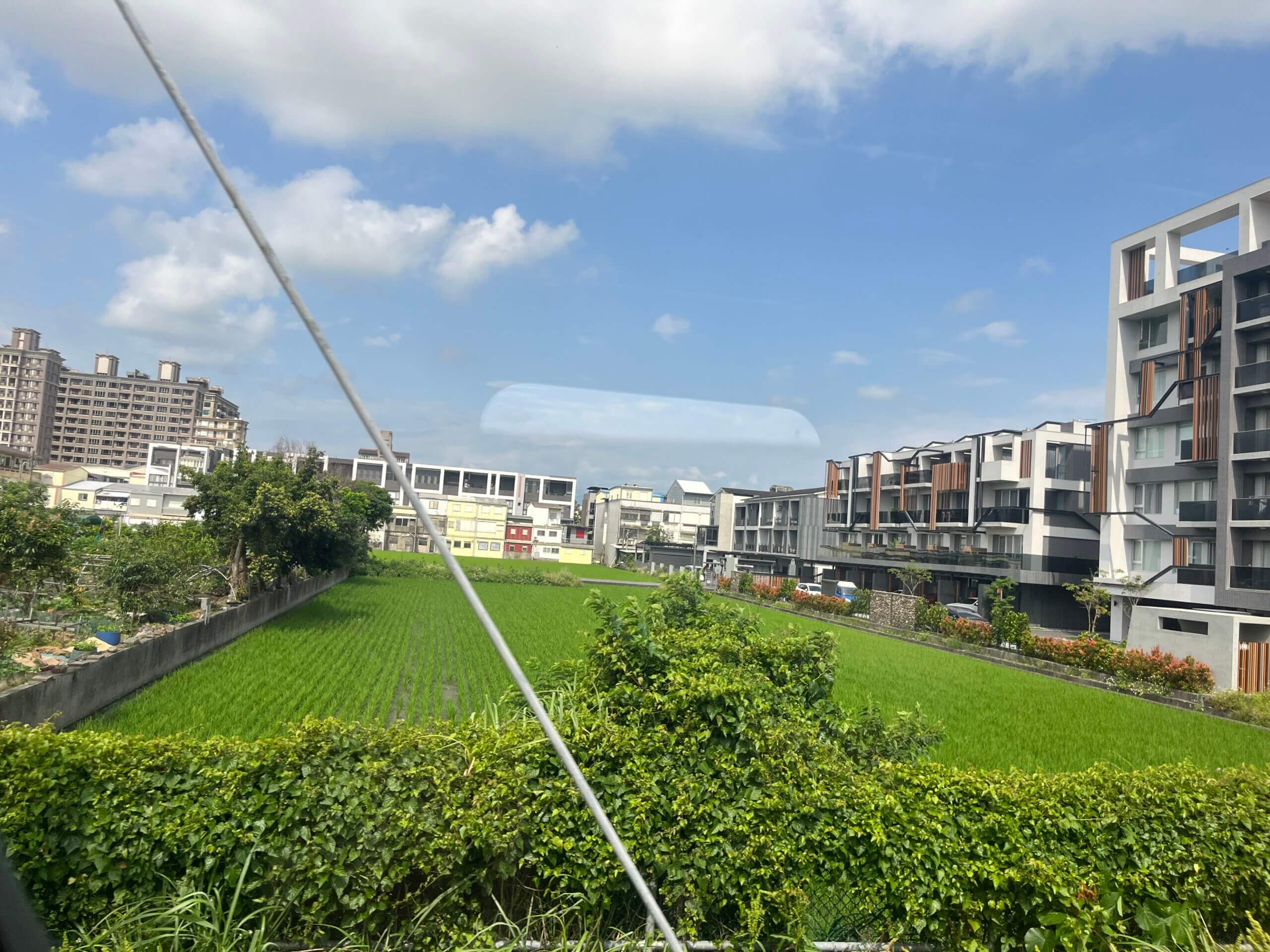
Visible signs of imminent threat were scarce. Some urban areas had signage indicating air raid shelters, but no obvious defensive fortifications were evident.
While visiting Tainan, we saw several Taiwanese fighter jets flying low over the city on their final approach to the airport. Since that’s unusual in the U.S., we stopped to look, but we noticed that only our fellow foreigners took notice of the spectacle.
Of all the conversations MacKenna shared with the locals in Mandarin, no one ever asked or hinted about the security dilemma nor the role the U.S. plays.
The main purpose of our trip was to get a feel for the terrain. With all the speculation that China is preparing to conduct a massive amphibious operation against Taiwan, Dan especially wanted to see how suitable the island is for large-scale military operations.
This research will support our upcoming work that will detail all the inherent difficulties involved in capturing Taiwan through military means, to make national decisionmakers and the American people question the idea that China intends to execute what would be the largest and most complex military operation in history. Our aim is to contribute to a more grounded understanding of Taiwan’s defensive landscape—one that can inform policy decisions about future U.S. posture and investment.
A clearer understanding of Taiwan’s defensive advantages may prompt reconsideration of some prevailing assumptions and may make it difficult for Congress to continue passing ever-increasing defense budgets. The current budget projections suggest the U.S. may spend over $1 trillion on defense in 2026, with the Taiwan scenario as a key rationale.
Taiwan’s daily life is vibrant, unguarded, and resolutely normal and offers a powerful counterpoint to Washington’s most dire projections.
Squeezing through the crowds of the night market, we asked each other “Does this seem like a population concerned about an invasion?”
That moment crystallized a broader truth. Any future debate on U.S. security strategy should begin with an honest look at the terrain, and the people, at the center.
Stay a little longer as we scroll through photos of Taiwan’s vibrant city life.