Chairwoman Kim, Chairman Huizenga, Ranking Member Bera, Ranking Member Kamlager-Dove, and distinguished members of the committee, thank you for the opportunity to testify and for your continued leadership on Myanmar; I hope this is an issue that continues to receive bipartisan attention and support.
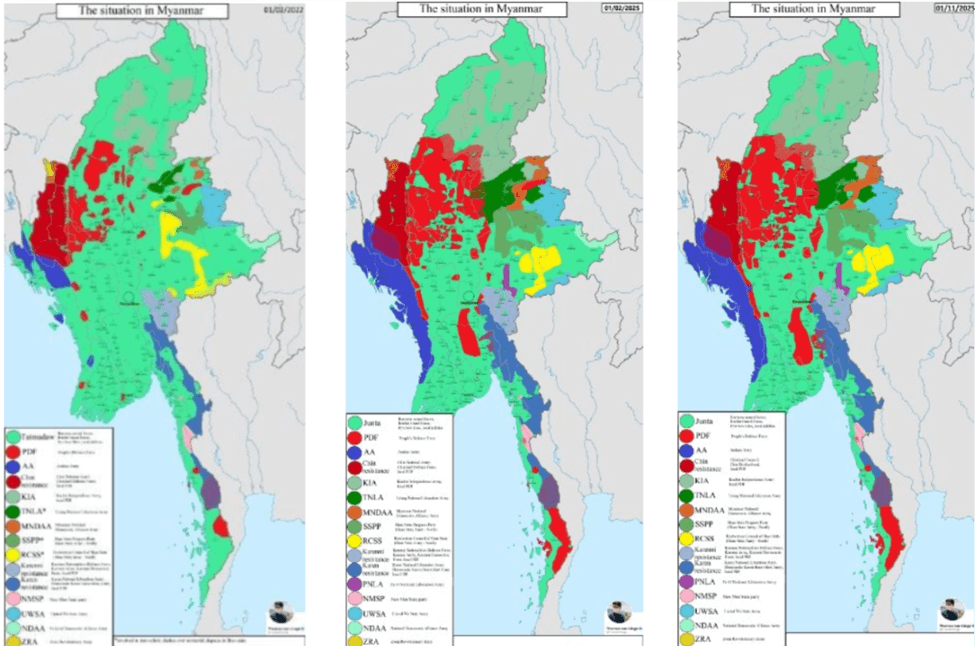
Nearly five years after a military coup prevented a democratically elected parliament from taking office, Myanmar is at a critical inflection point. In just six weeks, the military will begin phased elections which it hopes will rehabilitate its image, legitimize its reign, and ultimately enable it to consolidate control over the territory it has lost since the coup.1See Figure 1 on page 8, which depicts approximate changes in territorial control in Myanmar from one year after the coup (February 2021) to four years after the coup (February 2025) to the present (November 2025). But these so-called elections will not be free, fair, or inclusive; they do not represent the will of the Myanmar people and they do not present a path either towards democracy or a peaceful and sustainable solution to Myanmar’s decades-long conflict.
While there is a strong normative rationale for concern about developments in Myanmar, the conflict reverberates well beyond its borders and poses a threat to U.S. security and prosperity in both the Indo-Pacific and at home. Since the coup, the Myanmar military regime has deepened its ties with China and Russia while the military and its allies are at the root of regional instability and transnational crime, including through the proliferation of drug trafficking and scam centers that have cost Americans billions.
Given that the Myanmar military cannot credibly be viewed as a conduit for advancing U.S. interests, Congress and the U.S. Administration should:
- Reject military-planned elections and the regime that emerges from them, while encouraging partners and allies in the region to do the same;
- Engage and support the spectrum of democratic and resistance actors who offer a better prospect for securing a peaceful and prosperous Myanmar that protects and advances U.S. interests, including by appropriating assistance to support parallel and emerging governing structures;
- Provide continued lifesaving humanitarian support to populations in Myanmar and refugees in neighboring countries, including to treat infectious disease, ensuring assistance reaches frontline actors and is not channeled via the military;
- Seek to counterbalance Chinese influence while managing expectations for the U.S. role in Myanmar and recognizing that key governance actors in Myanmar will need to develop constructive relations with China to viably govern; and
- Building upon recent efforts, including several rounds of sanctions and the establishment of the Scam Center Strike Force, address transnational crime through additional targeted sanctions, enhanced enforcement and inter-agency coordination, and improved investigative capacity to track financial flows to those benefiting from transnational criminal activity.
The 2021 Military Coup and its Impact
On February 1, 2021, the day Myanmar’s new parliament was set to be seated following elections in November 2020, the Myanmar military launched a coup, detaining civilian leaders – including State Counsellor Aung San Suu Kyi and President Win Myint – and declaring a state of emergency under the false pretense of widespread electoral fraud.
Opposition to the coup began with peaceful mass protests and a Civil Disobedience Movement that garnered the support of some 400,000 striking civil servants, including many health workers. After the military opened fire on protesters, however, armed self-defense and armed resistance grew. Since then, the civil war, previously confined to Myanmar’s periphery, has expanded to nearly the entire country.
In response, the Myanmar military has waged a brutal counterinsurgency campaign based on what it calls the “four cuts,” which seeks to deprive insurgents of food, funds, information, and recruits. Through the “four cuts,” the military imposes collective punishment in the areas where insurgents operate, with a devastating and intentional impact on civilian populations. An estimated 85,000 people have been killed in conflict since the coup, including thousands of civilians, many the victims of indiscriminate military airstrikes. Arbitrary detention and torture are widespread, with over 20,000 political prisoners still in jail and some 2,000 people estimated to have died in military custody.2Agence France Presse. “Myanmar air strikes force youth into bunker schools”. 10 October 2025. https://www.france24.com/en/live-news/20251010-myanmar-air-strikes-force-youth-into-bunker-schools. See also “Daily Briefing in Relation to the Military Coup.” Assistance Association for Political Prisoners 13 November 2025. https://aappb.org/?p=35054.
The military’s indiscriminate violence, blockades on humanitarian assistance, and the torching of some 120,000 homes have fueled mass displacement, with more than 3.5 million people internally displaced; at least 275,000 have fled the country, joining 1.3 million refugees, mostly Rohingya who fled what the U.S. determined was genocide perpetrated by the military in 2017.3“Myanmar Situation Operational Data Portal”. The UN Refugee Agency (UNHCR). Accessed 14 November 2025. https://data.unhcr.org/en/situations/myanmar. See also, “Documenting the Monthly Impact of Arson Attacks on Civilian Homes”. Data for Myanmar. January 2025. https://drive.google.com/file/d/1SPGm8b3H1gSZwU1tmetC1koYbYAKFnZM/view. Blinken, Antony J. “Secretary Antony J. Blinken on the Genocide and Crimes Against Humanity in Burma.” U.S. Department of State. 21 March 2022. https://2021-2025.state.gov/secretary-antony-j-blinken-at-the-united-states-holocaust-memorial-museum/. As it has lost territory, the military has enforced conscription for the first time in Myanmar’s history, pressing some 80,000 recruits into service with only minimal training, and relied more heavily on drones as well as airstrikes, which have increased every year since the coup. And the regime has greatly enhanced its surveillance capabilities with assistance from China while simultaneously enforcing communication restrictions across much of the country.4See, for example, “Silk Road of Surveillance: The role of China’s Geedge Networks and Myanmar telecommunications operators in the junta’s digital terror campaign.” Justice for Myanmar. September 2025. https://jfm-files.s3.us-east-2.amazonaws.com/public/Silk+Road+of+Surveillance+EN.pdf.
Ongoing conflict combined with the regime’s economic mismanagement have also had a devastating impact on Myanmar’s economy. The economy is nearly 20% smaller than before the coup and annual inflation is over 30%, leading to a doubling of the poverty rate and a nearly eight-fold increase in food insecurity; according to the UN, nearly 1/3 of the population – almost 20 million people – are in need of humanitarian assistance.5“Economic Aftershocks.” The World Bank. Myanmar Economic Monitor. June 2025. https://documents1.worldbank.org/curated/en/099061125205014652/pdf/P507203-cbcf81b5-0107-4517-8ad7-82b588a6328f.pdf. See also, “Myanmar Humanitarian Needs and Response Plan.” United Nations Office for the Coordination of Humanitarian Affairs. December 2024. https://themimu.info/sites/themimu.info/files/nutrition_cluster/Myanmar_2025_HNRP_-_English_version.pdf.
As ethnic armed groups and resistance forces expanded their territorial control, a patchwork of parallel governance systems has emerged. Some of these systems, as in Kachin and Karen States, have been in place for decades, while others, particularly in Burmese-majority areas, are newer. These governance structures have sought to establish schools and health systems, public safety and dispute resolution mechanisms, and to collect taxes and provide humanitarian support. These structures have faced significant challenges from military airstrikes, weak accountability, and corruption, but reflect the desires of many in Myanmar for greater autonomy and systems that are more bottom-up than top-down.
Operation 1027: A Watershed for the Resistance and for China’s Role in Myanmar
Operation 1027, a joint offensive launched by several ethnic armed groups and allied resistance actors in October 2023, was a watershed moment in the conflict, pushing key ethnic armed groups and China decisively off the fence. The operation initially had tacit support from China, which was increasingly frustrated with the proliferation of scam centers along the China-Myanmar border and the Myanmar military’s unwillingness to do anything about them. Moreover, prior to Operation 1027, many of the most powerful ethnic armed groups had limited their involvement to providing training, weapons, and safe haven to other resistance actors, but had not directly entered the fight themselves. Their entry led to both unprecedented military collaboration among ethnic armed groups and other resistance actors, including Burmese-led groups, and unprecedented military and territorial gains across significant swathes of the country, including in northern Shan State along the China-Myanmar border and in Rakhine State in western Myanmar.6See Figure 1 on page 8, which depicts approximate changes in territorial control in Myanmar from one year after the coup (February 2021) to four years after the coup (February 2025) to the present (November 2025).
Though a Chinese-brokered ceasefire led to a temporary halt to conflict in Shan State, the Arakan Army continued to make territorial gains in Rakhine, the Kachin Independence Army launched new offensives in Kachin along the China-Myanmar border, and the ceasefire in northern Shan ultimately broke down in mid-2024. During this second phase of Operation 1027, the Myanmar military lost control of a regional command for the first time since Myanmar’s independence (it would lose a second regional command to the Arakan Army in December 2024) as well as key border crossings and trade routes with China; the Kachin Independence Army also gained control of the sites of hundreds of rare earth mines last October. Moreover, greater operational collaboration between ethnic armed groups and resistance forces enabled territorial gains in several predominantly Burmese regions, including Sagaing and Mandalay, posing a threat to Myanmar’s second city of Mandalay and, more broadly, to the Bamar heartland for the first time.
This was a bridge too far for China, which, by August 2024, had come to fear that resistance military gains combined with nascent inter-ethnic alliances posed an existential threat to the military regime; the regime’s collapse, China worried, would usher in either a power vacuum and state failure or a new government, potentially led by the National Unity Government, that would be irredeemably pro-U.S. and pro-Western. Its interests7China has three core interests in Myanmar: 1) advancing its geostrategic interests, including through China-Myanmar Economic Corridor projects (pipelines, ports, roads, rail, special economic zones, trade, etc.); 2) maintaining leverage over all key stakeholders in Myanmar to enable enough stability, particularly on the China-Myanmar border, to advance its geostrategic interests, but not so much stability that it does not have the ability to play one side off the other; and 3) ensuring Myanmar remains part of its sphere of influence, using the language of “sovereignty” and “non-interference” to keep the West out, but not viewing itself as subject to the same constraints. perceived to be at risk, China shifted from what had been a nominally neutral position to much more forcefully supporting the military regime while imposing significant pressure on the ethnic armed groups operating along the China-Myanmar border.
Chinese pressure on ethnic armed groups manifested in several ways: It closed off borders and trade; cut internet and electricity; detained the leader of one of the groups (it claimed he was receiving medical treatment); pressured ethnic armed groups not to ally with Burmese resistance forces; compelled the United Wa State Army, a powerful armed group close to China, not to provide support to other armed actors; and pressed armed groups into negotiations with the Myanmar military. In parallel, China ramped up its military, financial, and diplomatic support to the Myanmar regime: In August 2024, China’s Foreign Minister held his first meeting since the coup with Min Aung Hlaing, the coup-leader and military commander-in-chief; Min Aung Hlaing subsequently traveled to China twice, making his first post-coup visit in November 2024 and returning again in September 2025 to meet Chinese President Xi Jinping.
Chinese support to the regime – combined with the military’s forced conscription of tens of thousands as well as its better integration of forces and better use of new technology – has enabled the Myanmar military to shift some of the momentum on the battlefield. After several rounds of Chinese-facilitated negotiations and under immense Chinese pressure, the Myanmar National Democratic Alliance Army agreed to a bilateral ceasefire with the military in January, returning the regional command it captured six months prior in the process. The ceasefire with the MNDAA enabled the Myanmar military to launch a counteroffensive against another armed group in northern Shan, the Ta’ang National Liberation Army, which lost several towns to the military before last month agreeing to a bilateral ceasefire itself (in which it agreed to cede two further towns).
Though the areas it has recaptured are strategically significant, particularly with respect to trading routes with China, and the military has also launched somewhat successful counteroffensives in Mandalay, southern Shan, and Karenni, it has only managed to regain a fraction of the territory it lost since the launch of Operation 1027.8See, for example, “Regime Regains 11 Percent of Lost Ground in Northern Shan.” Institute for Strategy and Policy – Myanmar. 13 November 2025. https://ispmyanmar.com/wp-content/uploads/2025/11/SB2025_05_ENG.pdf
The Myanmar Military’s Electoral Plans
It is in this context – having lost significant territory, amidst a brutal counterinsurgency campaign, and with very little support from the public – that the Myanmar military will attempt to hold elections. Elections are set to begin with a first phase in 102 townships on December 28, a second phase in 100 townships on January 11, and a third phase in an unclear number of townships on January 25, though elections have already been canceled in 56 (of 330) townships and are likely to be limited in scope in dozens of other constituencies. Amidst on-going conflict and with changes to electoral rules and structures, there is no chance the elections will be free, fair, or inclusive. The regime’s electoral intent is not to gain domestic legitimacy or support, but to garner international recognition that it hopes will translate into political, financial, and military support that enables it to consolidate control.
Though elections are only now coming to pass, Min Aung Hlaing and the Myanmar military were already foreshadowing “a free and fair multiparty democracy election” just weeks after the coup and the concept was later ensconced in the regime’s Five Point Roadmap.9“Five future programmes of State Administration Council.” State Administration Council Ministry of Information. 24 February 2021. https://www.moi.gov.mm/moi:eng/news/2838. See also, “Five-Point Roadmap of State Administration Council.” State Administration Council Ministry of Information. 27 May 2021. https://www.moi.gov.mm/moi:eng/news/3631. But in maneuvers that were dubious even by the military’s loose interpretation of the 2008 Constitution it drafted, states of emergency were renewed eight times under the pretext that the military still needed to establish “peace and stability” across the country.
Even without this requisite peace and stability, the regime has pressed ahead with electoral preparations over the past year, beginning with a deeply flawed national census last October. Because of the military’s limited territorial control, however, only 145 of Myanmar’s 330 townships were fully counted. Moreover, census enumerators collected sensitive personal information, including biometrics, fueling concerns that the elections were being used as cover to expand Myanmar’s surveillance capabilities.
In parallel to the census, the military regime amended existing laws and introduced new ones to expand its electoral edge. A new Political Parties Registration Law10“Political Parties Registration Law.” State Administration Council Ministry of Information. 27 January 2023. https://www.moi.gov.mm/moi:eng/laws/9320 in 2023 led to the dissolution of political parties, most importantly the National League for Democracy, which collectively won 86% of the 498 seats elected to the national parliament in the 2020 elections. In contrast, the 57 parties contesting in 2025 won only 11% of the seats in 2020; only nine won any seats at all, and none won more than five seats besides the military-proxy Union Solidarity and Development Party. The regime also changed the electoral system to include proportional representation for some seats, giving itself a further advantage while also allowing it to depict elections as taking place in more constituencies than they will actually be held (for example, by combining a military-controlled constituency with constituencies it does not control and where voting will not take place). The military has also sought to stifle dissent by enacting a law earlier this year that imposes harsh penalties for criticism of or disruption to the elections; at least 120 people have been arrested under the new law so far.11“At least 25 more Myanmar citizens charged under new ‘Election Protection Law’”. Democratic Voice of Burma. 11 November 2025. https://english.dvb.no/at-least-25-more-myanmar-citizens-charged-under-new-election-protection-law/.
What Happens in Myanmar Matters to U.S. Interests
The trajectory of events in Myanmar impacts U.S. interests both in the Indo-Pacific and at home in the United States.
At the nexus of South and Southeast Asia, Myanmar is a hub for geopolitical competition in Asia. China has invested billions of dollars in infrastructure in Myanmar through the China-Myanmar Economic Corridor, including dual oil and gas pipelines that run from Myanmar’s coast to southern China, circumventing the Straits of Malacca; India, too, has invested in infrastructure in Myanmar while Russia has emerged as a key military partner and plans to build a nuclear plant. Fueling competition further, Myanmar is the world’s second largest producer of raw rare earth materials, with China the sole beneficiary. Though there are significant political, logistical, and legal barriers that inhibit U.S. access to these critical minerals, unregulated mining in Myanmar is already having a significant and adverse environmental impact in the region, potentially affecting seafood and agricultural products that flow into U.S. markets.12Thiha, Amara. “Four Reasons Why Proposals to Source Rare Earth Minerals from Myanmar Will Not Succeed.” Stimson Center. 1 August 2025. https://www.stimson.org/2025/four-reasons-why-proposals-to-source-rare-earth-minerals-from-myanmar-will-not-succeed/. See also Eyler, Brian and Regan Kwan. “Toxic Rare Earth Mining is Ruining Mekong Tributaries in the Golden Triangle.” Stimson Center. 22 September 2025. https://www.stimson.org/2025/toxic-rare-earth-mining-is-ruining-mekong-tributaries-in-the-golden-triangle/.
It may be tempting to look to engagement with the Myanmar military and the military-backed regime that emerges from the elections to counter Chinese influence. But such an approach will undermine U.S. interests in the region and at home. The Myanmar military is at the root of transnational crime and regional instability emanating from Myanmar and will remain so following elections. Scam centers have proliferated since the coup with Chinese crime syndicates, the Myanmar military, and military-aligned militias all profiting from the scam industry, which bilked Americans out of $10 billion last year.13“Treasury Sanctions Burma Armed Group and Companies Linked to Organized Crime Targeting Americans.” U.S. Department of the Treasury. 12 November 2025. https://home.treasury.gov/news/press-releases/sb0312. A crackdown over the past month on KK Park, a notorious scam center, is purely performative: Scam leaders were allowed to escape, evidence was destroyed, and dozens of scam centers with over 100,000 people, many trafficked into Myanmar from around the world, continue to operate with impunity.
Myanmar has also become a key source of narcotics under the military and its allies: Myanmar is now the world largest producer of opium, and the production of methamphetamines and synthetic drugs has surged since the coup, emblematic of the Myanmar military’s inability or unwillingness to combat drug trafficking.14“Synthetic Drugs in East and Southeast Asia: Latest developments and challenges.” United Nations Office on Drugs and Crime. 2025. https://www.unodc.org/roseap/uploads/documents/Publications/2025/Synthetic_Drugs_in_East_and_Southeast_Asia_2025.pdf. See also Tan, Rebecca. “China’s chemical exports are behind a ‘tsunami’ of meth flooding Asia.” The Washington Post. 8 November 2025. https://www.washingtonpost.com/world/2025/11/08/china-chemical-exports-drugs-meth-crisis/. Beyond drugs, Myanmar is the sixth leading source of refugees around the world and, with the collapse in immunizations and treatment for infectious diseases, Myanmar risks becoming a hotspot for a global health crisis, with major increases in cases of drug-resistant malaria and tuberculosis since the coup.15Lay, Maw and Khin. “In Myanmar, healthcare and disease prevention are neglected casualties of war.” The New Humanitarian. 15 January 2025. https://www.thenewhumanitarian.org/news-feature/2025/01/15/myanmar-healthcare-and-disease-prevention-are-neglected-casualties-war
Figure 1: Approximate Territorial Control in Myanmar
Notes
- 1See Figure 1 on page 8, which depicts approximate changes in territorial control in Myanmar from one year after the coup (February 2021) to four years after the coup (February 2025) to the present (November 2025).
- 2Agence France Presse. “Myanmar air strikes force youth into bunker schools”. 10 October 2025. https://www.france24.com/en/live-news/20251010-myanmar-air-strikes-force-youth-into-bunker-schools. See also “Daily Briefing in Relation to the Military Coup.” Assistance Association for Political Prisoners 13 November 2025. https://aappb.org/?p=35054.
- 3“Myanmar Situation Operational Data Portal”. The UN Refugee Agency (UNHCR). Accessed 14 November 2025. https://data.unhcr.org/en/situations/myanmar. See also, “Documenting the Monthly Impact of Arson Attacks on Civilian Homes”. Data for Myanmar. January 2025. https://drive.google.com/file/d/1SPGm8b3H1gSZwU1tmetC1koYbYAKFnZM/view. Blinken, Antony J. “Secretary Antony J. Blinken on the Genocide and Crimes Against Humanity in Burma.” U.S. Department of State. 21 March 2022. https://2021-2025.state.gov/secretary-antony-j-blinken-at-the-united-states-holocaust-memorial-museum/.
- 4See, for example, “Silk Road of Surveillance: The role of China’s Geedge Networks and Myanmar telecommunications operators in the junta’s digital terror campaign.” Justice for Myanmar. September 2025. https://jfm-files.s3.us-east-2.amazonaws.com/public/Silk+Road+of+Surveillance+EN.pdf.
- 5“Economic Aftershocks.” The World Bank. Myanmar Economic Monitor. June 2025. https://documents1.worldbank.org/curated/en/099061125205014652/pdf/P507203-cbcf81b5-0107-4517-8ad7-82b588a6328f.pdf. See also, “Myanmar Humanitarian Needs and Response Plan.” United Nations Office for the Coordination of Humanitarian Affairs. December 2024. https://themimu.info/sites/themimu.info/files/nutrition_cluster/Myanmar_2025_HNRP_-_English_version.pdf.
- 6See Figure 1 on page 8, which depicts approximate changes in territorial control in Myanmar from one year after the coup (February 2021) to four years after the coup (February 2025) to the present (November 2025).
- 7China has three core interests in Myanmar: 1) advancing its geostrategic interests, including through China-Myanmar Economic Corridor projects (pipelines, ports, roads, rail, special economic zones, trade, etc.); 2) maintaining leverage over all key stakeholders in Myanmar to enable enough stability, particularly on the China-Myanmar border, to advance its geostrategic interests, but not so much stability that it does not have the ability to play one side off the other; and 3) ensuring Myanmar remains part of its sphere of influence, using the language of “sovereignty” and “non-interference” to keep the West out, but not viewing itself as subject to the same constraints.
- 8See, for example, “Regime Regains 11 Percent of Lost Ground in Northern Shan.” Institute for Strategy and Policy – Myanmar. 13 November 2025. https://ispmyanmar.com/wp-content/uploads/2025/11/SB2025_05_ENG.pdf
- 9“Five future programmes of State Administration Council.” State Administration Council Ministry of Information. 24 February 2021. https://www.moi.gov.mm/moi:eng/news/2838. See also, “Five-Point Roadmap of State Administration Council.” State Administration Council Ministry of Information. 27 May 2021. https://www.moi.gov.mm/moi:eng/news/3631.
- 10“Political Parties Registration Law.” State Administration Council Ministry of Information. 27 January 2023. https://www.moi.gov.mm/moi:eng/laws/9320
- 11“At least 25 more Myanmar citizens charged under new ‘Election Protection Law’”. Democratic Voice of Burma. 11 November 2025. https://english.dvb.no/at-least-25-more-myanmar-citizens-charged-under-new-election-protection-law/.
- 12Thiha, Amara. “Four Reasons Why Proposals to Source Rare Earth Minerals from Myanmar Will Not Succeed.” Stimson Center. 1 August 2025. https://www.stimson.org/2025/four-reasons-why-proposals-to-source-rare-earth-minerals-from-myanmar-will-not-succeed/. See also Eyler, Brian and Regan Kwan. “Toxic Rare Earth Mining is Ruining Mekong Tributaries in the Golden Triangle.” Stimson Center. 22 September 2025. https://www.stimson.org/2025/toxic-rare-earth-mining-is-ruining-mekong-tributaries-in-the-golden-triangle/.
- 13“Treasury Sanctions Burma Armed Group and Companies Linked to Organized Crime Targeting Americans.” U.S. Department of the Treasury. 12 November 2025. https://home.treasury.gov/news/press-releases/sb0312.
- 14“Synthetic Drugs in East and Southeast Asia: Latest developments and challenges.” United Nations Office on Drugs and Crime. 2025. https://www.unodc.org/roseap/uploads/documents/Publications/2025/Synthetic_Drugs_in_East_and_Southeast_Asia_2025.pdf. See also Tan, Rebecca. “China’s chemical exports are behind a ‘tsunami’ of meth flooding Asia.” The Washington Post. 8 November 2025. https://www.washingtonpost.com/world/2025/11/08/china-chemical-exports-drugs-meth-crisis/.
- 15Lay, Maw and Khin. “In Myanmar, healthcare and disease prevention are neglected casualties of war.” The New Humanitarian. 15 January 2025. https://www.thenewhumanitarian.org/news-feature/2025/01/15/myanmar-healthcare-and-disease-prevention-are-neglected-casualties-war