

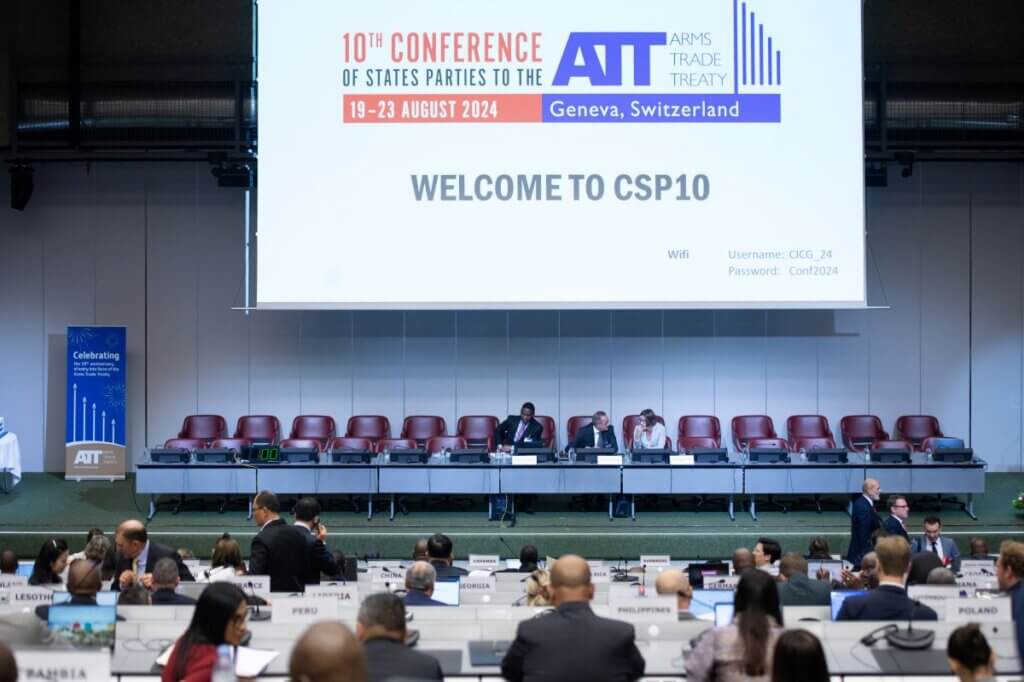
In mid-August, I traveled to Geneva, Switzerland to attend the 10th Conference of States Parties to the Arms Trade Treaty (CSP10). Adopted by the UN General Assembly in 2013, the Arms Trade Treaty (ATT) established, for the first time, legally binding global standards to regulate the international trade of conventional arms. Since 2015, the Conference of States Parties has gathered annually to assess the treaty’s progress. Though it had been hoped that these annual convenings would allow States to have serious conversations about the treaty’s implementation or the ways in which the treaty is reducing human suffering, the meetings have focused primarily on process and administrative details. Since this CSP marked both the tenth anniversary of the ATT’s entry into force and the tenth CSP convening, time was allotted to step back and reflect on the treaty’s impact and future.
My history with the ATT is personal. I was hired in 2007 to be the consultant to the UN Group of Governmental Experts on the Arms Trade Treaty in 2008 and then as the consultant to the UN ATT process from 2010-2013. During those years, I was involved in all aspects of the treaty’s development and negotiation. My colleagues and I diligently wordsmithed treaty text, drafting and re-drafting, searching for consensus language with the ultimate aim to better regulate the international arms trade. Watching the UN General Assembly ratify the treaty in 2013, I was cautiously optimistic. Although many compromises were made, I believed then, and still do now, that the final text gave us a real pathway to raise the standards of the international arms trade, to reduce the dangers it poses to human suffering, and to moderate its effects on global insecurity.
Ten years later, from the vantage point of civil society, I am able to still work on the ATT through my position and tenure at the Stimson Center. My efforts have now turned from the treaty’s creation to the pressing work of implementation, from aiding States in evaluating their national trade control measures to monitoring State adherence to treaty reporting requirements.
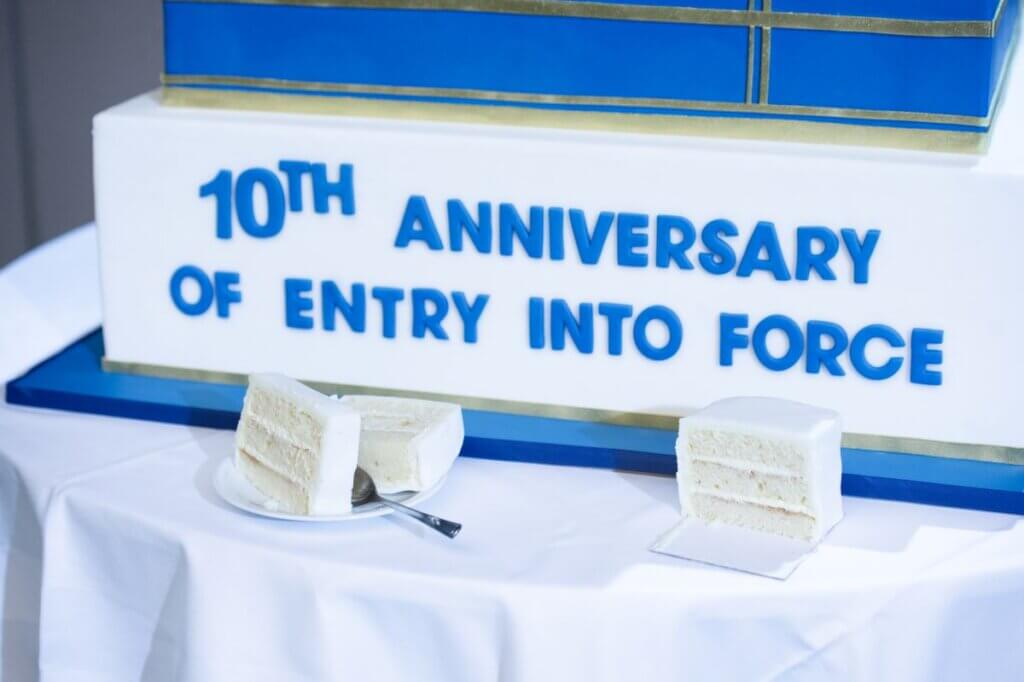
Special Session Celebrating the 10th Anniversary of the Entry into Force of the ATT” at the CSP10 opening plenary.
At the opening plenary of this year’s CSP, I was honored to represent civil society in a presentation on the treaty’s first decade. Although ten years is a relatively short period of time when trying to change global norms and State behavior, and treaty impact is difficult to measure (the treaty does not contain true quantitative metrics of success and counting the lives saved by transfers that never occurred is far from simple), a realistic evaluation of our work is both possible and essential.
As I told the conference plenary, throughout the treaty’s first decade of implementation, States have often been more focused on the bureaucracy of the treaty – on the development of treaty structures and rules of procedures – than on actual arms transfers. And while that makes sense to ensure the treaty is set up for success, there has unfortunately been less attention paid to first, ensuring the treaty lives up to its core object and purpose and second, making certain that actual arms transfers are being assessed against the ATT’s criteria and are not in violation of treaty prohibitions. In order to truly support the treaty’s object and purpose, we must talk about the arms trade during Arms Trade Treaty meetings and not be afraid to address hard issues in the forum that was created to address them. In my address to the Conference, I was quite forthright in my criticisms of the treaty but remained steadfast in my commitment to the treaty’s vision and effective implementation.

Rachel Stohl delivering remarks during the opening plenary of CSP10.
CSP10 provided the opportunity to consider the lessons we’ve learned after ten years of implementation, celebrate where we met the expectations of our ambitions, and chart a new course for moving forward on hopes we did not fulfill.
To that end, Stimson spent the last year undertaking an “ATT at 10” project to look back at the treaty’s accomplishments and develop recommendations to move the treaty forward into its next decade. At CSP10 I was able to launch the findings of this project, which brought together a diverse set of stakeholders, including those that were closely involved in the development of the treaty as well as those now focused on its implementation.
Our project’s conclusions balanced the accomplishments of the treaty with justifiable critiques of its implementation. The treaty’s first decade should be recognized as an achievement in and of itself. The mere presence of the ATT and its institutionalization of the link between the arms trade, international law, and human suffering is an enormous normative achievement. Additionally, the ATT has catalyzed the adoption or reformation of numerous national-level regulations and statutes related to the trade in conventional weapons, which is likely raising the day-to-day standards of the global arms trade.
However, to be true to the aims and goals of the ATT, we must also recognize where States Parties have fallen short in achieving the treaty’s expectations. When we consider the real-world implementation of the treaty to address human suffering, peace, and security and to improve transparency, we must concede that States have not yet developed processes or platforms to hold one another accountable for arms transfers that violate the treaty. The CSP process does not currently have a mechanism for States Parties to discuss or scrutinize real-world arms transfers. We must also highlight the lack of States Parties’ compliance on a technical level – particularly regarding reporting compliance and transparency – which has often left much to be desired.
Despite the ever-more complex geopolitical context, the ATT at 10 Project lays out concrete actions that States and ATT stakeholders may undertake to meet the ambitions, commitments, and aspirations represented in the treaty’s founding. We identified 10 areas of focus for the treaty’s future, from living up to treaty aspirations to measuring impact effectively.
While the project found many areas for improvement, my hopes and expectations for the ATT remain high. We look forward to operationalizing the project’s recommendations and working with a variety of stakeholders to ensure that elements of our project are incorporated into future treaty workstreams.

Stohl speaking to the ATT at 10 Project’s findings and recommendations at the launch reception.
While at CSP10, I also presented research included in the 2024 ATT Monitor Report, which found several positive developments in State reporting (such as the continuing decline in the submission of private ATT annual reports), as well as the unfortunate trends of low reporting compliance and private reporting. I also shared Stimson’s new report reflecting on the impact of revised reporting templates on transparency efforts. To round out the week, I spoke at an event highlighting an upcoming Stimson, Conflict Armament Research, and UNIDIR issue brief that provides an analysis of State Party measures on arms brokering and the ways in which gaps in such national measures have allowed for the diversion and illicit trade in conventional arms.
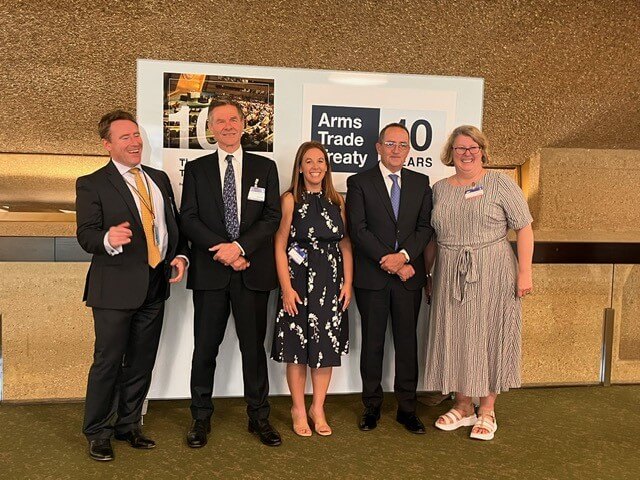
At the reception launch of the ATT at 10 Project (from left to right): H. E. Ambassador David Riley, Ambassador and Permanent Representative to the Conference on Disarmament, United Kingdom; H. E. Ambassador Peter Woolcott, Former Ambassador of Australia to the United Nations, Geneva (ATT Conference President 2013); Rachel Stohl; H.E. Ambassador Răzvan Rusu, Ambassador and Permanent Representative of Romania to the United Nations, Geneva (CSP10 President); and H. E. Ambassador Vanessa Wood, Ambassador for Arms Control & Counter-Proliferation, Australia.
We still have a long way to go to see the ATT meet its original promise. But, from the moment the green lights lit up the voting board in the General Assembly in 2013 to adopt the ATT, I hoped that real change in the international arms trade would follow. My goal, as it has been since the beginning, is to support the continued efforts to make the world a safer place through effective regulation of the arms trade. As I reminded the CSP10 plenary, “we owe it to those who suffer from the unregulated and irresponsible arms trade every day to ensure the treaty is implemented effectively.” Following CSP10, I hope this reminder of the human focus of the ATT will serve to revive the enthusiasm and political will we witnessed at the treaty’s adoption and commit ourselves to returning to that inspiration to move forward.
The ATT is needed now more than ever, and I am ready to do the hard work.









Community Adaptation for a Water Festival Without Clean Water