Editor’s Note: Lucas Ruiz is the inaugural Oppenheimer Fellow with the Oppenheimer Project, where he works on the trilateral nuclear relationship between China, Russia, and the United States. He was previously a Herbert Scoville Jr. Peace Fellow with the Reimagining U.S. Grand Strategy Program at the Stimson Center.
By Christopher Preble, Senior Fellow and Director, Reimagining US Grand Strategy Program
Acknowledgements
The authors wish to thank the many scholars and experts who informed and helped shape the arguments in this paper, including James Acton, Campbell Craig, Dan Grazier, and Geoff Wilson. Mark Bell and Francis Gavin read the entire paper and provided a number of helpful comments and suggestions. We are also grateful to the Stimson Center’s Reimagining U.S. Grand Strategy Program, including Alessandro Perri, for his timely and thorough research assistance, and Nevada Lee and Will Smith for reviewing early drafts. Stimson’s Kaitlyn Hashem was an expert copy editor.
Lucas Ruiz and Christopher Preble
April 2026
Executive Summary
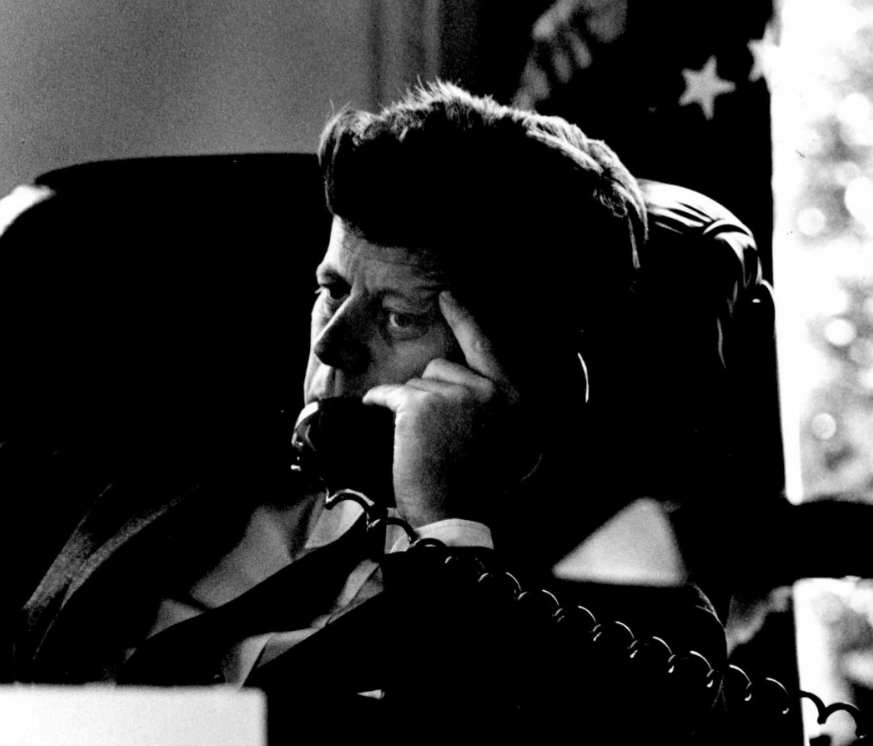
At the moment of maximum danger during the Cuban Missile Crisis, the U.S. leader whose judgment mattered most reached a conclusion that decades of U.S. nuclear strategy have preferred to ignore — nuclear superiority is a fool’s gambit. This paper takes that conclusion seriously.
The case for nuclear superiority rests on a conceptual confusion that its proponents have never adequately resolved. Deterrence and compellence belong to fundamentally different categories of statecraft — one oriented toward dissuasion, the other toward coercion — and the weapons, postures, and resolve required for each are not interchangeable. Superiority theory collapses this distinction, repurposing weapons designed to prevent catastrophe into instruments for extracting political concessions. This paper argues that this is not merely analytically imprecise. It is the source of a decades-long distortion in American strategic thinking, one with measurable consequences for force structure, arms control, and strategic stability.
Advocates for superiority do not rest their case on theory alone. They invoke history — the Cuban Missile Crisis, the Sino-Soviet Border Conflict of 1969, the 1973 Arab-Israeli (Yom Kippur) War, and the Kargil Crisis — as empirical proof that nuclear advantage confers coercive leverage. This paper examines each case in turn, drawing on declassified documents, transcripts, and primary sources that superiority theorists have either neglected or selectively read. What the full record reveals is considerably more unsettling than the standard account suggests. The leaders who actually bore responsibility for nuclear decisions did not experience superiority as leverage. They experienced it as irrelevant, at best, and as a source of dangerous pressure at worst. In at least one case, the crisis came within a single individual’s judgment call of going nuclear — through a mechanism entirely beyond the control of any head of state, and entirely invisible to the theoretical framework that claims to explain these events. This points to a deeper problem: Superiority theory treats these singular events as interchangeable data points from which generalizable causal laws can be extracted, abstracting away the very personalities, miscalculations, and contingencies that determined their outcomes.
The policy implications are significant. Effective deterrence requires sufficiency — a survivable force capable of inflicting unacceptable retaliation regardless of what an adversary does first — not superiority. Beyond that threshold, additional capability does not enhance security; it signals offensive intent, invites countermeasures, and erodes the stability that deterrence is supposed to protect. The current administration’s nuclear modernization agenda, its missile defense ambitions, and its abandonment of arms control are consistent with a bid for escalation dominance. If the historical record examined in this paper establishes anything, it is that no American president confronting the actual prospect of nuclear war has believed such dominance to be achievable — or safe. The gap between what superiority promises and what it delivers is not incidental; it is a failure of American nuclear orthodoxy. And it is past time for American scholars and strategists to reckon with it.