


Introduction
United Nations Security Council Resolution (UNSCR) 1540 was adopted in 2004 in response to heightened global concerns about the dangers of weapons of mass destruction (WMD) and their potential impact on the international safety and security of the global commons.1Security Council resolution 1540, S/RES/1540 (28 April 2004), available from https://documents-dds-ny.un.org/doc/UNDOC/GEN/N04/328/43/PDF/N0432843.pdf?OpenElement. https://undocs.org/Home/Mobile?FinalSymbol=S%2FRES%2F1540(2004)&Language=E&DeviceType=Desktop&LangRequested=False. It provided an agreed framework for action to address WMD proliferation risks. Similarly, escalating security threats in the digital domain impact the global commons and have brought cybersecurity concerns to the forefront; a framework is needed for overseeing the implementation of agreed-upon cyber norms and laws.
The implementation of the 1540 resolution required states to adopt domestic laws and regulations to help ensure nonproliferation of WMDs and associated technologies. Several experts led in translating the resolution into a matrix for state implementation. This matrix has been instrumental in helping states to better understand their own responsibilities. In cyberspace, the UN has developed broad norms for responsible state behavior and affirmed the applicability of international law; however, what states and stakeholders need to do to evidence compliance with laws and norms has not yet been fully agreed upon.2Note, much good work has and is going on in this area: Government of Switzerland, Federal Department of Foreign Affairs, “Geneva Dialogue on Responsible Behaviour in Cyberspace,” https://genevadialogue.ch/; and Christian Ruhl, Duncan Hollis, Wyatt Hoffman, and Tim Maurer, “Cyberspace and Geopolitics: Assessing Global Cybersecurity Norm Processes at a Crossroads,” Carnegie Endowment for International Peace, June 2023), https://carnegieendowment.org/2020/02/26/cyberspace-and-geopolitics-assessing-global-cybersecurity-norm-processes-at-crossroads-pub-81110; and a measure of States’s commitments to countries—International Telecommunications Union, “Global Cybersecurity Index,” https://www.itu.int/en/ITU-D/Cybersecurity/Pages/global-cybersecurity-index.aspx. New norms have been suggested at recent OEWG meetings.
The UN Security Council (UNSC) exercised its authority under Chapter VII of the UN Charter when it acted to protect international peace and security by unanimously adopting resolution 1540 in the year 2004. Resolution 1540 “imposes binding obligations on all States to adopt legislation to prevent the proliferation of nuclear, chemical and biological weapons, and their means of delivery, and to establish appropriate domestic controls over related materials to prevent their illicit trafficking. It also encourages enhanced international cooperation in this regard.”3The United Nations Security Council, with its 15 member states, passes many resolutions every year. To pass a resolution, nine votes are required without a veto from any of its permanent members (China, France, Russia, the United Kingdom, the United States). Unlike resolutions of the UN General Assembly, Security Council resolutions can be binding if evoked under the Chapter VII “threat to international peace and security” provision of the UN Charter, thereby imposing obligations on member states. When a Security Council resolution (UNSCR) is passed under Chapter VII of the charter, concerning threats to international peace and security, the Council “decides” that states must take some specific actions.
The resolution complements and strengthens existing mechanisms, informal and formal—including treaties for controlling nuclear, chemical, and biological weapons. It fills important gaps to complement other disarmament and nonproliferation frameworks. It takes a collaborative approach in that it does not require sanctions or other enforcement mechanisms. It does require states to implement domestic legislation to prevent proliferation including export controls and security measures for its materials and encourages accession to related international treaties.
UNSCR 1540 established a committee consisting of all UNSC members to oversee the resolution’s implementation with the assistance of what evolved into a Group of Experts (GOE). UNSCRs are binding on the entirety of the UN membership. Unlike the Committees of other subsidiary bodies to UN Security Council resolutions, the 1540 GOE has no agreed-upon mandate to engage with a UN member state without being prompted. The responsibilities of the expert group, as well as its independence, have been points of difference among some states.4Security Council Report, “Nonproliferation (1540 Committee),” February 2023, https://www.securitycouncilreport.org/monthly-forecast/2023-03/nonproliferation-1540-committee-6.php.
UNSCR 1540 resulted in part from post-9/11 concerns that nuclear, chemical, and biological weapons, as well as related materials and their means of delivery, could come into terrorists’ hands. While the United States (U.S.) had led development of the Proliferation Security Initiative (PSI) in 2003 to interdict suspected shipments of potential weapons of mass destruction and their means of delivery to terrorists and states of concern, it was a voluntary program with membership by invitation only and thus was not universally appreciated or adopted.5Economist, “No Place to Hide, Maybe,” October 28, 2004, accessed May 23, 2024, https://www.economist.com/asia/2004/10/28/no-place-to-hide-maybe.For more in-depth background on the early development of 1540, see: Rehman, H., & Qazi, A. (2019); “Significance of UNSCR 1540 and Emerging Challenges to its Effectiveness,” Strategic Studies, 39(2), 48–66. https://www.jstor.org/stable/48544299. In addition, the treaties controlling biological, chemical, and nuclear weapons were a patchwork with different memberships and provisions, creating an uneven global playing field.6Government of the United States. US Department of State Bureau of International Security and Nonproliferation, “Proliferation Security Initiative,” https://www.state.gov/proliferation-security-initiative/.
UNSCR 1540 was also driven by concerns about the privatization of proliferation that had emerged over the years leading up to 2004 resolution, in which nonstate actors including manufacturers, shippers, and brokers were increasingly providing WMD-related goods and knowledge to countries seeking WMD and/or their means of delivery. In February 2004 these concerns were heightened when Pakistani physicist A. Q. Khan gave a televised address in which he confessed to having a network for sales to support states’ nuclear programs.7David Rohde, “Pakistani A-Bomb Guru Says He, Alone, Let Secrets Out,” New York Times, February 5, 2004, accessed May 23, 2024, https://www.nytimes.com/2004/02/05/world/pakistani-a-bomb-guru-says-he-alone-let-secrets-out.html?searchResultPosition=8.
Early debates about UNSCR 1540 reflected some states’ concerns that the UNSC was overstepping its mandate by requiring states to prevent proliferation to all nonstate actors—both proliferation networks and terrorists—under the Security Council’s Chapter VII authorities.8India noted it had “basic concerns over the increasing tendency of the Council in recent years to assume new and wider powers of legislation on behalf of the international community, with its resolutions binding on all states. In the present instance, the Council seeks to both define the nonproliferation regime and monitor its implementation. But who will monitor the monitors?; Gabriel H. Oosthuizen and Elizabeth Wilmshurst, “Terrorism and Weapons of Mass Destruction: United Nations Security Council Resolution 1540,” Chatham House International Law Programme, September 2004, https://www.chathamhouse.org/sites/default/files/public/Research/International%20Law/ILP0904bp.pdf. To address these concerns, the resolution was ultimately updated to reference the importance of states working collaboratively through relevant regional and international organizations. While the 2004 resolution established the 1540 Committee and recognized the need for it to integrate other expertise, it was not until later resolutions that there were direct calls for experts to support the Committee’s work. These resolutions formalized a Group of Experts in 2011 to support the Committee.9This resolution established an initial group of eight experts appointed by the Secretary-General in consultation with the Committee. Security Council resolution 1540, S/RES/1540, April 28, 2004), available from https://documents-dds-ny.un.org/doc/UNDOC/GEN/N04/328/43/PDF/N0432843.pdf?OpenElement, 3, https://undocs.org/Home/Mobile?FinalSymbol=S%2FRES%2F1540(2004)&Language=E&DeviceType=Desktop&LangRequested=False. Internal Committee debates ensued as to the appropriate scope of all the GOE activities, from providing implementation support to states to monitoring versus evaluating implementation progress.
Developing Review and Assessment Mechanisms for Accountability
The 1540 Committee supports states by responding to requests for assistance. This support has included assisting states to develop voluntary national implementation plans, providing matchmaking needs and resources, and collaborating within regional and other training programs. Peer reviews have been undertaken when states request them, although they are not done as frequently as for other, more targeted, agreements, such as in nuclear security.10United Nations Security Council 1540 Committee, Dushanbe Meeting of the Trilateral Peer Review of Implementation of UN Security Council Resolution 1540 Among the Republic of Belarus, the Kyrgyz Republic and the Republic of Tajikistan, August 2-4, 2017, Official Record, August 2017, available from https://www.un.org/en/sc/1540/documents/Final%20Document%20Trilateral%201540%20Peer-Review%20Dushanbe%202017.pdf. More frequently, the Committee will engage when invited alongside other international and regional organizations, such as the International Atomic Energy Agency (IAEA), the Organization for the Prevention of Chemical Warfare (OPCW), and roughly a dozen other treaty- and other UN-based international organizations, https://disarmament.unoda.org/wmd/sc1540/.
Many have questioned the aspects of UNSCR 1540 that call for “appropriate” and “effective” laws and measures to prevent proliferation, because countries differ in what they consider to be “appropriate.” Yet it has been useful to share model laws and effective practices, leading to shared understanding of these terms. When updating the UNSCR 1540 mandate through a new resolution in 2011 (UNSCR 1977), the UNSC asked the 1540 Committee to, with GOE support, “consider developing a technical reference guide to help implementation, including civil society and the private sector, with, as appropriate, their State’s consent”; however, this objective was not achieved.11Note UNSCR 1977 (2011) also asked the 1540 Committee, with assistance from the group of experts, to “identify effective practices, templates and guidance, with a view to develop a compilation, as well as to consider preparing a technical reference guide about resolution 1540 (2004), to be used by States on a voluntary basis in implementing resolution 1540 (2004), and in that regard, encourages the 1540 Committee, at its discretion, to draw also on relevant expertise, including, civil society and the private sector, with, as appropriate, their State’s consent[.],” available at https://undocs.org/Home/Mobile?FinalSymbol=S%2FRES%2F1977%2520(2011)&Language=E&DeviceType=Desktop&LangRequested=False, 4.
UNSCR 1977 also promoted a trust fund managed by the UN Office of Disarmament Affairs (UNODA) intended to fund travel and other projects involving the GOE, often in collaboration with nongovernmental organizations (NGOs). As the 1540 Committee’s Secretariat, UNODA is able to provide an important coordination role and uses the trust fund to support awareness-raising workshops, meetings, 1540 National Points of Contact trainings, and other activities including those on regional levels to help states implement the resolution.12United Nations Office of Disarmament Affairs, Programmes Financed from Voluntary Contributions 2020—2021, available from https://www.unrec.org/docs/report/2022/xb-report-2021.pdf.
Since the Committee’s GOE has no mandate, it is not permitted to directly suggest how each member state might best implement the resolution when all its aspects are ostensibly given equal weight. This lack of guidance makes it difficult for states to identify their highest risks as no structured, systematic approach to risk assessments has been or can be developed by the Committee with regard to any of the resolution’s requirements. Prioritization ends up being a function of what a state cares about on the one hand, and where it might most easily obtain knowledge and available support on the other. A promising approach has been to provide assistance with clear developmental benefits while encouraging fulfillment of state obligations under 1540.
Facilitating Incentives for and Ensuring Implementation
The 1540 Committee supports states by responding to requests for assistance. This support has included assisting states to develop voluntary national implementation plans, providing matchmaking needs and resources, and collaborating within regional and other training programs. Peer reviews have been undertaken when states request them, although they are not done as frequently as for other, more targeted, agreements, such as in nuclear security.
Many have questioned the aspects of UNSCR 1540 that call for “appropriate” and “effective” laws and measures to prevent proliferation, because countries differ in what they consider to be “appropriate.” Yet it has been useful to share model laws and effective practices, leading to shared understanding of these terms. When updating the UNSCR 1540 mandate through a new resolution in 2011 (UNSCR 1977), the UNSC asked the 1540 Committee to, with GOE support, “consider developing a technical reference guide to help implementation, including civil society and the private sector, with, as appropriate, their State’s consent”; however, this objective was not achieved.
UNSCR 1977 also promoted a trust fund managed by the UN Office of Disarmament Affairs (UNODA) intended to fund travel and other projects involving the GOE, often in collaboration with nongovernmental organizations (NGOs). As the 1540 Committee’s Secretariat, UNODA is able to provide an important coordination role and uses the trust fund to support awareness-raising workshops, meetings, 1540 National Points of Contact trainings, and other activities including those on regional levels to help states implement the resolution.
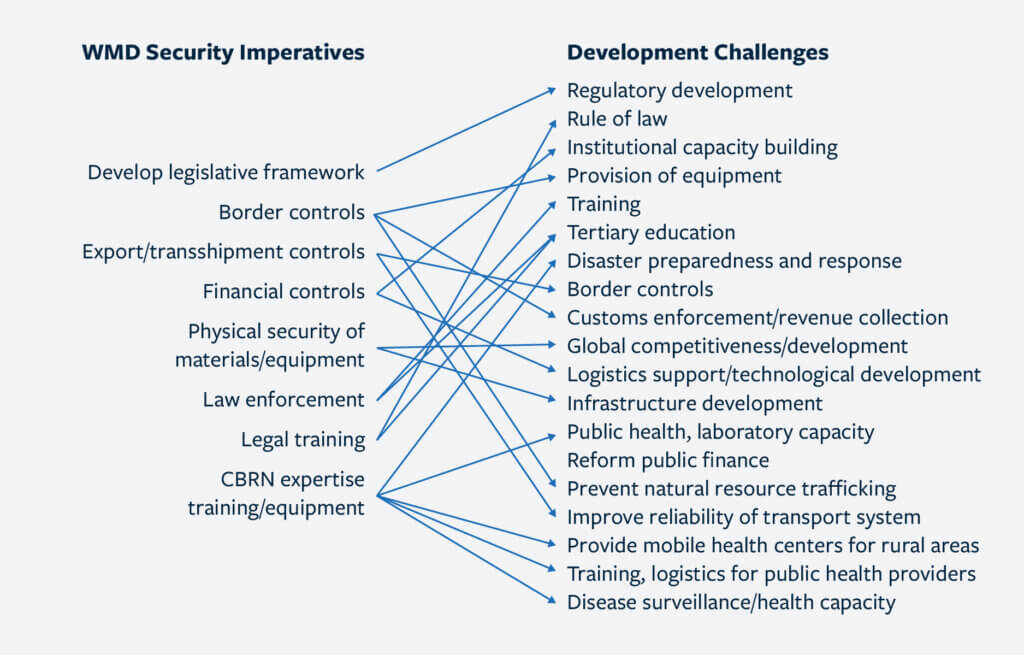
Since the Committee’s GOE has no mandate, it is not permitted to directly suggest how each member state might best implement the resolution when all its aspects are ostensibly given equal weight. This lack of guidance makes it difficult for states to identify their highest risks as no structured, systematic approach to risk assessments has been or can be developed by the Committee with regard to any of the resolution’s requirements. Prioritization ends up being a function of what a state cares about on the one hand, and where it might most easily obtain knowledge and available support on the other. A promising approach has been to provide assistance with clear developmental benefits while encouraging fulfillment of state obligations under 1540.
Demonstrating the value proposition of UNSCR 1540—that it complements the requirements put in place by other treaties and benefits the immediate domestic priorities of states—remains important.13Brian Finlay, “Bridging the Security/Development Divide with UN Security Council Resolution 1540,” Stimson Center, September 2009, https://www.stimson.org/2009/bridging-securitydevelopment-divide-un-security-council-resolution-1540-0/; see also: Brian Finlay, ”Bridging the Security/Development Divide with UN Security Council Resolution 1540: A Case Study Approach,” The Stanley Foundation, (September 2009): https://www.files.ethz.ch/isn/106569/Bridging_Divide_Finlay.pdf. UNODA and others have additionally emphasized the link between fulfilling UNSCR 1540 obligations and realizing some of the UN Sustainable Development Goals.14William Marshall, Christina McAllister, Gabriel Savagner, and Andrea Viski, “Leveraging UN Sustainable Development Goals and UN Security Council Resolution 1540 Synergies: The Case for Responsible Chemical Management,” Stimson Center, July 2023, https://www.stimson.org/2023/leveraging-un-sustainable-development-goals-and-un-security-council-resolution-1540-synergies-the-case-for-responsible-chemical-management/.
An important auxiliary benefit of UNSCR 1540 is the internal and interagency coordination that reporting generates. Officials from ministries of foreign affairs, trade, finance, or various other science, technology, and health-related organizations are responsible for implementing aspects of the resolution. Their involvement begets the need to report on all 1540-related functions, which facilitates better internal coordination.15United Nations, 1540 Committee, “National Points of Contact,” available at: https://www.un.org/en/sc/1540/national-implementation/national-points-of-contact.shtml. Often the states’ official point of contact with the Committee, which is publicly available, will facilitate reporting, although a survey found that many had difficulty in reporting and were not clear on their roles. The survey reached 105 of the 123 states with points of contact in 2020 and received 34 replies. Seema Gahlaut, “1540 Points of Contact: An Underutilized Resource,” The Stimson Center, August 1, 2022, https://www.stimson.org/2022/1540-points-of-contact-pocs-an-under-utilized-resource/. UNODA provides self-paced and instructor-led courses on UNSCR 1540 implementation, including development of National Action Plans for 1540 Implementation.16United Nations, Office for Disarmament Affairs, “Training Courses,” https://www.disarmamenteducation.org/index.php?go=education#online. Often the states’ official points of contact with the Committee, which are publicly available, will facilitate reporting, although a survey found that many had difficulty in reporting and were not clear on their roles. Forty-seven states have submitted such plans.17United Nations, 1540 Committee, “National Implementation Plans,” available at https://www.un.org/en/sc/1540/national-implementation/national-implementation-plans.shtml.
Countries with lesser capacity are hard-pressed to prioritize legislation or reporting because of the many complex and overlapping requirements among treaty-based agreements, UN resolutions, and export control regimes. NGOs have played an important role in this regard by providing prioritization suggestions where neither the Committee nor any given international organization lacked the capacity. Nongovernmental organizations therefore complement the Committee’s call for states to report more frequently whether to the Committee or domestically to legislative bodies and/or to executive branches of government.
Promoting Awareness and Best Practices
The original (2004) UNSCR 1540 resolution specifically calls upon states “To develop appropriate ways to work with and inform industry and the public regarding their obligations under the resolution.”18S/RES/1540 (2004). UNSCR 2325 adopted in 2016 emphasized this point and additionally noted the importance of outreach to parliaments as they enact the legislation needed to implement the resolution.19UNSCR S/RES/2325(2016), available at https://undocs.org/Home/Mobile?FinalSymbol=S%2FRES%2F2325(2016)&Language=E&DeviceType=Desktop&LangRequested=False. A diverse series of activities have helped to promote awareness of UNSCR 1540 and best practices in its implementation.
Informing industry: Germany has hosted an annual conference since 2011, which evolved into regional meetings starting in 2016 known as the Wiesbaden Process to engage industry and others to support 1540 implementation. Germany then initiated a cooperation with UNODA and held the Erlangen Conference in Nuremberg in 2023 to collaborate with regulators and academia. Recognizing new emerging threats, these players engaged in providing “user-friendly” guidance on the transfer of intangible technology and emphasized the need for classification systems.20United Nations, Office of Disarmament Affairs, “Erlangen Initiative: Fostering Collaboration Between Academia and Government Regulators for UNSCR 1540 Implementation,” December 23, 2023, available at: https://disarmament.unoda.org/update/erlangen-initiative-fostering-collaboration-between-academia-and-government-regulators-for-unscr-1540-implementation/.
Leveraging civil society to promote accountability: Civil society can provide innovative ways to promote and support UNSCR 1540 implementation. Support has included help with drafting model laws, matching States with needed resources, and promoting awareness among students and others in academia.21VERTIC (the Verification Research, Training and Information Centre) developed toolkits for states to use in legislation complying with obligations under 1540, including as part of the BWC, CWC, and other nuclear/radiological agreements. The Stimson Center initiated a pilot project that provided pro bono support from lawyers and from law school and graduate university students to develop prototype legislation and explain the benefits of better trade controls, with a focus on the Caribbean. Stimson also assists in supporting implementation and publishes a roster of support resources and developed a student essay contest to promote international awareness among students and others in academia.
Promoting good practices:22The Center for
International Trade and Security for a number of years published the journal 1540
Compass that shared ideas on effective 1540 implementation, https://disarmament.unoda.org/. International organizations such as the World Customs Organization work with states, industry, and others to train officials and organizations on good enforcement and compliance practices that include UNSCR 1540 and related obligations, including controls over technology.23World Customs Organization, Strategic Trade Control Enforcement Programme (STCE), https://www.wcoomd.org/en/topics/enforcement-and-compliance/activities-and-programmes/security-programme/stce-project.aspx. The UN’s hope was that UNSCR 1540 could help to standardize export controls, bringing more countries and better processes to the export control supplier regimes. However, many member states disagree with this objective and are instead inclined to adopt more streamlined control lists that are more representative of the industrial activities taking place in their countries. In addition, state control lists can evolve, reflecting differing views on technological, economic, and security interests.24Scott Jones, “Resolution 1540: Universalizing Export Control Standards?”, Arms Control Today, May 2006, https://www.armscontrol.org/act/2006-05/features/resolution-1540-universalizing-export-control-standards; and a 2023 assessment of some changes in Strategic Trade Review https://strategictraderesearch.org/wp-content/uploads/2023/02/Strategic-Trade-Review-Issue-10.pdf. Supplier regime lists change more slowly due to the time it takes to publish updated controls and the growing inability of states to agree on which updates, if any, are appropriate for some of these regimes.
Some countries work bilaterally via mutual assistance agreements with binding obligations to collaborate on customs law enforcement.25For example, see: United States Department of Homeland Security. “Customs Mutual Assistance Agreements (CMAA),” US Customs and Border Protection, https://www.cbp.gov/border-security/international-initiatives/international-agreements/cmaa. However, stopping the illicit spread of technology has been hard, with states often unable to manage processes to identify, predict, and coordinate controls even within their own governments.26See Michael Beck and Nick Stachowiak, “The Devolution of Export Controls: Rethinking Their Use in Technological Competition,” and Rudi du Bois, Julia Bell, and Dries Bertrand, “To Share or Not to Share?: The Challenge of Controlled Technologies in Research and Development (R&D),” and related articles in the Spring 2023 issue of Strategic Trade Review, https://strategictraderesearch.org/wp-content/uploads/2023/02/Strategic-Trade-Review-Issue-10.pdf.
Adapting to Change and Promoting Leadership
One mechanism that has worked to avoid bottlenecks in the UNSC’s 1540 Committee has been to establish regional 1540 coordinators that work with UNODA.27Including through 1540 Support Unit, United Nations, Office of Disarmament Affairs, “UNODA side event on the margins of the 1540 Committee’s Open Consultations,” updated June 7, 2022, available at https://disarmament.unoda.org/ar/update/unoda-side-event-on-the-margins-of-the-1540-committees-open-consultations/. This approach prevents a UNSC country from being able to stymie agreement on such issues as benchmarking standards of performance. Updates to the matrix may be forthcoming to reflect the role of new technologies in proliferation.
Most recently, UNSCR 2663 (2021) updated aspects of the original resolution (1540) and extended the 1540 Committee’s mandate by 10 years, reflecting that long-term commitment encourages implementation.28United Nations, 1540 Committee, “1540 Fact Sheet,” April 28, 2004, available at https://www.un.org/en/sc/1540/1540-fact-sheet.shtml. The matrix is still being used and evolving, with expectations of it being updated again., https://www.un.org/en/sc/1540/documents/Final%20Matrix%20Template%20(E).pdf. While 1540 (2004) directed states not to finance proliferation activities, UNSCR 1810 (2008), that renewed the original resolution, noted the need for additional focus to prevent “the financing of proliferation-related activities, taking into consideration the guidance of the framework of [FATF],” S/RES/1810 (2008), available at https://undocs.org/Home/Mobile?FinalSymbol=S%2FRES%2F1810(2008)&Language=E&DeviceType=Desktop&LangRequested=False. Yet, it was not until 2012 that FATF adopted specific guidance on proliferation financing and the need to address that in the context of 1540 requirements. Council of Europe, Resolution Res (2005), 47, https://www.coe.int/en/web/moneyval/implementation/financing-proliferation.30 See the latest resolution that recommends consideration of FATF’s guidance framework: Security Council Resolution S/RES/2462 (2019), available at https://documents.un.org/doc/undoc/gen/n19/090/16/pdf/n1909016.pdf?token=Dm4iB4izE2SCnxOey5&fe=true. A small group of states established FATF in 1989 to combat money laundering and, as its membership expanded and state participation grew, extended its work in 2001 to address terrorist financing and in 2007 to address proliferation financing, https://www.fatf-gafi.org/en/the-fatf/history-of-the-fatf.html; https://www.coe.int/en/web/moneyval/implementation/financing-proliferation. For example, the language in the original resolution simply recognized the importance of controlling proliferation financing, while later resolutions encouraged work with the Financial Action Task Force (FATF).29See the latest resolution that recommends consideration of FATF’s guidance framework: Security Council Resolution S/RES/2462 (2019), available at https://documents.un.org/doc/undoc/gen/n19/090/16/pdf/n1909016.pdf?token=Dm4iB4izE2SCnxOey5&fe=true. A small group of states established FATF in 1989 to combat money laundering and, as its membership expanded and state participation grew, extended its work in 2001 to address terrorist financing and in 2007 to address proliferation financing, https://www.fatf-gafi.org/en/the-fatf/history-of-the-fatf.html; https://www.coe.int/en/web/moneyval/implementation/financing-proliferation.
The 2663 resolution’s establishment of a committee to support implementation enabled Security Council countries to take part in various specific roles with concordant responsibilities. The Committee then set up four UNSC working groups: 1) monitoring and national implementation; 2) assistance; 3) cooperation with international, regional, and subregional organizations, including UN bodies; and 4) transparency and outreach. The leaders of these working groups thus take on added responsibilities for ensuring successful implementation as does the 1540 Committee chairperson.
Key Takeaways and Recommendations
1. Find and Mind the Gap
Just as states did not initially and fully appreciate the potentially catastrophic nature of WMD proliferation risks, many today do not understand the potential enormity of risks that cyber and other emerging technologies such as AI present. Building value propositions around security and accountability for implementation of norms and laws is important. States have such wide-ranging needs that capacity-building is necessary to foster development along with security.
Recommendation: The true value proposition in investments in compliance with cyber norms and international law has not yet been made clear, and common interest in global cybersecurity needs to be strengthened. Local interests will differ among countries but must take account of the knock-on global effects that local decisions can have for issues like cyber and malicious ICT activity. A better understanding of the consequences of local cyber insecurities on the global commons is needed. This would help prioritize the investments needed for capacity-building while weighing international and local interests. Research exploring states’ nonconformance with norms and different norm-development processes has been started and needs to be furthered.30See some excellent explorations of norms and the overlaps of efforts at: Christian Ruhl, Duncan B. Hollis, Wyatt Hoffman, and Tim Maurer, “Cyberspace and Geopolitics: Assessing Global Cybersecurity Norm Processes at a Crossroads,” Carnegie Endowment for International Peace, Feb 26, 2020, accessed May 24, 2024, https://carnegieendowment.org/research/2020/02/cyberspace-and-geopolitics-assessing-global-cybersecurity-norm-processes-at-a-crossroads?lang=en.
2. Recognize the Different Valuations of Risks—but Weight Effects on the Global Commons
Just as states did not initially and fully appreciate the potentially catastrophic nature of WMD proliferation risks, many today do not understand the potential enormity of risks that cyber and other emerging technologies such as AI present. Building value propositions around security and accountability for implementation of norms and laws is important. States have such wide-ranging needs that capacity-building is necessary to foster development along with security.
Recommendation: The true value proposition in investments in compliance with cyber norms and international law has not yet been made clear, and common interest in global cybersecurity needs to be strengthened. Local interests will differ among countries but must take account of the knock-on global effects that local decisions can have for issues like cyber and malicious ICT activity. A better understanding of the consequences of local cyber insecurities on the global commons is needed. This would help prioritize the investments needed for capacity-building while weighing international and local interests. Research exploring states’ nonconformance with norms and different norm-development processes has been started and needs to be furthered.31See some excellent explorations of norms and the overlaps of efforts at: Christian Ruhl, Duncan B. Hollis, Wyatt Hoffman, and Tim Maurer, “Cyberspace and Geopolitics: Assessing Global Cybersecurity Norm Processes at a Crossroads,” Carnegie Endowment for International Peace, Feb 26, 2020, accessed May 24, 2024, https://carnegieendowment.org/research/2020/02/cyberspace-and-geopolitics-assessing-global-cybersecurity-norm-processes-at-a-crossroads?lang=en.
3. Incentivize Performance
UNSCR 1540 has no enforcement mechanisms but relies on incentives for states to report and conform to the resolution’s obligations. The Committee leverages the work of other institutions that require interrelated reporting. The reporting and committee internal reviews incentivize compliance by encouraging transparency, trustworthiness, and more international accountability. Using the UNODA trust fund and working through assistance providers and other international organizations have helped implementation.
Recommendation: Supporting implementation and reporting, linking implementation to developmental goals, and providing funding for these efforts are all key to advancing compliance with cyber norms and laws. Existing organizations’ efforts in cyberspace can be better coordinated and harnessed in the digital domain. However, possible consequences from nonconformance with resolutions, norms, and laws also need to be discussed and articulated.
4. Adapt, Coordinate Efforts, and Lead
The Security Council believed that efforts to address WMD proliferation could be strengthened, expanded, and monitored centrally via the work of the 1540 Committee and its Group of Experts in cooperation with states and civil society. The Committee recognizes it now needs to review its work and the matrix to adapt to new and emerging needs and that this will take expert input and leadership. In the 1540 context, leadership could be provided by a wide range of actors: the Committee chair, member states that lead working groups, the local contacts in states and now regions, and the larger UN system of organizations. The local contacts and the COE have not reached their full potential due to states’ disagreement over their proper role and functions. The UNODA’s role in supporting regional leadership and its use of the voluntary trust fund for implementation has helped counterbalance some of the Committee’s challenges.
Recommendation: International leadership is needed to help reduce cyber risks and promote cyber norms and laws. While central coordination of the many ongoing efforts to promote cyber stability and reduce threats is needed, the challenges of UN coordination must be acknowledged. A recent UN policy brief from the UN Secretary-General highlights the need for new governance frameworks to mitigate harm and address cross-cutting risks. This includes consideration of how new digital technologies may be applied to multiple threats, such as in the biological and nuclear areas and calls for new mechanisms for accountability.32United Nations Secretariat, “Our Common Agenda Policy Brief 9: A New Agenda for Peace,” United Nations Publication, July 2023, https://www.un.org/sites/un2.un.org/files/our-common-agenda-policy-brief-new-agenda-for-peace-en.pdf. The proposed Cyber Programme of Action should ensure that the proposals being put forward are implementable and that there are clearly defined roles and responsibilities for all stakeholders.33See, for example, the French proposal here: United Nations Office for Disarmament Affairs, “Programme of action (PoA) to advance responsible State behaviour in the use of ICTs in the context of international security,” May 2021, https://docs-library.unoda.org/Open-Ended_Working_Group_on_Information_and_Communication_Technologies_-_(2021)/Proposal_of_structure_of_the_RID_future_mechanism_-_PoA_for_consideration_of_the_OEWG_(FR).pdf.







Community Adaptation for a Water Festival Without Clean Water