Introduction
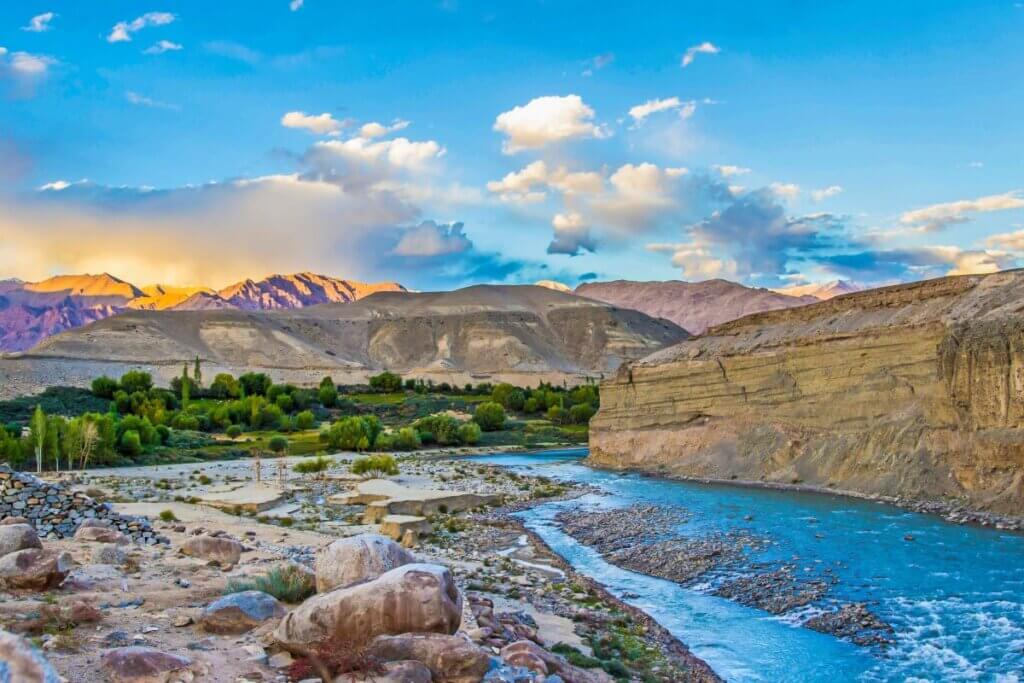
Roughly 300 million people in India and Pakistan live in the Indus Basin. The Indus Waters Treaty (IWT) is a water distribution agreement signed between India and Pakistan under the aegis of the World Bank in 1960 to manage the use of water in the basin. River tributaries in the basin cover 65 percent of Pakistan’s drainage area1Pakistan’s drainage area includes the entire province of Punjab and Khyber Pakhtunkhwa and most of the territory of Sindh and eastern Balochistan. and 14 percent of India’s drainage area.2India’s drainage area includes the states of Jammu and Kashmir, Himachal Pradesh, Punjab, Rajasthan, Haryana, and Chandigarh.3Food and Agriculture Organization of the United Nations, Transboundary River Basin Overview —Indus, Version 2011, accessed December 18, 2023, https://www.fao.org/3/CA2136EN/ca2136en.pdf. The IWT divides the Indus Basin between the two neighbors, with India exercising control over the three eastern rivers (Ravi, Sutlej, and Beas) and Pakistan exercising control over the three western rivers (Jhelum, Chenab, and Indus).
The IWT is regarded as one of the most successful global transboundary water-sharing treaties and an enduring bilateral confidence-building measure (CBM). Unlike many other CBMs, it has survived numerous wars and crises.4Mahesh Kumar Srivastava, “An enduring agreement bridging India-Pakistan ties”, The Hindu, June 10, 2022, https://www.thehindu.com/opinion/op-ed/an-enduring-agreement-bridging-india-pakistan-ties/article65511311.ece . One of the factors behind its success is the built-in conflict resolution mechanism, which allows a neutral expert or an international court of arbitration to settle disputes arising from yearly meetings between the Permanent Indus Commissioners of both countries.5“Pakistan Commissioner For Indus Waters.” Ministry of Water Resources, n.d. https://mowr.gov.pk/Detail/MDQ1NDQ1YTQtMzQ1MC00YTU5LTljMWEtMzliZTVhM2QxMjhl#:~:text=MEETINGS%20OF%20THE%20PERMANENT%20INDUS%20COMMISSION&text=%E2%80%9CThe%20Commission%20shall%20meet%20regularly,agreed%20upon%20between%20the%20Commissioners. Notably, the treaty does not have an exit clause in its current form, preventing any of the signatories—India, Pakistan, or the World Bank—from unilaterally exiting it. Modifications also require a consensus.6“Rectification of Indus Water Treaty”, Government of India, Press Information Bureau, July 23, 2002, accessed April 21, 2024, https://archive.pib.gov.in/archive/releases98/lyr2002/rjul2002/23072002/r230720029.html. Therefore, any unilateral action by one side could create legal and economic complexities.7Observer Research Foundation, “Indus Waters Treaty: Opening the Water Front,” Sushant Sareen, January 28, 2023, accessed February 3, 2024, https://www.orfonline.org/expert-speak/indus-waters-treaty. The IWT is a key tool for water conflict resolution between the two nuclear powers and is one of the oldest CBMs between both states. The treaty has an inbuilt, three-tiered dispute resolution process, making it a unique treaty between two adversaries. Pakistan is the lower riparian state and views the IWT as critical to its national security and agricultural productivity as it relies heavily on the Indus Basin, while India relies on the treaty to ensure its irrigation needs are met. As the propensity for resource-based conflict in South Asia increases due to the growing effects of climate change, India and Pakistan should focus on insulating the IWT from domestic pressures that threaten to politicize the treaty. Instead, both countries should use the treaty’s mechanisms to resolve their disputes and engage in technical dialogue to solve some of the ongoing tensions that fall within the parameters of the IWT.
Politicizing the Indus Basin
The technical and engineering details codified in the treaty make its understanding difficult for the wider public. This has created an environment where routine technical objections arising from the Permanent Indus Commissioners’ disagreements are taken out of context and dominate public discourse about the Indus Basin.
As the propensity for resource-based conflict in South Asia increases due to the growing effects of climate change, India and Pakistan should focus on insulating the IWT from domestic pressures that threaten to politicize the treaty.
India and Pakistan’s political establishments have used nationalistic rhetoric for their claims to water resources as a tool to vilify each other for political gains.8Mumtaz Haider, “Pakistan’s Water Woes Should Not Be Blamed on ‘Bogeyman India,’” Dawn, August 28, 2014, accessed September 24, 2023, https://www.dawn.com/news/1128132. In 2016, Indian Prime Minister (PM) Narendra Modi said that “blood and water cannot flow together” during an election rally following the Uri attacks.9“Blood and water cannot flow together: PM Modi at Indus Water Treaty meeting,” Indian Express, September 27, 2016, accessed June 10, 2024, https://indianexpress.com/article/india/india-news-india/indus-water-treaty-blood-and-water-cant-flow-together-pm-modi-pakistan-uri-attack/ After the 2019 Pulwama/Balakot crisis, an Indian minister called for suspending water supplies to Pakistan.10Nitin Gadkari, Twitter post, February 21, 2019, accessed September 25, 2023, https://twitter.com/nitin_gadkari/status/1098567044574916608?ref_src=twsrc%5Etfw%7Ctwcamp%5Etweetembed%7Ctwterm%5E1098567044574916608%7Ctwgr%5Ea811a2e851c69073322ba298ee296fba5053a1b6%7Ctwcon%5Es1_&ref_url=https%3A%2F%2Fwww.orfonline.org%2Fresearch%2Findus-treaty-why-india-cannot-afford-to-fight-fire-with-water-48487%2F. In that same year in an election rally in the Indian state of Haryana, PM Modi reiterated that waters that belonged to India and farmers of Haryana were going to Pakistan and that he would “stop it and bring it to your households.”11“PM Modi’s Water Threat to Pakistan: What India Can Do under Indus Waters Treaty,” India Today, October 16, 2019, https://www.indiatoday.in/india/story/pm-modi-s-water-threat-to-pakistan-what-india-can-do-under-indus-waters-treaty-1609883-2019-10-16.
Similar rhetoric makes headlines in downstream Pakistan. Pakistani media houses recently accused India of “water terrorism” following the construction of a barrage12A barrage is a type of dam that is built across a flat and relatively slow-moving river. The barrage is full of gates which are opened and closed to control the amount of water that passes through it. For more information, please see Gracon LLC, “Difference between Dam and Barrage,” 2024, accessed 26 May 2024, https://graconllc.com/difference-between-dam-and-barrage/ . on the Ravi River.13“Water Terrorism: Pak media on India completely stopping flow of Ravi river into Pakistan,” The Economic Times, February 27, 2024, accessed April 20, 2024, https://economictimes.indiatimes.com/news/india/water-terrorism-pak-media-on-india-completely-stopping-flow-of-ravi-river-into-pakistan/articleshow/108030562.cms?from=mdr . In 2016, a leading Pakistani politician claimed in the Pakistani Senate that any unilateral revocation of the IWT by India could be deemed “an act of war” by Pakistan.14“Revocation of Indus Waters Treaty Can Be Taken as an Act of War: Sartaj Aziz,” Dawn, September 27, 2016, accessed September 27, 2023, https://www.dawn.com/news/1286437/revocation-of-indus-waters-treaty-can-be-taken-as-an-act-of-war-sartaj-aziz. Demonstrating Pakistan’s vulnerability to both damming of the rivers and to the quick release of water by India, the Pakistan Disaster Management Authority (PDMA) informed a leading news agency that India had permitted the release of water to strangle Pakistan economically under the rubric of “fifth-generation warfare.”15Mehr Nadeem and Saad Sayeed, “Pakistan Accuses India of Using Water as a Weapon in Kashmir Dispute,” Reuters, August 19, 2023, accessed September 2023, https://www.reuters.com/article/india-kashmir-pakistan-water/pakistan-accuses-india-of-using-water-as-a-weapon-in-kashmir-dispute-idUKL4N25F2I8. This politicized discourse has had several adverse effects. First, it has led to speculation about the IWT and its powers within the public domain, further entrenching mutual distrust. Second, such statements have prevented both countries’ elites from creating goodwill and “social constituencies” that might otherwise support strengthened ties. Third, it has prevented policymakers from expanding the treaty to account for forward-looking issues associated with climate change, such as the frequency and severity of floods and droughts, melting of glaciers, and reduction of river water flows.16Anjal Prakash, “Revisiting the Indus Water Treaty: A path to sustainability and stability,” Forbes, March 02, 2023, accessed May 09, 2024, https://www.forbesindia.com/article/isbinsight/revisiting-the-indus-water-treaty-a-path-to-sustainability-and-stability-in-the-face-of-climate-change/83523/1#:~:text=Climate%20change%20severely%20impacts%20the,and%20effectiveness%20in%20the%20future.
Encouraging Dispute Resolution Under the IWT
Unfortunately, this is not the first time that the IWT has been subject to obstructionist attitudes from India and Pakistan, its key signatories. For example, both countries’ dam projects have threatened the primacy of its inbuilt conflict resolution mechanism. Article III of the IWT states that Pakistan shall have unrestricted use of the western rivers. India is obligated to “let flow” all waters not used for domestic needs, nonconsumptive requirements, agricultural use, and generation of hydroelectric power. These measures are designed to limit India’s storage capacity and ability to control downstream water flow while retaining power generation capacities.17Ramaswamy R. Iyer, “Indus Treaty: A Different View,” Economic and Political Weekly 40, no. 29 (July 16-22, 2005): 3140-3144.
Under the treaty, India can generate hydroelectricity on the western rivers, specifically through “run of the river” (RoR) hydroelectric projects. These projects use the natural downward water flow along with microturbine generators to capture kinetic energy.18“Run-of-River Hydropower,” United Nations Climate Technology Centre and Network, accessed December 19, 2023, https://www.ctc-n.org/technologies/run-river-hydropower#:~:text=Run%2Dof%2Driver%20hydro%20projects,pressurised%20pipeline%20(or%20penstock). Unlike dams, RoR projects have insignificant storage capacities, which protect lower riparian Pakistan’s security interests by allowing the water to flow. However, the technical designs of some of these RoR hydroelectric projects have become points of contention between both countries.
In January 2023, India officially requested to modify the IWT,19Article XII (3) of the Indus Waters Treaty (1960) states that the provisions of the treaty (could be) modified by a duly ratified treaty for that purpose by both governments. (Source: Government of India, Ministry of External Affairs, “Indus Waters Treaty,” September 19, 1960, https://www.mea.gov.in/bilateral-documents.htm?dtl/6439/Indus.) and Kanchan Gupta, Twitter post, January 27, 2023, accessed September 5, 2023, https://twitter.com/KanchanGupta/status/1618855123991826432?s=20&t=vIXM8HIgGFZiIWtaMBZwHQ. citing Pakistan’s “intransigence” in resolving outstanding disputes.20“The Economic Times India Issues Notice to Pak Seeking Review, Modification of Indus Waters Treaty,” The Economic Times, January 28, 2023, accessed September 14, 2023, https://infra.economictimes.indiatimes.com/news/water/india-issues-notice-to-pak-seeking-review-modification-of-indus-waters-treaty/97389091. Pakistan did not agree to modify the treaty, but future requests for revisions or modifications cannot be ruled out.21“Pakistan Has Replied to India on Indus Water Treaty Review: Foreign Office,” Business Standard, April 5, 2023, https://www.business-standard.com/world-news/pakistan-has-replied-to-india-on-indus-water-treaty-review-foreign-office-123040501244_1.html. India has called for modification to ensure its national security interests are not jeopardized, and water as a resource can be used to coerce Pakistan in a future conflict scenario.22Brigadier SK Singh, “India’s Approach to Indus Water Treaty: National Security Perspective,” Center for Joint Warfare Studies, January 29, 2024, accessed May 26, 2024, https://cenjows.in/indias-approach-to-indus-water-treaty-national-security-perspective/ . Similarly, India could potentially modify the treaty since the treaty enables the upper riparian state of India to use only 19.48 percent of the Indus water system, denying India the right to optimally use the waters of the rivers.23Brahma Chellaney, “Remake the terms of the Indus Treaty,” Hindustan Times, January 22, 2019, accessed May 26, 2024, https://www.hindustantimes.com/columns/remake-the-terms-of-the-indus-treaty/story-tIfaYZczE9P3nUlEaUqHlI.html. Also see, Brahma Chellaney, “South Asia’s Looming Water War,” Project Syndicate, February 16, 2023, accessed May 26, 2024, https://www.project-syndicate.org/commentary/india-pakistan-indus-waters-treaty-renegotiation-by-brahma-chellaney-2023-02 . Finally, the Indian stance on modifying the treaty has come to relate to questions of climate change and population stress — hitherto unaddressed issues that were not part of the original mandate of the treaty when it was signed in 1960.24Ambika Vishwanath, “Climate Diplomacy in South Asia: Transboundary Challenges, Collective Solutions,” Stimson Center, May 01, 2024, accessed May 26, 2024, https://www.stimson.org/wp-content/uploads/2024/04/Climate-Diplomacy-in-South-Asia__Transcript.pdf .
While India is the upper riparian state, it has also used the dispute resolution mechanism to address environmental and sovereignty concerns from Pakistani dam construction on the Indus.
In case of water disputes, all technical questions are first addressed by the Indus Waters Commission, which is a permanent bilateral body of the IWT that consists of two commissioners, one from India and the other from Pakistan. If the two sides cannot reach a resolution, then questions become “differences” and finally “disputes.”25Akhtar, D. Shaheen. “Emerging challenges to the Indus Waters treaty,” Regional Studies 28, no. 4 (2010): 3-66, irs.org.pk/f310.pdf. If the two sides cannot resolve a question or difference bilaterally, they are referred to a World Bank–appointed neutral expert or to an International Court of Arbitration, depending on the nature of the question.26“World Bank Makes Appointments Under the Indus Waters Treaty,” World Bank, October 17, 2022, accessed May 16, 2024, https://www.worldbank.org/en/news/press-release/2022/10/17/world-bank-makes-appointments-under-indus-waters-treaty#:~:text=Michel%20Lino%20has%20been%20appointed,appointments%20they%20may%20currently%20hold. In nearly six decades, legal options to resolve a dispute have only been used for three projects: Baglihar, Kishenganga, and Ratle.27Pia Krishnankutty, “Why India Wants to Modify Indus Waters Treaty with Pakistan,” ThePrint, January 30, 2023, https://theprint.in/diplomacy/why-india-wants-to-modify-indus-waters-treaty-with-pakistan/1338494/.
Formal disputes within the treaty initiated by Pakistan relate to project designs on whether India’s RoR projects can potentially control water flow into Pakistan. For instance, during the Baglihar RoR hydroelectric project on the river Chenab in Indian-administered Jammu and Kashmir, Pakistan’s objections were associated with the dam’s design, especially the project’s gated spillways, which were not in line with the spirit of the treaty of “letting water flow.”28Asia-Pacific Center for Security Studies, “Spotlight on Indus River Diplomacy: India, Pakistan, and the Baglihar Dam Dispute,” Robert G. Wirsing and Christopher Jasparro, May 2006, accessed September 4, 2023, https://apps.dtic.mil/dtic/tr/fulltext/u2/a454220.pdf. Eventually, Pakistan’s objections were heard by a neutral expert who ruled in India’s favor29“2007: Neutral expert gives his judgement on Baglihar Dam,” Dawn, July 2, 2011, accessed February 1, 2024 https://www.dawn.com/news/640989/2007-neutral-expert-gives-his-judgement-on-baglihar-dam. and enabled the completion of the Baglihar project.30Robert G. Wirsing and Christopher Jasparro, “Spotlight on Indus River Diplomacy: India, Pakistan, and the Baglihar Dam Dispute,” Asia-Pacific Center for Security Studies, May 2006, accessed September 4, 2023, https://apps.dtic.mil/dtic/tr/fulltext/u2/a454220.pdf.
While India is the upper riparian state, it has also used the dispute resolution mechanism to address environmental and sovereignty concerns from Pakistani dam construction on the Indus. For instance, India expressed concern that Pakistan’s Diamer Basha dam, located in Gilgit Baltistan, could submerge parts of Jammu and Kashmir in a climatic disaster31“India flays Pakistan for dam on Indus, says it will submerge parts of J-K and Ladakh,” Hindustan Times, July 16, 2020, accessed March 24, 2024, https://www.hindustantimes.com/india-news/india-flays-pakistan-for-dam-on-indus-says-it-will-submerge-parts-of-j-k-and-ladakh/story-hvvHUZFeNKRwMCDtUCvIbP.html#:~:text=India%20has%20condemned%20Islamabad’s%20decision,Jammu%20and%20Kashmir%20and%20Ladakh.&text=“India%20strongly%20protested%20against%20construction,Basha%20dam%20to%20Pakistan%20govt. and cause water shortages in Ladakh.32Dipanjan Roy Chaudhury, “China-funded Diamer-Basha Dam in PoK an ecological disaster in the making,” Economic Times, May 18, 2020, accessed March 25, 2024, https://economictimes.indiatimes.com/news/politics-and-nation/china-funded-diamer-basha-dam-in-pok-is-an-ecological-disaster-in-making/articleshow/75773410.cms?from=mdr. India also claimed that the dam was constructed in a disputed territory without India’s prior consent.33“India Flays Pakistan for Dam on Indus, Says It Will Submerge Parts of J-K and Ladakh,” Hindustan Times, July 16, 2020, accessed December 19, 2023, https://www.hindustantimes.com/india-news/india-flays-pakistan-for-dam-on-indus-says-it-will-submerge-parts-of-j-k-and-ladakh/story-hvvHUZFeNKRwMCDtUCvIbP.html. Despite these concerns, dam construction is underway.
Mnemonic communities34Diego Coraiola, Roy Suddaby, and William M. Foster, “Organizational Fields as Mnemonic Communities Knowledge,” Knowledge and Institutions (London: Springer, 2018), 45-69. in the Indus Basin—social groups that engage in the collective practice of commemoration35Eviatar Zerubavel, “Social Memories: Steps to a sociology of the past,” Qualitative Sociology 19, 1996, 283-299, accessed February 04, 2024, https://link.springer.com/article/10.1007/BF02393273#citeas. —tend to view the “denial of water” on both sides as a “prescriptive wound” caused by the other. This polarized political environment feeds a massive trust deficit between the two states, limiting the ability of the IWT to act as a meaningful confidence-building measure for India and Pakistan. Limited understanding of the technical aspects of the treaty among the public has rendered the treaty vulnerable to criticism as people have largely come to view it in zero-sum terms. Furthermore, Indian and Pakistani governments have tended to blame recurrent water unavailability in both countries on the IWT, deflecting attention away from governance failures and existing socio-economic realities.36John Wilson, “Water Security in South Asia: Issues and Policy Recommendation,” Observer Research Foundation, August 10, 2023, accessed April 21, 2024, https://www.orfonline.org/research/water-security-in-south-asia-issues-and-policy-recommendations .
Indeed, internal mismanagement of water resources within each country causes more water stress on local populations than the effects of the IWT. India uses 95 percent of the waters in the East-flowing rivers37“River Development and Ganga Indus Waters Treaty 1960: Present Status of Development,” Press Information Bureau, Government of India, February 28, 2019, https://pib.gov.in/Pressreleaseshare.aspx?PRID=1565906 . while continuing to be “water-stressed” due to internal mismanagement and climate changes, such as depleting groundwater levels,38Neel Kamal, “Groundwater Extraction Worst in Punjab, Haryana Close 3rd,” The Times of India, February 12, 2023, accessed September 27, 2023, https://timesofindia.indiatimes.com/city/chandigarh/groundwater-extraction-worst-in-punjab-haryana-close-3rd/articleshow/97833233.cms?from=mdr. mismanagement of canal water resources,39“Punjab is Losing 8 MAF of Water Per Year,” The Tribune, June 12, 2018, accessed September 23, 2023, https://www.tribuneindia.com/news/archive/comment/punjab-is-losing-8-maf-of-water-per-year-603829. and decreases in river water flows. Indian Punjab and its neighboring states, Haryana and Rajasthan, competed over access to water from the Ravi and Beas rivers for years, mirroring the international disputes that have played out between India and Pakistan. Politicians within Indian Punjab object to the construction of the Satluj-Yamuna Canal, a project envisaging the linking of the waters of the rivers Satluj and Yamuna in Punjab and Haryana, due to the unavailability of water.40Sushil Manav, “What’s Sutlej -Yamuna link dispute & why it’s had Punjab and Haryana at loggerheads for decades,” ThePrint, January, 04, 2023, accessed Much 04, 2024 https://theprint.in/india/whats-sutlej-yamuna-link-dispute-why-its-had-punjab-haryana-at-loggerheads-for-decades/1295711/ . Despite using almost all available water resources provided under the IWT, Indian states within the Indus Basin remain water-stressed. Pakistan is also reeling under the impact of climate change41Jumaina Siddiqui, “Pakistan’s Climate Challenges Pose a National Security Emergency,” United States Institute of Peace, July 7, 2022, accessed September 27, 2023, https://www.usip.org/publications/2022/07/pakistans-climate-challenges-pose-national-security-emergency. with glacial melt, flooding, droughts, and frequent heat waves. Receding glaciers, low river flows, and changing precipitation have further contributed to water shortages.42United Nations Development Programme (UNDP), “Scaling-Up of Glacial Lake Outburst Flood (GLOF) Risk Reduction in Northern Pakistan,” March 2017, accessed September 23, 2023, https://www.undp.org/pakistan/projects/scaling-glacial-lake-outburst-flood-glof-risk-reduction-northern-pakistan. In addition, water pollution and a water crisis related to equity, access, and intersectoral distribution in Pakistan are hampering water availability in the country,43Daanish Mustafa, Majed Akhter, and Natalie Nasralla, “Understanding Pakistan’s Water-Security Nexus,” U.S. Institute of Peace, May 14, 2013, accessed December 18, 2023, https://www.usip.org/publications/2013/05/understanding-pakistans-water-security-nexus. sowing seeds for a protracted social conflict.44Edward Azar, Paul Jureidini, and Ronald McLaurin, “Protracted Social Conflict: Theory and Practice in the Middle East,” Journal of Palestine Studies 8, no. 1 (Autumn, 1978): 41-60, https://www.jstor.org/stable/i323163.
Policy Recommendations
Disputes related to engineering problems will continue to arise between India and Pakistan as both countries grapple with climate change and water-related pressures. Instead of weakening the IWT through further politicization, both governments should seek to preserve and strengthen the treaty while focusing on becoming better stewards of shared water resources at a time when climate change raises shared challenges. The following recommendations provide some avenues through which both sides can reinforce the IWT.
Avoid Unilateral Abrogation of the IWT
Both Indian and Pakistani analysts have cautioned against altering the treaty’s essential provisions without proper review. Because the treaty lacks an exit clause, neither India nor Pakistan can legally abrogate unilaterally. Instead, any unilateral modifications require a consensus.45“Rectification of Indus Water Treaty,” Government of India, Press Information Bureau, July 23, 2002, accessed April 21, 2024, https://archive.pib.gov.in/archive/releases98/lyr2002/rjul2002/23072002/r230720029.html and Kishwar Munir, “Revoking the Indus Waters Treaty: India and Pakistan’s Options,” South Asian Voices, October 7, 2016, accessed December 19, 2023, https://southasianvoices.org/revoking-the-indus-waters-treaty-india-and-pakistans-options/. Attempts to pursue unilateral abrogation risk significantly weakening the treaty in ways that could greatly damage both sides’ interests. Both countries should instead commit to better managing their shared water resources to assuage domestic demand and avoid politicization.46The Chanakya Dialogues, “The Chanakya Dialogues Conclave” (video), April 29, 2023, 05:26:47, accessed September 24, 2023, https://www.youtube.com/watch?v=fI-SXobX_rM&t=19529s.
Continue Dispute Resolution Engagements
The IWT is a robust treaty due to its built-in dispute resolution mechanism, enabling India and Pakistan to negotiate any dispute with or without third-party intervention. Despite public commentary criticizing the treaty, existing disputes are related to engineering technicalities linked to Indian RoR projects on the Jhelum and Chenab rather than the overall function of the treaty, which has endured since 1960.47Uttam Kumar Sinha, “Indus Waters Treaty: Looking Back, Looking Ahead,” NatStrat, September 22, 2023, accessed September 28, 2023, https://natstrat.org/articledetail/publications/indus-waters-treaty-looking-back-looking-ahead-96.html. India and Pakistan must recognize the value of juridical and nonjuridical techniques within the IWT to enable complex dispute resolution and strengthen those techniques through continued engagement.
Improve Domestic Water Management in India and Pakistan
Both India and Pakistan should adopt measures to better utilize the existing water resources available to them. For instance, Indian authorities can facilitate the complete construction of the Satluj-Yamuna Canal for optimal use for agricultural communities in Indian Punjab. Similarly, key stretches of the canal that are damaged by floods should be repaired.48Vibhor Mohan, “122 km-long mess: SYL has caused damage that seems beyond repair,” The Times of India, October 17, 2023, accessed May 14, 2024, https://timesofindia.indiatimes.com/city/chandigarh/122-km-long-mess-syl-has-caused-damage-that-seems-beyond-repair/articleshow/104506632.cms . Pakistan can adopt integrated watershed management systems that will enable a reduction in the wastage of water resources. In addition, India and Pakistan should reduce their dependence on water-intensive crops like paddy and sugar, respectively, as the growing of such crops leads to additional water stress in both countries.
Depoliticizing the IWT Through Climate Cooperation
Climate change is a shared threat between India and Pakistan. The IWT could be modernized to include climate-related provisions to ensure its continued relevance and impact. The ambit of the office of the Indus Waters Commissioners can be expanded so that significant issues associated with climate change, such as receding water flows in the rivers and their ecological impact on the region, can be addressed. These issues can be expanded as trust-building exercises49India has leveraged the IWT consistently to build dams on the eastern rivers to meet its water and energy needs. For more information, see Chloe Stein, “The Crisis Potential of Pakistan’s Increasing Water Stress,” South Asian Voices, June 19, 2020, accessed April 21, 2024, https://southasianvoices.org/the-crisis-potential-of-pakistans-increasing-water-stress/. Also see, Rahul Lad and Ravindra Jaybhaye, “The Shahpur Kandi Balance: India’s Gain, Pakistan’s Concern,” South Asian Voices, April 4, 2024, accessed April 21, 2024, https://southasianvoices.org/geo-m-in-n-shahpur-dam-04-04-2024/ . through engagement at existing track 1, 1.5, and 2 levels. India and Pakistan are likely to continue growing water-intensive crops, further contributing to the region’s water stress. Climate change and internal mismanagement will increase each country’s claims to regional water resources. These issues could compound in the coming years and increase calls to revise the IWT in public and policymaking domains. Such pressures on the treaty risk jeopardizing one of the few successful examples of policymaking between the two sides, without which populations on both sides would suffer.50“Shahpurkandi Dam: India Pakistan experts advocate cooperation for security,” The Third Pole, March 09, 2024, accessed May 09, 2024, https://dialogue.earth/en/water/shahpurkandi-dam-india-pakistan-experts-advocate-cooperation-for-water-security/. Given this risk, India and Pakistan would do well to recognize and further invest in the IWT as an effective vehicle to manage a vital and vulnerable shared resource.
Notes
- 1Pakistan’s drainage area includes the entire province of Punjab and Khyber Pakhtunkhwa and most of the territory of Sindh and eastern Balochistan.
- 2India’s drainage area includes the states of Jammu and Kashmir, Himachal Pradesh, Punjab, Rajasthan, Haryana, and Chandigarh.
- 3Food and Agriculture Organization of the United Nations, Transboundary River Basin Overview —Indus, Version 2011, accessed December 18, 2023, https://www.fao.org/3/CA2136EN/ca2136en.pdf.
- 4Mahesh Kumar Srivastava, “An enduring agreement bridging India-Pakistan ties”, The Hindu, June 10, 2022, https://www.thehindu.com/opinion/op-ed/an-enduring-agreement-bridging-india-pakistan-ties/article65511311.ece .
- 5“Pakistan Commissioner For Indus Waters.” Ministry of Water Resources, n.d. https://mowr.gov.pk/Detail/MDQ1NDQ1YTQtMzQ1MC00YTU5LTljMWEtMzliZTVhM2QxMjhl#:~:text=MEETINGS%20OF%20THE%20PERMANENT%20INDUS%20COMMISSION&text=%E2%80%9CThe%20Commission%20shall%20meet%20regularly,agreed%20upon%20between%20the%20Commissioners.
- 6“Rectification of Indus Water Treaty”, Government of India, Press Information Bureau, July 23, 2002, accessed April 21, 2024, https://archive.pib.gov.in/archive/releases98/lyr2002/rjul2002/23072002/r230720029.html.
- 7Observer Research Foundation, “Indus Waters Treaty: Opening the Water Front,” Sushant Sareen, January 28, 2023, accessed February 3, 2024, https://www.orfonline.org/expert-speak/indus-waters-treaty.
- 8Mumtaz Haider, “Pakistan’s Water Woes Should Not Be Blamed on ‘Bogeyman India,’” Dawn, August 28, 2014, accessed September 24, 2023, https://www.dawn.com/news/1128132.
- 9“Blood and water cannot flow together: PM Modi at Indus Water Treaty meeting,” Indian Express, September 27, 2016, accessed June 10, 2024, https://indianexpress.com/article/india/india-news-india/indus-water-treaty-blood-and-water-cant-flow-together-pm-modi-pakistan-uri-attack/
- 10Nitin Gadkari, Twitter post, February 21, 2019, accessed September 25, 2023, https://twitter.com/nitin_gadkari/status/1098567044574916608?ref_src=twsrc%5Etfw%7Ctwcamp%5Etweetembed%7Ctwterm%5E1098567044574916608%7Ctwgr%5Ea811a2e851c69073322ba298ee296fba5053a1b6%7Ctwcon%5Es1_&ref_url=https%3A%2F%2Fwww.orfonline.org%2Fresearch%2Findus-treaty-why-india-cannot-afford-to-fight-fire-with-water-48487%2F.
- 11“PM Modi’s Water Threat to Pakistan: What India Can Do under Indus Waters Treaty,” India Today, October 16, 2019, https://www.indiatoday.in/india/story/pm-modi-s-water-threat-to-pakistan-what-india-can-do-under-indus-waters-treaty-1609883-2019-10-16.
- 12A barrage is a type of dam that is built across a flat and relatively slow-moving river. The barrage is full of gates which are opened and closed to control the amount of water that passes through it. For more information, please see Gracon LLC, “Difference between Dam and Barrage,” 2024, accessed 26 May 2024, https://graconllc.com/difference-between-dam-and-barrage/ .
- 13“Water Terrorism: Pak media on India completely stopping flow of Ravi river into Pakistan,” The Economic Times, February 27, 2024, accessed April 20, 2024, https://economictimes.indiatimes.com/news/india/water-terrorism-pak-media-on-india-completely-stopping-flow-of-ravi-river-into-pakistan/articleshow/108030562.cms?from=mdr .
- 14“Revocation of Indus Waters Treaty Can Be Taken as an Act of War: Sartaj Aziz,” Dawn, September 27, 2016, accessed September 27, 2023, https://www.dawn.com/news/1286437/revocation-of-indus-waters-treaty-can-be-taken-as-an-act-of-war-sartaj-aziz.
- 15Mehr Nadeem and Saad Sayeed, “Pakistan Accuses India of Using Water as a Weapon in Kashmir Dispute,” Reuters, August 19, 2023, accessed September 2023, https://www.reuters.com/article/india-kashmir-pakistan-water/pakistan-accuses-india-of-using-water-as-a-weapon-in-kashmir-dispute-idUKL4N25F2I8.
- 16Anjal Prakash, “Revisiting the Indus Water Treaty: A path to sustainability and stability,” Forbes, March 02, 2023, accessed May 09, 2024, https://www.forbesindia.com/article/isbinsight/revisiting-the-indus-water-treaty-a-path-to-sustainability-and-stability-in-the-face-of-climate-change/83523/1#:~:text=Climate%20change%20severely%20impacts%20the,and%20effectiveness%20in%20the%20future.
- 17Ramaswamy R. Iyer, “Indus Treaty: A Different View,” Economic and Political Weekly 40, no. 29 (July 16-22, 2005): 3140-3144.
- 18“Run-of-River Hydropower,” United Nations Climate Technology Centre and Network, accessed December 19, 2023, https://www.ctc-n.org/technologies/run-river-hydropower#:~:text=Run%2Dof%2Driver%20hydro%20projects,pressurised%20pipeline%20(or%20penstock).
- 19Article XII (3) of the Indus Waters Treaty (1960) states that the provisions of the treaty (could be) modified by a duly ratified treaty for that purpose by both governments. (Source: Government of India, Ministry of External Affairs, “Indus Waters Treaty,” September 19, 1960, https://www.mea.gov.in/bilateral-documents.htm?dtl/6439/Indus.) and Kanchan Gupta, Twitter post, January 27, 2023, accessed September 5, 2023, https://twitter.com/KanchanGupta/status/1618855123991826432?s=20&t=vIXM8HIgGFZiIWtaMBZwHQ.
- 20“The Economic Times India Issues Notice to Pak Seeking Review, Modification of Indus Waters Treaty,” The Economic Times, January 28, 2023, accessed September 14, 2023, https://infra.economictimes.indiatimes.com/news/water/india-issues-notice-to-pak-seeking-review-modification-of-indus-waters-treaty/97389091.
- 21“Pakistan Has Replied to India on Indus Water Treaty Review: Foreign Office,” Business Standard, April 5, 2023, https://www.business-standard.com/world-news/pakistan-has-replied-to-india-on-indus-water-treaty-review-foreign-office-123040501244_1.html.
- 22Brigadier SK Singh, “India’s Approach to Indus Water Treaty: National Security Perspective,” Center for Joint Warfare Studies, January 29, 2024, accessed May 26, 2024, https://cenjows.in/indias-approach-to-indus-water-treaty-national-security-perspective/ .
- 23Brahma Chellaney, “Remake the terms of the Indus Treaty,” Hindustan Times, January 22, 2019, accessed May 26, 2024, https://www.hindustantimes.com/columns/remake-the-terms-of-the-indus-treaty/story-tIfaYZczE9P3nUlEaUqHlI.html. Also see, Brahma Chellaney, “South Asia’s Looming Water War,” Project Syndicate, February 16, 2023, accessed May 26, 2024, https://www.project-syndicate.org/commentary/india-pakistan-indus-waters-treaty-renegotiation-by-brahma-chellaney-2023-02 .
- 24Ambika Vishwanath, “Climate Diplomacy in South Asia: Transboundary Challenges, Collective Solutions,” Stimson Center, May 01, 2024, accessed May 26, 2024, https://www.stimson.org/wp-content/uploads/2024/04/Climate-Diplomacy-in-South-Asia__Transcript.pdf .
- 25Akhtar, D. Shaheen. “Emerging challenges to the Indus Waters treaty,” Regional Studies 28, no. 4 (2010): 3-66, irs.org.pk/f310.pdf.
- 26“World Bank Makes Appointments Under the Indus Waters Treaty,” World Bank, October 17, 2022, accessed May 16, 2024, https://www.worldbank.org/en/news/press-release/2022/10/17/world-bank-makes-appointments-under-indus-waters-treaty#:~:text=Michel%20Lino%20has%20been%20appointed,appointments%20they%20may%20currently%20hold.
- 27Pia Krishnankutty, “Why India Wants to Modify Indus Waters Treaty with Pakistan,” ThePrint, January 30, 2023, https://theprint.in/diplomacy/why-india-wants-to-modify-indus-waters-treaty-with-pakistan/1338494/.
- 28Asia-Pacific Center for Security Studies, “Spotlight on Indus River Diplomacy: India, Pakistan, and the Baglihar Dam Dispute,” Robert G. Wirsing and Christopher Jasparro, May 2006, accessed September 4, 2023, https://apps.dtic.mil/dtic/tr/fulltext/u2/a454220.pdf.
- 29“2007: Neutral expert gives his judgement on Baglihar Dam,” Dawn, July 2, 2011, accessed February 1, 2024 https://www.dawn.com/news/640989/2007-neutral-expert-gives-his-judgement-on-baglihar-dam.
- 30Robert G. Wirsing and Christopher Jasparro, “Spotlight on Indus River Diplomacy: India, Pakistan, and the Baglihar Dam Dispute,” Asia-Pacific Center for Security Studies, May 2006, accessed September 4, 2023, https://apps.dtic.mil/dtic/tr/fulltext/u2/a454220.pdf.
- 31“India flays Pakistan for dam on Indus, says it will submerge parts of J-K and Ladakh,” Hindustan Times, July 16, 2020, accessed March 24, 2024, https://www.hindustantimes.com/india-news/india-flays-pakistan-for-dam-on-indus-says-it-will-submerge-parts-of-j-k-and-ladakh/story-hvvHUZFeNKRwMCDtUCvIbP.html#:~:text=India%20has%20condemned%20Islamabad’s%20decision,Jammu%20and%20Kashmir%20and%20Ladakh.&text=“India%20strongly%20protested%20against%20construction,Basha%20dam%20to%20Pakistan%20govt.
- 32Dipanjan Roy Chaudhury, “China-funded Diamer-Basha Dam in PoK an ecological disaster in the making,” Economic Times, May 18, 2020, accessed March 25, 2024, https://economictimes.indiatimes.com/news/politics-and-nation/china-funded-diamer-basha-dam-in-pok-is-an-ecological-disaster-in-making/articleshow/75773410.cms?from=mdr.
- 33“India Flays Pakistan for Dam on Indus, Says It Will Submerge Parts of J-K and Ladakh,” Hindustan Times, July 16, 2020, accessed December 19, 2023, https://www.hindustantimes.com/india-news/india-flays-pakistan-for-dam-on-indus-says-it-will-submerge-parts-of-j-k-and-ladakh/story-hvvHUZFeNKRwMCDtUCvIbP.html.
- 34Diego Coraiola, Roy Suddaby, and William M. Foster, “Organizational Fields as Mnemonic Communities Knowledge,” Knowledge and Institutions (London: Springer, 2018), 45-69.
- 35Eviatar Zerubavel, “Social Memories: Steps to a sociology of the past,” Qualitative Sociology 19, 1996, 283-299, accessed February 04, 2024, https://link.springer.com/article/10.1007/BF02393273#citeas.
- 36John Wilson, “Water Security in South Asia: Issues and Policy Recommendation,” Observer Research Foundation, August 10, 2023, accessed April 21, 2024, https://www.orfonline.org/research/water-security-in-south-asia-issues-and-policy-recommendations .
- 37“River Development and Ganga Indus Waters Treaty 1960: Present Status of Development,” Press Information Bureau, Government of India, February 28, 2019, https://pib.gov.in/Pressreleaseshare.aspx?PRID=1565906 .
- 38Neel Kamal, “Groundwater Extraction Worst in Punjab, Haryana Close 3rd,” The Times of India, February 12, 2023, accessed September 27, 2023, https://timesofindia.indiatimes.com/city/chandigarh/groundwater-extraction-worst-in-punjab-haryana-close-3rd/articleshow/97833233.cms?from=mdr.
- 39“Punjab is Losing 8 MAF of Water Per Year,” The Tribune, June 12, 2018, accessed September 23, 2023, https://www.tribuneindia.com/news/archive/comment/punjab-is-losing-8-maf-of-water-per-year-603829.
- 40Sushil Manav, “What’s Sutlej -Yamuna link dispute & why it’s had Punjab and Haryana at loggerheads for decades,” ThePrint, January, 04, 2023, accessed Much 04, 2024 https://theprint.in/india/whats-sutlej-yamuna-link-dispute-why-its-had-punjab-haryana-at-loggerheads-for-decades/1295711/ .
- 41Jumaina Siddiqui, “Pakistan’s Climate Challenges Pose a National Security Emergency,” United States Institute of Peace, July 7, 2022, accessed September 27, 2023, https://www.usip.org/publications/2022/07/pakistans-climate-challenges-pose-national-security-emergency.
- 42United Nations Development Programme (UNDP), “Scaling-Up of Glacial Lake Outburst Flood (GLOF) Risk Reduction in Northern Pakistan,” March 2017, accessed September 23, 2023, https://www.undp.org/pakistan/projects/scaling-glacial-lake-outburst-flood-glof-risk-reduction-northern-pakistan.
- 43Daanish Mustafa, Majed Akhter, and Natalie Nasralla, “Understanding Pakistan’s Water-Security Nexus,” U.S. Institute of Peace, May 14, 2013, accessed December 18, 2023, https://www.usip.org/publications/2013/05/understanding-pakistans-water-security-nexus.
- 44Edward Azar, Paul Jureidini, and Ronald McLaurin, “Protracted Social Conflict: Theory and Practice in the Middle East,” Journal of Palestine Studies 8, no. 1 (Autumn, 1978): 41-60, https://www.jstor.org/stable/i323163.
- 45“Rectification of Indus Water Treaty,” Government of India, Press Information Bureau, July 23, 2002, accessed April 21, 2024, https://archive.pib.gov.in/archive/releases98/lyr2002/rjul2002/23072002/r230720029.html and Kishwar Munir, “Revoking the Indus Waters Treaty: India and Pakistan’s Options,” South Asian Voices, October 7, 2016, accessed December 19, 2023, https://southasianvoices.org/revoking-the-indus-waters-treaty-india-and-pakistans-options/.
- 46The Chanakya Dialogues, “The Chanakya Dialogues Conclave” (video), April 29, 2023, 05:26:47, accessed September 24, 2023, https://www.youtube.com/watch?v=fI-SXobX_rM&t=19529s.
- 47Uttam Kumar Sinha, “Indus Waters Treaty: Looking Back, Looking Ahead,” NatStrat, September 22, 2023, accessed September 28, 2023, https://natstrat.org/articledetail/publications/indus-waters-treaty-looking-back-looking-ahead-96.html.
- 48Vibhor Mohan, “122 km-long mess: SYL has caused damage that seems beyond repair,” The Times of India, October 17, 2023, accessed May 14, 2024, https://timesofindia.indiatimes.com/city/chandigarh/122-km-long-mess-syl-has-caused-damage-that-seems-beyond-repair/articleshow/104506632.cms .
- 49India has leveraged the IWT consistently to build dams on the eastern rivers to meet its water and energy needs. For more information, see Chloe Stein, “The Crisis Potential of Pakistan’s Increasing Water Stress,” South Asian Voices, June 19, 2020, accessed April 21, 2024, https://southasianvoices.org/the-crisis-potential-of-pakistans-increasing-water-stress/. Also see, Rahul Lad and Ravindra Jaybhaye, “The Shahpur Kandi Balance: India’s Gain, Pakistan’s Concern,” South Asian Voices, April 4, 2024, accessed April 21, 2024, https://southasianvoices.org/geo-m-in-n-shahpur-dam-04-04-2024/ .
- 50“Shahpurkandi Dam: India Pakistan experts advocate cooperation for security,” The Third Pole, March 09, 2024, accessed May 09, 2024, https://dialogue.earth/en/water/shahpurkandi-dam-india-pakistan-experts-advocate-cooperation-for-water-security/.