Today’s world is in flux. Global dynamics are changing: the unipolar moment is ending, China is rising, and power is diffusing to a variety of middle powers around the world, from Turkey to Germany and Brazil. At home, the United States is going through a period of transition and change in foreign policy: the Biden administration, which came into office promising to reset U.S. foreign policy to the pre-Trump norm, found it impossible to do so – and has in turn been replaced by a second Trump administration, which seems determined to make radical changes in its pursuit of an ‘America First’ foreign policy. But there are many other options for U.S. policymakers: renewed primacy, restraint, offshore balancing, nationalist autarky, progressive worldbuilding, hemispheric defense, and many more.
This project engages with some of the most challenging questions facing US policymakers. What will the emerging world order look like? Should the United States aim to transform the world – or just achieve a narrow set of security-based interests? Which tools should the U.S. prioritize: military force, diplomatic ties, or economic engagement? Is the United States stronger with allies, or simply tied down by them? Each of our authors brings a distinct perspective to bear on these questions – and offers their own vision for the future of U.S. grand strategy.
The Strategy Session Episodes
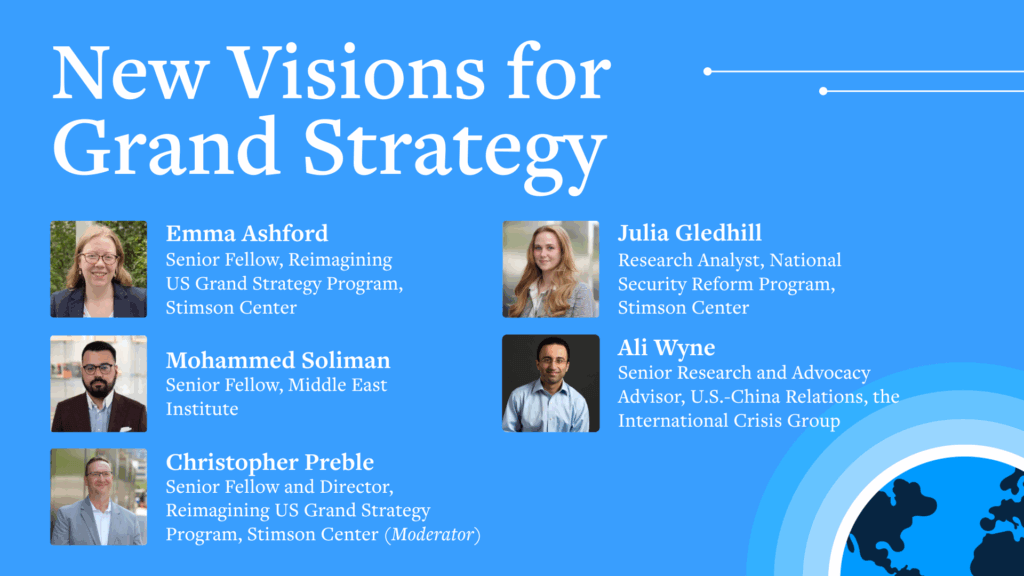
A limited-run podcast hosted by Emma Ashford, a senior fellow with the Reimagining US Grand Strategy Program at the Stimson Center.

Issue Briefs
Foreword by Emma Ashford
This is an era of upheaval in Washington, where the doors of foreign policy debate have been flung open in ways that would have seemed extraordinary just a few short years ago.
There are good reasons for this. The unipolar moment — the post-Cold War period of American global predominance — is ending. Trend lines in military capabilities, industrial strength, economic and technological innovation, and even cultural power suggest that American power is in relative decline. China is rising, transforming its economic heft into military might as it does so. Meanwhile, globalization is allowing economic and technological power to diffuse to a much wider variety of states.
America’s foreign policy community must also contend with a period of unprecedented soul-searching created by the perceived failures of the unipolar moment — from Iraq to Afghanistan and democracy promotion to globalization. They must cope with the increasing rejection of a global, liberal project by the American electorate, embodied in the unorthodox presidency of Donald Trump.
As we enter this new era, the most important question for U.S. policymakers is, “How can America adapt its foreign policy to address the challenges of the 21st century?”
The Debate
In the foreign policy community today, a messy debate rages among those who seek retrenchment from the war on terror, those who seek to pivot the United States to confront China, those who want to build a new liberal order around democracy, those who want a nationalist retrenchment, and many others. Most engaged in this discussion believe that the United States made mistakes during the unipolar moment, but they differ wildly in their assessment of the problem as well as the solutions they offer.
The various camps competing to direct the future of U.S. foreign policy are not just divided along partisan lines. They differ in how they understand and prioritize U.S. interests, in their assessments of threats to the United States, and in their approaches to global involvement. None are isolationist in the conventional sense; even the staunchest advocates of “America First” nationalism argue that the United States should use military force when needed, and even the most dovish analysts aim to stay connected with the world through aid, trade, and diplomacy.
Nevertheless, although they may agree with the necessity of some U.S. global engagement, current thinkers differ widely over how expansive that engagement should be. Does the United States need to transform the world, or should it just achieve a narrow set of security-based interests? Should America aim to be a champion for democracy everywhere? Which tools should the United States prioritize: military force, diplomacy, or economic engagement? Is the United States stronger with allies, or simply tied down by them?
These are some key strains of thought emerging from this debate:
The nationalists, best represented by policymakers in the Trump administration, are more focused on domestic issues than foreign ones, but they are willing to use military force or economic coercion when necessary. This group has a strong emphasis on American sovereignty and unilateralism.
The liberal internationalists, many of whose beliefs align with past proponents of this approach, emphasize global supranational organizations and international law. They advocate for democracy promotion to some extent, but they tend to eschew the most extreme nation-building transgressions of the war on terror. This group was well-represented in the Biden administration, with its characteristic regard for alliances as “sacred commitments.”
Other camps are less consolidated. Some of the left-wing progressives in the Democratic Party are beginning to construct a strategy that focuses on using U.S. power to build a better world through nonmilitary tools. This runs the gamut from peaceful engagement with China to combating kleptocracy and autocracy around the world. Though highly ambitious, their strategies — and the means they intend to use to achieve them — remain poorly defined.
The realists (sometimes described as “prioritizers” or “restrainers”) emphasize American security and the costs and risks of an overly adventurous foreign policy. This group transcends party lines and can, at times, include some progressive thinkers as well. Realists — this author included — tend to favor some level of U.S. military retrenchment, along with prioritization among regions, and a narrowing of U.S. interests to form a more modest or reasoned approach to foreign policy.
Each of these perspectives is important. America’s complex global challenges require open and active debate that seeks to move discussions beyond conventional wisdom.
The Essays
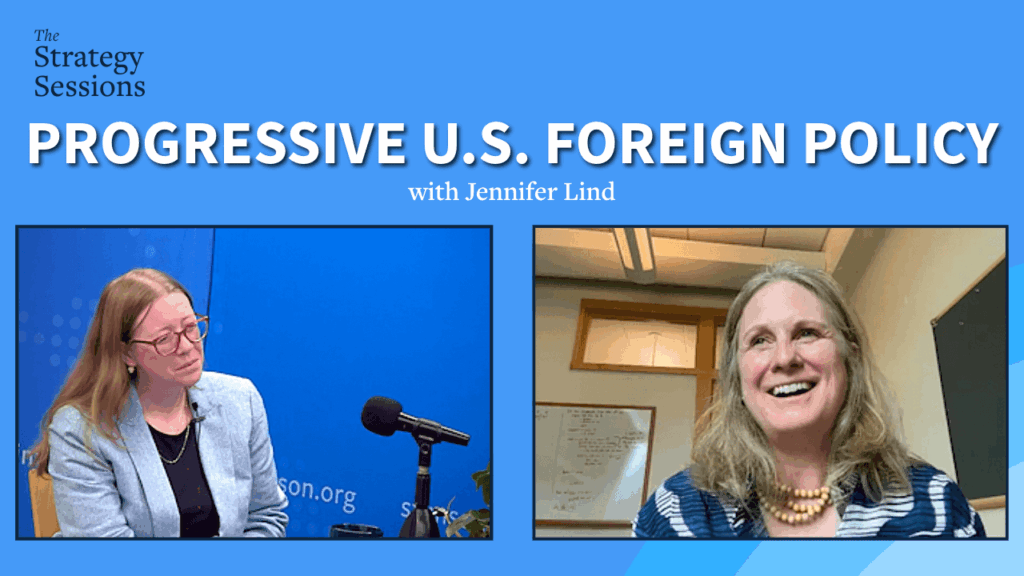
This volume contributes to this debate by bringing together some of these disparate foreign policy viewpoints. To do so, we commissioned essays from ten notable, out-of-the box thinkers. The writers come from across the ideological and political spectrum; from both academia and the policy community; and from all four of the groups described above. The resulting essays cover a wide range of views and provide a variety of insights into the different visions currently being offered for U.S. foreign policy. Our authors also joined us to discuss their essays in a podcast and video series entitled “The Strategy Sessions.” This series is available at Stimson.org and via all major podcast services.
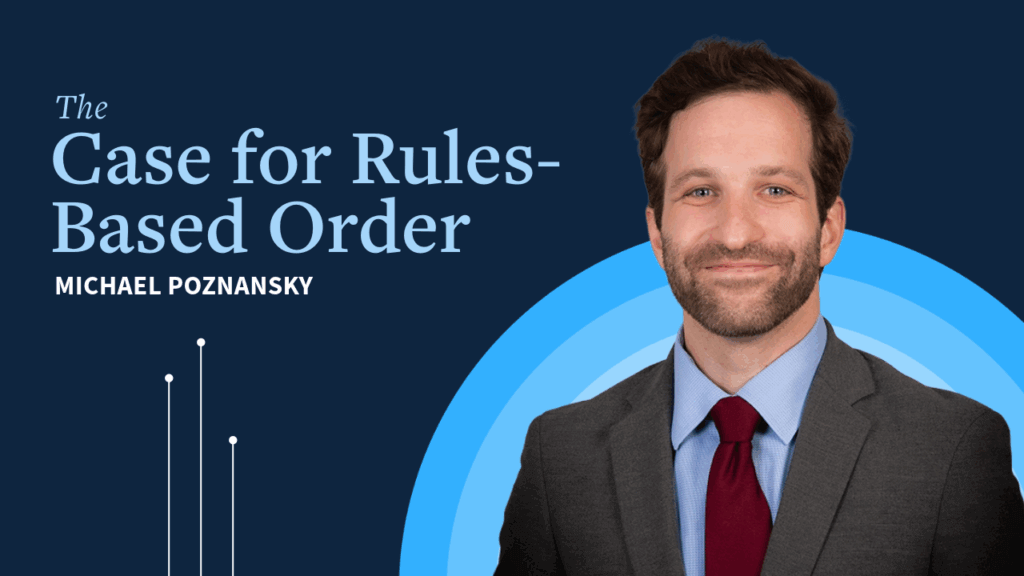
The essays are organized around five big questions, but all the contributions address multiple issues. In the first section, Mike Beckley, a professor at Tufts University, and Mike Poznansky, a professor at the Naval War College, explore what America’s role in the world should be. The former offers a hard-edged, coercive and unilateralist vision of America unchained. The latter suggests a return to a more modest, but still liberal, international order akin to that of the Cold War.
The second section addresses the question of how the United States should view its allies – and how it should treat alliances moving forward. Sumantra Maitra, a senior writer at the American Conservative magazine, explores an inherent contradiction that realists face: in advocating burden-shifting to Europe, they cannot risk empowering a European hegemon. American Enterprise Institute scholar Zack Cooper, meanwhile, explores the difficulties of coalition-building in the Indo-Pacific under multipolarity.
Still focusing on the Indo-Pacific, the third section of this volume addresses China, America’s biggest potential rival, the Pentagon’s “pacing threat,” and the focus of much of today’s debate in Washington. Both writers here — Ali Wyne of the International Crisis Group and Mike Brenes of Yale University — take a contrarian view, arguing that competition with China should not be an end of U.S. foreign policy and that cohabitation, even cooperation, might be possible with Beijing.
The fourth set of essays delves into the techno-economic issues surrounding U.S. grand strategy — and the big question of whether the United States remains competitive in a rapidly changing, technological world. The Middle East Institute’s Mohammed Soliman makes the case for a grand strategy grounded in techno-industrial partnerships that enable the United States to compete with China on its own terms. Stimson’s own Julia Gledhill, meanwhile, turns her attention inward to America’s sclerotic defenseindustrial base, suggesting that radical solutions might be needed to fix American defense contracting.
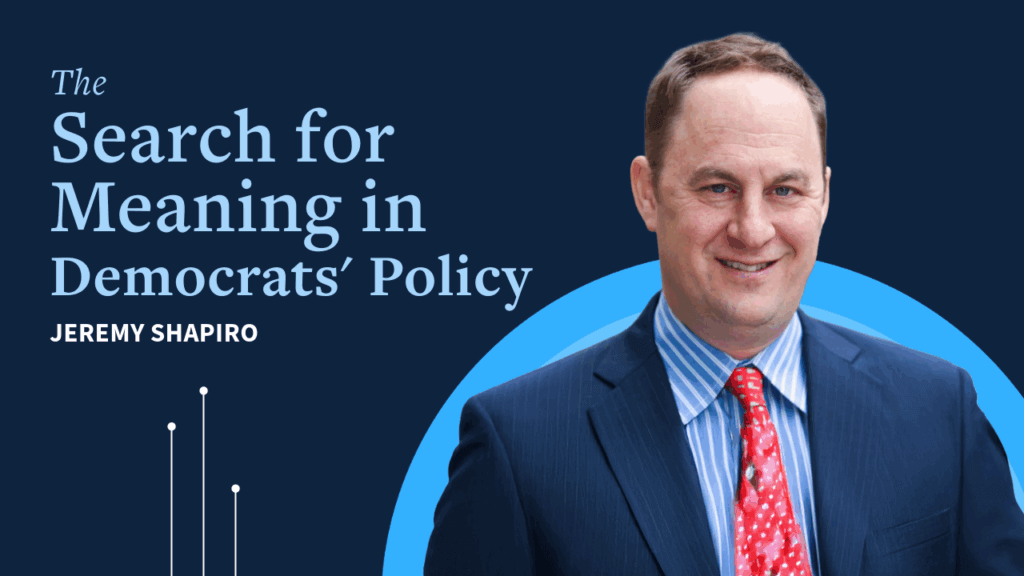
The final set of essays discusses the Democratic Party. Though Republicans under the Trump administration are beginning to coalesce around a new, nationalist vision, Democrats remain divided and unsure. Jennifer Lind, a professor at Dartmouth College, takes a deep dive into progressives’ attempts to build a new grand strategy and assesses the gaps that remain to be filled in this approach. Jeremy Shapiro of the European Council on Foreign Relations looks more broadly at how a new Democratic foreign policy might fit into a candidate’s overall messaging.
Each of the following essays are thoughtful commentaries that tackle the fundamental questions facing American policymakers and thinkers alike. I hope you enjoy reading them as much as I have.