
Introduction
U.S. arms sales and military assistance programs have a profound effect on international peace and security. Across the world, American security assistance and arms sales shape conflicts, politics, and civilian protection environments. But despite the weighty consequences, public reporting on the scale, scope, and nature of U.S. security cooperation and assistance is deteriorating, adding to an already opaque enterprise and presenting an acute risk to public and legislative oversight. Moreover, limited public visibility undermines research and analysis efforts that could ensure policy approaches are evidence-based and thus improve security cooperation and assistance outcomes.
This factsheet provides an overview of some significant changes in reporting formats and practices that have diminished the value of reporting on U.S. security cooperation and assistance and undermined an already fragile public transparency ecosystem.
Annual Reports to Congress on Direct Commercial Sales Authorizations to Foreign Countries and International Organizations (655 Reports)
Despite the fact that Direct Commercial Sales (DCS) — arms transfers negotiated directly between a foreign recipient and a U.S. company — made up more than 66% of U.S. arms transfers in FY2023, the process for these sales remains especially opaque. In practice, there is only one consistent source of publicly available DCS information. Colloquially known as the “655 Report,” the statutorily mandated publication summarizes defense articles and defense services licensed for commercially permanent export during the previous fiscal year. The report also includes a single country total for “shipped” DCS articles and services in that fiscal year.
The Problem
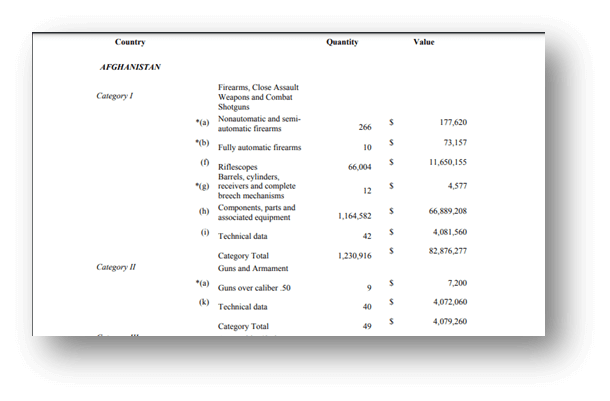
Recent 655 reports have provided significantly fewer details than their predecessors. Before FY2010, “655 Reports” disaggregated DCS data by subcategories of the United States Munitions List (USML) — items or services designated as “defense articles or services” by the U.S. government (Figure 1). For example, the FY2009 655 Report broke down authorizations for Category 1 of the USML (Firearms and Related Articles) into sub-components, including “Firearms, Close Assault Weapons and Combat Shotguns,” “Fully Automatic Rifles,” “Rifle scopes,” or “Components, parts and associated equipment.”1 Some of the items enumerated in earlier iterations of the 655 report on DCS have been moved from the USML to the Commerce Control List, and are no longer included in the 655 report. While these sub-components do not seem to reflect any official or codified typologies, they still offered an improved sense of the types of transfers being authorized.
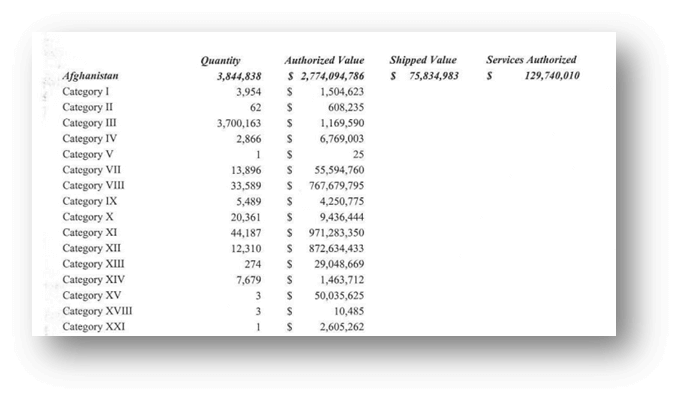
Beginning with the FY2010 report, those subcategories were amalgamated into country totals by USML category, eliminating an important level of granularity (Figure 2). Whereas the FY2009 report would have provided individual numbers and dollar values for authorization of “Fully automatic firearms,” “Silencers, mufflers, sound, and flash suppressors,” “Combat shotguns,” or “Components, parts, and associated equipment,” more recent reports provide just a single count of items under Category 1 and a dollar figure.
The Fix
The Department of State should reconfigure the annual 655 Report to disaggregate USML categories. Beyond simply reverting to past practice, new reporting methods should, at a minimum, provide detail at the USML sub-category level. In addition, for items of particular concern, including assembled weapons, ammunition, and explosives, the report should include information on the make, model, quantity, dollar value, year of shipment or delivery, destination country, and category of end-users (e.g. military, law enforcement, civilian, commercial). While it may not be practical to provide this degree of detail for every part, component, or element of technical data, it should be provided for key sub-categories of the USML.
The “Historical Sales Book” Reports on US Security Cooperation and Arms Transfers
Each year the Defense Security Cooperation Agency (DSCA) publishes its Historical Sales Book (formerly Historical Facts Book), which provides summaries of U.S. Foreign Military Sales (FMS) — arms transfers conducted by the U.S. government — and “Building Partnership Capacity (BPC) and Foreign Area Assistance Programs” by country and program. In its current format, the report provides a single aggregated yearly sum of FMS for each foreign recipient and yearly sums for BPC programs, in some cases including additional information regarding relevant Combatant Commands or State Department regions.
The Problem
Under current practice, the information provided in the Historical Sales Book has inherent methodological and practical shortcomings that severely limit the utility of the data for analysis or study. Many operational definitions remain unclear, such as the stage of the transfer process reflected within the report. Additionally, information on the specific weapons systems or platforms sold under FMS are not included, and data on BPC programs are presented without sufficient operational definitions or country-level detail.
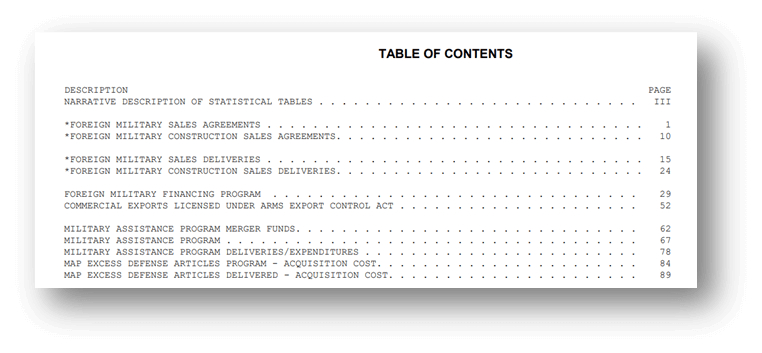
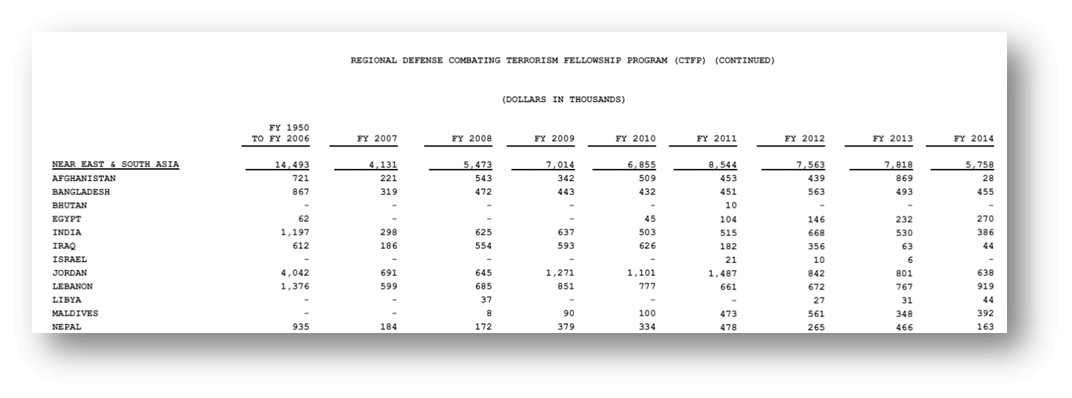
Past versions of the reports broke FMS down into distinct categories, including “FMS Agreements,” “FMS Construction Sales Agreements,” “FMS Deliveries,” and “FMS Construction Deliveries” (Figure 3). Past reports also provided yearly country-level information on Foreign Military Financing (FMF) extended to foreign governments and international organizations for the procurement of U.S. defense articles, services, and construction. The reports also provided country-level information on certain portions of military assistance funding, including, in some cases, country and program totals by fiscal year (Figure 4). Earlier iterations of the report also included clear operational definitions to facilitate understanding of the data provided.
The Fix
The DSCA should refine and enhance its Historical Sales Book to reflect better reporting methodologies, transparency, and clarity. The report should be explicit in its operational definitions, should include separate sections for authorizations and deliveries, and should present specifics on platforms and capabilities authorized or delivered to foreign recipients in each fiscal year under FMS. Additionally, information on military assistance programs should be far more detailed, and include, at the very least, program totals for each country by fiscal year, and the type of security aid provided by categories enumerated in a report methodology section.
Department Defense Security Cooperation Budget Justifications
Congressional budget justifications (CBJs) for U.S. security assistance programming are an essential mechanism for transparency, offering a small but important window into the sorts of hardware, financial assistance, and military support the U.S. is offering to foreign security partners, particularly in environments where security governance and human rights practices remain problematic. In addition to justifying requests for the coming fiscal year, the documents also provide important data on past allocations and expenditures on these programs.
The Problem
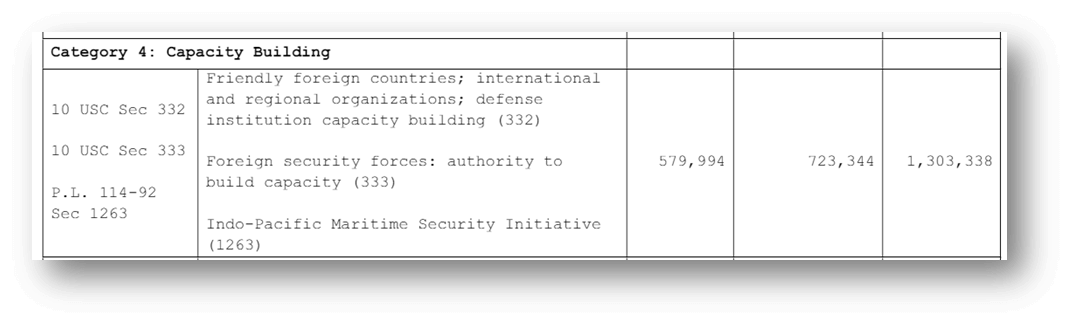
Though far from the only agency engaged in security sector assistance, in recent years the Department of Defense’s Justification for Security Cooperation Program and Activity Funding has offered insufficient detail to be of practical use for researchers and civil society. The budget document is divided between thematic and programmatic tables, with amalgamations of some authorities alongside single programs that prevent useful comparisons. Moreover, the documents contain almost no country-level specificity and instead present yearly totals by program or activity type. Even when the report does mention noteworthy programs or authorities, they are often aggregated with other initiatives. For example, in the FY2024 request, the summary table that provides dollar figures for the Department’s Section 333 Building Partner Capacity program also includes two other authorities — Indo-Pacific Maritime Security Initiative and Section 332 — making it impossible to discern the funding split between the programs (Figure 5).
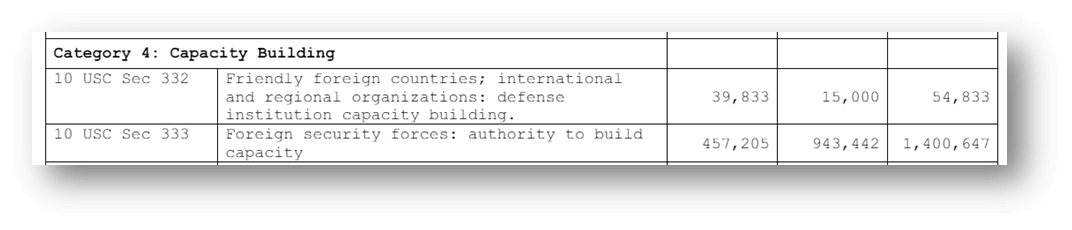
By comparison, the Department’s FY2019 budget justification disaggregated more of its assistance programming, including by providing standalone figures for Section 333 (Figure 6). The departure from past practice reflects a broader trend towards increasing aggregation of security cooperation budget data, making it impossible to discern program- or country-specific information.
The Fix
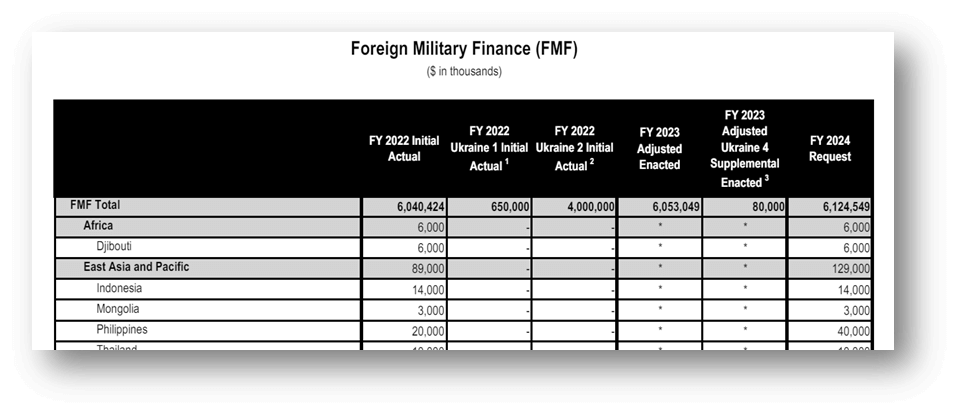
The Department of Defense should improve its reporting on U.S. security cooperation programming by providing publicly available budget justifications that include dollar figures by country and, where appropriate, details for certain categories of complete (assembled) weapons, ammunition, platforms, and other high-risk commodities by program. There are examples of good practices from which the Department of Defense should borrow; for instance, the Department of Defense should copy the Department of State’s CBJ practice and provide country-level figures by program. Beyond the requested amount for the upcoming fiscal year, the Department should also provide the estimated and actual amounts committed in previous fiscal years, as State does (Figure 7).
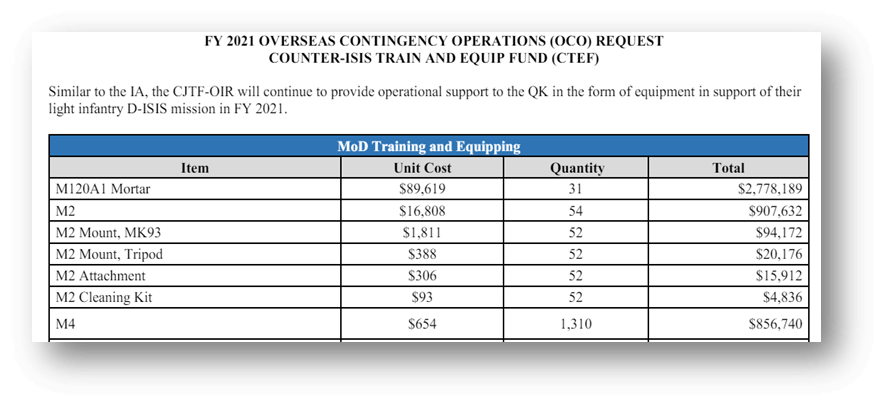
Similarly, improved reporting should adopt the notable granularity and detail of similar budget justifications the Department of Defense has provided in the past, including the annual reporting it used to provide on the Afghanistan Security Forces Fund and the Counter-Islamic State Train and Equip Fund (Figure 8).
“For Official Use Only” Reporting to Congress
Each year the Department of Defense and Department of State submit dozens of reports to Congress related to U.S. security cooperation and arms transfers, typically to key committees. For many years, researchers and civil society stakeholders were able to engage with committee staff to view and, on a limited basis, copy the data for later use.2 In the past, Committee staff did not allow for photocopies to be made but were willing to allow interested parties to make handwritten copies of relevant data. For example, although not publicly released, individuals were able to visit Committee offices and read through notifications to Congress on U.S. military assistance programs, information related to foreign military training exercises, Leahy Law-related findings, and other such documents.
The Problem
In recent years these reports have increasingly been submitted to Congress under “For Official Use Only,” “Sensitive but Unclassified,” or “Controlled Unclassified Information” designations. Though these reports remain technically unclassified, their transmission under these headings prevents public visibility or use of the information. That past reporting was considered safe for public use gives rise to concerns that these communications are now being placed under varying degrees of restriction as a matter of course, rather than as a result of specific national security considerations.
The Fix
The U.S. government should endeavor to make its security cooperation reporting to Congress as free for public use as possible, to use classification and other restrictions sparingly, and to have such restrictions implemented only in response to demonstrable national security concerns. These reports and notifications should be published on the State Department and Defense Department websites when the unclassified information is transferred to Congress, as is done with other reporting requirements.
Consistently Late Reporting
Timely reporting is important for assessing the impact of U.S. security cooperation and assistance, especially in the event of conflict or crises. It ensures that oversight and accountability mechanisms have bearing on contemporary practice and can shape ongoing policy. In many cases, the due dates for reports are mandated by law, and reflect the urgent need for timely arms transfer and assistance information.
The Problem
In recent years, the U.S. government has become increasingly lax about the timeliness of its security cooperation and assistance reporting, even in cases when U.S. law requires the provision of reports by certain dates. As a result, many government agencies are often late, in some cases by months or even years, in submitting the required reports.
For example, though the Foreign Assistance Act requires an annual report on all military training provided to foreign military personnel by the Departments of Defense and State during the previous fiscal year by January 31 of each year, no such report has been provided for FY2022 or FY2023. Similarly, the U.S. government is regularly months late in providing the statutorily required 655 Reports, and the DSCA’s database on the transfer of “Excess Defense Articles” has not had a new entry since 2020.
The challenge may be one of capacity: U.S. law and budgeting processes often place significant reporting burdens on the U.S. government. However, late public reporting may also reflect a disregard for the importance of these resources and an absence of political interest in meeting statutorily mandated transparency obligations.
The Fix
The U.S. government should work urgently to make available all past due reports on U.S. security cooperation and assistance work with Congress to ensure reporting functions are properly resourced. Additionally, the Executive Branch should engage with lawmakers to identify possible reporting synergies, minimize redundant or obsolete reporting requirements, and ensure as much information as possible can be made public.








Current Geopolitics Shift Deep-Sea Mining Debates