
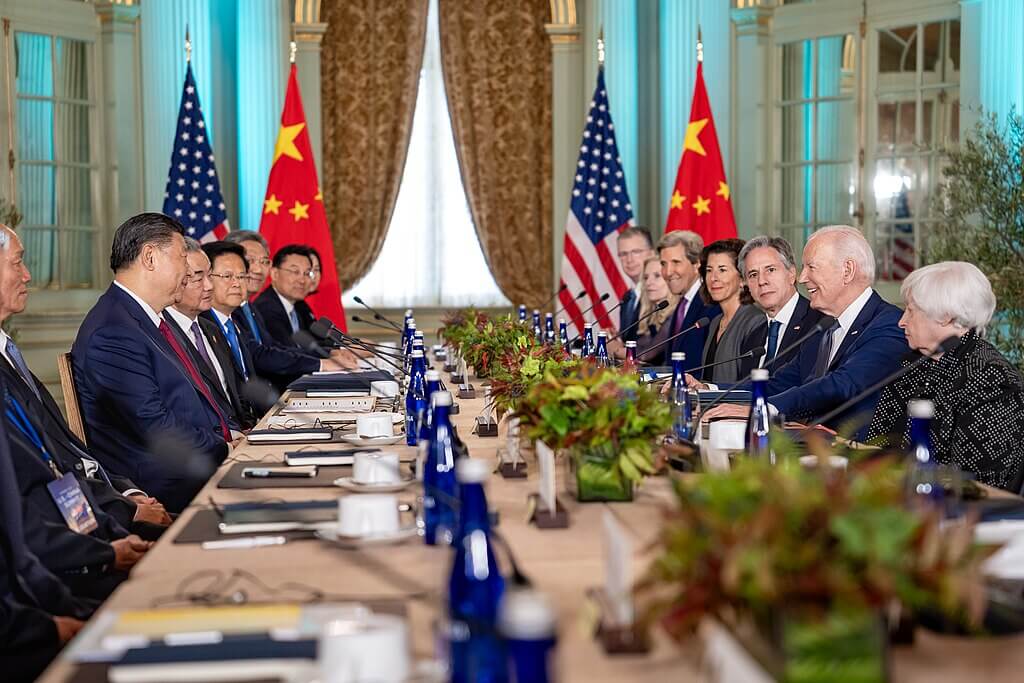
U.S. President Joe Biden’s China policy rests on two conceptual pillars: great-power relationships as battles between two ideological blocs, democracy and autocracy; and globalization as a zero-sum game in the struggle for hegemony. But China’s supposed tilt towards Western norms was essentially wishful thinking on the part of the US policy elite, and Chinese leaders have emphasized the country’s aim of peaceful, ‘win–win’ advancement. The Biden administration should realize that the democracy-versus-autocracy paradigm has all but collapsed and that China desires constructive economic engagement rather than outright dominance. All major powers face challenges and constraints, and none now appears strong enough to secure a decisive advantage. Chinese President Xi Jinping’s goal is strategic stability, especially with respect to Taiwan, but Washington has been unreceptive. For Beijing to take engagement with the Biden administration seriously, Biden’s team would have to dispense with its inconsistent positions and condescending attitude.
The Biden administration has largely continued the confrontational approach towards China initiated by the Trump administration, which includes tariffs, export controls, and various sanctions. But President Joe Biden’s China policy lacks a coherent and comprehensive strategy. While the administration has articulated its commitment to competing with China and defending U.S. interests, it has been unclear about specific priorities, long-term goals, and the means of achieving them. The Biden administration sent mixed signals to China, indicating a willingness to cooperate on certain issues such as climate change and global health while emphasizing strategic competition and containment overall. This inconsistency undermines the credibility and effectiveness of US policy.
Biden’s China policy rests on two conceptual pillars: great-power relationships as battles between two ideological blocs, one democratic, the other autocratic; and globalization as a zero-sum game in the struggle for hegemony.1White House, ‘National Security Strategy’, October 2022, Part I, https://www.whitehouse.gov/wp-content/uploads/2022/10/Biden-Harris-Administrations-National-Security-Strategy-10.2022.pdf. See also Antony J. Blinken, ‘The Administration’s Approach to the People’s Republic of China’, speech at George Washington University, 26 May 2022, https://www.state.gov/the-administrations-approach-to-the-peoples-republic-of-china/. Neither concept is original, but the fusion of the two could trigger a conflagration – in particular, by driving the U.S.-China dispute over Taiwan towards military confrontation.
Read the full article at the International Institute for Strategic Studies.










Community Adaptation for a Water Festival Without Clean Water