By Eli Enos and Rachel Stohl
Less than a month after President Trump visited Saudi Arabia and praised members of the Gulf Cooperation Council (GCC), the chairman of the Senate Committee on Foreign Relations, Bob Corker (R-Tenn.), sent a letter to Secretary of State Rex Tillerson stating his intention to halt new sales of lethal military equipment to the Gulf until the dispute in the region is resolved. This withholding of new clearances for arms to the region could have far-reaching effects on countries like Saudi Arabia, Bahrain, and Qatar, all of which have arms deals in the U.S. pipeline.
Corker’s surprising letter comes after the June actions by Saudi Arabia, Bahrain, and the United Arab Emirates, who cut diplomatic, economic, and political ties with Qatar for its alleged support of terrorism. As internal divisions within the Trump administration over which side to support have undermined U.S. efforts to mediate the crisis, Senator Corker’s maneuver may be an attempt to put additional outside pressure on the Gulf countries to find a solution. State Department officials have publicly questioned the details of the claims made toward Qatar, and Qatar has thus far rejected the demands of its GCC partners as unreasonable.
Click here for further information
For Qatar, there is a lot at stake with this potential halt in new approvals. The United States and Qatar have enjoyed a lucrative and extensive defense relationship for 25 years. Following the expulsion of Iraqi forces from Kuwait in 1991, the two countries signed a defense cooperation agreement (DCA), renewed in 2013, which governs the U.S. training of Qatar’s military, its forward deployment of military equipment, and permission for the United States to operate out of Al Udeid airbase. As the largest U.S. air base in the region, Al Udeid is home to roughly 11,000 U.S. personnel and CENTCOM’s Combat Air Operations Center. It serves as the nerve center for all U.S. operations in the Middle East and remains essential in supporting U.S. and coalition combat operations in Iraq, Syria, and Afghanistan.
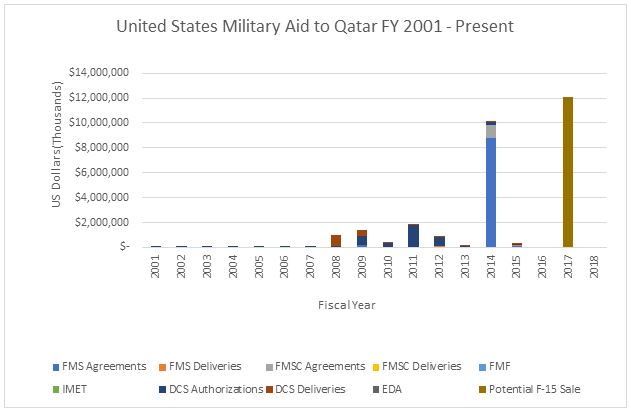
Since 2001, Qatar has spent more than $9 billion on U.S. arms and $1 billion on base construction. Purchases of U.S. weapons systems — including Apache attack helicopters, Javelin missiles, and missile defense systems — follow a regional trend towards advanced U.S. systems and cut into French domination of the Qatari arms market. Should the $12.1 billion F-15 deal signed earlier this month go through, it would mark Qatar’s largest purchase of U.S. arms to date. With the second smallest standing military in the Gulf, the addition of dozens of new aircraft would vastly expand Qatar’s current fleet and its ability to conduct operations in the region.
Despite the current crisis within the GCC and recent White House rhetoric, Qatar saw the recent F-15 agreement as a sign of continued U.S. commitment to their security relationship. The temporary halt to new approvals probably won’t impact arms sales in the long run, but it may give Qatar an additional level of uncertainty as it navigates the current regional stalemate.
___
Eli Enos is a Program Assistant for — and Rachel Stohl is Director of — the Conventional Defense Program at the Stimson Center.
Additional Resources
Direct Commercial Sales (DCS) Reports:
https://www.pmddtc.state.gov/reports/655_intro.html
Excess Defense Articles (EDA) FY 2001 – FY 2018:
https://www.dsca.mil/programs/excess-defense-articles-eda
Foreign Military Financing (FMF):
2001-2005 Actual: https://www.state.gov/s/d/rm/rls/cbj/
2006 Actual: https://www.state.gov/documents/organization/84462.pdf
2007 Actual: https://www.state.gov/documents/organization/101447.pdf
2008 Actual: https://www.state.gov/documents/organization/124295.pdf
2009 Actual: https://www.state.gov/documents/organization/138174.pdf
2010 Actual: https://www.state.gov/documents/organization/158269.pdf
2011 Actual: https://www.state.gov/documents/organization/185016.pdf
2012 Actual: https://www.state.gov/documents/organization/208292.pdf
2013 Actual: https://www.state.gov/documents/organization/222898.pdf
2014 Actual: https://www.state.gov/documents/organization/236395.pdf
2015 Actual: https://www.state.gov/documents/organization/252179.pdf
2016 Actual: https://www.state.gov/documents/organization/271013.pdf
2017 Estimate: https://www.state.gov/documents/organization/271013.pdf
2018 Request: https://www.state.gov/documents/organization/271013.pdf
Foreign Military Sales (FMS):
https://www.dsca.mil/sites/default/files/historical_facts_book_-_30_september_2015.pdf
Foreign Military Construction Sales (FMCS):
https://www.dsca.mil/sites/default/files/historical_facts_book_-_30_september_2015.pdf
International Military Education & Training (IMET):
2001 – 2015 Actual: https://www.dsca.mil/sites/default/files/historical_facts_book_-_30_september_2015.pdf
2016 Actual: https://www.state.gov/documents/organization/271013.pdf
2017 Estimate: https://www.congress.gov/114/crpt/srpt290/CRPT-114srpt290.pdf
2018 Request: https://www.state.gov/documents/organization/271013.pdf

Conventional Arms
By Eli Enos and Rachel Stohl
Less than a month after President Trump visited Saudi Arabia and praised members of the Gulf Cooperation Council (GCC), the chairman of the Senate Committee on Foreign Relations, Bob Corker (R-Tenn.), sent a letter to Secretary of State Rex Tillerson stating his intention to halt new sales of lethal military equipment to the Gulf until the dispute in the region is resolved. This withholding of new clearances for arms to the region could have far-reaching effects on countries like Saudi Arabia, Bahrain, and Qatar, all of which have arms deals in the U.S. pipeline.
Corker’s surprising letter comes after the June actions by Saudi Arabia, Bahrain, and the United Arab Emirates, who cut diplomatic, economic, and political ties with Qatar for its alleged support of terrorism. As internal divisions within the Trump administration over which side to support have undermined U.S. efforts to mediate the crisis, Senator Corker’s maneuver may be an attempt to put additional outside pressure on the Gulf countries to find a solution. State Department officials have publicly questioned the details of the claims made toward Qatar, and Qatar has thus far rejected the demands of its GCC partners as unreasonable.
Click here for further information
For Qatar, there is a lot at stake with this potential halt in new approvals. The United States and Qatar have enjoyed a lucrative and extensive defense relationship for 25 years. Following the expulsion of Iraqi forces from Kuwait in 1991, the two countries signed a defense cooperation agreement (DCA), renewed in 2013, which governs the U.S. training of Qatar’s military, its forward deployment of military equipment, and permission for the United States to operate out of Al Udeid airbase. As the largest U.S. air base in the region, Al Udeid is home to roughly 11,000 U.S. personnel and CENTCOM’s Combat Air Operations Center. It serves as the nerve center for all U.S. operations in the Middle East and remains essential in supporting U.S. and coalition combat operations in Iraq, Syria, and Afghanistan.
Since 2001, Qatar has spent more than $9 billion on U.S. arms and $1 billion on base construction. Purchases of U.S. weapons systems — including Apache attack helicopters, Javelin missiles, and missile defense systems — follow a regional trend towards advanced U.S. systems and cut into French domination of the Qatari arms market. Should the $12.1 billion F-15 deal signed earlier this month go through, it would mark Qatar’s largest purchase of U.S. arms to date. With the second smallest standing military in the Gulf, the addition of dozens of new aircraft would vastly expand Qatar’s current fleet and its ability to conduct operations in the region.
Despite the current crisis within the GCC and recent White House rhetoric, Qatar saw the recent F-15 agreement as a sign of continued U.S. commitment to their security relationship. The temporary halt to new approvals probably won’t impact arms sales in the long run, but it may give Qatar an additional level of uncertainty as it navigates the current regional stalemate.
___
Eli Enos is a Program Assistant for — and Rachel Stohl is Director of — the Conventional Defense Program at the Stimson Center.
Additional Resources
Direct Commercial Sales (DCS) Reports:
https://www.pmddtc.state.gov/reports/655_intro.html
Excess Defense Articles (EDA) FY 2001 – FY 2018:
https://www.dsca.mil/programs/excess-defense-articles-eda
Foreign Military Financing (FMF):
2001-2005 Actual: https://www.state.gov/s/d/rm/rls/cbj/
2006 Actual: https://www.state.gov/documents/organization/84462.pdf
2007 Actual: https://www.state.gov/documents/organization/101447.pdf
2008 Actual: https://www.state.gov/documents/organization/124295.pdf
2009 Actual: https://www.state.gov/documents/organization/138174.pdf
2010 Actual: https://www.state.gov/documents/organization/158269.pdf
2011 Actual: https://www.state.gov/documents/organization/185016.pdf
2012 Actual: https://www.state.gov/documents/organization/208292.pdf
2013 Actual: https://www.state.gov/documents/organization/222898.pdf
2014 Actual: https://www.state.gov/documents/organization/236395.pdf
2015 Actual: https://www.state.gov/documents/organization/252179.pdf
2016 Actual: https://www.state.gov/documents/organization/271013.pdf
2017 Estimate: https://www.state.gov/documents/organization/271013.pdf
2018 Request: https://www.state.gov/documents/organization/271013.pdf
Foreign Military Sales (FMS):
https://www.dsca.mil/sites/default/files/historical_facts_book_-_30_september_2015.pdf
Foreign Military Construction Sales (FMCS):
https://www.dsca.mil/sites/default/files/historical_facts_book_-_30_september_2015.pdf
International Military Education & Training (IMET):
2001 – 2015 Actual: https://www.dsca.mil/sites/default/files/historical_facts_book_-_30_september_2015.pdf
2016 Actual: https://www.state.gov/documents/organization/271013.pdf
2017 Estimate: https://www.congress.gov/114/crpt/srpt290/CRPT-114srpt290.pdf
2018 Request: https://www.state.gov/documents/organization/271013.pdf
Photo credit John Murphy
Recent & Related
Made in the Gulf, Designed in America: How the Iran War Has Incentivized Drone Production in the GCC
The Orphan of the Summit of the Future: The Declaration on Future Generations
Experts React: Takeaways from the Trump-Xi Summit
Kabuki Diplomacy Between US and Iran at UNGA
Is the Iran War Worth It? Six Months Later, Still No
Why Iran-Backed Iraqi Armed Groups Are Hedging on Disarmament
9 Issues to Watch at UNGA 81
Why the Houthi Capture of Mocha Matters Far Beyond Yemen
Nuclear Disruption: The US-Saudi 123 Agreement and the Future of Nuclear Cooperation in the Middle East
The Nation Is Not Alone. We Need Reflexive Multilateralism
“No, History Begins Today”: Why Washington Could Not Reshape Pakistan’s Interests After 9/11
What if the US Had Made Peace With Iran After 9/11?
Find an Expert
Home to more than 100 scholars and global affiliates, the Stimson Center is proud to be a magnet for the world’s leading experts on the most pressing foreign policy and national security issues of our time. Explore our experts and their work.