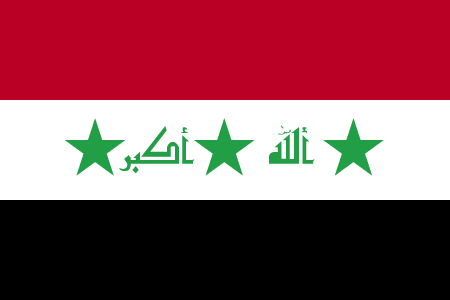
Each shaded box corresponds to a year the country appeared on the CSPA list and what types of waivers it received, if any.
Iraq first appeared on the CSPA list in 2016 and reappeared on the list from 2018 through 2021. The U.S. president fully waived CSPA prohibitions against the provision of U.S. arms sales and military assistance to Iraq for each of the five years it was listed, resulting in the provision of more than $1.46 billion in arms sales and military assistance between FY2017 and FY2022. Specifically, the president has waived over $208 million in Direct Commercial Sales, more than $275,000 in Excess Defense Articles, more than $1.25 billion in Foreign Military Financing, and more than $4.1 million in International Military Education and Training. The president has never denied Iraq any arms sales or military assistance due to CSPA prohibitions.
Since the CSPA took effect.
Iraq was first placed on the CSPA list in 2016 following reports that the Popular Mobilization Forces (PMF), an umbrella organization that has operated as a component of Iraq’s armed forces since 2016, and multiple volunteer militia affiliated with the PMF (which the Iraqi government has historically struggled to bring under control) recruited and used children to serve in combat roles in 2015 and 2016.1Government of the United States, U.S. Department of State. “Iraq,” in Trafficking in Persons Report 2016, pp. 207, https://2009-2017.state.gov/documents/organization/258876.pdf (https://2009-2017.state.gov/j/tip/rls/tiprpt/2016/). In addition, a Yazidi armed militia group, known as the Sinjar Resistance Units (YBS), forcibly recruited and used children in combat and support roles in 2016 while the Iraqi government was reportedly paying its salaries.2Government of the United States, U.S. Department of State. “Iraq – Trafficking Profile,” in Trafficking in Persons Report 2017, pp. 215-216, https://www.state.gov/wp-content/uploads/2019/02/271339.pdf (https://www.state.gov/reports/2017-trafficking-in-persons-report/iraq/). Despite these allegations, Iraq was removed from the CSPA list in 2017, though it was added again the next year following reports of PMF-affiliated militias recruiting and training child soldiers.3Government of the United States, U.S. Department of State. “Iraq – Trafficking Profile,” in Trafficking in Persons Report 2018, https://www.state.gov/reports/2018-trafficking-in-persons-report/iraq/. In 2018 and 2019, other PMF-associated militias, including Asa’ib Ahl al-Haq (AAH), Kata’ib Hizbullah (KH), and Harakat Hezbollah al-Nuijaba (HHN), reportedly recruited and used child soldiers to fight in Syria and Yemen.4Government of the United States, U.S. Department of State. “Iraq,” Trafficking in Persons Report 2023, https://www.state.gov/reports/2023-trafficking-in-persons-report/iraq/. The last credible report of the recruitment of soldiers younger than the age of 18 by the PMF occurred in 2019.5Government of the United States, U.S. Department of State. “Iraq – Trafficking Profile,” in Trafficking in Persons Report 2024, https://www.state.gov/reports/2024-trafficking-in-persons-report/iraq/.
According to the U.S. State Department, there were no reports of official complicity in the recruitment or use of child soldiers in 2021 (either directly or through the funding of culpable groups), and Iraq was subsequently removed from the CSPA list in 2022.6Government of the United States, U.S. Department of State. “Iraq – Prosecution,” in Trafficking in Persons Report 2022, pp. 292, https://www.state.gov/wp-content/uploads/2022/10/20221020-2022-TIP-Report.pdf (https://www.state.gov/reports/2022-trafficking-in-persons-report/).
The Iraqi government has taken some steps to prevent the recruitment and use of child soldiers by government and government-backed forces. Since 2015 it has reportedly provided training to military officers on child soldier issues, and starting in 2016, halted payment of salaries to child volunteers in an effort to discourage PMF commanders from accepting children who volunteer to fight for the group.7Government of the United States, U.S. Department of State. “Iraq – Prevention,” in Trafficking in Persons Report 2017, https://www.state.gov/reports/2017-trafficking-in-persons-report/iraq/. The government of Iraq signed a UN Action Plan in March 2023 (specifically in order to prevent the recruitment and use of child soldiers by the PMF), but as of 2024 had not reported on plan implementation.8Office of the Special Representative of the Secretary-General for Children and Armed Conflict. “The Government of Iraq, supported by the United Nations, strengthens its commitment to prevent the recruitment and use of children by armed forces,” 30 March 2023, https://childrenandarmedconflict.un.org/2023/03/the-government-of-iraq-supported-by-the-united-nations-strengthens-its-commitment-to-prevent-the-recruitment-and-use-of-children-by-armed-forces/.; Government of the United States, U.S. Department of State. “Iraq,” in Trafficking in Persons Report 2024, https://www.state.gov/reports/2024-trafficking-in-persons-report/iraq/.
Prevention and protection efforts have been particularly undermined by the Iraqi government’s lack of control over the PMF and affiliated forces as well as the government’s failure to adequately investigate and prosecute continued allegations of child soldier recruitment and use by these groups. In 2015, the government struggled to exercise full control over all of the PMF factions, which severely limited its ability to prevent these groups from recruiting and using child soldiers. The government sought to address this issue in 2016 when it formalized the PMF’s status as a component of the Iraqi armed forces, but as of March 2023 the government still lacked complete control of the PMF and various units continued to undertake operations independent of political or military leadership.9Government of the United States, U.S. Department of State. “Iraq – Prevention,” in Trafficking in Persons Report 2023, https://www.state.gov/reports/2023-trafficking-in-persons-report/iraq/. Meanwhile, the Iraqi government has repeatedly failed to adequately investigate and hold people criminally accountable for child soldiering offenses despite years of allegations against the PMF and affiliated groups, and significant concerns remain around alleged official complicity in trafficking crimes following reports in 2018 that key Iraqi security officials shielded traffickers from investigation and prosecution.10Government of the United States, U.S. Department of State. “Iraq – Prosecution,” in Trafficking in Persons Report 2022, pp. 292, https://www.state.gov/wp-content/uploads/2022/10/20221020-2022-TIP-Report.pdf (https://www.state.gov/reports/2022-trafficking-in-persons-report/).
Since 2021, U.S. presidents have been required to include justifications for CSPA waivers that were issued during the previous year in the annual Trafficking in Persons Report. Iraq’s 2020 waiver justification maintained that “U.S. strategy in Iraq is focused on working with the [government of Iraq] to achieve a unified, democratic, peaceful, and inclusive Iraq by: defeating the terrorist entity known as the Islamic State of Iraq and Syria (ISIS); promoting good governance and reform; supporting the increased capacity and professionalization of Iraq’s security forces to bring them more in line with international best practices; promoting human rights; and promoting the protection of Iraq’s diverse and often marginalized communities, regardless of their ethnicity, religion, or gender. This waiver will allow the United States to continue to provide the assistance, support, and human rights training necessary to achieve these goals, and to help Iraq build its capacity to conduct effective, sustained counterterrorism operations against ISIS.”11Government of the United States, U.S. Department of State. “Annual Report on the Use of Child Soldiers,” in Trafficking in Persons Report 2021, pp. 630, https://www.state.gov/wp-content/uploads/2021/09/TIPR-GPA-upload-07222021.pdf (https://www.state.gov/reports/2021-trafficking-in-persons-report/). Similar language was included in Iraq’s 2021 waiver justification.12Government of the United States, U.S. Department of State. “Annual Report to Congress on the Use of Child Soldiers Under Section 405(c) of the Child Soldiers Prevention Act of 2008,” in Trafficking in Persons Report 2022, pp. 616, https://www.state.gov/wp-content/uploads/2022/10/20221020-2022-TIP-Report.pdf (https://www.state.gov/reports/2022-trafficking-in-persons-report/).
For more information, see the U.S. State Department’s 2024 Trafficking in Persons Report and 2023 Country Reports on Human Rights Practices. More information on the situation in Iraq can also be found in the UN Secretary-General’s 2024 annual report on Children and Armed Conflict and 2024 country-specific report on Iraq.
Country- and program-level data on the number and type of national interest waivers granted, as well as the amount of arms sales and military assistance waived.
You can opt out at any time. We respect your privacy and will not sell your personal information. See our privacy policy for more.